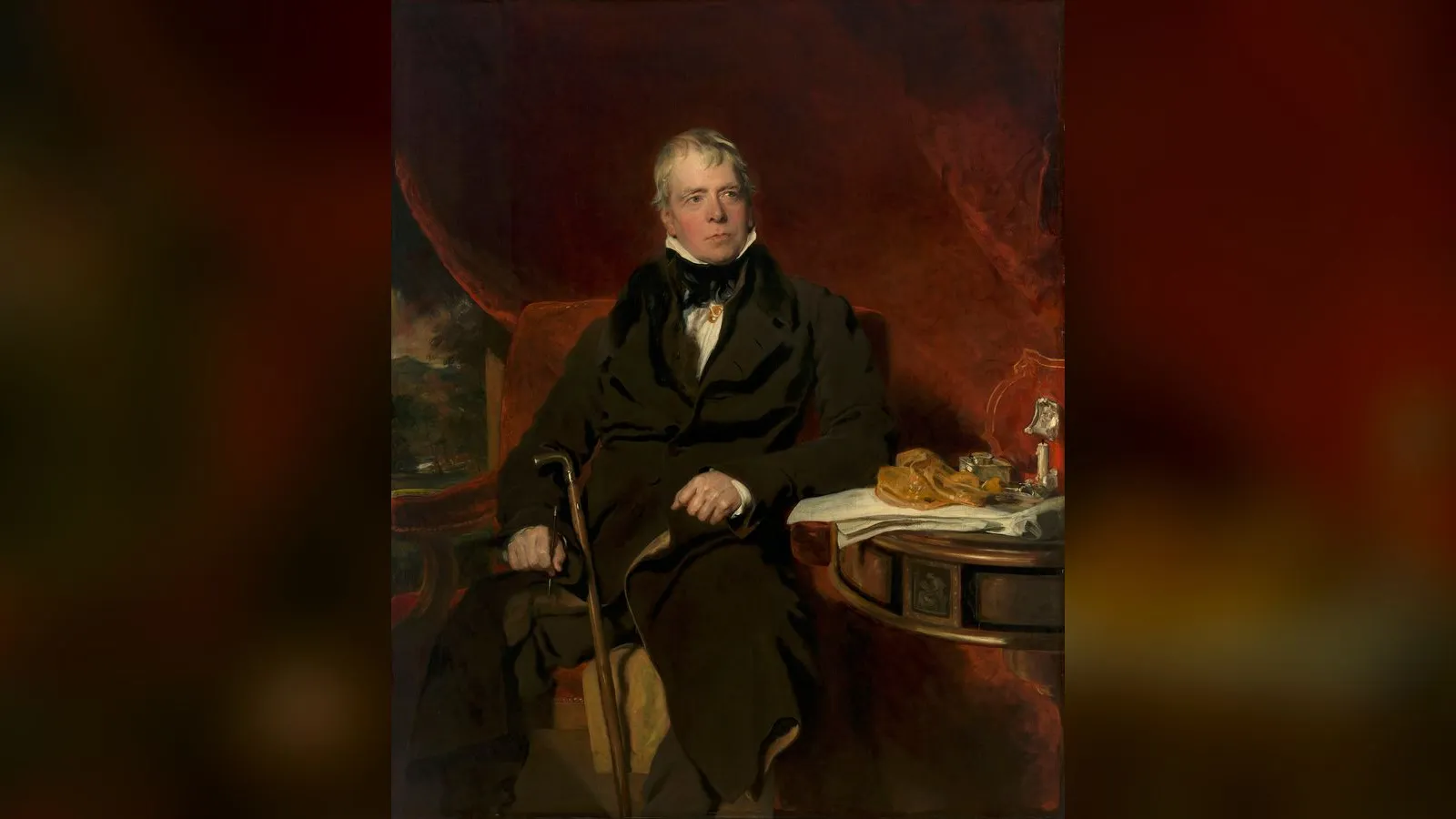

Walter Scott & the Historical Novel
Contents
Walter Scott didn't just write popular fiction — he arguably invented a genre, shaped how Europe thought about its own history for a century, and, almost as a side effect, designed much of the "tartan Scotland" imagery the world still associates with the country today. The last part is not a compliment without qualification: much of what tourists now consider ancient Highland tradition was substantially staged, standardised, or outright invented within Scott's own lifetime, with his direct involvement.
Legend vs Myth
Popular imagination often treats clan tartans, bagpipe pageantry, and kilted Highland romance as ancient, unbroken Scottish tradition stretching back centuries. In reality, much of this specific visual and ceremonial package was assembled, systematised, and popularised in a concentrated burst in the early 19th century — with Walter Scott as its single most important architect — rather than inherited intact from the medieval or early-modern Highlands.
TL;DR
- Walter Scott's Waverley (1814) is widely credited as the first major modern historical novel. established Literary historians consistently identify it as the foundational text of the genre, directly influencing historical fiction across Europe and America for the rest of the 19th century.
- Scott stage-managed King George IV's 1822 Edinburgh visit, deliberately promoting tartan and Highland dress as symbols of a unified Scottish national identity. established This is documented through contemporary accounts, pageant records, and Scott's own direct organisational role.
- Clan-specific tartan patterns as understood today are substantially a 19th-century standardisation, not an unbroken ancient tradition. established Textile historians have traced the systematic association of specific tartan setts with specific clan names largely to commercial pattern books and the Highland revival period, including the 1822 visit and its aftermath.
- Scott single-handedly "invented" Scottish national identity from nothing. [Legend] This overstates his role considerably; Highland and Lowland Scottish cultural distinctiveness predated Scott by centuries — what he did was selectively amplify, romanticise, and nationally universalise specific Highland symbols (previously associated mainly with a Jacobite-linked, often suppressed culture) into an acceptable, unifying national brand.
- Scott's novels were read on a mass scale in the United States and became a model for American fiction. established American presses issued an estimated 200,000 copies of the Waverley novels by 1823, and American critics such as John Neal and Rufus Choate urged their own writers to do for America what Scott had done for Scotland. The literary historian Andrew Hook's further argument, that Scott succeeded there because Ossian, Burns and Scottish song had prepared the ground, is shared.
- Scott's novels were written anonymously for years, and his authorship was widely suspected but formally undisclosed. established Scott published the "Waverley novels" without his name attached until 1827, a documented publishing and commercial strategy.
Key Facts
- Figure
- Sir Walter Scott (1771–1832)
- Key work
- Waverley (1814), Rob Roy (1817), Ivanhoe (1819), Redgauntlet (1824), among many others
- Genre
- Historical novel (widely credited as genre founder/populariser)
- Key event
- Organisation of King George IV's 1822 state visit to Edinburgh
- Category
- Literature & Poetry
- Cultural impact
- Major reshaping of Scottish national imagery, tartan symbolism, and Highland tourism culture
- Status/Legacy
- Foundational figure of the historical novel genre; central (and contested) figure in the construction of modern "tartan" Scottish identity
Scottish Impact Index (SI Score)
- Cultural Impact
- 10/10
- Enduring Relevance
- 10/10
- Artistic / Cultural Contribution
- 10/10
- Artistic Originality
- 10/10
- Artistic Legacy
- 10/10
- Recognition
- 10/10
60/60
Ranked =1st of 50 in Arts
A Note on Claims and Evidence
Scott's literary career and the 1822 royal visit are both unusually well documented, resting on surviving correspondence, contemporary press accounts, pageant planning records, and Scott's own extensive writings about his intentions. The genuinely contested terrain is not whether Scott promoted and systematised specific Highland symbols — that is well established — but how much credit or blame he deserves relative to other contributors (including tailors, tartan manufacturers, antiquarians, and earlier Highland-revival sentiment already building through the late 18th century). This article treats Scott as the single most consequential individual in this process without claiming he acted alone or created the material from nothing; the surrounding cultural movement, sometimes called "Highlandism," had deeper roots that Scott channelled and accelerated rather than originated outright.
Timeline
Walter Scott born in Edinburgh.
Scott publishes Minstrelsy of the Scottish Border, a collection of traditional ballads, establishing his credentials as an antiquarian and folklorist before his novel-writing career.
The Lay of the Last Minstrel is published at Philadelphia, the first American edition of Scott.
The Dunfermline Tradesmen's Library is founded; within fifteen years its weaver members' demand for the Waverley novels turns it towards fiction.
Waverley published anonymously on 7 July in an edition of 1,000 copies, widely regarded as the first major modern historical novel; immediate and enormous commercial success.
Scott publishes a rapid sequence of further "Waverley novels" (Guy Mannering, Rob Roy, Ivanhoe, and others), still formally anonymous but widely attributed to him.
Rob Roy is published, dated 1818 on its title page, in a first impression of 10,000 copies; four stage versions follow within weeks.
Jane Porter's The Scottish Chiefs appears in Britain and is published at Philadelphia and New York the same year.
James Fenimore Cooper publishes The Spy, which John Neal later praises in Blackwood's Magazine as a step towards fiction "as much American" as the Scotch novels are Scotch.
Scott organises and stage-manages King George IV's state visit to Edinburgh, the first visit by a reigning monarch to Scotland in over a century, extensively using tartan and Highland dress as unifying national symbols.
Fiction makes up 85 of the 290 volumes in the Dunfermline Tradesmen's Library. In Philadelphia, C. J. Ingersoll claims nearly 200,000 copies of the Waverley novels have been printed in America in nine years.
Scott's financial affairs collapse following the failure of his publishing partnership, leading him into years of heavy debt-driven writing to recover his losses.
Scott formally and publicly acknowledges authorship of the Waverley novels.
The "magnum opus" collected edition of the Waverley Novels, in 48 volumes.
Scott dies at Abbotsford, his home, having spent his final years working to pay off his debts through continued writing.
At Salem, Massachusetts, Rufus Choate calls for New England history to be told in "a series of romances like the Waverley novels".
Asked by the Review of Reviews to name the authors who most influenced them, 11 of 45 responding Labour MPs cite Scott.
Details
Inventing — or at least founding — the historical novel
Waverley, published anonymously in 1814 and set during the 1745 Jacobite rising, is conventionally identified by literary historians as the first major modern historical novel: a work of extended prose fiction that treats a specific, researched historical period and its social texture as central subject matter, rather than using history as mere decorative backdrop for romance or adventure. Scott's innovation lay in combining rigorous (for the period) historical and antiquarian research — drawing on his earlier work collecting Border ballads and his personal immersion in Jacobite-era source material and oral testimony — with the narrative techniques of the novel, particularly a device scholars call the "waverer" protagonist: a relatively passive, often politically uncommitted central character (Edward Waverley himself) through whose eyes the reader experiences a turbulent historical moment from multiple sides. This structure let Scott present competing historical perspectives (Jacobite and Hanoverian, Highland and Lowland) with real sympathy for sides that had, in his own lifetime, been the losing and often criminalised party, while still ultimately endorsing the political settlement that had actually prevailed. The commercial and critical success of Waverley and its rapidly produced successors was immediate and enormous, and the "Waverley novel" format was directly and explicitly imitated across Europe and America for decades, with writers from Alexandre Dumas and Victor Hugo in France to James Fenimore Cooper in America citing Scott's influence on their own historical fiction.
The anonymous years
Scott published the Waverley novels without his name attached for thirteen years, from 1814 until a formal public acknowledgement in 1827. His authorship was an open secret for much of this period — widely suspected and privately known to many in literary circles — but the anonymity was a deliberate commercial and reputational strategy rather than genuine concealment from everyone. Scott already had a substantial public reputation as a poet (notably through works like The Lay of the Last Minstrel and Marmion) and may have wished to protect that established reputation from any risk associated with the still-somewhat-disreputable status of novel-writing as a genre in the period, as well as to generate commercial intrigue around the mysterious "Author of Waverley." The eventual 1827 disclosure came in the context of Scott's financial collapse the previous year, when continued anonymity had become commercially and personally less useful than open acknowledgement of his already widely assumed authorship.
The 1822 royal visit: stage-managing a nation
The event that most directly connects Scott's literary career to the modern image of "tartan Scotland" was not a novel at all but a piece of elaborate real-world political theatre: King George IV's 1822 state visit to Edinburgh, the first visit to Scotland by a reigning British monarch in over 170 years. Scott was given substantial responsibility for organising the visit's ceremonial programme, and he used the opportunity to stage an extraordinarily tartan-saturated, Highland-dress-heavy pageant — including persuading the famously overweight King himself to appear in Highland dress (including, reportedly, flesh-coloured tights beneath a kilt, to the amusement of some contemporary observers) and encouraging Edinburgh's largely Lowland citizenry, who had no strong existing Highland cultural connection, to adopt tartan sashes and Highland-style dress for the occasion. This was a deliberate act of national reconciliation theatre: barely 75 years after the 1745–46 Jacobite rising and its brutal aftermath, during which Highland dress and tartan had been formally criminalised for decades under the Dress Act (not repealed until 1782) precisely because of their association with Jacobite rebellion, Scott was now rehabilitating and universalising the same symbols as safe, patriotic, pan-Scottish (not merely Highland, still less Jacobite) national costume, under the warm approval of the Hanoverian monarchy whose predecessors had suppressed them.
Tartan, clan patterns, and manufactured tradition
The 1822 visit accelerated an already-building commercial and cultural phenomenon: the systematic association of specific tartan "setts" (colour and pattern combinations) with specific named clans, something textile historians generally agree was far less fixed, consistent, or ancient before the late 18th and early 19th centuries than popular tradition today assumes. Highland dress and tartan weaving certainly had genuine older roots, but the specific, standardised idea of "the MacGregor tartan" or "the Campbell tartan" as a fixed, exclusive clan identifier owes much to commercial tartan manufacturers (notably the Edinburgh firm of William Wilson & Son) producing pattern books and actively marketing specific setts under specific clan names during this same Highland-revival period, a process that intensified considerably around and after the 1822 visit and the broader vogue it created. Some later 19th-century additions to supposed clan-tartan "tradition" — most notoriously claims advanced in the 1842 book Vestiarium Scoticum by the Allen brothers (self-styled "Sobieski Stuarts"), which purported to document ancient clan tartans on dubious or fabricated evidence — are now generally regarded by historians as substantially invented, though some of their fabricated patterns nonetheless passed into accepted modern usage regardless of their shaky origins. Scott did not personally fabricate tartan patterns, but his pageantry created exactly the cultural demand and legitimising royal spectacle that made this commercial standardisation and romanticisation both profitable and respectable.
Candour about Scott's role in "inventing" Highland Scotland
It is important to state plainly, in keeping with this collection's evidentiary standards, that Scott's role in popularising tartan Highlandism involved real romanticisation and historical simplification, not neutral commemoration. The Highlands Scott helped popularise as symbol of the whole Scottish nation had, within living memory for some of his own contemporaries, been subjected to the Clearances (the often forced displacement of Highland tenant communities for sheep farming) and continuing social and economic hardship — realities that the romantic, tartan-pageantry version of Highland identity Scott helped construct tended to obscure or aestheticise rather than confront. Historians studying this period, notably in the influential scholarly framework of "the invention of tradition" (associated with historian Eric Hobsbawm and collaborators, and applied specifically to Scotland by historian Hugh Trevor-Roper, among others), treat the 1822 visit and its surrounding tartan culture as a clear case study in how national symbols can be substantially manufactured and backdated to appear far more ancient and organic than their actual documented history supports. This does not mean Scott acted in bad faith — he was a serious antiquarian who also did real work preserving genuine older ballad and Border material — but his most visible and lasting popular legacy, the tartan-pageant image of Scotland, is best understood as a deliberate 19th-century construction he was centrally responsible for building, not an ancient tradition he merely documented.
Why Scott Invented the Historical Novel
Cairns Craig, in the Oxford Handbook of Modern Scottish History (2012), argues that Scott's achievement grew out of the Scottish Enlightenment's theory of history as a series of stages. Stung by the success of Byron's Childe Harold and fearing his poetry was going out of fashion, Scott turned secretly to fiction. Waverley (1814) was something new: a novel that dramatised a turning point between two stages of society, the clan world of family loyalty and the modern commercial world of property. Its hero, an Englishman caught up in the 1745 rising, finds himself "an actor on the wrong side of the transition". David Hume had already called Scotland "the historical nation" in 1770, for its fame in writing history.
The novels' theatricality made them easy to stage. Dramatisations of Scott were the staple of Scottish theatre throughout the nineteenth century, and The Bride of Lammermoor passed into European opera through Donizetti. Scott also inspired a wave of experimental fiction in the twenty years after 1814. James Hogg's The Brownie of Bodsbeck (1818) and John Galt's Ringan Gilhaize (1823) both challenged his portrait of the Covenanters in Old Mortality (1816). Hogg's Confessions of a Justified Sinner (1824) used an "Editor" figure to turn the method against itself. Craig traces Scott's influence through Stevenson's Kidnapped (1886) and Weir of Hermiston (1896), John Buchan's Witch Wood (1927) and Naomi Mitchison's The Bull Calves (1948), and in English fiction through George Eliot and Thomas Hardy.
Waverley's sales and a rival claim
Graeme Morton notes that Waverley began with a print run of one thousand copies, and writes that its sales grew tenfold before the end of 1814. The publishing records assembled by Peter Garside suggest a slower climb: second and third editions of 2,000 each followed in August and October 1814, so about 5,000 copies had been printed by the end of the year, and the separately printed editions to 1821 totalled 11,500. He also records an earlier claim to the invention of the historical novel. Scott's childhood friend Jane Porter (1776–1850), born in Durham and raised in Edinburgh, published Thaddeus of Warsaw (1803) and The Scottish Chiefs (1810), a novel about William Wallace. Morton judges that their "lack of temporal sensitivity" weakened both, but The Scottish Chiefs was reprinted in England, Ireland and North America throughout the century and translated into German, Hungarian and French. Like Scott, Porter mixed Jacobite romance with a firmly British loyalty to crown and army. Morton describes Scott's own mix of "sentimental Jacobitism" and strong political unionism, visible in his novels, letters and the gathering of the clans he organised for George IV in 1822, the first visit of a Hanoverian monarch to Scotland.
Waverley and the Edinburgh book trade
established Waverley was a gamble. Novels then usually sold in editions of a few hundred, mostly to circulating libraries, and no novel had yet been launched with success from Edinburgh; between 1770 and 1799 just seven new novels gave Edinburgh as their main place of publication. James Ballantyne asked Constable in February 1814 whether to order paper for 750 or 1,000 copies. Constable chose 1,000 but hedged by offering 700 to Longman in London, who accepted only on condition that unsold copies could be returned after six months. The novel appeared in Edinburgh on 7 July 1814 at a guinea a set. By early August Longman had only 150 copies left.
established Garside's study of the manuscript and letters also undercuts the long-told story that Scott began the novel in 1805 and found the forgotten chapters years later while looking for fishing tackle. There is no concrete evidence of work in 1805; the date in the opening chapter is better read as a fictional device. The first chapters were probably drafted around 1808, Ballantyne commented on a sample in September 1810, and John Ballantyne's catalogue listed the novel as forthcoming in September 1811. Scott seems to have written the last two volumes in a burst in June 1814.
established Waverley turned Edinburgh into the home of the "Scotch novel", a term that referred as much to where a novel was made as to its subject. Rob Roy (1818) appeared in a first impression of 10,000, so large that Robert Cadell had to send the London consignment by wagon. Following Scott, William Blackwood published more than twenty new novels in 1821–25, by John Galt, J. G. Lockhart, John Wilson and others, and in the mid-1820s Scotland produced nearly 15 per cent of all new British fiction; more than 130 new novels were published from Scotland in 1800–29. In 1822 the London Monthly Review complained of "the vast forge of novels which within the last few years has been established in the Scottish capital".
established The novels went on selling long after Scott's death. The "magnum opus" collected edition of 1829–33, issued in 48 monthly volumes at 5 shillings with new introductions and illustrations, sold towards 30,000 copies a volume. A. & C. Black, who bought the copyrights in 1851, issued a sixpenny edition in 1866–68 that sold more than two million volumes, including 131,000 copies of Waverley and 137,000 of Rob Roy.
Rob Roy (1817): a famous name on a minor character
A title chosen to sell. established The historian David Stevenson, in The Hunt for Rob Roy (2004), shows how Scott's fifth novel came by its title. It was planned as a tale of family feud and Jacobite plotting centred on an Englishman, Francis Osbaldistone. The publisher Archibald Constable suggested calling it Rob Roy, because the outlaw's name was already well known. Scott at first protested, preferring titles that "told nothing", but agreed. Rob Roy appears only occasionally, at moments of crisis. From October to December 1817 Blackwood's Magazine ran a "Memoir of Rob Roy" by "Dicaledon", the Glasgow physician Kenneth Macleay, which worked as advance publicity. The novel came out at the very end of 1817, with 1818 on its title page. Constable printed 10,000 copies and needed a second impression of 3,000 a fortnight later. established The publicity worked in America too. Andrew Hook (1975) notes that the Philadelphia Analectic Magazine reprinted the Blackwood's account of Rob Roy before the novel arrived, and that Macleay's book on Rob Roy and the Clan Gregor was printed at Philadelphia within a year of its Glasgow publication, reviewed by the Port Folio in 1819.
What Scott made of him. shared Stevenson reads Scott's Rob Roy as fairly hard-headed: an anachronism from a doomed, backward society, honourable but surrounded by squalor, set against modern commercial Glasgow. Those who cashed in on the novel kept the heroism and dropped the analysis. Within weeks four plays had appeared, and Isaac Pocock's Rob Roy MacGregor; or, Auld Lang Syne held the stage for decades; George IV saw it in a royal command performance in Edinburgh in 1822. Audiences came mainly for the comic Glasgow merchant Bailie Nicol Jarvie.
Distortions that stuck. established Several of Scott's touches have no basis in the record. He named Rob Roy's wife Helen, when she was Mary MacGregor; Stevenson suggests the name may come from a London melodrama of 1803, Red Roy; or, Oswyn and Helen. Scott turned hearsay that she had been "insulted" into a veiled suggestion of rape, which later writers inflated into an atrocity, though Rob Roy never behaved like a man seeking vengeance for it. Scott appears to have been the first to print that Rob Roy's arms were so long he could tie his garters without stooping. Stevenson points out that in Gaelic "he has long arms" was a way of calling a man a thief. Scott also treated relics generously, collecting a gun engraved "R.M.C." and later a dirk, sword, purse and sporran said to be Rob Roy's.
Scott as historian of Rob Roy. established Scott had collected anecdotes about Rob Roy since 1787 and 1792, partly from old men who had known him, and wrote them down a quarter of a century or more later. For the "magnum opus" edition in 1829 he added more than a hundred pages of introduction on the real Rob Roy, with letters and documents. Stevenson credits this as the most serious attempt to recover the historical man before the twentieth century, while showing that some of Scott's anecdotes, such as Rob receiving a visitor in a cave hung with stolen beef, look embellished. Scott took pride in having been, as he put it, the first modern writer to treat "the oppressed clan" with sympathy.
Old Mortality and the Covenanters
Old Mortality (November 1816) was Scott's attempt to deal with the Covenanters, centred on Drumclog and Bothwell Bridge in 1679. Edward J. Cowan reads it as a study of revolution written in the year after Waterloo, amid unemployment and unrest. Scott's sympathies lay with the cavalier John Graham of Claverhouse, not with the Covenanters. The Secession minister Thomas McCrie attacked the novel for satirising the Covenanters and flattering their persecutors, and Scott replied with an anonymous review of his own book in the Quarterly Review. Other writers answered him in fiction. James Hogg's Brownie of Bodsbeck (1818) turns its "brownies" into Covenanters hiding in a cave. John Galt's Ringan Gilhaize (1823) ends with its Covenanter narrator shooting Claverhouse at Killiecrankie.
Scott and working-class readers
Opening libraries to fiction. established The historian Jonathan Rose, in The Intellectual Life of the British Working Classes (2001), shows that Scott changed what working people could borrow. Drawing on John Crawford's research, he notes that Scotland's early working-class libraries were stocked mainly with religion: in 1800 the lead miners' library at Leadhills held 24.6 per cent religious books and 8.5 per cent fiction, and at Wanlockhead fiction did not overtake theology until the early twentieth century. Some working-class libraries banned novels outright until Scott's popularity made the ban unsustainable. The Dunfermline Tradesmen's Library, founded in 1808, gave way when it found its weaver members clubbing together to buy the Waverley novels; by 1823, 85 of its 290 volumes were fiction, and membership and borrowing rose sharply.
A Tory read by radicals. established Radical papers of the early nineteenth century attacked Scott's conservatism, but their readers did not always agree. In 1832 a writer in the Edinburgh Schoolmaster argued that Scott could be read as anti-Tory, since his lower-class characters were more attractive than his aristocrats. Ramsay MacDonald said the Waverley novels "opened out the great world of national life for me and led me on to politics". The Communist T. A. Jackson thought Scott "a shocking old Tory", yet found that Ivanhoe, reread after socialist reading, led him "right straight to" socialism's heart (both as quoted by Rose). In 1906, 11 of the 45 Labour MPs who answered a Review of Reviews survey on their most influential authors named Scott, more than named Burns.
Cheap and everywhere. established Cheap reprints kept Scott in working-class hands long after his death. John Dicks sold the Waverley novels at 3d. each, the boys' paper Union Jack serialised abridged Scott novels under more sensational titles, and Scott was among the most widely stocked novelists in the South Wales miners' libraries.
shared The reach had limits. One scholar of Chartist journals called the Edinburgh Schoolmaster reading "incredibly far-fetched", and Rose's argument that conservative classics could make readers radical is his interpretation of autobiographies that over-represent the bookish. By 1941 miners using the Tylorstown library in South Wales borrowed nothing by Scott at all. A British Communist writer's claim in 1945 that Marx considered Old Mortality a "masterpiece" is second-hand.
Scott in America: readers, imitators and a national model
Reprinted everywhere. established The literary historian Andrew Hook, in Scotland and America: A Study of Cultural Relations, 1750–1835 (1975), shows how quickly the historical novel crossed the Atlantic. With no international copyright, American printers reprinted each new Waverley novel as soon as copies arrived. In 1823 the Philadelphia lawyer C. J. Ingersoll claimed that nearly 200,000 copies, some 500,000 volumes, had issued from the American press in nine years, and in 1825 John Neal estimated half a million. shared These are contemporary estimates rather than counts. American reviews followed a fixed pattern: a few pages of praise, then many pages of extracts. By 1822 the Philadelphia Port Folio, which had doubted in 1815 that anything as poor as Waverley could be Scott's, called him "the first genius of our age" (as quoted by Hook).
Porter before Scott. established Jane Porter's The Scottish Chiefs reached Americans first. It was published at Philadelphia and New York in 1810, and Hook lists further editions at New York (1815, 1817, 1819), Baltimore (1811, 1812), Brattleboro, Vermont (1814, 1818) and Hartford (1822). In 1811 Robert Walsh's American Review said it had had "so wide a circulation among us" (as quoted by Hook). Hook suggests it helped prepare American readers for Waverley, and that through Porter William Wallace became an American hero too.
On stage. established American theatres staged Scott almost as fast as British ones. Thomas Dibdin's version of The Lady of the Lake was acted in Richmond, Virginia, on 31 October 1811. New Orleans saw plays from Guy Mannering (1820), Rob Roy, Marmion, The Talisman and others, and its 1824 "Grand Operatic Play of Rob Roy" was padded with Scots songs such as "My love is like the red rose". Hook reads these productions as showing how naturally Americans fitted Scott into the older Scottish song tradition they already knew.
The Scotch novel and its followers. established American journals also reviewed the Edinburgh novelists who followed Scott, including John Galt, J. G. Lockhart and John Wilson, partly because the Edinburgh Review and Blackwood's were themselves widely read in America. Scottish tales, some in Scots, ran in American magazines such as the New York Literary Gazette and The Casket in the later 1820s.
A model for American writers. established Scott gave American critics an argument: if Scotland had overcome English prejudice to produce a national literature the world read, America could do the same. In 1820 the Philadelphia Analectic Magazine reprinted an article from Constable's Edinburgh Magazine that made this case, imagining future "Ladies of the Lake from Ontario" (as quoted by Hook). John Neal, in his Blackwood's essays of 1824–25, asked for American books rather than English ones and praised Cooper's The Spy as a plain North American story. In 1833 the lawyer Rufus Choate, speaking at Salem, Massachusetts, imagined a writer who would do for New England, from the Pilgrims to the Revolution, what Scott had done for Scotland. shared Hook argues that Scott's American triumph is best explained not by Southern taste for chivalry, as Mark Twain claimed, but by a long American affection for Scottish writing, from Home's Douglas and Ossian to Burns. That is his interpretation. Hook himself cites earlier studies, by G. Harrison Orians and others, on the "romance ferment" Scott set off in American fiction.
Did You Know?
- Preparing for George IV's 1822 visit, Scott wrote to Macleod of Macleod: "Arms and men are the best thing we have to show him… Pray come and do not forget to bring the Bodyguard for the Credit of Old Scotland" (quoted by Murray Pittock, 2002).
- Scott kept his authorship of the Waverley novels formally unacknowledged for 13 years, even though it was an open secret in literary circles for much of that time.
- King George IV reportedly wore flesh-coloured tights under his kilt during the 1822 Edinburgh pageant, to the private amusement of some contemporary observers.
- Highland dress and tartan had been formally banned under British law for decades (the Dress Act, in force from 1746 to 1782) because of their association with the Jacobite risings — making their rehabilitation as safe national costume by 1822 a remarkably fast reversal.
- Some of today's accepted "ancient" clan tartans trace their specific pattern-to-clan association to an 1842 book, Vestiarium Scoticum, now generally regarded by historians as largely fabricated.
- Scott's earlier work, before his novels, was collecting and publishing traditional Border ballads — genuine antiquarian folklore preservation that gave him real credibility as a historian of Scottish tradition.
- Scott's financial ruin in 1826, following the collapse of his publishing partnership, led him to spend his final years writing at a punishing pace specifically to pay off his debts.
- The term "Waverley" was used by Scott for an entire series of his historical novels, not just the first book — giving rise to the general label "the Waverley novels."
- Weavers in Dunfermline clubbed together to buy the Waverley novels, pushing their tradesmen's library to stock fiction; by 1823 nearly a third of its books were novels.
- Ramsay MacDonald said the Waverley novels "led me on to politics".
- The title Rob Roy was the publisher Archibald Constable's idea, not Scott's, and the outlaw is a secondary character in the book named after him.
- In 1818 an American magazine attributed the Waverley novels to a "Dr Greenfield" who had visited America, partly because Rob Roy used the word "wigwam".
- A New Orleans theatre advertised a "Grand Operatic Play of Rob Roy" in 1824, filled out with Scots songs by Burns, Tannahill and others.
- In 1833 the Massachusetts lawyer Rufus Choate asked for "a thousand neat duodecimos of the size of 'Ivanhoe'" about New England (as quoted by Andrew Hook).
- Edinburgh's main railway station, Waverley Station, is named after Scott's novel, a measure of how thoroughly his fiction became embedded in the city's own civic identity.
FAQ
1What makes Waverley the "first" historical novel?
It combined serious historical and antiquarian research with novelistic narrative technique and a character positioned to experience a historical conflict from multiple sides, establishing a template directly and widely imitated across Europe and America afterward.
2Did Scott really help invent modern "tartan Scotland"?
He played the single most consequential individual role in popularising and nationalising specific Highland tartan symbolism, especially through the 1822 royal visit — but he built on, rather than created from nothing, an already-developing Highland revival and commercial tartan industry.
3Are clan tartans an ancient Scottish tradition?
Tartan weaving itself is genuinely old, but the specific, standardised association of named patterns with named clans is substantially a product of commercial and cultural developments in the late 18th and early 19th centuries, intensified by the 1822 visit and later by sometimes fabricated sources like the 1842 Vestiarium Scoticum.
4Why was tartan illegal in Scotland before Scott's time?
Following the 1745–46 Jacobite rising, the Dress Act (1746–1782) banned Highland dress, including tartan, specifically because of its association with Jacobite rebellion — a ban lifted only decades before Scott's pageantry rehabilitated it as patriotic national costume.
5Why did Scott publish his novels anonymously?
Likely to protect his existing reputation as a poet and to build commercial intrigue, though his authorship was widely suspected; he formally acknowledged it only in 1827.
6What happened to Scott financially?
His publishing partnership collapsed in 1826, leaving him deeply in debt; he spent his remaining years writing intensively to pay off creditors, a strain that likely contributed to his death in 1832.
7Did Scott only write about Scotland?
No — later novels such as Ivanhoe (1819) moved into medieval English settings, showing his historical-novel template could be applied well beyond Scottish subject matter.
8How did Scott's novels influence other countries' literature?
Directly and explicitly — European writers such as Alexandre Dumas and Victor Hugo, and American writers such as James Fenimore Cooper, drew on Scott's historical-novel model for their own work.
9How were Scott's novels received in America?
With enormous enthusiasm. American printers reprinted each novel almost at once, an 1823 estimate put American printings at nearly 200,000 copies in nine years, and theatres from Richmond to New Orleans staged versions of them. Andrew Hook's Scotland and America (1975) judges that no writer of the time, American, English or Scottish, matched his American fame.
10Did Scott influence American novelists?
Yes, as an example of what a national literature could be. John Neal wanted American stories as American as "the Scotch novels are Scotch", praised Cooper's The Spy on those terms, and Rufus Choate in 1833 called for Waverley-style romances of New England history.
11Is it fair to say Scott romanticised the Highlands at the expense of harder realities?
Largely yes — his tartan-pageant version of Highland identity tended to aestheticise a culture that had, within recent memory, experienced suppression and the hardships of the Clearances, a tension historians studying "the invention of tradition" have examined specifically in relation to Scott's influence.
12Is Scott's Rob Roy an accurate picture of the real Rob Roy?
No. Rob Roy is a secondary character, his wife is given the wrong name, and some of the best-known details, such as his garter-tying long arms and the assault on his wife, are hearsay or invention. Scott later printed a long historical introduction (1829) that is still useful, but David Stevenson's The Hunt for Rob Roy (2004) shows how far the novel's image departs from the archives.
13Did working people read Scott?
Yes, widely. Weavers in Dunfermline clubbed together to buy his novels, cheap 3d. editions and boys' papers spread them further, and 11 of the 45 Labour MPs who answered a 1906 survey named Scott as an influence. Ramsay MacDonald credited the Waverley novels with leading him into politics.
14How could a Tory novelist appeal to radicals?
Readers made their own use of him. Some radicals read his sympathetic humble characters and his contempt for idle aristocrats as anti-Tory, and the Communist T. A. Jackson found Ivanhoe an attack on greed. The historian Jonathan Rose treats this as evidence that readers were not simply shaped by an author's politics, an interpretation rather than a settled fact.
15What is Vestiarium Scoticum and why does it matter here?
An 1842 book claiming to document ancient clan tartans, produced by brothers who styled themselves the "Sobieski Stuarts"; it is now generally regarded as substantially fabricated, yet some of its invented patterns passed into ongoing use regardless.
16Does Scott deserve sole "credit" (or blame) for tartan Highlandism?
No — tartan manufacturers, antiquarians, and an already-building Highland-revival sentiment were all contributing factors; Scott's distinctive role was providing the single most visible, royally sanctioned, and widely publicised moment (the 1822 visit) that accelerated and legitimised the trend nationally.
Sources and Further Reading
Primary/Institutional
- National Library of Scotland, Walter Scott digital collections and manuscripts
- Abbotsford Trust (Walter Scott's home), historical and biographical archive materials
Scholarly/Critical
- Richard J. Finlay, "Queen Victoria and the Cult of Scottish Monarchy", in Edward J. Cowan and Richard J. Finlay (eds), Scottish History: The Power of the Past (Edinburgh University Press, 2002).
- Murray G. H. Pittock, "The Jacobite Cult", in Edward J. Cowan and Richard J. Finlay (eds), Scottish History: The Power of the Past (Edinburgh University Press, 2002).
- Edward J. Cowan, "The Covenanting Tradition in Scottish History", in Edward J. Cowan and Richard J. Finlay (eds), Scottish History: The Power of the Past (Edinburgh University Press, 2002).
- Peter Garside, "The Rise of the Scottish Literary Market" and "Waverley and the National Fiction Revolution", in Bill Bell (ed.), The Edinburgh History of the Book in Scotland, Volume 3: Ambition and Industry 1800–1880 (Edinburgh University Press, 2007)
- Graeme Morton, "Identity within the Union State, 1800–1900", in T. M. Devine and Jenny Wormald (eds), The Oxford Handbook of Modern Scottish History (Oxford University Press, 2012)
- Cairns Craig, "The Literary Tradition", in T. M. Devine and Jenny Wormald (eds), The Oxford Handbook of Modern Scottish History (Oxford University Press, 2012)
- Jonathan Rose, The Intellectual Life of the British Working Classes (Yale University Press, 2001), including Table 4.1, "Holdings in Eighteenth-Century Scottish Libraries", and Table 1.1, "Favorite Authors of Early Labour MPs, 1906"
- David Stevenson, The Hunt for Rob Roy: The Man and the Myths (John Donald, 2004), especially the chapters "Out of Order" and "Life after Death" on Scott's sources and the novel's afterlife
- Andrew Hook, Scotland and America: A Study of Cultural Relations, 1750–1835 (Blackie, 1975), chapter V, on American editions, reviews, stage versions and imitators of Scott and Jane Porter
- Hugh Trevor-Roper, "The Invention of Tradition: The Highland Tradition of Scotland," in Eric Hobsbawm and Terence Ranger (eds.), The Invention of Tradition (Cambridge University Press)
- John Prebble, The King's Jaunt: George IV in Scotland, 1822
- Fiona Robertson (ed.), introductions and critical apparatus to the Edinburgh Edition of the Waverley Novels (Edinburgh University Press)
General
- Encyclopaedia Britannica, entries on Sir Walter Scott and the historical novel
- Piecework Magazine, "Walter Scott and the Tartan Craze"
Caveats: Myths and Disputed Claims
-
"The 1822 royal visit launched tartan Scotland." Overstated. Richard Finlay (2002) points out that the visit was short, confined to Edinburgh and largely aristocratic. It was widely ridiculed, it was followed by twenty years without a royal visit, and Highlandism was largely absent in the late 1820s–30s. Queen Victoria's decades-long association with Scotland from 1842 did more to popularise it. Murray Pittock (2002) adds that tartan was a patriotic symbol long before Scott.
-
Elsewhere this card describes the 1822 visit as the first by a reigning monarch in "over a century" and "over 170 years". The last reigning monarch in Scotland before George IV was Charles II, crowned at Scone in 1651, so the gap was 171 years. Graeme Morton's phrase, "the first visit of a Hanoverian monarch to Scotland", is also accurate.
It is a myth that today's clan-specific tartan patterns represent an unbroken ancient tradition; the specific standardised pattern-to-clan associations now taken for granted are substantially a product of commercial tartan manufacturing and romantic revival in the late 18th and early 19th centuries, with some supposedly "historic" patterns dating only to the demonstrably questionable 1842 Vestiarium Scoticum. It would also be a distortion to credit (or blame) Scott alone for this process; he amplified and legitimised an existing trend rather than creating Highland romanticism single-handedly. Finally, popular retellings of the 1822 royal visit sometimes present it as straightforward celebration without noting its more uncomfortable context: it rehabilitated, within living memory, symbols that had been criminalised specifically for their association with Jacobite rebellion, and it did so in a way that tended to romanticise and obscure the contemporaneous hardships, including the Highland Clearances, experienced by many of the people whose culture was being turned into pageantry.
- Do not repeat the story that Scott began Waverley in 1805 and rediscovered it in a drawer while looking for fishing tackle as established fact; Peter Garside finds no concrete evidence of work before about 1808.
- Do not give the American sales figures of 200,000 (Ingersoll, 1823) or half a million (Neal, 1825) as exact counts; they are contemporary estimates.
- Do not treat Mark Twain's claim that Scott's romances helped cause the Civil War as established. Andrew Hook (1975) notes that Scott was read as eagerly in Boston and New York as in the South.
- Do not treat Scott's Toryism as proof that his readers were conservative. Working-class radicals, socialists and Labour MPs read him widely and often against his politics.
- Do not say Waverley sold 10,000 copies in 1814; publishing records show about 5,000 printed by the end of that year.
- Do not treat details from Scott's Rob Roy as history: the hero's wife was Mary, not Helen; the "garters without stooping" arms are storyteller's rhetoric; and the story that she was raped by Montrose's men is unsupported. Both 1817 (publication) and 1818 (title page) are correct dates for the novel.
Card 004 · Arts