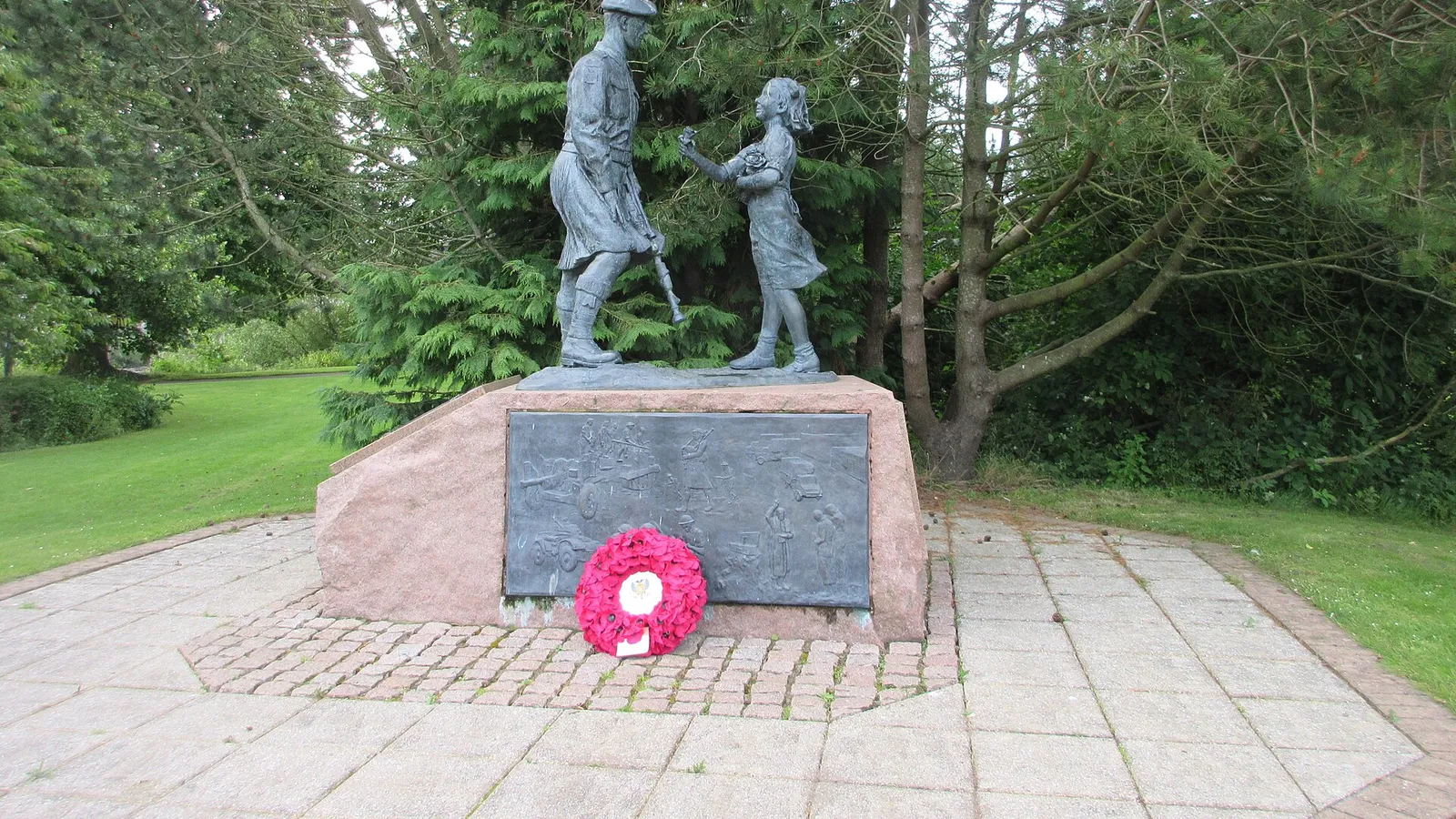

The 51st (Highland) Division — Defence Series Card #21
TL;DR
- The 51st (Highland) Division was not a regiment but a large composite infantry division of the British Army in both world wars, combining Territorial battalions drawn from the Highland regiments covered individually elsewhere in this series (Black Watch, Seaforth, Gordon, Cameron, Argyll & Sutherland Highlanders and others) into a single formation with its own command, its distinctive "HD" insignia, and its own institutional identity. (Established.)
- This card delivers the full, dedicated treatment cross-referenced from the Seaforth (#10), Gordon (#11), Cameron (#12) and Argyll & Sutherland (#13) cards, which flagged the 1940 St Valery-en-Caux surrender for detailed handling here.
- In the First World War the division earned a formidable reputation as an assault formation — decisively so at Beaumont-Hamel (November 1916) — after an unpromising start; German 1918 intelligence rated it "an especially good assault division." (Established, with the popular "Ladies from Hell / most feared" claims requiring caution — Traditional/Disputed.)
- On 12 June 1940 the greater part of the division surrendered to Rommel's 7th Panzer Division at St Valery-en-Caux while under French command, after being cut off during the collapse of France. Reconstituted in August 1940, it went on to fight at El Alamein, in Tunisia, Sicily and North-West Europe from D-Day to the German surrender. (Established.)
- The persistent claim that "Churchill deliberately sacrificed/abandoned the Highlanders because they were expendable Scots" is rejected by current scholarship (notably Barclay & Brown 2021/2023) as a politically-driven myth; the force was also not purely Scottish, including English, Welsh, French and French Colonial troops. (Disputed claim — corrected here.)
Key Facts
- Period/dates covered: 1908 (raised as Territorial Force division) – 1968 (final disbandment); principal combat 1915–1918 and 1939–1945.
- Type of institution: A British Army infantry division (a large composite formation of multiple regiments' battalions plus artillery, engineers and supporting arms), originally Territorial Force / later Territorial Army.
- Peacetime headquarters: Perth, Scotland.
- Notable feature: The stylised red "HD" cypher within a red circle on a blue ground; nicknames "Harper's Duds" and "Ladies from Hell" (WWI) and "Highway Decorators" (WWII).
- Current status/legacy: Lineage and name maintained by the 51st Highland Volunteers, 7th Battalion, The Royal Regiment of Scotland (7 SCOTS), an Army Reserve battalion headquartered in Perth, and echoed in the title of the 51st Infantry Brigade and Headquarters Scotland.
Scottish Impact Index (SI Score)
- Military Impact
- 9/10
- Enduring Significance
- 9/10
- Strategic Importance
- 9/10
- Military Distinctiveness
- 9/10
- Military Legacy
- 10/10
- Recognition
- 9/10
55/60
Ranked =10th of 43 in Defence
Claim Status
Consistent with this series' "accuracy over patriotism" principle and its three-tier framework:
- Established (documented): The division's Territorial origins (1908); its WWI battle honours and rising reputation; the 1940 deployment under French command and the St Valery surrender on 12 June 1940; the August 1940 reconstitution; and its WWII campaigns in North Africa, Sicily and North-West Europe. These rest on official histories, war diaries, the Imperial War Museum, and peer-reviewed scholarship.
- Shared/Traditional: The "Ladies from Hell" nickname and the notion that the Germans "feared the Highlanders above all others." The nickname is real in Allied usage but its German origin is unverified; the "most feared" idea is largely projection.
- Disputed (corrected here): The claim that "Churchill deliberately sacrificed/abandoned the 51st because they were Scots." This is the card's most important mythbusting task. Professional military historians treat it as a demonstrable myth. It is examined in detail below.
Timeline
Territorial Force created; the Highland Division formed, HQ Perth.
Renamed the 51st (Highland) Division; deployed to the Western Front.
High Wood (Somme); costly and unsuccessful, the low point of the "Harper's Duds" period.
Capture of Beaumont-Hamel (Battle of the Ancre); the "foundation stone" of the division's reputation.
Arras, Third Ypres, Cambrai — established as a leading assault division.
Heavy losses resisting the German Spring Offensive.
Reconstituted in the Territorial Army as the 51st (Highland) Infantry Division.
TA doubled; 9th (Highland) Division raised as the 51st's duplicate.
Division lands at Le Havre with the BEF.
Detached to the French Army in front of the Maginot Line ("Saar Force").
German offensive opens; the 51st is far to the south, away from the main BEF.
Fighting on the Somme (Abbeville); the German "Fall Rot" offensive.
Surrender at St Valery-en-Caux to Rommel's 7th Panzer Division.
9th (Highland) Division redesignated the 51st (Highland) Division (reconstitution).
Second Battle of El Alamein.
Allied invasion of Sicily (Operation Husky).
Lands in Normandy (D+1).
Rhine crossing (Operation Plunder); GOC Tom Rennie killed.
51st Highland Volunteers formed, perpetuating the name.
51st (Highland) Division finally disbanded.
Details
A division, not a regiment
The single most important framing point for this card is one of scale and character. Every preceding Defence card in the regimental sequence (#1–19) treated a distinct regiment with its own cap badge, recruiting area and continuous institutional life. The 51st (Highland) Division was something different: a divisional formation — roughly 15,000–18,000 men at full establishment — assembled from the Territorial battalions of several Highland (and, in practice, Lowland and English) regiments, together with divisional artillery, engineers, signals, machine-gun, pioneer, medical and supply units. Its brigades in both wars carried the numbers 152, 153 and 154. Battalions of the Seaforth, Cameron, Gordon, Black Watch and Argyll & Sutherland Highlanders fought within it under a single divisional command and a single sign, the "HD." When people speak of "the 51st" being "lost at St Valery," they mean this composite formation — which is why the same event recurs, from different regimental angles, across Cards #10–13.
First World War: origins and combat record
The division originated on 1 April 1908 as the Highland Division, one of fourteen infantry divisions of the newly created Territorial Force under Richard Haldane's reforms, with its headquarters in Perth. Its "Highlandness" derived from the recruiting areas of the five Highland infantry regiments that fed volunteer battalions into it — although, as the scholarship stresses, those areas already reached deep into Lowland and industrial Scotland (Dundee, Fife, Renfrewshire, Dunbartonshire), so the division was a mix of Highland and Lowland men from the outset.
Its early war was inauspicious. During the crisis of late 1914–early 1915 the division was "plundered": six of its twelve pre-war Highland battalions were seconded to Regular formations. To bring it up to strength for overseas service it received two Black Watch battalions and a complete English Territorial brigade — the North Lancashire (later 164th) Brigade — and, so reconstituted and renumbered the 51st (Highland) Division, was rushed to the Western Front in May 1915 for the Second Battle of Ypres. Lieutenant-General Sir Douglas Haig judged it at Festubert "practically untrained and very green in all field duties," and under Major-General George Harper it acquired the mocking nickname "Harper's Duds."
That reputation was transformed. After a bloody and unsuccessful assault on High Wood (July 1916, over 3,500 casualties), the division was chosen to take the fortified village of Beaumont-Hamel on 13 November 1916 during the Battle of the Ancre — a position that had defied capture since the disastrous first day of the Somme. In thick fog the 51st outflanked and took it, overrunning the German garrison (Infantry Regiment 62) and taking over 2,000 prisoners at a cost of about 2,200 casualties (roughly 500 killed). Beaumont-Hamel became, in the words of the division's official historian Major F. W. Bewsher, "the foundation stone on which the reputation of the Highland Division was built," and the division's granite memorial with its kilted Highlander now stands near Y Ravine on the site. Through 1917 it was used repeatedly as an assault division — Arras, Third Ypres (Passchendaele) and the tank-infantry battle at Cambrai. In March–April 1918 it was caught in the German Spring Offensive and suffered severely (the March fighting alone cost 219 officers and 4,696 other ranks) before sharing in the victorious Hundred Days.
On reputation: the evidence is strong that the division was genuinely rated a first-class assault formation by 1917–18. German Army intelligence in 1918 assessed it as a "besonders gute Angriffsdivision" ("an especially good assault division"). The popular claim that the Germans nicknamed the kilted Highlanders "Ladies from Hell" (or "Devils in Skirts") and feared them above all other Allied units should be handled with care: the phrase circulated widely in Allied and American press during the war (an early appearance is in the New York Times), but a documented German origin has never been established, and the idea that the Germans singled the Highlanders out for special dread is best regarded as tradition and projection rather than documented fact.
Interwar period and reformation for the Second World War
The Territorial Force stood down after the war and was reconstituted as the Territorial Army in 1920–21, re-forming the 51st (Highland) Infantry Division. Like the rest of the Army it was under-trained and under-equipped through the interwar years. After the 1938 Munich crisis the TA was doubled in size, and the 51st spawned a duplicate second-line formation, the 9th (Highland) Division — a decision that would prove significant in 1940. Major-General Victor Fortune took command (from 1937/38). The division mobilised on 24 August 1939; its men were required to hand in their kilts, the War Office having judged them unsuited to mechanised warfare and gas attack.
The 1940 France campaign: deployment under French command explained
This is the sequence most often garbled in popular retellings, so it is worth setting out precisely. The 51st landed at Le Havre in January 1940 and initially served with the BEF's I Corps on the Franco-Belgian frontier. In February–March it underwent "stiffening": roughly a third of its units were exchanged with Regular Army units to strengthen the inexperienced Territorial formation — a process that further diluted its Scottish, let alone Highland, character.
From November 1939 the War Office had an arrangement with the French to rotate British brigades through the quiet Saar sector, in front of (not inside) the Maginot Line fortresses, to gain front-line experience. In April 1940 it was decided to send a whole division at a time, and the 51st — as a long-established, large formation — was simply the first chosen. It moved to the Saar in late April, supplemented with additional (largely English) units into a self-contained mini-corps, "Saar Force." Crucially, this was a routine rotation, not a deliberate posting to a place of danger: the Saar was regarded as quiet, and the 50th (Northumbrian) Division could as easily have gone first.
When the German offensive struck on 10 May 1940, it fell far to the north and through the Ardennes; the 51st, stationed south near Metz, was nowhere near the fighting that led to Dunkirk and took no part in the Dunkirk evacuation (Operation Dynamo, 26 May–4 June). As the front collapsed, the French reorganised, and Fortune's force was moved by a circuitous route around Paris to the River Somme, coming under the newly formed French Tenth Army as part of General Marcel Ihler's IX Corps. There it held the northern flank of the Weygand Line, integrated so closely with the French that its brigades straddled the French 31st Alpine Division. Winston Churchill had placed British forces under French command as part of his effort to keep France in the war, assuring the French premier Paul Reynaud that Britain would "never abandon her ally in her hour of need."
The retreat and encirclement at St Valery-en-Caux
On 4 June the division attacked the German bridgehead at Abbeville and suffered heavily (the 152nd Brigade alone lost 20 officers and 543 other ranks); on 5 June the German "Fall Rot" offensive fell on IX Corps, and the 7th Battalion, Argyll & Sutherland Highlanders sustained the worst casualties in that regiment's history. On 7 June General Weygand ordered IX Corps to hold the River Bresle — a decision the scholarship identifies as fatal, since it foreclosed a timely withdrawal to the ports. On 9 June German panzers reached Rouen, cutting the escape route south across the Seine, and Le Havre became the only hope.
Fortune detached about a third of his command — the weaker infantry with the stronger artillery and engineers — as "Arkforce," sent west to protect Le Havre. Most of Arkforce escaped: around 11,000 men were lifted from Le Havre in Operation Cycle on 13 June, the day after the main surrender. But Rommel's 7th Panzer Division reached the coast at Fécamp first, cutting off the remainder of the division, which fell back into a shrinking pocket around the small Norman port of St Valery-en-Caux, alongside substantial French forces of IX Corps. The harbour dried at low tide, had a narrow mouth and was overlooked by high cliffs. A Royal Navy fleet of some 200+ vessels assembled offshore under Admiral Sir William James (C-in-C Portsmouth), but daylight evacuation was impossible under German gunfire, and on the night of 11/12 June dense fog made co-ordinated lifting impossible. Some 3,355 British and French troops were nonetheless taken off the beach at nearby Veules-les-Roses, though few were from the Highland infantry battalions still holding the perimeter.
The surrender examined precisely — and the composition of the force
On the morning of 12 June the French forces in the pocket surrendered first; the British followed about half an hour later, Fortune giving the order at around 10:00–10:30 after concluding that his exhausted, surrounded and near-ammunitionless men could not hold and could not be lifted. He became one of the most senior British officers taken prisoner in the war, and after 1945 was knighted for his work sustaining his men's welfare in captivity, having refused repatriation.
Numbers commonly cited put British prisoners at around 10,000 (estimates vary from about 8,000 to 11,000), with several thousand French troops captured alongside them. Recent scholarship (Barclay & Brown) estimates that only around 850–1,000 British soldiers — Scots, English, Welsh and Irish — were killed or died of wounds in Upper Normandy between 4 and 13 June, correcting wildly inflated popular figures. The prisoners faced a brutal forced march across Belgium into Germany and Poland (many to Stalag XX-A at Toruń), followed for many by the harrowing "Long March" west in the winter of 1945.
On composition, the key correction — already flagged in Cards #10–13 — is decisive and is the settled finding of current scholarship. The force lost at St Valery was not purely Scottish. Nominally a Highland division, by June 1940 it was, in Barclay and Brown's words, "as diverse as any regular British army division, with gunners from Staffordshire and Flintshire; Pioneers from Ayrshire and Norfolk; machine-gunners from Northumberland and London; and infantry from Kent, West Yorkshire, East Surrey, East Sussex, Shropshire, Cumberland and Nottinghamshire." Attached English units included the 1st Battalion Princess Louise's Kensington Regiment and the 7th Royal Northumberland Fusiliers (machine-gun battalions), the 7th Royal Norfolks (pioneers), and elements such as the 2/7th Duke of Wellington's Regiment; Welsh Territorial artillery was also present. Beyond the British, the defenders of the pocket included large numbers of French troops of IX Corps (cavalry and Alpine mountain units) and French Colonial troops, including West African units and colonial gunners from Madagascar — the latter, like the Indians at Dunkirk, long airbrushed from the story. The division "relied heavily on the Highland infantry battalions for front-line defence but [was] much more than just a Highland, or indeed a Scottish, formation."
The "Churchill sacrificed the Highlanders" claim, examined
This is the card's central mythbusting task, and it must be handled with rigour rather than either repetition or breezy dismissal.
The claim. In its popular form the assertion is that Churchill (or "the English," or "Westminster") deliberately sacrificed or abandoned the 51st at St Valery — often conflated with Dunkirk — so that "English" troops could escape, and specifically "because they were expendable Scots." A milder version simply says "Churchill abandoned the fighting Scots."
The state of scholarship. The strongest recent work is by the archaeologist-historian Dr Gordon J. Barclay and Adam Brown, whose detailed study The surrender of the 51st Highland Division at St Valery, 12 June 1940 (2021) was developed into the peer-reviewed article "'Churchill abandoned the fighting Scots': The Mythology and Reality of the Surrender of the 51st Highland Division at St Valery-en-Caux, 12 June 1940," Scottish Affairs 32.1 (2023, doi:10.3366/scot.2023.0441). Barclay had earlier laid out the argument in the International Churchill Society's Finest Hour (No. 189, 2020). Their verdict is unambiguous: the "sacrifice/abandonment because they were Scots" narrative is a myth, and one deliberately deployed in "narratives of grievance and victimhood." Their concluding judgement is worth quoting: "The force captured in St Valery was neither placed there nor sacrificed because they were Scots — the force by June 1940 was neither all 'Highland' nor indeed all 'Scottish'. It was not weak or understrength. It was not abandoned by the Royal Navy nor unsupported by the RAF. The mythology that claims otherwise can only be designed to promote division and distrust."
What the evidence actually shows. Several documented points dismantle the popular claim:
- Chronology. The Dunkirk evacuation ended on 4 June 1940, over 200 km away; the 51st surrendered eight days later, on 12 June. The two events were not militarily dependent, and the 51st was never a "rearguard for Dunkirk."
- Chain of command. The division was under French command (IX Corps, Tenth Army). Its entrapment owed most to French High Command failures — above all Weygand's 7 June order to hold the Bresle rather than withdraw to the ports. As even Saul David (whose book bears the provocative title Churchill's Sacrifice of the Highland Division) acknowledges, French disorganisation as much as any callousness in London sealed the division's fate; there was "no real decision to sacrifice them on the part of Churchill."
- No order to abandon. Barclay and Brown find no order from Downing Street to halt the evacuation. On the contrary, Admiral James was under Admiralty orders to lift as many men as possible, and Operation Cycle succeeded in evacuating over 11,000 from Le Havre. The failure at St Valery itself was caused by fog, cliffs and German artillery, not a decision to leave the men.
- The Calais contrast. The scholarship notes that Churchill did deliberately sacrifice the Calais garrison in May 1940 — and said so openly — which shows that when he made such a decision he made it explicitly. No comparable order exists for St Valery.
- The legitimate strategic decision. What is documented is a calculated decision to keep British forces (including the 51st) fighting alongside the French to hold the alliance together as Norway fell and Italy entered the war. That is a matter of coalition realpolitik, not a plot against Scots. Its value was attested by General de Gaulle, who said in a 1942 speech in Scotland: "I can tell you that the comradeship in arms experienced on the battlefield of Abbeville in May and June 1940 between the French armoured division which I had the honour to command, and the 51st Highland Division under General Fortune, played its part in the decision which I took to continue fighting on the side of the Allies to the end, whatever the course of events."
A fair verdict. There is room for legitimate debate about whether the division could have been extracted earlier had London or Paris acted differently — some contemporaries, such as Fortune's intelligence officer Captain Ian Campbell (later Duke of Argyll), bitterly believed it could ("no division has ever been more uselessly sacrificed"). But that is a question of Allied command failure and lost opportunities, not of a deliberate, ethnically-motivated "sacrifice by Churchill." The specific popular claim, as usually stated, is false, and this card states so plainly while acknowledging the genuine tragedy and the real strategic misjudgements involved.
Reconstitution and subsequent WWII service
The 51st was reborn quickly. In August 1940 its second-line duplicate, the 9th (Highland) Division, was redesignated the 51st (Highland) Infantry Division, absorbing the survivors of the original. After nearly two years of home defence and training — under Cunningham, then Ritchie, then (from June 1941) Major-General Douglas Wimberley, a veteran of the original division — it went to North Africa in August 1942.
At the Second Battle of El Alamein (October–November 1942) it fought in the centre of the northern push and suffered the heaviest casualties of any division in the battle: 2,827 killed, wounded and missing, with its nine infantry battalions taking a casualty rate of around 40 per cent. It fought on through Tunisia, where Lieutenant-Colonel Lorne MacLaine Campbell of the 7th Argylls won the Victoria Cross at Wadi Akarit (April 1943). In July 1943 it took part in the invasion of Sicily (Operation Husky), suffering comparatively light losses (124 officers and 1,312 other ranks) in the 38-day campaign; it was there that Hamish Henderson, a divisional intelligence officer, wrote the celebrated song "The 51st (Highland) Division's Farewell to Sicily." The division's association with Montgomery was close; he later wrote (quoted in the official divisional history): "Of the many fine divisions that served under me in the Second World War, none were finer than the Highland Division… It was the only infantry division in the armies of the British Empire that accompanied me during the whole of the long march from Alamein to Berlin."
Recalled to Britain to prepare for the invasion of North-West Europe, the division landed in Normandy on 7 June 1944 (D+1) and fought difficult actions east of the Orne — Bréville, Colombelles — in support of the airborne bridgehead. Its Normandy performance was, by its own high standards, disappointing; Montgomery judged it temporarily not battleworthy and relieved its GOC, Major-General Charles Bullen-Smith, in late July 1944. The scholarly case-study by Anthony King ("Why did 51st Highland Division Fail?", British Journal for Military History, 2017) concludes that the decisive factor was command — Bullen-Smith's shortcomings — rather than any failing in the men. Under his successor, Major-General Tom Rennie, the division recovered. In a moment of powerful symbolism it was directed, on Montgomery's orders, to liberate St Valery-en-Caux in September 1944, its massed pipes and drums playing in the streets where it had surrendered four years before. It went on through Le Havre, the Ardennes, Operation Veritable (the Rhineland) and Operation Plunder (the Rhine crossing of March 1945, in which Rennie was killed by mortar fire), ending the war near Bremerhaven. Across the North-West Europe campaign the division recorded a total of 19,524 battle casualties.
Divisional identity and insignia
The division's sign was a stylised red "HD" (for Highland Division), the letters conjoined within a red circle on a blue ground — a design used, with minor variation, in both world wars. In the desert and North-West Europe the division marked its bridges and routes so assiduously with the sign that it earned the affectionate nickname "Highway Decorators." Its identity was also carried in music and tradition: the pipe marches, Henderson's "Farewell to Sicily," and the Reel of the 51st (Highland) Division, a Scottish country dance devised by officers in a POW camp after St Valery.
Current institutional status and memory
The division was reconstituted in the postwar TA (briefly amalgamated with the 52nd (Lowland) Division as the 51st/52nd Scottish Division, 1947–50), placed on a lower home-defence footing from the mid-1950s, and finally disbanded in 1968. Its name lives on: the 51st Highland Volunteers, raised in 1967, became in 2006 the 7th Battalion, The Royal Regiment of Scotland (7 SCOTS), an Army Reserve battalion headquartered in Perth whose name expressly commemorates the division. The 51st Infantry Brigade and Headquarters Scotland likewise carries the number and identity forward. Memorials stand at Beaumont-Hamel (WWI), at Bréville-les-Monts in Normandy (WWII), on the North Inch at Perth, and on the cliffs above St Valery-en-Caux.
Did You Know?
- The division's WWI nickname "Harper's Duds" was a pun on the initials of its commander, Major-General George Montague Harper — and on the "HD" sign itself.
- Of the 219 British Army prisoners of war who had escaped and returned to Britain by the end of June 1941, 134 were men of the 51st (Highland) Division — a remarkable concentration of escapers.
- The Reel of the 51st Division, one of the best-known modern Scottish country dances, was devised by captured officers in a German POW camp (Laufen) after the 1940 surrender.
- In September 1944 the reconstituted division deliberately liberated the very town where it had surrendered in 1940, St Valery-en-Caux, with its pipes and drums playing and 1940 veterans on parade.
- German Army intelligence in 1918 formally rated the division "besonders gute Angriffsdivision" — "an especially good assault division" — one of the few documented enemy assessments behind its fearsome reputation.
- The division was so diligent in signposting its routes in WWII that it was nicknamed the "Highway Decorators."
- Charles de Gaulle publicly credited the 51st's stand alongside his own armoured division at Abbeville as one influence on his decision to fight on with the Allies.
- The much-loved song "The 51st (Highland) Division's Farewell to Sicily" was written by folk-revival figure Hamish Henderson, who served as an intelligence officer in the division.
FAQ
1Was the 51st (Highland) Division a regiment?
No. It was a division — a large composite formation of around 15,000–18,000 men, combining infantry battalions from several Highland and Scottish regiments (Seaforth, Cameron, Gordon, Black Watch, Argyll & Sutherland and others) together with artillery, engineers, signals and supporting units, all under one command and one "HD" sign. The individual regiments are covered on earlier cards in this series.
2When was it formed?
It was raised on 1 April 1908 as the Highland Division under the Territorial Force reforms, with its headquarters at Perth, and was renumbered the 51st (Highland) Division in May 1915 when sent to the Western Front.
3What was its reputation in the First World War?
After a poor start ("Harper's Duds"), it became regarded as one of the finest assault divisions in the British Army, decisively so after capturing Beaumont-Hamel in November 1916. German intelligence in 1918 rated it "an especially good assault division."
4Did the Germans really call them "Ladies from Hell"?
The nickname was widely used by Allied and American sources during the First World War, applied to kilted Highland troops generally. A documented German origin has never been established, so the phrase — and the idea that the Germans especially feared the Highlanders — is best treated as tradition rather than confirmed fact.
5What happened at St Valery-en-Caux in 1940?
Fighting under French command during the collapse of France, the division was cut off on the Channel coast and, unable to be evacuated because of fog, cliffs and German artillery, surrendered to Rommel's 7th Panzer Division on 12 June 1940. Around 10,000 of its men were taken prisoner.
6Was the 51st part of Dunkirk?
No. It was around 200 km south of Dunkirk, serving with the French Army, and took no part in the Dunkirk evacuation, which had ended on 4 June — eight days before St Valery.
7Did Churchill deliberately sacrifice the Highlanders because they were Scots?
No. Current scholarship (notably Barclay & Brown) rejects this as a politically-driven myth. The division was under French command, its entrapment owed most to French High Command failures, no order to abandon it exists, and the Royal Navy did attempt to evacuate it. There is legitimate debate about missed chances to withdraw it earlier, but not about a deliberate ethnic "sacrifice."
8Was the surrendered force entirely Scottish?
No. By June 1940 the division included English gunners, machine-gunners, pioneers and infantry, plus Welsh artillery; and the wider pocket also contained large numbers of French and French Colonial troops (including West African and Madagascan units). It was "Highland in name only."
9How many were killed, and how many captured?
Recent scholarship estimates around 850–1,000 British soldiers killed or died of wounds in Upper Normandy in June 1940 — far fewer than popular myth claims. Prisoners numbered roughly 10,000 British (estimates range from about 8,000 to 11,000), plus several thousand French.
10How was the division reconstituted?
In August 1940 its second-line duplicate, the 9th (Highland) Division, was redesignated the 51st (Highland) Infantry Division, absorbing the survivors and carrying the name forward for the rest of the war.
11What did the reconstituted division do next?
It fought at El Alamein (1942), in Tunisia and Sicily (1943), and in North-West Europe from D+1 (7 June 1944) through Normandy, the Rhineland and the Rhine crossing to the German surrender in 1945, ending near Bremerhaven.
12Does the 51st still exist today?
The division itself was disbanded in 1968, but its name and lineage are carried by the 51st Highland Volunteers — now the 7th Battalion, The Royal Regiment of Scotland (7 SCOTS), an Army Reserve battalion headquartered in Perth — and by the 51st Infantry Brigade and Headquarters Scotland.
Sources
Primary / Institutional
- Imperial War Museums — formation badge records for the 51st (Highland) Infantry Division (the "HD" sign) and photographs including the 12 June 1940 surrender (IWM RML 342).
- Imperial War Museums War Memorials Register — 51st (Highland) Division memorials.
- L. F. Ellis, The War in France and Flanders 1939–1940 (HMSO official history, 1954).
- F. W. Bewsher, The History of the 51st (Highland) Division 1914–1918 (Blackwood, 1921; available via Project Gutenberg / Internet Archive).
- J. B. Salmond, The History of the 51st Highland Division 1939–1945 (Blackwood, 1953).
- The Long, Long Trail — order of battle of the 51st (Highland) Division, WWI.
- UK Parliament, Early Day Motion 57083 (2020) — 80th anniversary of St Valery.
Scholarly
- Gordon J. Barclay & Adam Brown, "'Churchill abandoned the fighting Scots': The Mythology and Reality of the Surrender of the 51st Highland Division at St Valery-en-Caux, 12 June 1940," Scottish Affairs 32.1 (2023), doi:10.3366/scot.2023.0441 — the strongest scholarly treatment of the mythology.
- Brown & Barclay, The surrender of the 51st Highland Division at St Valery, 12 June 1940 (2021, open-access PDF) — the extended research paper behind the journal article.
- Gordon J. Barclay, "A 'Villain for All Seasons': Churchill and Scottish Mythologies of Grievance," Finest Hour 189 (2020).
- Anthony King, "Why did 51st Highland Division Fail? A case-study in command and combat effectiveness," British Journal for Military History 4.1 (2017).
- Edward M. Spiers, Jeremy A. Crang & Matthew Strickland (eds.), A Military History of Scotland (Edinburgh University Press, 2012).
- E. W. McFarland, "The Great War", in T. M. Devine and Jenny Wormald (eds), The Oxford Handbook of Modern Scottish History (Oxford University Press, 2012) — further reading on Scottish units in the Great War
General further reading
- Saul David, Churchill's Sacrifice of the Highland Division / After Dunkirk (1994; rev. 2017) — the fullest narrative of the 1940 campaign, though its title should be read against the scholarship above.
- Richard Doherty, None Bolder: The History of the 51st Highland Division in the Second World War (Spellmount, 2006).
- Patrick Delaforce, Monty's Highlanders: 51st Highland Division in the Second World War (Pen & Sword).
- Colin Campbell, The 51st (Highland) Division in the Great War: Engine of Destruction (Pen & Sword, 2019).
- June Goodfield, Glory from Defeat: Our Second Dunkirk (2019).
Honest Caveats
"Churchill deliberately sacrificed/abandoned the Highlanders because they were Scots" (the central myth). This is the most important claim on the card and the current scholarly consensus is clear: as usually stated, it is false. The division was under French command; its encirclement owed most to French High Command decisions (above all Weygand's order to hold the Bresle); there is no documented order from London to abandon it; the Royal Navy did try to evacuate it (Operation Cycle lifted over 11,000 from Le Havre, and 3,355 more came off at Veules-les-Roses); and the final failure at St Valery was caused by fog, cliffs and German gunfire. The myth is demonstrably deployed in modern "grievance" politics, sometimes in explicitly anti-English terms. A legitimate residue of debate remains — whether the division might have been withdrawn earlier had Allied commanders decided differently, a view held by some veterans and explored by Saul David — but that concerns coalition command failure, not a deliberate, ethnically-motivated sacrifice. This card rejects the popular "betrayal" narrative while honouring the genuine tragedy.
The "purely Scottish force" oversimplification. The idea that only Scots were lost at St Valery is inaccurate. By June 1940 the division included substantial English and some Welsh personnel, and the St Valery pocket also held large numbers of French and French Colonial troops. Reducing the event to a story of solely Scottish loss, as much popular memory does, airbrushes those other men — English, Welsh, French, West African and Madagascan — from the record.
Disputed casualty and prisoner figures. Numbers vary by source and should be given with caveats. British prisoners at St Valery are variously stated as about 8,000, "around 10,000," or nearly 11,000; the difference reflects whether French prisoners, wounded and stragglers are counted. Deaths in the 1940 campaign have been wildly exaggerated in popular accounts; the best recent estimate is around 850–1,000 British killed or died of wounds. El Alamein casualties for the division are most reliably given as 2,827 killed, wounded and missing (the highest of any division in that battle); and the North-West Europe total of 19,524 battle casualties (from the divisional history) is itself a specific but source-dependent figure. Where precision matters, the official histories and the Barclay & Brown study are the most reliable guides.
The "Ladies from Hell" nickname and "most feared" reputation. The nickname is genuine in Allied usage but of unproven German origin, and the claim that the Germans feared the Highlanders above all other Allied troops is not supported by the documentary record; it belongs to the Traditional tier.
Card 021 · Defence