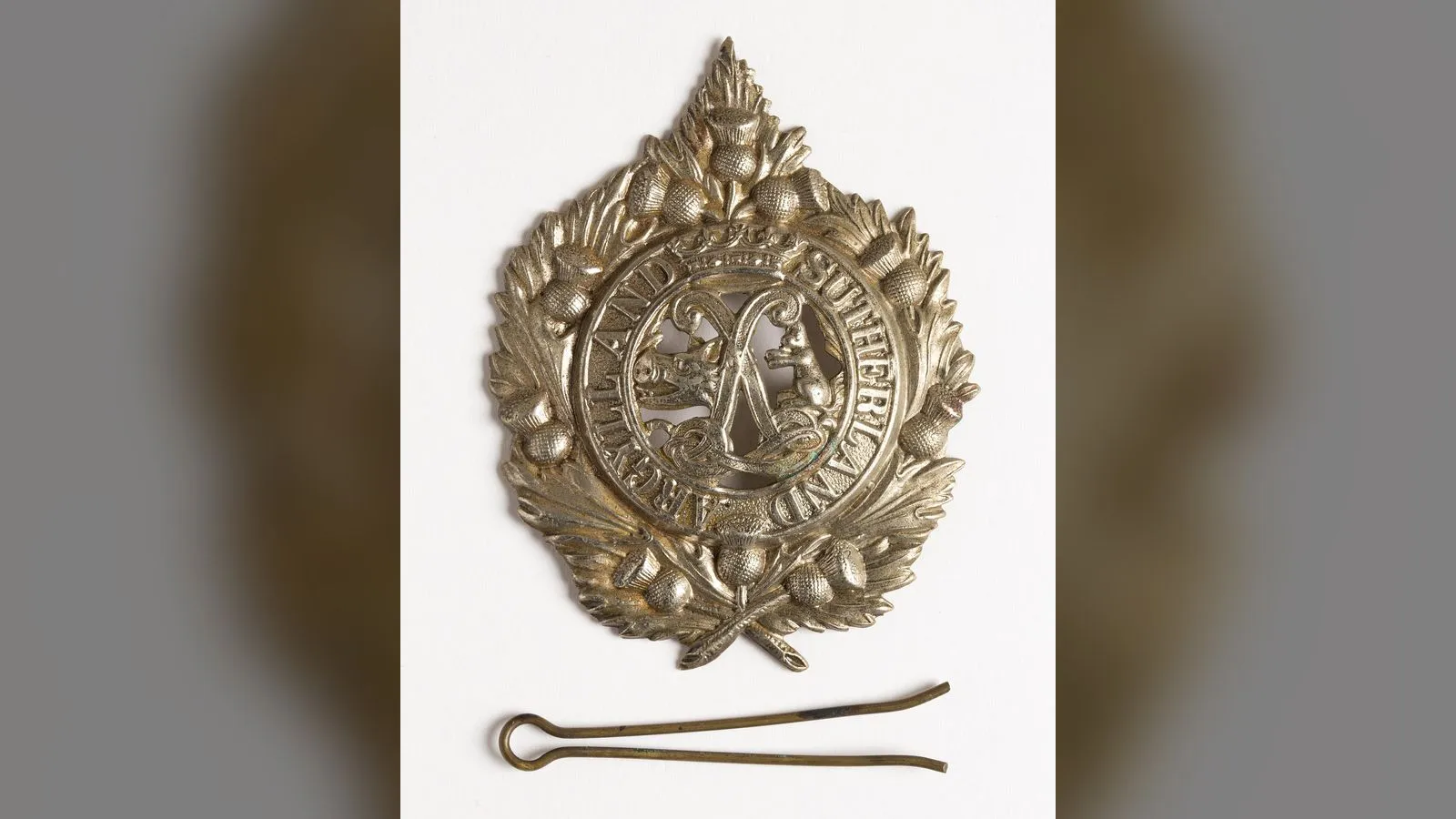

The Argyll & Sutherland Highlanders — Card #13, Defence Series
Contents
TL;DR
- The Argyll and Sutherland Highlanders (Princess Louise's) was created on 1 July 1881 under the Childers Reforms by amalgamating two older regiments — the 91st (Argyllshire Highlanders), raised 1794, and the 93rd (Sutherland Highlanders), raised 1799 — a fact that is documented and well-attested by the National Army Museum and the regimental museum at Stirling Castle.
- On the sensitive Sutherland Clearances question, the chronology is precise and important: the 93rd was raised in 1799–1800, but the most notorious Sutherland/Strathnaver clearances (Patrick Sellar's Strathnaver evictions) began in 1814 — over a decade after the regiment was raised. The regiment was NOT "raised then cleared"; rather the same estate that raised the men later evicted their families (documented chronology; the "betrayal" framing is traditional/interpretive).
- The regiment's iconic identity rests on the 93rd's "Thin Red Line" stand at Balaclava (1854) — treated only briefly here, see Card #27 — the Sutherland/Government 1A tartan, the largest cap badge in the British Army, and the red-and-white diced Glengarry commemorating Balaclava (documented).
- The regiment served across the Empire (South Africa, the Indian Mutiny including six VCs at Lucknow, Egypt/Sudan, the Boer War), both World Wars, Korea and Aden, and — distinctively among the Highland regiments in this series — went from its 1881 formation directly into the 2006 Royal Regiment of Scotland WITHOUT any intermediate 20th-century amalgamation (documented; a genuinely distinctive institutional feature).
- Post-2006 the Argylls became 5 SCOTS, then in 2012 were reduced to a single ceremonial/public-duties company — Balaklava Company — the deepest reduction of any antecedent regiment in the new structure (documented).
Key Facts
- Period/dates covered: 1794 (raising of 91st) / 1799–1800 (raising of 93rd) → 1881 amalgamation → 2006 into the Royal Regiment of Scotland (and 2012 reduction to company strength)
- Key institution: The Argyll and Sutherland Highlanders (Princess Louise's); Regimental Headquarters and Depot at Stirling Castle
- Notable features: The "Thin Red Line" (93rd at Balaclava, 1854); largest cap badge in the British Army; six VCs at Lucknow in a single day; the Sutherland (Government No. 1A) tartan
- Current status/legacy: Balaklava Company, 5th Battalion, Royal Regiment of Scotland (based at Redford Barracks, Edinburgh); Regimental Museum at Stirling Castle
Scottish Impact Index (SI Score)
- Military Impact
- 9/10
- Enduring Significance
- 10/10
- Strategic Importance
- 8/10
- Military Distinctiveness
- 10/10
- Military Legacy
- 10/10
- Recognition
- 9/10
56/60
Ranked =8th of 43 in Defence
Claim-status / evidence framing note
The core institutional facts of this card are Established (documented): the 1794 raising of the 91st, the 1799–1800 raising of the 93rd, the 1881 amalgamation, recruiting areas, tartan, and campaign service are all corroborated by the National Army Museum, the Argyll and Sutherland Highlanders Regimental Museum, contemporary regimental records, and standard scholarship.
Several elements are Shared/Traditional: the colourful accounts of the 93rd's recruitment (the "pinch of snuff and glass of whisky" story), the "six VCs before breakfast" phrase, and the "last great act of clan loyalty" framing of the regiment's founding. These are widely repeated and rooted in fact but carry romantic embellishment.
One point requires special care and is flagged here explicitly: the Sutherland Clearances chronology. It is a documented fact that the 93rd was raised in 1799–1800 and that the notorious Strathnaver clearances by Patrick Sellar began in 1814 — i.e. the regiment predates the worst clearances by well over a decade. The emotionally powerful narrative that men were recruited and their families then evicted is chronologically real in sequence but must not be compressed into a false "raised in order to be cleared" causation. This precision distinguishes the honest account from the popular myth.
Timeline
91st raised by Duncan Campbell of Lochnell for John Campbell, 5th Duke of Argyll, as the 98th (Argyllshire Highlanders) Regiment of Foot
91st serves in the capture of the Cape of Good Hope; renumbered 91st in 1796
93rd (Sutherland Highlanders) raised on 16 April 1799 by Major-General William Wemyss for Elizabeth, Countess of Sutherland; first muster at Skail, Strathnaver, 1800
91st in the Peninsular War (Roliça, Vimeiro, Corunna, Pyrenees); 93rd at the Cape
93rd at the Battle of New Orleans (War of 1812)
91st present in the Waterloo campaign but held on the right flank; did NOT fight in the battle (see Card #26)
Sutherland (Strathnaver/Kildonan) Clearances at their most notorious, more than a decade after the 93rd was raised
93rd forms the "Thin Red Line" at Balaclava (see Card #27 for full treatment)
93rd wins six VCs at the Secundra Bagh, Lucknow (Indian Mutiny)
91st becomes "Princess Louise's Argyllshire Highlanders"
91st in the Anglo-Zulu War (Gingindlovu)
Childers Reforms amalgamate the 91st and 93rd into Princess Louise's (Sutherland and Argyll Highlanders); order reversed in 1882
Boer War (Modder River, Magersfontein, Paardeberg)
27 battalions raised; over 6,900 dead; six VCs
Nine battalions; 51st Highland Division and St Valery 1940 (see Card #21); Malaya/Singapore; North-West Europe
1st and 2nd Battalions merged into a single-battalion regiment
Korea (Hill 282/Naktong, Pakchon)
Aden: Lt-Col Colin "Mad Mitch" Mitchell leads the re-occupation of Crater
"Save the Argylls" campaign resists disbandment
Amalgamated into the Royal Regiment of Scotland as 5 SCOTS (see Card #23)
5 SCOTS reduced to Balaklava Company, a single public-duties company
Details
1794: the origins of the 91st (Argyllshire) Highlanders
The senior antecedent regiment was raised in 1794, when King George III asked John Campbell, 5th Duke of Argyll, to raise a kilted regiment for foreign service during the French Revolutionary Wars. The Duke, unwell, delegated the task to his kinsman Duncan Campbell of Lochnell. The unit was gazetted as the 98th (Argyllshire Highlanders) Regiment of Foot and renumbered the 91st in 1796. This was a classic example of the clan-gentry raising system: of the 33 original officers, 15 were Campbells and two others had married Campbells. But Argyllshire alone could not fill the ranks: about a third of the men came from Argyll and the Isles, and the remainder came largely from Glasgow, Edinburgh, Renfrew, Paisley and elsewhere in the central belt, with a small Irish contingent. The regiment was quickly sent to help capture the Cape of Good Hope from the Dutch (1795–96), and returned repeatedly to South Africa over the following decades. It then fought in the Peninsular War (Roliça, Vimeiro, Corunna, and later the Pyrenees). Notably, the regiment lost its Highland dress and territorial designation between 1809 and 1820 — de-kilted, like several other regiments, to widen recruiting.
In 1871 the 91st provided the guard of honour at the wedding of Queen Victoria's daughter, Princess Louise, to the Marquess of Lorne (heir to the Dukedom of Argyll). In 1872 the regiment became "Princess Louise's Argyllshire Highlanders," gaining her cipher and coronet, the Argyll boar's head, and the motto Ne Obliviscaris ("Do not forget").
1799–1800: the origins of the 93rd (Sutherland) Highlanders — and the Clearances chronology examined precisely
The junior antecedent was raised in 1799–1800 from the estates of Elizabeth, Countess of Sutherland, the task delegated to her kinsman Major-General William Wemyss. It drew on men recently serving in the Sutherland Fencibles. The regiment was formally raised on 16 April 1799 and first mustered at Skail in Strathnaver in 1800; a memorial cairn stands today at Syre marking the gathering place. The recruitment has long been described as the "last great act of clan loyalty" in Highland history — carried out with a census, a proclamation, and (in tradition) a snuff-mull and a bottle of whisky. The 93rd became famous as perhaps the most solidly Highland, Gaelic-speaking, and religiously observant of all the Scottish regiments: it formed its own kirk session and elected elders from the ranks, and one company is said to have gone nineteen years without a single man being punished.
Here the editorial standard demands precision. The Sutherland estate is notorious for the Highland Clearances, and it is tempting — and common — to fuse the two stories into a single tale of a landlord who recruited her tenants' sons and then evicted their families. The chronology must be kept exact: the 93rd was raised in 1799–1800; the most infamous clearances on the estate — Patrick Sellar's Strathnaver evictions, including the death of Margaret MacKay in June 1814 — began in 1814, with the largest waves in 1818–1820. Sellar was employed as factor only from 1811. In other words, the regiment was raised more than a decade before the worst of the clearances. The powerful and painful truth — documented in the regimental and clearance literature alike — is that some soldiers who had been recruited under the old bonds of loyalty later returned, or heard, that the same estate had burned out their families. That is a genuine and honest tragedy of sequence. It is not accurate to say the men were recruited in order to be cleared, or that the regiment was founded as an instrument of clearance. The reluctance of Sutherland men to enlist in later decades is itself documented as a consequence of the clearances — a reversal of the founding loyalty.
The 1881 formation explained
Both regiments existed as single-battalion line regiments (the 91st and 93rd Regiments of Foot) through the 19th century. Under the Childers Reforms — the continuation of the Cardwell Reforms that created multi-battalion county regiments — the two were amalgamated on 1 July 1881. The 91st became the 1st Battalion and the 93rd the 2nd Battalion of the new regiment, initially styled "Princess Louise's (Sutherland and Argyll Highlanders)," with the order of the county titles reversed the following year to "Argyll and Sutherland." Militia and volunteer battalions across Argyllshire, Buteshire, Dumbartonshire, Kinross-shire, Renfrewshire and Stirlingshire were folded into the structure. The regiment took two mottoes — Ne Obliviscaris (from Argyll) and Sans Peur (from Sutherland) — and its home became Stirling Castle. The full title became "The Argyll and Sutherland Highlanders (Princess Louise's)" in 1921.
Argyll and Sutherland recruiting areas
The regiment's recruiting geography was unusual in uniting two widely separated territories: Argyllshire in the western Highlands and islands (Campbell country) and Sutherland in the far north (Mackay, Gordon and Sutherland country). In practice, from 1881 the regiment recruited across a broad west-and-central Scotland belt — Argyllshire, Buteshire, Clackmannanshire, Dumbartonshire, Kinross-shire, Renfrewshire and Stirlingshire — with heavy contributions from industrial areas such as the Renfrewshire and Inverclyde shipyards. This distinguishes it from, say, the Seaforth (Ross-shire/Caithness), Gordon (Aberdeenshire/Banffshire) or Cameron (Inverness-shire) Highlanders covered in Cards #10–12, whose territories were more geographically contiguous.
Iconic uniform and tartan
The regiment wore the Sutherland district tartan (Government No. 1A) — a lightened version of the Black Watch/Government (No. 1) sett. The 93rd had worn the same Government sett as the 91st, differentiated in the way it was kilted: as worn by the Argylls the kilt was set to show the green, whereas the Black Watch kilted to show the blue. Other distinctive features: the largest cap badge in the British Army (a boar's head and cat, with the coronet and cipher of Princess Louise), the Glengarry bonnet with red-and-white dicing that commemorates the Thin Red Line, and the regimental mascot, a Shetland pony named Cruachan. These elements make the Argylls among the most instantly recognisable of Highland regiments.
Balaclava (brief — see Card #27)
On 25 October 1854, at the Battle of Balaclava in the Crimean War, the 93rd Sutherland Highlanders under Sir Colin Campbell stood in a two-deep line — rather than the textbook defensive square — against a charge of Russian cavalry. War correspondent William Russell described them in his despatch to The Times as "that thin red streak tipped with a line of steel," a phrase soon immortalised as "The Thin Red Line." Campbell's reported words to his men as he rode down the line — "There is no retreat from here, men. You must die where you stand" (to which his right-hand man John Scott is said to have replied, "Ay, Sir Colin. An needs be, we'll do that.") — and his later remark that he "did not think it worth the trouble of forming square," are part of the regiment's founding legend. This card treats Balaclava only in outline; Card #27 ("The Thin Red Line") provides the full dedicated account. The episode's legacy survives in the diced Glengarry and in "Balaklava" as a battle anniversary and company name.
Waterloo (brief — see Card #26)
Neither antecedent regiment fought in the Battle of Waterloo itself, and this precision matters. The 91st was present in the 1815 campaign — it formed part of the 4th Division under Sir Charles Colville and was posted on the army's right flank, covering the road to Brussels and later storming Cambrai — but it did not take part in the fighting at Waterloo and never carried Waterloo as a battle honour. The 93rd was not in the campaign at all; its 1st Battalion was en route to (or engaged in) North America and the New Orleans operation. Full Waterloo treatment belongs to Card #26.
Major imperial campaigns
The Argylls' antecedents and the amalgamated regiment served extensively across the British Empire, and this service should be understood honestly as imperial and colonial soldiering.
- South Africa: The 91st was repeatedly deployed to the Cape from the 1790s and fought in the Anglo-Zulu War of 1879 (Gingindlovu, and as post-Isandlwana reinforcements). The famous 1852 Birkenhead shipwreck, source of the "women and children first" tradition, carried reinforcements for the 91st, most of whom went down with the ship.
- The Indian Mutiny (1857–59): The 93rd's most celebrated imperial action. On 16 November 1857, at the storming of the Secundra Bagh during the relief of Lucknow, the regiment won six Victoria Crosses in a single day. The fighting was ferocious hand-to-hand slaughter, and honest treatment acknowledges the brutality on both sides during the suppression of the rebellion.
- Egypt/Sudan and beyond: Victorian and inter-war deployments included the Umbeyla Campaign (1863–64), and 20th-century service in Sudan (1923), Egypt (1925) and Palestine.
- The Boer War (1899–1902): The 1st Battalion fought in the Highland Brigade at Modder River, Magersfontein and Paardeberg.
First World War
At the outbreak of war in 1914 the regiment had two Regular and seven Territorial battalions. Over the course of the war it raised or fielded 27 battalions in total — a figure confirmed both by the regiment's own WWI memorial ("27 battalions were raised during the First World War") and by the full battalion order of battle, which itemises four Regular, sixteen Territorial (first-, second- and third-line plus the 16th) and seven New Army/Service battalions. The frequently quoted figure of "fifteen" is a looser summary that excludes many reserve, depot, home-service and duplicate battalions and should be treated as imprecise; the National Army Museum's own summary text gives the lower figure, noting the regiment began with "two Regular battalions and seven Territorial battalions" and "raised seven more service battalions." The regiment fought on the Western Front, at Gallipoli, and at Salonika. It won 78 battle honours and six Victoria Crosses, and lost over 6,900 officers and other ranks — the figure recorded on the regimental WWI memorial window (dedicated 1 July 2016 in the Church of the Holy Rude, Stirling, and depicting a young Argyll soldier standing in the cemetery at Beaumont-Hamel). Casualty figures always carry source variation depending on whether attached men, later deaths and different rolls are counted.
Second World War (brief — see Card #21)
Nine battalions served in the Second World War. The 5th and 7th Battalions were part of the 51st (Highland) Division that fought in France in 1939–40 and were caught up in the surrender at St Valery-en-Caux on 12 June 1940, when much of the division was forced to capitulate — a story treated in full in Card #21 and which should be understood with care: recent scholarship (in Scottish Affairs, 2023) cautions against recasting the loss as a purely Scottish grievance, since the force also included English, Welsh and French troops. A distinctive Argyll footnote to St Valery: the Scottish country dance "The Reel of the 51st (Highland) Division" was devised by Lt J.E.M. "Jimmy" Atkinson of the 7th Argylls while a prisoner of war, and his coded instructions were reportedly intercepted and puzzled over by the German Abwehr. The 1st Battalion fought in North and East Africa, Crete, and Sicily and Italy; the 2nd Battalion was overwhelmed covering the retreat to Singapore and surrendered in February 1942, reinforced late by Royal Marine survivors of HMS Prince of Wales and Repulse (the "Plymouth Argylls"). A reconstituted 2nd Battalion fought from Normandy to the Elbe.
The long regimental tradition to 2006 and beyond (see Card #23)
Here lies the genuinely distinctive institutional feature. Most other Scottish regiments in this series underwent an intermediate 20th-century merger before 2006: the Royal Scots Fusiliers and HLI merged in 1959 (Card #9), the Seaforth and Cameron in 1961 (Cards #10/12), and the Queen's Own Highlanders and Gordons in 1994 (Card #11). The Argyll and Sutherland Highlanders, by contrast, retained its 1881 identity intact all the way to 2006 — it never merged with another regiment in the 20th century. (Its two Regular battalions were merged into one in 1948, but that was an internal reduction, not a merger with another regiment.)
This continuity was hard-won. The regiment survived a 1948 single-battalion reduction, and famously fought off disbandment in 1968–72 through the enormously popular "Save the Argylls" campaign, whose petition was so vast that a Commons discussion (Hansard, 17 December 1968) estimated that a single clerk checking 1,000 signatures a day would take some 2¾ years to complete it — consistent with the popular account of roughly a million signatures. Balaclava Company continued as an independent unit from 20 January 1971 until the regiment was restored to full battalion size on 17 January 1972. In the post-war decades the Argylls saw more active service than almost any other British regiment: Korea (including the tragic friendly-fire napalm attack on Hill 282 in September 1950, where Major Kenneth Muir was posthumously awarded the VC), Borneo, Cyprus, Aden (the 1967 Crater re-occupation under "Mad Mitch"), Northern Ireland, and Iraq (2004).
On 28 March 2006 the regiment was amalgamated into the seven-battalion Royal Regiment of Scotland as its 5th Battalion (5 SCOTS) — the full formation is covered in Card #23. Then, following the Army 2020 defence review announced by Defence Secretary Philip Hammond on 5 July 2012, 5 SCOTS was reduced to a single company, Balaklava Company, 5th Battalion, Royal Regiment of Scotland (Argyll and Sutherland Highlanders), based at Redford Barracks, Edinburgh, and performing public (ceremonial) duties in Scotland. This makes the Argylls the antecedent regiment reduced most severely within the new structure, and is a notable, and to many a controversial, later development that deserves honest recording. The Regimental Museum remains at Stirling Castle.
Did You Know?
- The Argylls had the largest cap badge in the British Army — a substantial white-metal badge roughly 8 cm tall.
- The regiment's mascot is a Shetland pony named Cruachan, after the Argyll war cry "Cruachan!"
- The red-and-white dicing on the Argylls' Glengarry is a permanent commemoration of the 93rd's Thin Red Line stand at Balaclava.
- The 1852 wreck of HMS Birkenhead — origin of the "women and children first" protocol ("the Birkenhead Drill") — was carrying reinforcements for the 91st; the soldiers stood fast on deck as the ship went down.
- During the 93rd's raising, the men were reportedly recruited so peacefully that at Inverness there was "no place of confinement, nor were any guards mounted" — one company is said to have gone nineteen years without a single man being punished.
- Colonel Sir Colin Campbell reportedly told the 93rd before Balaclava, "There is no retreat from here, men. You must die where you stand."
- Lt-Col Colin "Mad Mitch" Mitchell named the 1967 re-occupation of Crater "Operation Stirling Castle," after the regiment's home, and sent the pipers down the main street playing regimental tunes.
- The Scottish country dance "The Reel of the 51st Highland Division" was composed by an Argyll officer, Lt Jimmy Atkinson, in a German POW camp after St Valery — and his coded instructions were reportedly intercepted and puzzled over by the Abwehr.
FAQ
1When was the Argyll and Sutherland Highlanders formed?
The regiment was formed on 1 July 1881 under the Childers Reforms by amalgamating the 91st (Argyllshire Highlanders), raised 1794, and the 93rd (Sutherland Highlanders), raised 1799. It was first titled "Princess Louise's (Sutherland and Argyll Highlanders)," with the order reversed to "Argyll and Sutherland" in 1882.
2Who raised the two original regiments?
The 91st was raised in 1794 by Duncan Campbell of Lochnell on behalf of John Campbell, 5th Duke of Argyll. The 93rd was raised in 1799–1800 by Major-General William Wemyss on behalf of Elizabeth, Countess of Sutherland, largely from men of the disbanded Sutherland Fencibles.
3Were the 93rd Sutherland Highlanders raised as part of the Highland Clearances?
No. The 93rd was raised in 1799–1800, whereas the most notorious Sutherland (Strathnaver) clearances began in 1814 and peaked around 1818–1820. The regiment predates the worst clearances by more than a decade. The tragedy is one of sequence — men recruited under the old bonds of loyalty later found their families evicted by the same estate — not a founding purpose.
4What was the "Thin Red Line"?
At Balaclava on 25 October 1854, the 93rd stood in a thin two-deep line and repelled Russian cavalry rather than forming square. The Times correspondent's "that thin red streak tipped with a line of steel" became "The Thin Red Line." Card #27 covers this episode in full dedicated detail.
5Did the Argylls fight at Waterloo?
Not in the battle itself. The 91st was present in the 1815 campaign on the army's right flank, covering the Brussels road, but did not fight at Waterloo and never carried it as a battle honour. The 93rd was not in the campaign. See Card #26 for full Waterloo coverage.
6What did the regiment do in the Indian Mutiny?
The 93rd took part in the relief of Lucknow, and on 16 November 1857 won six Victoria Crosses in a single day at the storming of the Secundra Bagh — the origin of the "six VCs before breakfast" phrase (a partial embellishment). It later fought at Cawnpore.
7What tartan did the Argylls wear?
The Sutherland district tartan (Government No. 1A), a lightened version of the Black Watch/Government sett. The distinguishing feature was how it was kilted — the Argylls set the kilt to show the green, the Black Watch to show the blue.
8How many battalions and casualties did the regiment have in the First World War?
The regiment raised or fielded 27 battalions across Regular, Territorial, New Army and reserve categories (a commonly quoted "fifteen" is a looser summary). More than 6,900 men died, and the regiment won six VCs and 78 battle honours. Casualty figures vary by source and counting method.
9What happened to the regiment at St Valery in 1940?
The 5th and 7th Battalions, part of the 51st (Highland) Division, were caught in the surrender at St Valery-en-Caux on 12 June 1940. Card #21 covers this in full. Recent scholarship stresses the division also included English, Welsh and French troops, cautioning against a purely Scottish grievance narrative.
10Who was "Mad Mitch"?
Lt-Col Colin Mitchell commanded the 1st Battalion in Aden in 1967 and led the re-occupation of the Crater district, codenamed Operation Stirling Castle, with pipers playing. He became a national figure, later an MP, and resigned his commission in 1968.
11Did the Argylls merge with another regiment in the 20th century?
No — and this is distinctive. Unlike most Scottish regiments in this series, the Argylls kept their 1881 identity intact until 2006, when they became the 5th Battalion of the Royal Regiment of Scotland. Their two Regular battalions had merged into one in 1948, but that was an internal reduction.
12What is the regiment's status today?
Since the 2012 defence review, the Argylls survive as Balaklava Company, 5th Battalion, Royal Regiment of Scotland — a single public-duties/ceremonial company based at Redford Barracks, Edinburgh. The Regimental Museum is at Stirling Castle. Card #23 covers the 2006 Royal Regiment of Scotland formation in full.
Sources
Primary / Institutional
- The Argyll and Sutherland Highlanders Regimental Museum, Stirling Castle (argylls.co.uk) — regimental history, WWI/WWII battalion counts, Lucknow, tartan
- National Army Museum (nam.ac.uk) — dedicated articles on the 91st, 93rd, and the amalgamated regiment
- Historical Records of the 91st Argyllshire Highlanders and Historical Records of the 93rd Sutherland Highlanders (19th-century regimental records, via Internet Archive)
- The Long, Long Trail (longlongtrail.co.uk) — WWI battalion order of battle
- Imperial War Museums / War Memorials Online / War Memorials Register — WWI memorial and casualty records
- Hansard (House of Commons) — 1968 debates and petition on the future of the regiment
Scholarly
- Trevor Royle, The Argyll and Sutherland Highlanders: A Concise History (Mainstream/Birlinn)
- Peer-reviewed article on the 51st Highland Division and St Valery, Scottish Affairs (Edinburgh University Press, 2023)
- James Hunter, The Making of the Crofting Community and writings on the Sutherland Clearances (for Clearance chronology)
- Comparative Highland-regiment scholarship for context on recruitment and Clearance-era estate practice
General further reading
- Aboutscotland.co.uk regimental history pages
- National Records of Scotland guidance on Highland regiments and estate records
- Britain's Small Wars (Aden, Korea) for post-war campaign detail
Honest Caveats
- The Sutherland Clearances chronology (key precision point). The 93rd was raised in 1799–1800; the notorious Sellar-era Strathnaver clearances began in 1814 and peaked 1818–1820. The regiment was NOT raised in order to be cleared. The honest account is one of tragic sequence and later betrayal of loyalty — not simple cause and effect. Popular retellings frequently compress these into a false causation.
- "Six VCs before breakfast." Six VCs were genuinely won by the 93rd on 16 November 1857 at the Secundra Bagh, Lucknow, but the regimental museum itself notes that "it is commonly – and falsely – believed that all six VCs were won 'before breakfast'."
- WWI battalion numbers. Figures range from a summary "fifteen" (used, for example, in the National Army Museum's overview) to a documented "twenty-seven"; the higher figure counts all battalions raised (including reserve, depot, home-service and duplicate Territorial battalions) and is confirmed by both the regiment's WWI memorial and the full battalion order of battle. Present the total as 27 with the caveat.
- Casualty figures. WWI dead are given as "over 6,900" on the regimental memorial; totals vary by source and counting method (attached men, later deaths, different rolls). WWII figures likewise vary.
- Recruitment romance. The "snuff-and-whisky" recruitment of the 93rd and the "last great act of clan loyalty" framing are traditional and rooted in fact but carry romantic embellishment; the regiment, like all Highland regiments of the period, also relied on the coercive realities of the landlord–tenant relationship.
- Distinctions from other Highland regiments in this series. Unlike the Black Watch (Cards #3–4, senior Highland regiment, Government No. 1 tartan kilted to show blue), the Seaforth (Card #10), Gordon (Card #11) and Cameron (Card #12) Highlanders — all of which underwent intermediate 20th-century mergers — the Argylls went from 1881 directly to 2006 without an intermediate amalgamation, before their post-2006 reduction to company strength.
Card 013 · Defence