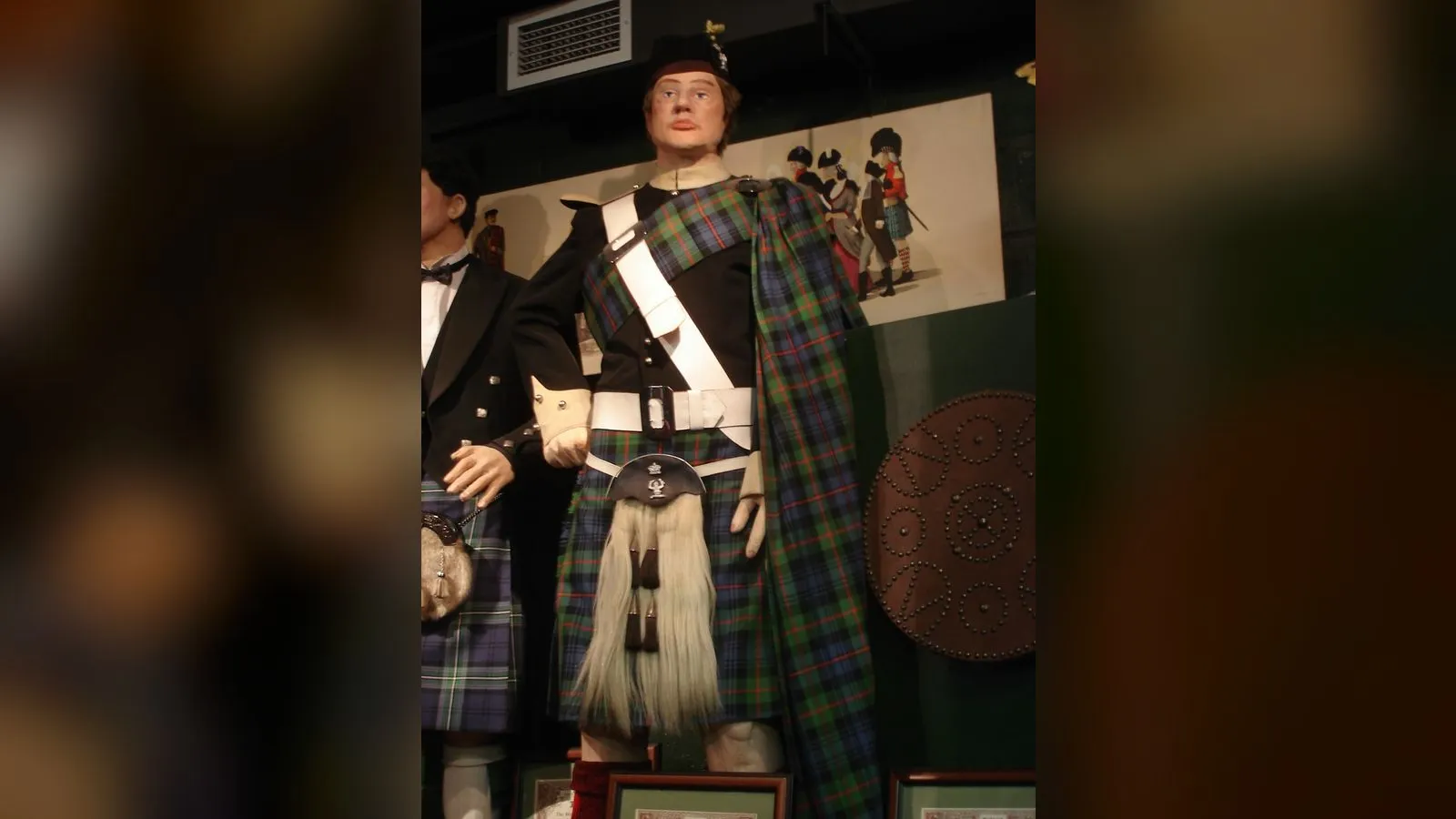

The Atholl Highlanders: Europe's Ceremonial "Private Army"
TL;DR
- The Atholl Highlanders are not a British Army unit and never have been in their modern form — unlike every regiment covered in Cards #5–18 (line infantry, Foot Guards, cavalry, yeomanry, scouts), they are a private ceremonial body maintained personally by the Duke of Atholl at Blair Castle in Highland Perthshire. [Documented]
- Their fame rests on the phrase "Europe's only legal private army." This is best treated as popular/tourism shorthand rather than a strict legal fact: no surviving royal warrant, letters patent or statute has been found; the regiment's "official status" rests on Queen Victoria's presentation of Colours in 1845, and the "only in Europe" superlative is contestable. [Traditional / partly Disputed]
- The modern body dates from 1839, when George Murray, Lord Glenlyon (later 6th Duke of Atholl), re-raised a retinue for the Eglinton Tournament; its defining moment came with Queen Victoria's 1844 stay at Blair Castle and the 1845 presentation of Colours. The name is inherited from the earlier 77th Regiment of Foot (1777–1783), a genuine British Army regiment with no institutional continuity to the present body. [Documented]
- The regiment has no operational military role and has never seen action; it is around 100 strong including its pipe band, recruits by personal invitation of the Duke, carries Victorian-era Lee–Metford rifles, and parades chiefly at its annual inspection and the Atholl Gathering each May. [Documented]
- It wears the Murray of Atholl tartan — the same tartan worn by the Scottish Horse (see Card #17), whose founders were the Atholl/Tullibardine family and whose pipers were substantially drawn from Atholl Highlanders musicians. [Documented]
Key Facts
- Period/dates covered: earlier Atholl family military history (medieval–1746) as background; modern body 1839–present; 77th Foot 1777–1783.
- Key institution: the Dukedom of Atholl / Clan Murray, seat at Blair Castle, Blair Atholl, Perthshire.
- Notable feature: widely described as "Europe's only legal private army"; a purely ceremonial regiment in the private employ of the Duke, not part of the British Armed Forces.
- Current status/legacy: active ceremonial regiment of approximately 100 men including pipes and drums; Colonel-in-Chief is Bruce Murray, 12th Duke of Atholl; a major visitor attraction and the ceremonial opening act of the Atholl Gathering Highland Games.
Scottish Impact Index (SI Score)
- Military Impact
- 2/10
- Enduring Significance
- 8/10
- Strategic Importance
- 2/10
- Military Distinctiveness
- 10/10
- Military Legacy
- 6/10
- Recognition
- 6/10
34/60
Ranked #43 of 43 in Defence
Claim Status
Applying the site's three-tier framework (Documented / Traditional / Legend-Myth) and its "accuracy over patriotism" standard:
- Established (Documented): The 1777 raising of the 77th Foot and its 1783 disbandment; the 1839 re-raising for the Eglinton Tournament; Victoria's 1842 escort and 1844 stay; the 1845 Colours presentation; the regiment's purely ceremonial modern character; its Murray of Atholl tartan; its 20th-century lapse and 1966 revival.
- Shared/Traditional: The framing of the 1844/45 events as a personal royal "grant" of the right to bear arms and "official status in perpetuity." The colours were genuinely presented, but the interpretation that this conferred a standing legal privilege is traditional gloss rather than a documented instrument.
- Disputed / Myth-flagged: The headline claim that the Atholl Highlanders are "Europe's only legal private army." This is a popularised simplification. It requires the exclusion of other armed ceremonial bodies (the Vatican Swiss Guard, the Royal Company of Archers, and — most directly — the Hillsborough Fort Guard, which holds a documented 1660 Royal Charter). The related claim that Victoria "revoked the 1746 Disarming Act for the Duke" is folklore: a monarch could not personally repeal a statute.
Timeline
The Murrays (descended from Freskin) rise in Scotland; the earldom of Atholl passes to the Murrays (1626); Blair Castle becomes the family's Highland seat.
Men of Atholl repeatedly mustered in the Wars of the Three Kingdoms and Jacobite risings. In the 1745 Rising, Lord George Murray commands the Atholl Brigade for the Jacobites; the Siege of Blair Castle (1746) is the last time Blair was besieged.
After Culloden, the Act of Proscription / Disarming Act bars Highland chiefs from maintaining private armed forces (repealed 1782).
John Murray, 4th Duke of Atholl, raises the 77th Regiment of Foot (Atholl Highlanders / Murray's Highlanders) for the American War; it serves mainly in Ireland.
After a mutiny at Portsmouth over being sent to India, the 77th is marched to Berwick and disbanded.
George Murray, Lord Glenlyon (later 6th Duke), re-raises a retinue of Atholl Highlanders as his "Knight of the Gael" bodyguard at the Eglinton Tournament, Ayrshire.
The regiment escorts Queen Victoria on her tour of Perthshire.
Victoria and Prince Albert stay at Blair Castle; the Highlanders mount the guard for the duration.
First stand of Colours presented by Lady Glenlyon on the Queen's behalf — the act popularly held to confer "official status."
Guards mounted for the Crown Prince of Japan (Hirohito) and King Faisal of Iraq at Blair; activity dwindles thereafter.
Iain Murray, 10th Duke, revives the regiment; seven local men parade on 8 April.
New stands of Colours presented.
Atholl Gathering Highland Games revived at Target Park.
On the 10th Duke's death, the 11th Duke (resident in South Africa) commits to continuing the tradition.
Notable parades — Edinburgh Homecoming; Braemar (Colours presented to the Queen); Windsor (90th birthday); WWI war-graves tour of Europe.
Bruce Murray, 12th Duke, is Colonel-in-Chief; the regiment parades each May and remains around 100 strong.
Details
Earlier Atholl military history — background, not continuity
The district of Atholl sits astride strategic Highland passes, and the men of Atholl were mustered for war for centuries under their earls and (from 1703) dukes. Contemporary estimates of clan strength ran into the low thousands: General George Wade's 1724 report and Lord President Duncan Forbes's 1745 estimate placed the Atholl following at hundreds under the chief plus allied tenants (Robertsons and others), with the wider Atholl Brigade said to muster up to about 3,000 men. The most famous fighting formation was the Atholl Brigade, raised for the Jacobite cause in 1745 under Lord George Murray, sixth son of the 1st Duke — a genuine military force that fought at Prestonpans and elsewhere, even as the 2nd Duke stayed loyal to the Hanoverian government. This is real, documented military history, but it belongs to the clan and to the Jacobite army, not to the modern ceremonial regiment. After the 1745 Rising, the Act of Proscription 1746 specifically ended the legal ability of Highland chiefs to keep private armed forces; it was repealed in 1782. The modern Atholl Highlanders are therefore a Victorian revival of an idea, not an unbroken continuation of a feudal levy.
The 77th Foot (1777–1783): the name, not the institution
The name "Atholl Highlanders" originates with the 77th Regiment of Foot, raised in December 1777 by John Murray, 4th Duke of Atholl, as a relief regiment for the American War of Independence. It never reached North America, spending most of its existence garrisoned in Ireland. When its three-year term expired in 1781, the men expected to be discharged; instead they were marched to Portsmouth for embarkation to India. They mutinied, the embarkation was countermanded, and the regiment was marched to Berwick and disbanded in 1783. As Blair Castle's own history and the standard reference works make explicit, the modern regiment "has no connection, except the name, with the 77th Foot of 1777."
1839 and 1844: the modern origins examined precisely
The two dates most often cited represent two distinct stages, and the site's editorial precision requires distinguishing them:
- 1839 — the re-raising. George Murray, then Lord Glenlyon and heir to the 5th Duke, re-formed a body of Atholl Highlanders from his family's tenants to serve as his retinue at the Eglinton Tournament of August 1839, a lavish mock-medieval jousting revival staged by the 13th Earl of Eglinton in Ayrshire. Glenlyon appeared as "The Knight of the Gael" and, according to National Museums Scotland (via The Scotsman), "spent the equivalent of £90,000 equipping himself and his retinue, which included an Elizabethan costume made with velvet Murray of Atholl tartan." This is the true birth of the modern body — created as Romantic-revival pageantry, not as a fighting force.
- 1842 & 1844 — royal service. The regiment escorted Queen Victoria during her 1842 Perthshire tour, and in September 1844 mounted the guard throughout her three-week stay at Blair Castle, her first extended Highland residence and, by common account, the seedbed of her lifelong attachment to Scotland. (The size of the guard is not firmly settled across sources — figures range from about 50 to 200 men.)
- 1845 — the Colours. In recognition of these services, Victoria resolved to present the regiment with Colours; per the Chronicles of the Athole family, "The Ceremony was duly arranged to take place on September 4th, 1845," when "about 4:30 p.m. the general parade of the Athole Highlanders was formed in the Castle Park," the Colours being presented by Lady Glenlyon on the Queen's behalf. This is the act traditionally described as giving the regiment "official status in perpetuity."
The "only legal private army in Europe" claim — a careful mythbust
This is the card's central verification task, and the evidence supports a firmly nuanced treatment.
What actually exists is the presentation of Colours — not a legal instrument. No surviving royal warrant, letters patent, charter or statute granting the Duke of Atholl a private army has been located in the official Atholl Estates account, the Blair Castle archivist's published descriptions, the primary Chronicles of the Atholl and Tullibardine Families, or standard reference works. Every authoritative account traces the regiment's "official status" to the single ceremonial act of 1845. Popular and aggregator sources routinely inflate this into a "royal warrant," but that elaboration is unsupported by any cited document. The verifiable core is: Victoria presented Colours; tradition has interpreted that presentation as conferring a standing right.
The "only in Europe" superlative is contestable. Even cautious reference works hedge — noting only that the regiment "has been described as" the only legal private army in Europe and "claims to be" so. The claim survives only through careful definitional gatekeeping:
- The Vatican's Pontifical Swiss Guard (founded 1506, the world's oldest standing military corps) is excluded as the armed force of a sovereign state rather than a private individual.
- The Royal Company of Archers — the Sovereign's Bodyguard for Scotland since 1822, a private club with a ceremonial armed role — is excluded because it serves the Crown, not a private master.
- Most directly, the Hillsborough Fort Guard in Northern Ireland openly styles itself a private army/militia and rests on a documented Royal Charter: "On the 21st December 1660 under a Royal Charter from Charles II, Hillsborough Fort became a Royal Fort with Arthur Hill becoming Hereditary Constable of the Fort of Hillsborough with command of Twenty Warders" (hillsboroughfortguard.org) — arguably a stronger legal footing than Atholl's. Atholl partisans distinguish "private regiment" from "fort guard/militia," but this is a fine semantic line.
Legality and the Bill of Rights 1689. The Bill of Rights 1689 declares "that the raising or keeping a standing army within the kingdom in time of peace, unless it be with consent of Parliament, is against law" — the same principle that requires Parliament to renew the Armed Forces Act periodically. The Atholl Highlanders do not offend this because they are not a genuine standing army in the prohibited sense: they have no operational role, have never seen action, carry only antique Lee–Metford rifles, and parade about twice a year. Their lawfulness is best understood as ceremonial tolerance rather than statutory authorisation. No published scholarly legal analysis explicitly tests the regiment against the Bill of Rights; this reconciliation is reasoned inference from the statute's wording and the regiment's uniformly ceremonial character, not an adjudicated fact. (One secondary source, the Boot Camp & Military Fitness Institute, even claims that "the regiment is technically part of the British Army, and still carries the Queen's Colours" — a statement inconsistent with the private-army branding and reflecting the genuine ambiguity of its status.)
Organisational structure and modern status
The regiment is in the private employ of the Duke of Atholl, based at Blair Castle, and is not part of the British Armed Forces. Membership is by the Duke's personal invitation; recruits are men with ties to the Atholl Estate or the local area, with officers typically lairds from around Blair Atholl. The current Duke, resident in South Africa, travels to inspect the regiment. Strength is maintained at "approximately 100 men, including pipes and drums" (the standard reference account, which stresses that "this regiment has no connection, except the name, with the 77th Foot of 1777"), and all members must reach a reasonable standard of foot and arms drill. The chain of command in recent years has included the Commanding Officer (the Earl of Kinnoull) and the Marquess of Tullibardine, the Duke's heir, with a Regimental Sergeant Major and Company Sergeant Major. New recruits are admitted from time to time and, on admission, are presented with a sprig of juniper (the clan plant) for the bonnet; awards for long service and marksmanship are also presented at the annual parade.
In practice the regiment parades chiefly at its annual inspection and the Atholl Gathering in late May, with occasional additional outings permitted by the Duke — royal visits, overseas tours, and set-piece national events. Documented modern appearances include the 2009 Homecoming parade in Edinburgh (its first there in nearly 30 years), Braemar in 2011 (where it presented Colours to the Queen), Windsor for the Queen's 90th birthday in 2016, and a WWI war-graves tour of Europe in 2018.
Relationship to genuine military history and to the Scottish Horse (Card #17)
The modern regiment itself has never had an operational role or seen action. Its members, however, have often been men with real service records in British Army regiments, and the wider Atholl family's military record is substantial — most relevantly through the Scottish Horse (Card #17). The Scottish Horse was raised for the Second Boer War by John Stewart-Murray, Marquess of Tullibardine (later 8th Duke of Atholl), with his father the 7th Duke; it wore the Murray of Atholl tartan (pipers wore Murray of Tullibardine), and — as documented in period recordings — its pipers were substantially drawn from, and overlapping with, the Atholl Highlanders' pipe band, whose players "in recent years… belonged to the Scottish Horse." The two bodies are institutionally separate but bound by shared Atholl family patronage, tartan and personnel. (The South African Transvaal Scottish / Solomon Mahlangu Regiment, also founded by Tullibardine, likewise carries the Murray of Atholl tartan and "The Atholl Highlanders" as its regimental march — a further echo of the same family's reach.)
Uniform and traditions
The regiment wears full Highland dress in the Murray of Atholl tartan, with the clan crest (the "Wild Man of Atholl," a demi-savage) as its badge, worn with the sprig of juniper. It carries Lee–Metford rifles — a British service rifle pattern of the late 19th century — for ceremonial drill and firing. Its regimental march is the traditional jig "The Atholl Highlanders." The motto associated with the Murray chiefs and regiment is "Furth Fortune and Fill the Fetters." The pipe band is integral to the regiment's identity and to the ceremonial of the annual parade, which includes the firing of a field gun/cannon.
Cultural and tourism significance today
The Atholl Highlanders are inseparable from Blair Castle as a visitor attraction. Their annual parade on the castle forecourt — followed the next day by the Atholl Gathering Highland Games in the grounds — is one of the first and best-known events of the Highland Games season, drawing thousands. The parade combines inspection, march-past, Colours, pipe music and the presentation of juniper to new recruits, and functions simultaneously as a genuine living tradition and as a carefully staged heritage spectacle. The regiment's "private army" mystique is actively used in the marketing of the castle and estate, which is precisely why the underlying claim deserves the measured, evidence-tiered treatment set out above.
Did You Know?
- The regiment that gives the Atholl Highlanders their name ended in mutiny: the 77th Foot refused embarkation to India in 1781 and was disbanded at Berwick in 1783.
- The modern body was reborn as jousting pageantry — Lord Glenlyon's retinue at the 1839 Eglinton Tournament, where he competed as "The Knight of the Gael" and reportedly spent the equivalent of £90,000 kitting himself and his men out.
- Queen Victoria's 1844 stay at Blair Castle is widely regarded as the beginning of her love affair with the Highlands, which culminated in the purchase of Balmoral.
- The regiment's rifles — Victorian-era Lee–Metford rifles — are older than most museums' working firearms, and are carried purely for ceremony.
- New recruits are welcomed not with a medal but with a sprig of juniper, the Clan Murray plant badge, worn in the bonnet.
- The regiment's badge is the "Wild Man of Atholl," a demi-savage figure from Clan Murray heraldry, also found on the regimental silversmith's sgian dubhs.
- An affiliated but institutionally separate American pipe band, the Atholl Highlanders Pipes & Drums USA (formed 1981, Stone Mountain, Georgia), was granted permission by the 10th Duke to wear Murray of Atholl tartan and — per the standard reference account — "has the distinction of being the first pipe band to play at the Super Bowl, when it appeared at Super Bowl XXXIV."
- The Atholl Highlanders' regimental march, "The Atholl Highlanders," is a centuries-old jig also adopted by the Scottish Horse and the South African Transvaal Scottish.
FAQ
1Are the Atholl Highlanders part of the British Army?
No. Unlike every regiment covered in Cards #5–18, they are not part of the British Armed Forces. They are a private ceremonial regiment in the personal employ of the Duke of Atholl, based at Blair Castle in Perthshire. They report to the Duke rather than to the Crown or the Ministry of Defence, and their members are recruited by the Duke's personal invitation.
2Are they really "Europe's only legal private army"?
That is the famous description, but it is best treated as popular shorthand rather than a strict legal fact. There is no surviving warrant or statute granting a "private army"; the phrase rests on Victoria's 1845 presentation of Colours. The "only in Europe" claim is contestable, most directly by Northern Ireland's Hillsborough Fort Guard, which holds a documented 1660 Royal Charter.
3When were the Atholl Highlanders founded?
The modern body dates from 1839, when Lord Glenlyon re-raised it for the Eglinton Tournament. Its name, however, comes from the 77th Regiment of Foot, raised in 1777 and disbanded in 1783, to which the modern regiment has no institutional continuity beyond the name.
4What did Queen Victoria actually grant them?
She presented the regiment with Colours — the first stand delivered by Lady Glenlyon on 4 September 1845 — in recognition of their service as her guard in 1842 and 1844. Tradition interprets this as conferring "official status in perpetuity" and the right to bear arms, but no legal instrument survives; the act was ceremonial recognition rather than documented statutory privilege.
5Have the Atholl Highlanders ever fought in a war?
No. The modern regiment has never had an operational role and has never seen action. Individual members have often served in the regular British Army, and the wider Atholl family has a substantial military record — notably through the Scottish Horse (Card #17) — but the ceremonial regiment itself is purely for parade and display.
6How do you join the Atholl Highlanders?
Only by personal invitation of the Duke of Atholl. Recruits are typically men with connections to the Atholl Estate or the local Blair Atholl area; officers are usually local lairds. On admission, a new member is presented with a sprig of juniper, the Clan Murray plant badge, to wear in his bonnet.
7How big is the regiment?
Approximately 100 men, including the pipes and drums. It is roughly the size of an army company and is maintained at that strength by admitting new members from time to time.
8What tartan and uniform do they wear?
Full Highland dress in the Murray of Atholl tartan, with the "Wild Man of Atholl" clan-crest badge and a sprig of juniper. They carry Victorian Lee–Metford rifles for ceremonial purposes. The same Murray of Atholl tartan is worn by the Scottish Horse (Card #17), reflecting shared Atholl family patronage.
9What is the connection to the Scottish Horse?
Both bodies are tied to the Atholl/Tullibardine family. The Scottish Horse was founded by the Marquess of Tullibardine (later 8th Duke) and his father the 7th Duke, wore the Murray of Atholl tartan, and drew its pipers substantially from the Atholl Highlanders' pipe band. They are separate institutions linked by family, tartan and personnel — see Card #17 for the Scottish Horse's own story.
10What happens at the annual parade?
Held on the Blair Castle forecourt in late May, the parade features the marching-on of the Colours, inspection of the pipes, drums and Highlanders, a march-past and salute to an inspecting officer, pipe music, the firing of a field gun, and the presentation of juniper to new recruits and of long-service and marksmanship awards. The Atholl Gathering Highland Games follows the next day.
11Who commands the regiment today?
Bruce Murray, 12th Duke of Atholl, is Colonel-in-Chief. Day-to-day command in recent years has rested with the Commanding Officer (the Earl of Kinnoull) and senior officers including the Marquess of Tullibardine, the Duke's heir, with a Regimental Sergeant Major and Company Sergeant Major.
12Why does the Duke of Atholl live in South Africa?
The 11th and 12th Dukes were born and based in South Africa; the title passed through a South African branch of the family after the 10th Duke died without a direct heir in 1996. The Duke travels to Blair Atholl to inspect the regiment, and the castle itself is held by a charitable trust rather than owned personally by the Duke.
Sources
Primary / Institutional
- Atholl Estates / Blair Castle official history of the Atholl Highlanders (atholl-estates.co.uk) and the Atholl Gathering and Atholl Highlanders Parade event pages.
- Royal Collection Trust: Charles Landseer, Blair Castle, with the Highland guard drawn up (1844); Leaves from the Journal of Our Life in the Highlands (Queen Victoria).
- Chronicles of the Atholl and Tullibardine Families (as reproduced by the Clan Murray Society), recording the 4 September 1845 Colours ceremony.
- Blair Castle archive holdings described via the Scottish Records Association (archivist Keren Guthrie).
- Bill of Rights 1689 (legislation.gov.uk; Avalon Project, Yale Law School); UK Parliament / House of Commons Library briefing on the Armed Forces Act.
- Hillsborough Fort Guard (hillsboroughfortguard.org) for the comparative 1660 Royal Charter.
Scholarly / Reference
- Act of Proscription / Disarming Act 1746 and its 1782 repeal (standard reference works and the Scottish Tartans Authority's analysis of the "tartan ban" myth).
- Histories of the Eglinton Tournament of 1839 (National Museums Scotland collections; The Scotsman heritage coverage).
- Accounts of the Jacobite Atholl Brigade and Lord George Murray (standard Jacobite histories).
General Further Reading
- Country Life and quality-press features on the Atholl Highlanders and the Atholl Gathering.
- Clan Murray Society materials on tartans, the "Wild Man of Atholl" badge and regimental history.
- Comparative material on the Royal Company of Archers, the Vatican Swiss Guard and the Hillsborough Fort Guard for context on the "private army" claim.
Honest Caveats
- "Europe's only legal private army." The signature claim is a popularised simplification, not a verified legal fact. No royal warrant, letters patent or statute conferring a "private army" has been found; the regiment's status rests on Victoria's 1845 Colours presentation. The "only in Europe" superlative survives only by excluding the Vatican Swiss Guard and Royal Company of Archers as state/Crown bodies and by drawing a fine line against the Hillsborough Fort Guard, which openly calls itself a private army and holds a documented Royal Charter from Charles II dated 21 December 1660. Present the phrase as heritage branding, appropriately qualified.
- "Victoria revoked the 1746 Disarming Act for the Duke." Folklore, propagated verbatim by sources such as the Scotland Info Guide ("in a bout of sentimentality that she was prone to, she revoked the law of 1746 for the duke, and presented him with Regimental Colours"). A monarch could not personally repeal a statute; the Act of Proscription was repealed by Parliament in 1782, decades before Victoria's visit. No documentation of any personal royal exemption exists.
- Continuity with the 77th Foot. The modern regiment shares only the name with the 1777–1783 77th Regiment of Foot; there is no institutional continuity. Earlier Atholl fighting formations (e.g. the 1745 Atholl Brigade) belong to clan and Jacobite history, not to the ceremonial body.
- "Technically part of the British Army." Some secondary sources (e.g. the Boot Camp & Military Fitness Institute) assert this; it contradicts the regiment's core status as a private body outside the British Armed Forces and should be rejected. The confusion arises from the regiment carrying Colours.
- Fundamentally non-operational. The single most important point of distinction from every other unit in this series (Cards #5–18): the Atholl Highlanders have no operational military function, have never been deployed, and exist for ceremony, heritage and display. They are a genuine historical curiosity — Europe's grandest surviving expression of a Highland chief's private retinue — but they are not, and in their modern form never have been, a fighting force.
Card 019 · Defence