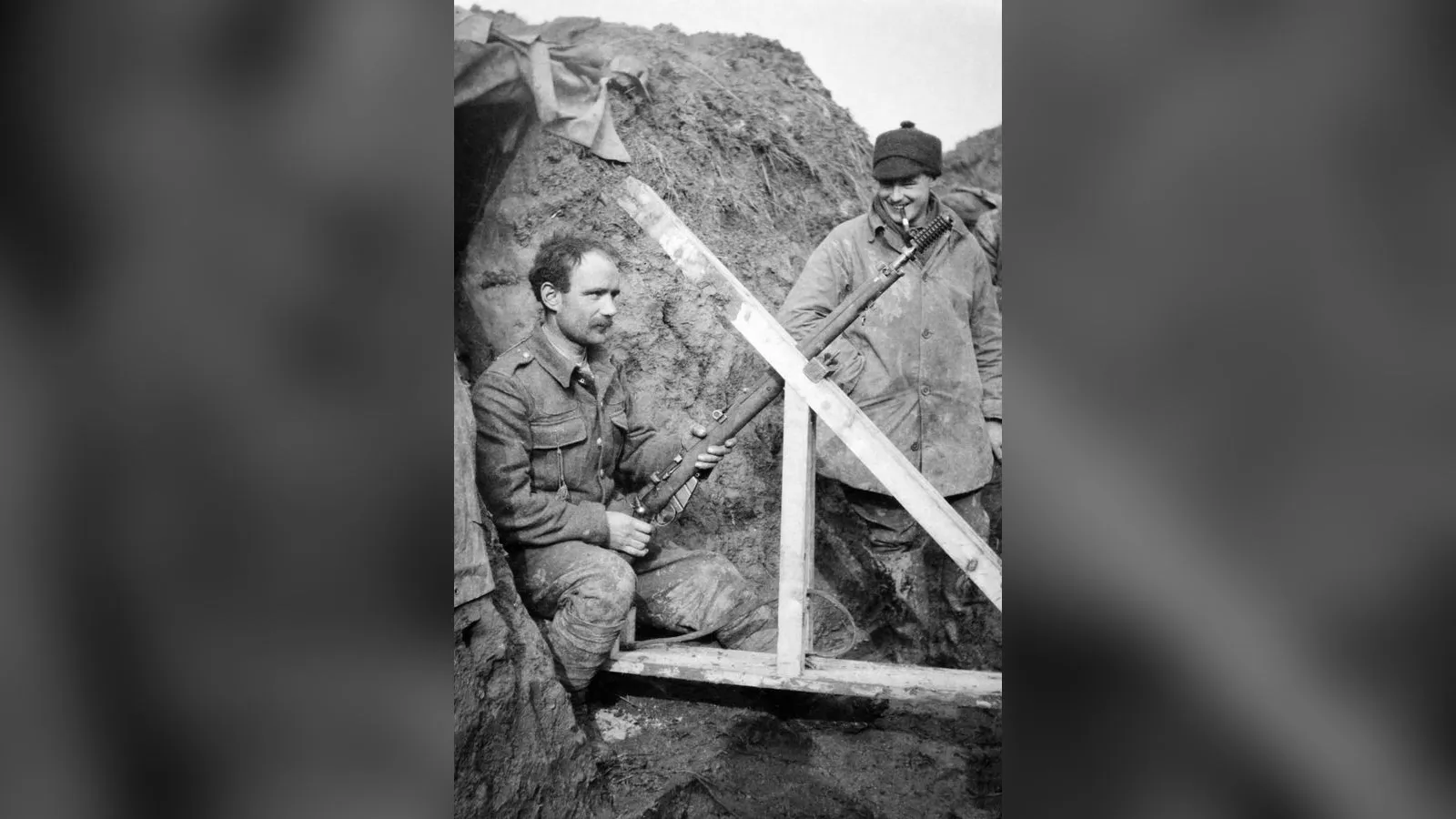

The Cameronians (Scottish Rifles): Covenanter Origins, Rifle-Regiment Status, and a Regiment That Chose to Die Rather Than Merge
TL;DR
- The Cameronians were the only British Army regiment with an explicitly religious origin established: raised on 14 May 1689 near Douglas, Lanarkshire, from radical Covenanter "Society people" who followed the martyred field preacher Richard Cameron. Founding colonel was the 19-year-old James Douglas, Earl of Angus; the field commander was Lieutenant-Colonel William Cleland.
- They were Scotland's only rifle regiment established: the 1881 title "Cameronians (Scottish Rifles)" reflected rifle/light-infantry status — rifle-green uniforms, no Colours, a bugle-horn cap badge, and a fast marching pace — distinct from standard Scottish line-infantry culture.
- The famous "no pipes" idea is a myth [Disputed/oversimplified]: as a rifle regiment they used bugle calls for field signals and carried no Colours, but they nonetheless maintained pipers in Douglas tartan kilts. The accurate distinction is bugles-for-signalling alongside pipers-for-ceremony, not an absence of pipes.
- Their casualties were heavy [Established, with source variation]: over 7,000 dead in the First World War (the regimental roll of honour records 7,106); the regiment raised its two regular battalions plus 25 additional Reserve, Territorial and New Army battalions.
- In 1968 they chose disbandment rather than amalgamation established — one of only two British infantry regiments to do so (with the York and Lancaster Regiment). The 1st Battalion held its final "Conventicle" at Douglas on 14 May 1968, exactly 279 years after its raising. It has no successor regiment.
Key Facts
- Period/dates covered: 1689 (raising of the Earl of Angus's Regiment) to 1968 (disbandment); antecedent 26th (Cameronian) Regiment of Foot 1689–1881; 90th Perthshire Light Infantry raised 1794.
- Key institution: The Cameronians (Scottish Rifles), formed 1 July 1881 under the Childers Reforms; regimental home Hamilton, Lanarkshire.
- Notable feature: The only British regiment of explicitly religious (radical Covenanter Presbyterian) origin, and the only Scottish rifle regiment.
- Current status/legacy: Disbanded 14 May 1968 with no successor. Collection preserved in the Cameronians (Scottish Rifles) gallery, Low Parks Museum, Hamilton; Kelvingrove memorial, Glasgow; founding/disbandment monument at Douglas.
Scottish Impact Index (SI Score)
- Military Impact
- 6/10
- Enduring Significance
- 8/10
- Strategic Importance
- 6/10
- Military Distinctiveness
- 7/10
- Military Legacy
- 7/10
- Recognition
- 5/10
39/60
Ranked =38th of 43 in Defence
Claim Status
The core facts of this card are established: the 1689 raising date and place, the founding personnel (Angus and Cleland), the 1751 numbering as the 26th Foot, the 1881 amalgamation and rifle designation, the war service, and the 1968 disbandment are all documented by the National Army Museum, Imperial War Museums, Hansard, and the regimental record.
The following are Shared/Traditional and are presented as such: the "1,200 men in a single day, without beat of drum" recruiting story (a traditional figure of varying value across sources); the precise numbers at Dunkeld; and the emotive framing of the disbandment ceremony.
Two claims are Disputed / require correction: (1) the popular "no pipes" tradition, which is an oversimplification — the regiment had pipers; and (2) the rumour that the regiment was disbanded as punishment for the 1962 "Poison Dwarfs" affair in Minden, which the regimental record and a written retraction by the author who repeated it show to be false.
Consistent with this site's "accuracy over patriotism" standard, the radical Covenanter movement from which the regiment took its name is presented honestly as a genuinely extreme, uncompromising religious-political faction, some of whose broader associates were involved in political violence — not romanticised.
Timeline
Archbishop James Sharp of St Andrews murdered by nine Covenanters at Magus Muir, Fife — an act of the radical Covenanter milieu.
Battle of Drumclog; Covenanters (William Cleland among them) defeat government dragoons.
Richard Cameron and armed followers issue the Sanquhar Declaration, effectively declaring war on Charles II.
Cameron killed by government dragoons at Airds Moss, Ayrshire.
Cameron's followers organise into "Societies" ("Society people"), refusing the Restoration church settlement.
A "Cameronian Guard" raised to protect the Convention of Estates in Edinburgh; then dismissed.
The Earl of Angus's Regiment raised near Douglas from Cameronians; William Cleland as lieutenant-colonel.
Battle of Dunkeld — the regiment holds the town against a much larger Jacobite force; Cleland killed.
The civilian Cameronian Societies form the Reformed Presbytery, forerunner of the Reformed Presbyterian Church.
Ranked as the 26th (Cameronian) Regiment of Foot.
90th Perthshire Volunteers (Light Infantry) raised by Thomas Graham of Balgowan.
Childers Reforms merge the 26th and 90th into The Cameronians (Scottish Rifles); designated a rifle regiment.
2nd Battalion suffers heavily at Spion Kop, Second Boer War.
Two regular battalions plus 25 additional battalions raised; over 7,000 dead.
Battalions serve at Dunkirk, Sicily, Italy, North-West Europe, and Burma (with the Chindits).
Defence Secretary Denis Healey announces the 1st Battalion will be reduced.
Final Conventicle and disbandment at Douglas, 279 years to the day after the raising.
Details
Covenanter origins and Richard Cameron — honestly told
The Cameronians took their name from Richard Cameron (c. 1648–1680), a Fife schoolmaster turned militant field preacher. Building on the general Covenanting movement already covered in Card #1, Cameron represented its most uncompromising wing. In exile in the Netherlands after the Covenanter defeat at Bothwell Bridge (1679), he returned and, on 22 June 1680, rode into Sanquhar with a small band of armed men and issued the Sanquhar Declaration — a document that renounced allegiance to Charles II and effectively declared war on the Crown. A price was placed on his head, and on 22 July 1680 he was tracked down and killed by government dragoons at Airds Moss in Ayrshire. His severed head and hands were reportedly taken to Edinburgh.
Cameron's followers — variously called "Society people," "Sanquharians," "Hillmen," or "Cameronians" — organised into local "Societies" across south-west Scotland and refused to accept the post-Restoration religious settlement. This card presents that movement honestly: it was a genuinely extreme, absolutist religious-political faction that rejected any compromise with an "uncovenanted" state and repudiated civil oaths. The wider Covenanting milieu of these years also produced acts of political violence, most notoriously the assassination of Archbishop James Sharp of St Andrews at Magus Muir on 3 May 1679 by nine Covenanters led by John Balfour of Kinloch and David Hackston — men whose networks overlapped with Cameron's circle. Genuine religious conviction and real persecution ("the Killing Time") coexisted with sectarian extremism and, at the movement's fringe, murder. Both truths belong in the record.
The regiment's founding and its unusual conditions
By 1689 the political situation had transformed. The Catholic James VII/II had been replaced by William of Orange, and the Convention of Estates needed loyal troops against Jacobite resistance in the Highlands. A short-lived "Cameronian Guard" was raised in March 1689 to protect the Convention in Edinburgh, then dismissed. On 14 May 1689, near Douglas on the banks of the Douglas Water, a full regiment was raised from the Cameronians under the colonelcy of the 19-year-old James Douglas, Earl of Angus, son of the Marquess of Douglas. The field command fell to Lieutenant-Colonel William Cleland, a 27-year-old veteran of the Covenanter victory at Drumclog and an accomplished poet.
The regiment's religious character produced genuinely unusual founding conditions. Traditional accounts (repeated by the National Army Museum) hold that the regiment was raised very rapidly from committed volunteers "without beat of drum" — that is, without conventional active recruiting or bounty money. Figures given for its initial strength vary between traditional accounts; a commonly cited nominal strength is 1,200 men in twenty companies of sixty. The National Army Museum confirms the genuinely documented distinctive terms: each company was to have a Presbyterian elder, and the regimental chaplain was himself a Cameronian. A Bible was issued to every recruit — a custom the regiment maintained until 1968. Some romanticised versions add that the men enlisted only on condition of guaranteed freedom of worship; the substantiated core is the elder-per-company rule and the Cameronian chaplaincy.
The armed church parade was the most striking survival of these origins. Recalling the days when Covenanters posted armed lookouts at illegal open-air conventicles, the Cameronians attended church under arms and posted sentries at the corners of the building; by tradition the service did not begin until an officer reported to the minister that "the pickets are posted and there is no enemy in sight." The regiment is commonly described as the only unit in the British Army permitted to attend church armed.
Within three months of its raising the regiment fought its first and defining action. On 21 August 1689 at the Battle of Dunkeld, the inexperienced Cameronians — roughly 1,200 men — held the town against a much larger Jacobite Highland force in the aftermath of the Jacobite victory at Killiecrankie. According to the National Trust for Scotland, the government troops "numbered around 1,200" and were "attacked in the early hours of 21 August by 5,000 Jacobite clansmen." Fighting from the cathedral and Dunkeld House, and reportedly stripping lead from roofs for ammunition, they broke the Highland assault. Cleland was killed in the first hour of the battle and is buried in Dunkeld Cathedral. On the losses, the National Trust for Scotland records that "the Cameronians emerged victorious, with 300 Jacobite casualties compared to 45 Cameronians, including Lieutenant Colonel Cleland, who is buried at the cathedral." Dunkeld effectively ended the first Jacobite rising in the field.
The Cameronian movement beyond the regiment
established The regiment and the religious movement went separate ways after 1689. Many Society people refused to join the restored Church of Scotland, which they regarded as insufficiently covenanted, and kept their own field meetings. In 1743 they formed the Reformed Presbytery, which grew into the Reformed Presbyterian Church. The regiment, by contrast, served the Crown and the established church settlement.
shared The historian David Hackett Fischer, in Albion's Seed (1989), gives an outsider's account of the movement. He describes the Cameronians as strong in the south and west of Scotland, notorious for "rabbling", the forcible ejection of unacceptable clergy from their parishes, and hunted by the authorities through the 1680s. He presents the raising of the regiment as a "typically North British solution": recruiting Protestant rebels to fight Catholic Jacobites. His summary of Dunkeld agrees with the figures above, about 1,200 men against some 5,000, and adds that the Cameronians "burnt many in their fortifications", a reference to the houses the Highlanders occupied being set on fire. Fischer's source for the regiment is a general history of Scottish regimental uniforms, and his phrase that the authorities "conceded defeat" in 1689 oversimplifies a change of government brought about by the Revolution, not by the Cameronians.
shared Fischer also says that many followers of the Reformed Presbytery "found their way to the American backcountry" with other Scottish and Ulster Presbyterians, as part of the eighteenth-century emigration from the Lowlands, Ulster and northern England. Reformed Presbyterian ("Covenanter") congregations did take root in Pennsylvania and the Carolinas, but Fischer gives no figures, and his wider argument that this militant faith shaped backcountry culture is contested by other historians.
Rifle-regiment status and distinct traditions
The modern regiment was created on 1 July 1881 under the Childers Reforms, merging the 26th (Cameronian) Regiment of Foot with the 90th Regiment of Foot (Perthshire Volunteers) (Light Infantry). The 26th became the 1st Battalion, the 90th the 2nd. Crucially, the new regiment was designated a rifle regiment — the only one among the Scottish infantry — and this shaped its whole culture. As the senior single-battalion Scottish regiment with a strong reputation for marksmanship, joined to a regiment with a long light-infantry tradition, it was a natural choice for the new "Scottish Rifles" role.
Rifle-regiment status carried specific, documented distinctions inherited from the skirmishing and marksmanship units of the Napoleonic era. Rifle regiments wore rifle green rather than scarlet (an early form of camouflage); carried no Colours, since skirmishers operating in open order had no need of a battlefield rally-point; used the bugle-horn rather than the drum to pass signals in the field; and marched at a faster pace than line infantry (rifle and light-infantry regiments are associated with 140 paces per minute against the line's 120, and Highland regiments' slower pace). The Cameronians' cap badge captured this precisely: the Douglas mullet (star) set upon a stringed bugle-horn within a wreath of thistles — the star for the founding Earl of Angus's family, the bugle-horn for light-infantry/rifle status. The regiment was also one of only two in Britain to retain the shako as full-dress headwear after 1878, and wore Douglas tartan trews.
The "no pipes" tradition — corrected
This card treats the widely repeated "no pipes" claim as an oversimplification bordering on myth. The accurate, documented position — confirmed by the National Army Museum, Imperial War Museums badge records, and the regimental association — is twofold. First, as a rifle regiment the Cameronians genuinely used the bugle (not the drum) for field signalling and routine calls, and they carried no Colours; the bugle-horn was their badge and a "Bugle-Major" appointment existed. Second, and contrary to the myth, the regiment did maintain pipers — indeed it is often described as the only Lowland (non-Highland) Scottish regiment to employ pipers, who wore the Douglas tartan kilt (while the rest of the regiment wore trews). An official "Pipe Major and Pipers" sporran badge was approved as late as January 1966, and a substantial body of Cameronian pipe music survives. The distinctive Douglas tartan of their pipers is still worn by the pipers of the Royal Gurkha Rifles. So the correct formulation is: bugles for signalling and rifle-regiment ceremony, pipers for regimental and ceremonial music — not an absence of pipes. The "no pipes" shorthand conflates the rifle-regiment bugle culture with a false belief that a rifle or Lowland regiment could not have pipers at all.
Major European and imperial campaigns
Across the eighteenth and nineteenth centuries the 26th and 90th between them compiled a long campaign record. The 26th fought in the Nine Years' War and the War of the Spanish Succession, earning honours at Blenheim, Ramillies, Oudenarde and Malplaquet under Marlborough; it served in the American War of Independence, the French Revolutionary and Napoleonic Wars, the First Opium War in China, and the British expedition to Abyssinia. The 90th earned distinction in the Peninsular War (its founder, Thomas Graham, becoming Lord Lynedoch), the Crimean War, the Indian Mutiny, and the Second Boer War. These campaigns are presented honestly as including imperial and colonial service — the Opium War in China, the Abyssinian expedition, and colonial policing in South Africa and India were instruments of British imperial power, not solely defensive wars.
In the Second Boer War (1899–1902) the 2nd Battalion suffered severely at the Battle of Spion Kop in January 1900 and took part in the relief of Ladysmith; the names of its dead are recorded on the Spion Kop memorial.
First World War
The Cameronians were heavily engaged from the outset. Both regular battalions were on the Western Front by 1914, and the regiment ultimately raised a large number of battalions — the figure of 27 battalions is cited by the regimental record and Trevor Royle's history, while the National Army Museum counts the two regular battalions plus "25 additional Reserve, Territorial and New Army battalions [that] saw service in France and Flanders, Gallipoli, Egypt, Salonika." They fought at Mons, Le Cateau, the Marne, Neuve Chapelle, Loos, the Somme, Arras, Ypres/Passchendaele and in the final advances of 1918, as well as at Gallipoli, in Egypt and Palestine, and at Salonika.
Casualty figures should be handled with the usual caution about how such totals are compiled (dead only, or dead plus wounded; regiment of death versus regiment of enlistment). The most authoritative single figure is from the regimental roll of honour: the Cameronians Museum records that "7106 Cameronian soldiers who died are commemorated on the regiment's First World War roll of honour, and it has been estimated that at least a further 10,000 Cameronians had been wounded"; the same source notes the regiment was "awarded a total of 55 battle honours." The National Army Museum rounds the dead to "over 7,000." Three men of the regiment were awarded the Victoria Cross during the war. A frequently repeated regimental point of pride is that the 1st Battalion declined to take part in the 1914 Christmas truce; the war diary is silent on any truce, and Captain James Jack's private diary confirms his battalion did not fraternise — so this is well grounded, though it should not be inflated into a regiment-wide stance.
Second World War
In 1939–45 the battalions served across multiple theatres. The 2nd Battalion deployed to France with the BEF in 1939, was evacuated at Dunkirk in 1940, then fought in the invasion of Sicily (1943), the Italian campaign (including the Moro River and Anzio), and finally North-West Europe in 1945. The 6th and 7th (Territorial) Battalions served with the 52nd (Lowland) Division, providing cover during the 1940 withdrawal and later fighting in North-West Europe from late 1944, including the liberation of Walcheren. The 9th Battalion landed in Normandy with the 15th (Scottish) Division. The 1st Battalion, in India at the outbreak of war, deployed to Burma in 1942, took part in the long fighting retreat (reduced at one point to 14 officers and 120 other ranks), and later served behind Japanese lines with the Chindits in 1944. Second World War battle honours span Ypres-Comines Canal, Odon, Caen, Scheldt, Walcheren Causeway, the Rhineland and Rhine, Sicily, the Garigliano and Anzio, and Pegu, Yenagyaung and the Chindits in Burma.
The 1968 disbandment — examined in full
After 1945 the regiment served in Palestine, garrisoned Trieste and Hong Kong, fought in the Malayan Emergency (1950–53), served repeated tours in West Germany with BAOR, and undertook its final overseas posting in the Aden Emergency in 1966. In 1948, like every line infantry regiment, it was reduced to a single regular battalion (the 1st placed in suspended animation, the 2nd renamed 1st).
The reductions of the 1967 Defence White Paper, driven by Britain's withdrawal from east of Suez and fiscal pressure, required the Lowland Brigade to lose one battalion. On 18 July 1967 Defence Secretary Denis Healey announced that this would be the 1st Battalion, The Cameronians (Scottish Rifles) — the junior regiment in the brigade, selected on a "last in, first out" principle. Faced with the choice between amalgamation and disbandment, the regiment chose to disband. The regimental record is precise about why: the commanding officer took soundings down to the rank of corporal, and "the overwhelming view at all levels was that disbandment was preferable to amalgamation." The reasoning was pragmatic rather than sentimental — it was felt that no other regiment would agree to be converted into a rifle regiment, and the Cameronians would never surrender their rifle status or their original name and Covenanter identity. This made them one of only two British infantry regiments to choose disbandment over amalgamation in this era; the other was the York and Lancaster Regiment.
The disbandment ceremony was deliberately freighted with the regiment's origins. On 14 May 1968 — 279 years to the day after the raising — the 1st Battalion paraded at the holm at Douglas, near the spot where the regiment was raised, in the presence of the Duke of Hamilton (Earl of Angus). The final act took the form of a Conventicle: an open-air religious service echoing the illegal field-worship of the Covenanters, complete with the traditional posting of pickets, after which the regimental flag was lowered for the last time. The men marched at the rifle-regiment pace to the regimental quick march. Contemporary and later accounts describe an emotionally overwhelming occasion. A stone memorial erected by Lanarkshire County Council records that "within a mile of the spot where the 26th Cameronian Regiment was raised by the Earl of Angus on the 14th May 1689, the 1st Bn. Cameronians (Scottish Rifles) held a Conventicle and lowered the regimental flag to mark its disbandment on orders of the Government."
Two points require careful handling. First, on the emotive framing: descriptions of universal weeping and a semi-mystical sense that "the Cameronians remain ready to rise again" come largely from memoir and forum testimony and should be read as authentic sentiment rather than documented fact. Second, and more importantly, a persistent rumour holds that the regiment was singled out for disbandment as punishment for the 1962 "Poison Dwarfs" affair — a bar brawl involving Cameronian soldiers in Minden, West Germany, that received sensational British press coverage. This is false. The rumour surfaced publicly via Brigadier Allan Mallinson's review of Trevor Royle's regimental history in the Times Literary Supplement (April 2010); the regimental association records that it "caused considerable surprise that it should surface, apparently from nowhere, 40 years after the event" and that it "had not occurred to any of the officers who were serving with the regiment at the time." The regimental history sets out that selection followed the mechanical "last in, first out" rule applied across every brigade, that the battalion's subsequent record (prestigious public duties in Edinburgh, guarding Balmoral, a well-regarded Aden tour) was excellent, and that the future Sultan Qaboos of Oman was posted to the regiment shortly after the Minden episode — implausible had it been in disgrace. The explorer Sir Ranulph Fiennes, who had repeated the punishment story in print, later wrote a full retraction, apologising that "the stories had no basis in fact."
Unusually, disbandment was not quite total in one narrow sense: Territorial elements carried the Cameronian name onward, and the last Cameronian company in the Territorial Army survived until being rebadged in the 1990s. But as a regular fighting regiment the Cameronians ceased to exist in 1968. Their recruiting area passed to the King's Own Scottish Borderers, and the Regimental Headquarters finally closed in 1987. Unlike the other regiments in this Defence series — the Royal Scots, Royal Scots Fusiliers and King's Own Scottish Borderers, all of which eventually fed into the Royal Regiment of Scotland in 2006 — the Cameronians have no successor regiment in today's British Army. This is the card's defining endpoint: an institution that chose extinction over merger, and got it.
Did You Know?
- A regiment raised without a recruiting drive. Traditional accounts say the regiment was raised in a single day "without beat of drum" — that is, without the usual active recruiting or bounty payments — because the Cameronian Societies already stood ready to serve.
- They went to church armed — legally. The Cameronians are commonly described as the only unit in the British Army permitted to attend divine service under arms, with sentries posted at the corners of the church and the service delayed until "the pickets are posted and there is no enemy in sight."
- A Bible for every recruit. From 1689 until disbandment in 1968, each new soldier was issued a Bible in memory of Richard Cameron.
- No Colours, ever. As a rifle regiment the Cameronians carried no Colours; their battle honours were displayed on the cap badge and appointments instead.
- The name outlived the regiment's founders in two forms. While the regiment served the Crown, the civilian Cameronians organised their own church, the Reformed Presbytery, in 1743.
- A Swedish king as Colonel-in-Chief. From his appointment on 10 August 1956 until 1968, the regiment's Colonel-in-Chief was King Gustaf VI Adolf of Sweden.
- A future Sultan in the ranks. Qaboos bin Said, later Sultan of Oman (r. 1970–2020), served as a junior officer in the Cameronians.
- A dog with a medal. Rifleman Khan — German Shepherd "War Dog 147" of the 6th Battalion, handled by L/Cpl Jimmy Muldoon of Strathaven — was awarded the Dickin Medal on 27 March 1945, the PDSA citation reading: "For rescuing L/Cpl. Muldoon from drowning under heavy shell fire at the assault of Walcheren, November 1944, while serving with the 6th Cameronians (SR)."
- Seven Victoria Crosses in one museum. Low Parks Museum in Hamilton holds over 1,000 of the regiment's medals, including seven Victoria Crosses and the "Bluidy Banner" carried by Covenanters at Bothwell Bridge in 1679.
FAQ
1When and where were the Cameronians founded?
The regiment was raised on 14 May 1689 near Douglas, on the Douglas Water in Lanarkshire, as the Earl of Angus's Regiment. Its recruits were radical Covenanters — followers of the preacher Richard Cameron — and its field commander was Lieutenant-Colonel William Cleland. It became popularly known as "The Cameronians" and was ranked the 26th Regiment of Foot in 1751.
2Why were they called Cameronians?
They were named after Richard Cameron (c. 1648–1680), a militant Covenanter field preacher killed by government dragoons at Airds Moss in 1680. His followers — the "Society people" or "Cameronians" — supplied the regiment's original recruits, so the regiment carried his name.
3Were the Cameronians religious extremists?
The movement they came from was genuinely uncompromising. The Cameronian Societies refused any accommodation with the post-Restoration church and repudiated allegiance to an "uncovenanted" state. The broader Covenanting fringe included acts of violence such as the 1679 murder of Archbishop James Sharp. The 1689 regiment, however, was a disciplined military unit serving the new Williamite government, not a terrorist band.
4What happened to the civilian Cameronians?
Many refused to rejoin the Church of Scotland after 1690 and in 1743 formed the Reformed Presbytery, later the Reformed Presbyterian Church. Some emigrated to North America in the eighteenth century, where Reformed Presbyterian congregations were established.
5What made them a "rifle regiment"?
From the 1881 amalgamation the Cameronians (Scottish Rifles) were the only Scottish rifle regiment. Rifle regiments wore rifle green, carried no Colours, used bugle-horns rather than drums for signals, and marched at a faster pace — traditions inherited from Napoleonic-era skirmishers and marksmen. Their cap badge showed a bugle-horn with the Douglas star.
6Did the Cameronians really have "no pipes"?
No — this is a myth. As a rifle regiment they used bugles for field signalling and carried no Colours, but they still maintained pipers, who wore the Douglas tartan kilt. They are often called the only Lowland regiment to employ pipers. The accurate distinction is bugles-for-signalling alongside pipers-for-ceremony, not an absence of bagpipes.
7What was the Battle of Dunkeld?
On 21 August 1689, just three months after being raised, the Cameronians (around 1,200 men) held the town of Dunkeld against a far larger Jacobite Highland force after the Jacobite victory at Killiecrankie. They broke the assault but lost their commander, William Cleland. The action effectively ended the first Jacobite rising in the field.
8How many battalions and casualties in the First World War?
The regiment raised as many as 27 battalions during 1914–18 (two regular plus 25 additional). Its roll of honour records 7,106 men who died (the National Army Museum says "over 7,000"), with the regimental museum estimating at least a further 10,000 wounded, and the regiment earning 55 battle honours. Three Victoria Crosses were awarded.
9Where did they fight in the Second World War?
Cameronian battalions served at Dunkirk (1940), in the invasion of Sicily and the Italian campaign (including Anzio), in North-West Europe from 1944 (including Walcheren), and in Burma, where the 1st Battalion fought with the Chindits behind Japanese lines in 1944.
10Why were the Cameronians disbanded in 1968?
The 1967 Defence White Paper required the Lowland Brigade to lose its junior regiment, and the Cameronians were selected on a "last in, first out" basis. Offered amalgamation or disbandment, the regiment overwhelmingly chose disbandment, believing no other regiment would adopt rifle status and that they would not give up their identity.
11Was the disbandment a punishment for the "Poison Dwarfs" scandal?
No. This persistent rumour — linking disbandment to a 1962 bar brawl in Minden — is false. It surfaced only in 2010 via a Times Literary Supplement review. Selection followed the standard "last in, first out" rule, and the battalion's later record was excellent. Sir Ranulph Fiennes, who repeated the story in print, later issued a full written retraction.
12What was the final Conventicle?
On 14 May 1968, exactly 279 years after its raising, the 1st Battalion paraded at Douglas and held a final Conventicle — an open-air service echoing the Covenanters' illegal field-worship, with pickets posted — before lowering the regimental flag for the last time. It is one of the most poignant regimental endings in British Army history.
13Do the Cameronians still exist in any form?
Not as a regiment. Territorial companies carried the name into the 1990s, and an association still gathers for the annual Conventicle at Douglas, but there is no successor regular regiment. Unlike other Scottish regiments, the Cameronians did not feed into the Royal Regiment of Scotland (2006). Their collection is preserved at Low Parks Museum, Hamilton.
Sources
Primary / Institutional
- National Army Museum — "The Cameronians (Scottish Rifles)" and "26th (The Cameronians) Regiment of Foot" regimental histories and object collection (cap badges, uniforms).
- Imperial War Museums — Cameronians disbandment memorial record (Douglas); badge object records; "Lives of the First World War."
- Hansard, UK Parliament — House of Commons debates of 18 July 1967 and 15 July 1968 on the reduction of the 1st Battalion.
- The Cameronians (Scottish Rifles) Regimental Museum, Low Parks Museum, Hamilton (South Lanarkshire Leisure and Culture); cameronians.org regimental association.
- National Trust for Scotland — Battle of Dunkeld (Killiecrankie/Dunkeld interpretation).
- The disbandment order of service / "Form of Parade," 14 May 1968.
Scholarly
- Trevor Royle, The Cameronians: A Concise History (Mainstream, 2009).
- John Baynes, The History of the Cameronians (Scottish Rifles), Vol. IV.
- Historic Environment Scotland, Inventory of Historic Battlefields — Battle of Dunkeld.
- David Hackett Fischer, Albion's Seed: Four British Folkways in America (Oxford University Press, 1989).
- Peer-reviewed and reference scholarship on Richard Cameron and the Covenanters (Oxford Companion to British History; Encyclopaedia Britannica).
General further reading
- Undiscovered Scotland and the Gazetteer for Scotland — biographies of Richard Cameron.
- The Long, Long Trail — Cameronians (Scottish Rifles) order of battle 1914–18 and the 1914 Christmas truce.
- Reformation Scotland — Richard Cameron's sermons and the Covenanting context.
Honest Caveats
- The "no pipes" myth. The regiment did have pipers (in Douglas tartan kilts). Its rifle-regiment distinctiveness lay in using bugles for signals and carrying no Colours, not in banning bagpipes. Present the tradition as bugles-plus-pipers, not "no pipes."
- Founding embellishments. The "1,200 men in a single day without beat of drum" recruiting story is traditional and its figures vary; the reliably documented distinctive conditions are the elder per company, the Cameronian chaplain, and the Bible issued to each recruit. Claims that men enlisted only on explicit written guarantees of religious freedom are romanticised beyond what the record supports.
- Romanticising the Covenanters. Genuine conviction and real persecution must be balanced against the movement's extremism and its association with political violence (the murder of Archbishop Sharp, 1679). The regiment served the government of 1689; it was not itself a party to that violence.
- The regiment and the church are different things. Do not merge the 1689 regiment with the Reformed Presbytery of 1743, whose members largely stood apart from the established church the regiment served. Fischer's claim that Cameronian militancy shaped the American backcountry is his interpretation, not settled history.
- Disputed casualty figures. The 7,106 figure is the regimental roll-of-honour count of the dead; "over 7,000" is the National Army Museum's rounding. Wounded totals (~10,000+) are estimates. Treat any single number with care about what it counts.
- The "Poison Dwarfs" disbandment rumour. False. Disbandment followed the standard "last in, first out" rule, not disciplinary punishment; the author who popularised the punishment story retracted it.
- Unique status, correctly stated. The Cameronians were one of only two British infantry regiments (with the York and Lancaster Regiment) to choose disbandment over amalgamation in this era, and — crucially for this series — the only one of the Scottish regiments covered here to do so. They have no successor and, unlike Cards #5–7, do not hand off to Card #23 (Royal Regiment of Scotland).
Card 008 · Defence