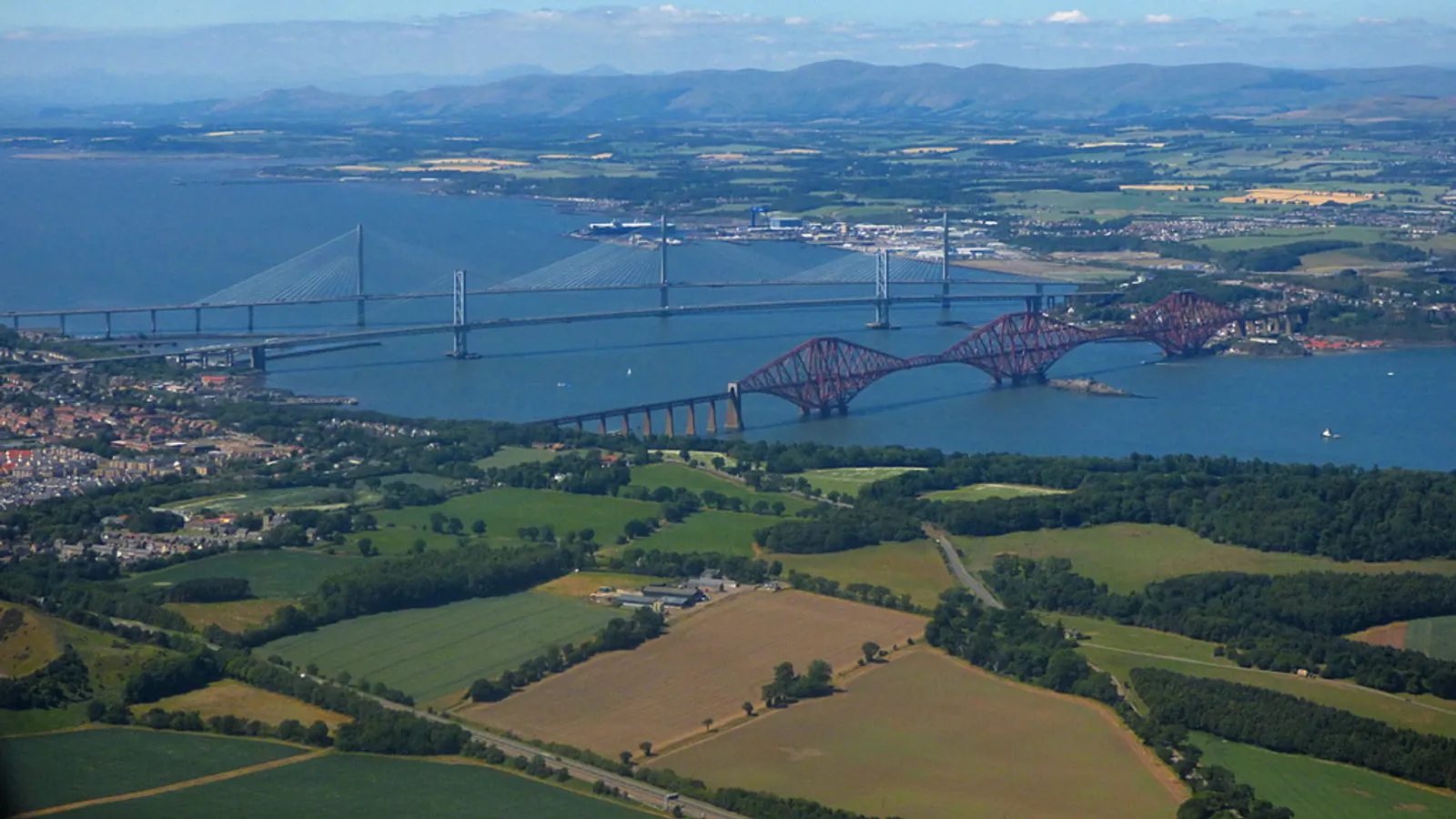

The Firth of Forth Defences: Guarding Scotland's East-Coast Naval Gateway
TL;DR
- The Firth of Forth was fortified from 1878 into the 1950s as a purpose-built coastal-artillery and naval-defence system — nicknamed the "Forth Fortress" — protecting the naval dockyard at Rosyth, the Forth Bridge and the anchorage sheltering the fleet; this card is the dedicated treatment of that infrastructure, distinct from Card #25's broader WWII overview and Card #30's west-coast Loch Ewe. established
- Its defences were organised in three lines across the estuary — Outer (Inchkeith/Kinghorn/Leith), Middle (Braefoot/Inchcolm/Inchmickery/Cramond) and Inner (near the Forth Bridge: Inchgarvie, Carlingnose, Dalmeny, Downing Point, Hound Point) — each backed by anti-submarine and anti-boat booms. established
- On 16 October 1939 the Forth was the target of the first Luftwaffe air raid on Britain of the Second World War (the "Battle of the River Forth"/"Forth Bridge Raid"), when Ju 88s attacked warships near the bridge; RAF Auxiliary Spitfires shot down two aircraft — the first German aircraft brought down over Britain in the war. [Established, but widely muddled — see mythbusting]
- The genuine operational success of the Forth defences lay less in their guns (which never destroyed an enemy warship) than in the boom, net, minefield and detection systems: no submarine ever penetrated the inner Forth. [Established/Scholarly assessment]
- Rosyth remains a working naval-industrial site today (now Babcock-operated, having assembled the Queen Elizabeth-class carriers and now building Type 31 frigates), while many battery remains survive — most accessibly at Inchcolm, Cramond Island and Downing Point. established
Key Facts
- Period/dates covered: 1878 (first modern forts on Inchkeith and Kinghorn) through both World Wars to the final decommissioning of coast artillery in 1956; Rosyth continues as a naval-industrial site to the present (2026).
- Key institution/theme: The "Forth Fortress" — a layered coastal-artillery, boom/net and anti-aircraft system defending Rosyth Dockyard, the Forth Bridge and Edinburgh/the central belt.
- Notable feature: Fortified estuary islands (Inchkeith, Inchcolm, Inchmickery, Inchgarvie, Cramond) with interlocking gun batteries, plus the surviving anti-boat concrete-pylon barrier at Cramond Island.
- Current status/legacy: Battery remains survive across the islands and shores; Inchcolm (Historic Environment Scotland) is open to visitors; Rosyth is an active Babcock shipyard. Most island batteries are scheduled monuments.
Scottish Impact Index (SI Score)
- Military Impact
- 8/10
- Enduring Significance
- 9/10
- Strategic Importance
- 10/10
- Military Distinctiveness
- 8/10
- Military Legacy
- 9/10
- Recognition
- 7/10
51/60
Ranked =19th of 43 in Defence
Claim Status
The core narrative of this card is established and unusually well-documented, resting on War Office and Admiralty archives, Historic Environment Scotland/Canmore records, and the definitive peer-reviewed study by Gordon J. Barclay and Ron Morris, The Fortification of the Firth of Forth 1880–1977: "The most powerful naval fortress in the British Empire" (Edinburgh: Society of Antiquaries of Scotland; first published 2019, open-access e-book 2022; ISBN 9781908332264; DOI 10.9750/9781908332264). The facts of the 16 October 1939 raid — date, targets, ships damaged, casualties, and the downing of two aircraft — are established. What is frequently Disputed or muddled in popular retellings is the precise meaning of the various "firsts" attached to that raid, and the popular framing of the Forth Bridge as the raid's primary target; these are addressed in the Caveats. The characterisation of the Forth as "the most powerful naval fortress in the British Empire" is a genuine but Traditional/rhetorical contemporary quotation (1922) rather than a modern comparative metric.
Timeline
Royal Engineers build the first modern forts on Inchkeith (South, West and East forts) and at Kinghorn, armed with 10-inch rifled muzzle-loaders — the first modern coastal defences of the Forth.
Inchkeith rearmed with breech-loading disappearing guns, including a 9.2-inch gun (1893) and 4.7-inch quick-firers.
Batteries built at Carlingnose Point and Inchgarvie to guard the approaches near the future bridge crossing.
British government announces a new naval dockyard at Rosyth, driven by the Anglo-German naval arms race.
Construction of Rosyth Dockyard begins (contractors Easton, Gibb & Son).
Beatty's battlecruisers move to the Forth after the German raid on the Yorkshire coast.
Middle Line islands (Inchcolm, Inchmickery) manned from March; Braefoot Battery built.
Rosyth Dockyard becomes fully operational; the Forth defences reach their greatest complexity.
Beatty's Battle Cruiser Fleet sails from Rosyth to the Battle of Jutland.
The "Battle of May Island" — a disastrous series of collisions among Royal Navy vessels leaving Rosyth kills 105 men (no enemy involved).
With anti-submarine defences complete, the whole Grand Fleet's main base transfers from Scapa Flow to Rosyth. (The Grand Fleet was itself disbanded in April 1919.)
Post-war rundown; Rosyth dockyard placed on care-and-maintenance and effectively closed by 1925.
Rosyth reopens as relations with Germany deteriorate.
First Luftwaffe raid on Britain over the Firth of Forth; three warships damaged, 16 sailors killed; two Ju 88s shot down.
WWII coast batteries (e.g., Kincraig, Charles Hill), booms/nets, and anti-aircraft rings defend the estuary; Inchkeith garrisoned by around 2,000 personnel.
Coast artillery in the Forth deemed obsolete and stood down.
Rosyth refits conventional and nuclear submarines during the Cold War.
Rosyth privatised (Babcock), Britain's first privatised naval dockyard.
Rosyth assembles the Queen Elizabeth-class carriers and builds Type 31 frigates.
Details
Strategic significance explained
The Firth of Forth was, for centuries, perceived as one of the most vulnerable points on Britain's coast: a deep estuary facing continental Europe, cutting far inland, with the nation's capital on its southern shore and — critically — the only sheltered deep-water anchorage of any size between Invergordon in Easter Ross and the Humber. Historic Environment Scotland's records note that from the era of Mary Queen of Scots to the mid-1950s the islands of Inchgarvie, Inchcolm, Inchmickery, Inchkeith and the Isle of May all carried defences at one time or another.
The modern significance crystallised around three assets. First, Rosyth Dockyard, the Royal Navy's new North Sea base, built expressly to give the fleet a rapid response to the German High Seas Fleet. Second, the Forth Bridge (opened 1890), a critical rail artery whose destruction would have severed supply lines and could have trapped ships above it. Third, Edinburgh, Leith and the industrial central belt, dense with population and war industry. Barclay and Morris stress that the simplistic "the guns were to protect the dockyard and rail bridge" narrative understates the reality: the whole estuary functioned as an integrated fortress sheltering a fleet, with interlocking gun-fire, booms, minefields, nets and detection systems organised under common control.
According to Barclay and Morris, the Forth Fortress "was described in 1922 by the recently-retired professional head of the Royal Engineers, as 'the most powerful naval fortress – most powerful whether measured by armament, by garrison, or by any other standard – in the British Empire, and probably, therefore, in the World'." The authors add that "at its height, when it became the base of the British Grand Fleet in 1918, it was defended by 44 guns." The claim is rhetorical and of its time, but it captures how heavily the estuary was defended. Notably, German naval intelligence in March 1939 independently judged the Firth of Forth to be the most important area of the Scottish east coast for British war-making.
First World War defences and Rosyth's establishment
The Forth Fortress was unusual among British naval bases in being built essentially from new, so it could reflect the most up-to-date thinking in coast defence and was upgraded on a faster cycle than older south-coast bases. By the end of the 19th century six coastal batteries guarded the estuary, centred on Inchkeith and Kinghorn.
In the First World War the defences were organised into three lines:
- Outer Line: from a battery at Kinghorn (and Pettycur) on the north shore to Leith Docks on the south, with the powerfully armed island of Inchkeith as its keystone. Inchkeith was the headquarters of the Outer Defences in both wars.
- Middle Line: from Braefoot Battery in the north, across Inchcolm and Inchmickery islands, to a battery on Cramond Island in the south. Inchcolm carried eight 12-pounder guns by 1915, upgraded to a mix of 6-inch, 4-inch and 4.7-inch guns by 1916, and by 1921 was the fire-control command for the whole Middle Line.
- Inner Line: clustered around the Forth Bridge, with batteries at Downing Point and Hound Point, and additional batteries at Carlingnose Point, Dalmeny and on the island of Inchgarvie, whose four-gun battery sits beneath the bridge.
Each line had an associated anti-submarine boom, and there was a total of some 18 miles (around 29 km) of permanent indicator net deployed in the Forth. The Inchgarvie battery "fired in anger" during the war — the first coast-defence shots were fired on 6 August 1914 to bring to a Danish cargo steamer.
Rosyth's establishment followed the 1903 government decision to build a North Sea base; construction began in 1909 and the dockyard became fully operational in March 1916. Beatty's battlecruisers moved to the Forth from December 1914, and after the estuary's anti-submarine defences were completed the entire Grand Fleet transferred its main base from Scapa Flow to Rosyth in April 1918. It was from Rosyth that Beatty's Battle Cruiser Fleet sailed to the Battle of Jutland in May 1916.
The war's darkest Forth episode involved no enemy at all. On the night of 31 January–1 February 1918, during Operation E.C.1, two flotillas of steam-powered K-class submarines and escorts left Rosyth for exercises; in mist and near-darkness five collisions occurred between eight vessels, sinking two submarines (K4, with 55 dead, and K17, with 48 dead) and damaging four more submarines plus a scout cruiser — 105 British sailors died in total. Sardonically dubbed the "Battle of May Island," the disaster and its inquiry were kept under wraps until 1994.
The 16 October 1939 air raid examined precisely
Six weeks into the war, and two days after the loss of HMS Royal Oak at Scapa Flow, the Luftwaffe mounted its first raid on Britain — over the Firth of Forth. On the morning of 16 October 1939, Heinkel He 111 reconnaissance aircraft of Kampfgeschwader 26 confirmed warships in the estuary. That afternoon, twelve Junkers Ju 88s of Kampfgeschwader 30, led by Hauptmann Helmuth Pohle, attacked in waves of three.
Their prize target, the battlecruiser HMS Hood, was not available: the ship the Germans had earlier identified was actually HMS Repulse, and in any case she was in Rosyth dockyard — and under Hitler's rules of engagement, ships in dock (and land targets) were off-limits to avoid civilian casualties. The bombers therefore attacked ships in open water near the bridge: the cruisers HMS Southampton and HMS Edinburgh and the destroyer HMS Mohawk. Southampton was struck by a 500 kg bomb (which passed through the ship without fully detonating) and had boats sunk alongside, including the admiral's barge; Edinburgh took minor splinter damage; Mohawk, steaming up-river, was near-missed and sprayed with splinters. Her captain, Commander Richard Jolly, though mortally wounded, brought his ship safely to Rosyth before dying. Casualties were distributed across the three ships — Southampton light, Edinburgh with several injured, and Mohawk bearing the heaviest toll — and later reports of Royal Navy casualties record 16 killed and 44 wounded, including Commander Jolly; these figures were not made public at the time.
RAF response came from the Auxiliary Air Force: Spitfires of No. 602 (City of Glasgow) and No. 603 (City of Edinburgh) Squadrons. Two Ju 88s were shot down into the sea. At about 14:45, Red Section of 603 Squadron under Flight Lieutenant "Patsy" Gifford fatally damaged a Ju 88 near Cockenzie, which crashed into the Forth about four miles offshore, its surviving crew rescued by the Cockenzie fishing boat Dayspring, skippered by John Dickson; a second Ju 88 (Pohle's aircraft) was brought down off Crail, credited to Flight Lieutenant George Pinkerton of 602 Squadron. Gifford and Pinkerton both received the Distinguished Flying Cross. Anti-aircraft batteries (including at Dalmeny) also engaged.
Second World War defence infrastructure
The inter-war rundown was reversed from the late 1930s. By the outbreak of war the fixed defences again spanned Outer, Middle and Inner lines. In November 1939 the coast armament included three 9.2-inch guns, twelve 6-inch guns, four 12-pounders and older weapons; at the WWII peak (recorded November 1941) the system mounted 9.2-inch guns (all on Inchkeith), 6-inch batteries at Kincraig, Fidra, Kinghorn, Pettycur, Inchkeith and Leith, plus 12-pounders and modern twin 6-pounder QF guns for tackling fast motor-torpedo-boats at Inchcolm, Charles Hill, Inchmickery and Cramond Island.
Underwater and surface obstruction remained central: anti-submarine nets, anti-torpedo nets and anti-boat booms crossed the estuary in successive lines, with floating gates that could be winched open. One line ran from Dalgety Bay across to Inchcolm, Inchmickery and Cramond Island; another from Burntisland to Granton; and an outer line from Elie in Fife to Fidra in East Lothian, with the heavily patrolled two-mile "Fidra Gap" left in the centre. The largest guns covering these barriers were on Inchkeith, at Kinghorn and at Braefoot Point.
Anti-aircraft defence ringed Edinburgh, Leith and the anchorages, coordinated through the Territorial 3rd Anti-Aircraft Division, headquartered in Edinburgh; the 16 October 1939 raid was engaged by heavy AA guns and was the division's first action. Barrage balloons were flown to deny low-level bombing runs up the estuary — famously, a complete balloon barrage was hauled down in Glasgow, moved by special train and re-established over the Forth within a day after the October raid highlighted the anchorage's vulnerability. New WWII coast batteries such as Kincraig (near Elie) were commissioned partly in direct response to that raid.
Inchkeith alone had a WWII garrison of around 2,000 soldiers and sailors — the Royal Artillery manning the guns, with naval personnel operating the booms, nets and patrol vessels. Life on the islands was sustained by NAAFI facilities, concerts and film shows; in March 1944 the actress Dame Sybil Thorndike was ferried out in a gale to give theatrical readings.
Key defended locations and their remains
- Inchkeith: The keystone of the Outer Line and HQ of the Outer Defences in both wars. Fortified continuously from 1878 until coast artillery was declared obsolete in 1956 — the only site in Scotland to see the full arc of latter-day coast-artillery development, and, in Barclay and Morris's judgement, the most important site of its kind in Scotland. Now privately owned, a scheduled monument, not generally open to the public; the Stevenson lighthouse (first lit 1804) remains.
- Inchcolm: Fortified in both wars to defend Edinburgh, Rosyth and the bridge; retains WWI/WWII batteries, searchlight and engine houses and a 1916–17 ammunition tunnel. Also home to Scotland's most complete surviving medieval abbey. Managed by Historic Environment Scotland and open to visitors by ferry from South Queensferry (seasonal).
- Inchmickery: Heavily built up so that, like Inchgarvie, its silhouette resembles a warship; WWI emplacements (12-pounder and 4-inch) survive alongside WWII works. Now an RSPB seabird reserve; landing not generally permitted.
- Inchgarvie: Directly beneath the Forth Bridge; a WWI four-gun battery survives substantially complete with searchlight emplacements, magazines and barracks. Within the Forth Bridge World Heritage Site; uninhabited, no public access.
- Cramond Island: A tidal island reached by a causeway from Cramond village at low tide. Its most striking feature is the line of angled concrete pylons — a Second World War anti-boat boom (frequently, and wrongly, called an anti-submarine barrier: the water is far too shallow for submarines). WWII gun emplacements, searchlight housings and engine rooms survive. Freely accessible on foot at low tide, with strict tide-timing warnings.
- Downing Point (Dalgety Bay): WWI battery whose two concrete gun emplacements survive on the Fife Coastal Path, with an interpretation board.
- Carlingnose Point (North Queensferry): Pre-WWI 6-inch battery (guns installed 1902, moved to Pettycur in 1916); the site is now a Scottish Wildlife Trust nature reserve on the Fife Coastal Path.
- Kincraig and Charles Hill (Fife): WWII coast batteries; Kincraig's collapsed emplacements and observation post survive above the Elie Chain Walk.
Current status and heritage legacy
Rosyth's naval significance has proved remarkably durable. After Cold War decades refitting conventional and nuclear submarines, it became Britain's first privatised naval dockyard in 1997 (Babcock). It served as the integration site for the Royal Navy's two Queen Elizabeth-class aircraft carriers and is currently building the Type 31 (Inspiration-class) frigates. According to Defence Equipment & Support (24 March 2026), the Type 31 programme is "sustaining 2,500 highly skilled jobs, with 1,250 directly employed at Babcock in Rosyth and a further 1,250 across the UK supply chain," building five Inspiration-class frigates (lead ship HMS Venturer, F12); the second vessel, HMS Active, completed its float-off in February 2026. The adjacent MOD Caledonia was recommissioned as HMS Caledonia in 2023, preserving the Navy's historic link to the Forth.
The fixed defences, by contrast, are now heritage. Most of the island and shore batteries are scheduled monuments; some, like Inchcolm and the Fife Coastal Path sites, are interpreted and accessible, while others decay quietly or have been removed. Barclay and Morris argue that the memory of the Forth as a great fleet anchorage has been unjustly eclipsed by the "mythologisation" of Scapa Flow, and that the surviving fortifications deserve wider recognition and preservation. Their scholarly verdict on effectiveness is nuanced: the heavy coast guns never destroyed an enemy warship, and the fortress's real operational achievement lay in its obstruction and detection systems — no submarine ever penetrated the inner Forth.
Did You Know?
- The first coast-defence shots in the Forth were fired on 6 August 1914 — not at a warship, but to bring to a Danish cargo steamer near Inchgarvie.
- When the first bombs fell on 16 October 1939, a soldier on Inchgarvie, Charles Grant, blazed away with a Lewis gun and fired some 750 rounds to no effect — then was reprimanded for losing the spent cartridge cases, because the military was still on peacetime accounting.
- Cramond Island's dramatic row of concrete "teeth" is an anti-boat boom, not an anti-submarine barrier — the water there is too shallow for a submarine, a point the site's own historians are keen to correct.
- Inchmickery and Inchgarvie were deliberately built up so that, from a distance, they resemble warships — a form of camouflage-by-silhouette.
- The "Battle of May Island" of January 1918 was not a battle at all: 105 British sailors died in a chain of collisions during a night exercise, with no enemy within a hundred miles, and the disaster was kept secret until 1994.
- In 1918 the entire Grand Fleet moved its main base to Rosyth — for a brief period the Forth, not Scapa Flow, was the principal home of Britain's battle fleet.
- Dame Sybil Thorndike was ferried out to Inchkeith through gale-force winds in March 1944 to give theatrical readings to the garrison.
- The first German aircraft to be brought down on British soil (as opposed to into the sea) — the "Humbie Heinkel" — crashed in East Lothian on 28 October 1939, twelve days after the Forth raid, after being intercepted over Inchkeith.
FAQ
1What were the "Firth of Forth defences"?
A layered coastal-defence system — sometimes called the "Forth Fortress" — built from 1878 into the 1950s to protect the naval base at Rosyth, the Forth Bridge and Edinburgh. It combined coast-artillery batteries on the estuary's islands and shores with anti-submarine nets, anti-boat booms, minefields, searchlights and, in WWII, anti-aircraft guns and barrage balloons.
2Why was the Firth of Forth so important to defend?
It is the only large sheltered deep-water anchorage between Invergordon and the Humber, it faces continental Europe, and it leads to Edinburgh and the industrial central belt. From 1903 it also hosted Rosyth, the Royal Navy's new North Sea dockyard, and it was spanned by the strategically vital Forth Bridge.
3When were the defences first built?
The first modern forts were built on Inchkeith and at Kinghorn between 1878 and 1881, armed with 10-inch rifled muzzle-loaders. Earlier fortifications existed on the islands from the 16th century, but the continuous modern coast-artillery system dates from 1878 and ran until 1956.
4What happened on 16 October 1939?
Twelve Junkers Ju 88s attacked Royal Navy warships in the Forth near the bridge — the first Luftwaffe raid on Britain in WWII. They damaged the cruisers Southampton and Edinburgh and the destroyer Mohawk, killing 16 sailors. RAF Auxiliary Spitfires of 602 and 603 Squadrons shot down two of the bombers.
5Was the Forth Bridge itself the target of the 1939 raid?
No. Despite the popular nickname "Forth Bridge Raid," the German objective was Royal Navy warships (they hoped to find HMS Hood). Hitler's rules of engagement barred attacks on land targets and docked ships. The bridge acquired its starring role partly through a wartime propaganda film; it was not the intended target.
6Which "first" really belongs to the Forth raid?
The Forth raid was the first Luftwaffe attack on Britain and produced the first enemy aircraft shot down over/into British territory in WWII (both crashed into the sea). The first German aircraft downed on British soil was the "Humbie Heinkel" on 28 October 1939; the first bombs on British soil fell over Orkney (Scapa Flow) around 16–17 October 1939. These distinct "firsts" are often conflated.
7Which islands were fortified?
Chiefly Inchkeith (Outer Line), Inchcolm and Inchmickery (Middle Line) and Inchgarvie (Inner Line, under the bridge), plus Cramond Island. Mainland/shore batteries included Kinghorn, Pettycur, Leith, Braefoot Point, Carlingnose, Dalmeny, Downing Point, Hound Point, Charles Hill and Kincraig.
8How effective were the defences?
The fixed heavy guns never sank or destroyed an enemy warship. The system's genuine success was defensive denial: its booms, nets, minefields and detection systems meant no submarine ever penetrated the inner Forth. Historians therefore rate the fortress's obstruction systems, not its artillery, as its real achievement.
9What was the "Battle of May Island"?
A catastrophic accident, not a battle. On 31 January–1 February 1918, K-class submarines and escorts leaving Rosyth for exercises suffered five collisions in the dark off the Isle of May, sinking two submarines and killing 105 men. No enemy was involved, and the event was kept secret until 1994.
10Can I visit the Forth defences today?
Yes, several. Inchcolm (with its abbey and wartime batteries) is open by ferry from South Queensferry in season. Cramond Island's WWII remains and its anti-boat pylons are reachable on foot at low tide. Downing Point and Carlingnose batteries lie on the Fife Coastal Path. Inchkeith, Inchmickery and Inchgarvie are scheduled monuments but not generally open to the public.
11Is Rosyth still a naval base?
Rosyth is no longer a Royal Navy operational base but remains a major naval-industrial site, operated by Babcock. It assembled the Queen Elizabeth-class aircraft carriers and is building Type 31 frigates; the neighbouring HMS Caledonia was recommissioned in 2023.
12How does this card differ from Cards #25 and #30?
Card #25 (Scottish Forces in WWII) mentioned the Forth's WWII "firsts" only in passing within a broad thematic overview. Card #30 covered Loch Ewe, a west-coast Arctic-convoy anchorage. This card (#35) is the dedicated treatment of the Forth's east-coast coastal/naval defence infrastructure across its full history.
Sources
Primary / Institutional
- Historic Environment Scotland — Canmore records for the Forth Defences (Inchkeith, Inchcolm, Inchmickery, Inchgarvie, Carlingnose, Downing Point, Kincraig, Charles Hill) and Rosyth HM Dockyard.
- Historic Environment Scotland — Inchcolm Abbey site pages and Statement of Significance; online exhibition "Defending our Shores."
- The National Archives (Kew) — War Office and Admiralty files on the Firth of Forth defences (WO 78, WO 166, WO 192 series) and the 16 October 1939 air raid.
- National Library of Scotland — Scottish military maps, 20th century (Forth defence charts).
- Imperial War Museums — Battle of Jutland records and Firth of Forth fleet photographs.
- Royal Navy / Babcock International / Defence Equipment & Support — Rosyth and Type 31 programme information.
Scholarly
- Gordon J. Barclay & Ron Morris, The Fortification of the Firth of Forth 1880–1977: "The most powerful naval fortress in the British Empire" (Edinburgh: Society of Antiquaries of Scotland, 2019; open-access e-book 2022; ISBN 9781908332264; DOI 10.9750/9781908332264) — the definitive study.
- Gordon J. Barclay & Ron Morris, "The anti-invasion defences of the Forth and Tay estuaries, eastern Scotland: 1900 to 1919," Proceedings of the Society of Antiquaries of Scotland 148 (2018), 283–331 (DOI 10.9750/PSAS.148.1264).
- A. Saunders, "The defences of the Firth of Forth," in D. J. Breeze (ed.), Studies in Scottish Antiquity presented to Stewart Cruden (Edinburgh, 1984), 469–80.
- David Ross, Bruce Blanche & William Simpson, The Greatest Squadron of Them All: The Definitive History of 603 (City of Edinburgh) Squadron (Grub Street, 2003).
General further reading
- Walter Burt, Rosyth Dockyard and Naval Base Through Time (Amberley, 2016).
- Queensferry History Group, "War in the Forth."
- Commonwealth War Graves Commission, "Tragedy at Sea: The 'Battle' of May Island."
Honest Caveats
- The tangle of "firsts." The 16 October 1939 raid is genuinely the first Luftwaffe raid on Britain and produced the first enemy aircraft shot down in British airspace in WWII — but popular accounts routinely blur three separate claims. The first bombs to hit British soil fell over Orkney (Scapa Flow area) around 16–17 October 1939; the two aircraft downed over the Forth crashed into the sea; and the first German aircraft to come down on British soil was the "Humbie Heinkel" in East Lothian on 28 October 1939. Card #25's brief mention should be read with these distinctions in mind. There is also a long-standing (and unresolved) dispute over which of the two Forth aircraft was downed first — 603 Squadron's (Gifford) or 602 Squadron's (Pinkerton) — with timing evidence generally favouring 603's.
- The "Forth Bridge Raid" misnomer. The bridge was not the German target; warships were. The bridge-centred framing owes much to a wartime documentary that dramatised the action, and to passengers on a train crossing the bridge who believed themselves under attack. The defences did protect the bridge, but the 1939 raid was an anti-shipping strike.
- "Anti-submarine" pylons at Cramond. The famous concrete barrier is an anti-boat boom; the water is too shallow for submarines. This is one of the most common local misconceptions.
- "Most powerful fortress in the world." This is a real 1922 quotation from a senior Royal Engineer, but it is rhetorical and of its era, not a modern comparative ranking. It should be presented as a contemporary characterisation, not an established metric.
- Effectiveness. Patriotic accounts sometimes imply the guns "guarded" the fleet decisively. Scholarship is more precise: the coast artillery never destroyed an enemy warship, and the fortress's real value lay in deterrence and in its boom/net/mine/detection systems, which kept submarines out of the inner Forth.
- Distinct focus. This card deliberately does not re-narrate Card #25's broader WWII thematic content, nor Card #30's Loch Ewe/Arctic-convoy material; it treats the Forth's east-coast coastal and naval defence infrastructure as a subject in its own right.
Card 035 · Defence