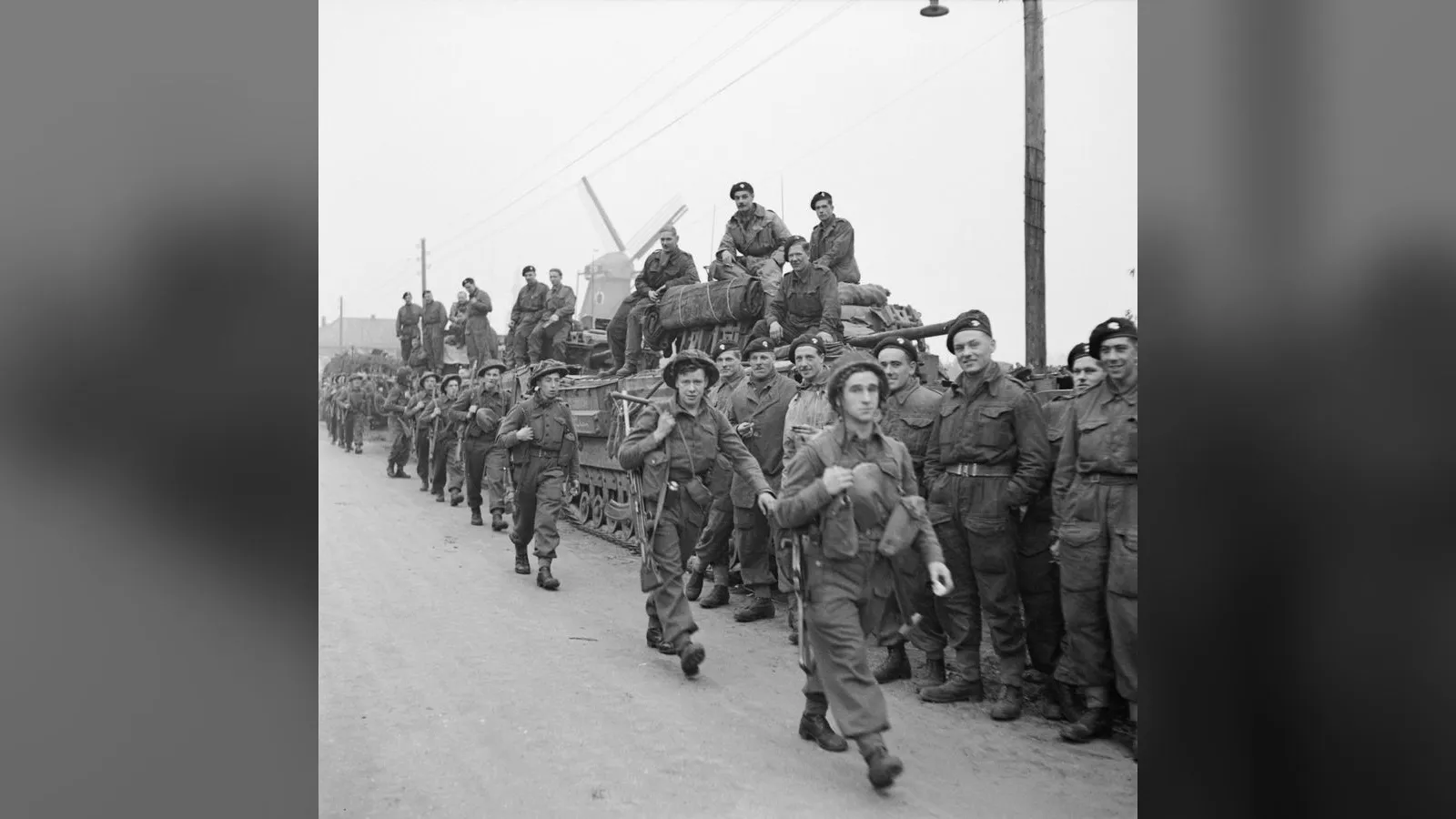

The Highland Light Infantry (City of Glasgow Regiment)
Defence Series · Card 9 of 50 · ScottishInventions.com
TL;DR
- The Highland Light Infantry (HLI) was formally created on 1 July 1881 under the Childers Reforms by amalgamating the 71st (Highland) Light Infantry and the 74th (Highland) Regiment of Foot into a single two-battalion regiment designated the "city regiment of Glasgow" — a documented fact.
- Its defining paradox is documented: though classed as a Highland regiment, the HLI wore tartan trews, not the kilt, from 1809 onward, making it the only regular Highland regiment in trews for full dress until kilts were authorised in 1947 — a status it clung to fiercely even as it recruited overwhelmingly in Lowland Glasgow.
- Its battle heritage is documented and distinguished: the antecedent 71st and 74th fought in the Mysore Wars, at Assaye (1803), across the Peninsular War and at Waterloo (1815); the HLI itself served in the Boer War, both World Wars, and imperial garrisons — service that should be read honestly as imperial/colonial as well as European.
- The regiment's Glasgow identity is documented: from the 1809 title "Glasgow Highland Light Infantry" through the 1923 formal designation "City of Glasgow Regiment", the HLI was a genuinely urban regiment, raising the celebrated Glasgow "Pals" battalions (Tramways, Boys' Brigade, Chamber of Commerce) in 1914.
- The regiment ended its independent existence on 20 January 1959, amalgamating with the Royal Scots Fusiliers to form the Royal Highland Fusiliers (covered in full on Card #14; the RSF side of that merger is on Card #6). This card covers the HLI's own history to that handoff only.
Key Facts
- Period/dates covered: 1777 (raising of the senior antecedent) – 1959 (amalgamation)
- Formal formation of the HLI: 1 July 1881 (Childers Reforms)
- Key institutions: British Army; the City of Glasgow; Royal Highland Fusiliers Museum, 518 Sauchiehall Street, Glasgow (holds HLI heritage material)
- Notable feature: A "Highland"-designated regiment that wore trews rather than the kilt — a genuine Highland/Lowland hybrid identity — and Glasgow's own city regiment
- Recruiting base: Glasgow and the western/central Lowlands (not a Highland county base)
- Nickname: "Hell's Last Issue" (a backronym of HLI); earlier "The Glesga Keelies"
- Cap badge: Star of the Order of the Thistle, bugle horn with "HLI" cypher (from the 71st's light-infantry status), surmounted by a crown, with the Assaye elephant and scroll below (from the 74th)
- Marches: Quick — "Whistle o'er the Lave o't" (Seann Triubhas); Slow — "Garb of Old Gaul"
- Regimental anniversary: Assaye Day, 23 September
- Current status/legacy: Lineage carried since 1959 by the Royal Highland Fusiliers, today 2nd Battalion, The Royal Regiment of Scotland (2 SCOTS)
Scottish Impact Index (SI Score)
- Military Impact
- 8/10
- Enduring Significance
- 9/10
- Strategic Importance
- 8/10
- Military Distinctiveness
- 9/10
- Military Legacy
- 9/10
- Recognition
- 7/10
50/60
Ranked =23rd of 43 in Defence
Claim Status
Consistent with the ScottishInventions "accuracy over patriotism" standard and the three-tier framework applied in Cards #5–8, the core claims of this card are assessed as follows:
- Established (documented): The 1881 formation from the 71st and 74th; the trews-not-kilt status and its 1809 origin; the Glasgow city-regiment identity and the 1923 title; the major campaign honours; the raising of the Glasgow "Pals" battalions in 1914; and the 20 January 1959 amalgamation. These are supported by the National Army Museum, the regiment's own museum/association, Hansard, the London Gazette and Imperial War Museum records.
- Shared/Traditional: Colourful regimental lore — the nickname "Hell's Last Issue", the claim that the 71st "fired the last shot at Waterloo", and the exact WWI death toll (widely cited as "over 10,000" but not resolved to a single authoritative figure). These are true in outline but carry embellishment or source variation.
- Disputed/Requires care: Precise casualty figures for the World Wars; the exact count of battalions raised in 1914–18 (memorial "twenty-three" vs. other tallies); and loose lineage shorthand that conflates the HLI's antecedents with the separate 73rd Regiment that became a Black Watch battalion.
The single most important accuracy point on this card: the HLI's senior antecedent (the 71st) began life in 1777 as the 73rd (Highland) Regiment of Foot, "MacLeod's Highlanders" — a regiment renumbered the 71st in 1786. This is not the same unit as the later 73rd (Perthshire) Regiment, which was raised in 1780 as the 2nd Battalion of the 42nd (Black Watch) and rejoined the Black Watch in 1881. Sources sometimes blur these two "73rds"; the distinction is set out precisely below.
Timeline
MacLeod's Highlanders raised by Major-General John Mackenzie, Lord MacLeod, as the 73rd (Highland) Regiment of Foot, from an independent company that had existed since 1771; a 2nd battalion followed in 1778.
Service in the Second Anglo-Mysore War in India; the regiment's flank companies were captured at Conjeveram (1780), and it fought at Perambaukam (1780), Sholinghur (1781) and Cuddalore (1783).
The regiment is renumbered the 71st (Highland) Regiment of Foot.
The 74th (Highland) Regiment of Foot ("Campbell's Highlanders") raised by Major-General Sir Archibald Campbell for service in India.
74th and 71st fight in the Third Anglo-Mysore War (Bangalore, Seringapatam).
The 74th makes its celebrated stand at Assaye (Second Anglo-Maratha War), earning the elephant-and-"Assaye" distinction later carried on the HLI badge.
The 71st serves throughout the Peninsular War (Roliça, Vimeiro, Corunna, Fuentes de Oñoro, Vitoria, the Pyrenees, Nivelle, Nive, Orthes, Toulouse).
The 71st is converted to light infantry and titled the 71st (Glasgow Highland Light Infantry); the kilt is set aside for trews/trousers.
The 71st fights at Waterloo.
Crimean War (Sevastopol).
Both antecedents involved in suppressing the Indian Rebellion (Mutiny).
Childers Reforms amalgamate the 71st and 74th into The Highland Light Infantry (1st and 2nd Battalions), the city regiment of Glasgow.
2nd Battalion at Tel-el-Kebir (Anglo-Egyptian War).
Second Boer War (Magersfontein, Modder River).
First World War: some two dozen battalions raised, including the Glasgow "Pals".
Title formally expanded to The Highland Light Infantry (City of Glasgow Regiment).
Second World War: France/Dunkirk, Keren, the Western Desert, Sicily, Italy, Greece, Normandy and North-West Europe.
Kilts authorised for the HLI (reversing the 1809 trews decision) under Colonel-in-Chief Princess Margaret.
Amalgamation with the Royal Scots Fusiliers to form the Royal Highland Fusiliers (→ Card #14).
Details
18th-century origins: two regiments, and a tale of two "73rds"
The senior of the HLI's two parents, the 71st, was raised in December 1777 by Major-General John Mackenzie, Lord MacLeod — son of the Earl of Cromartie, whose family had been attainted after the 1745 Jacobite rising and who himself had served abroad. As the National Army Museum records, it was raised "from an independent company that had existed since 1771", drawing on Highland clan country, and was first numbered the 73rd (Highland) Regiment of Foot, nicknamed MacLeod's Highlanders. It sailed to the West African fort of Fort James (in modern Gambia) in 1779 and then to India, where it fought through the Second and Third Anglo-Mysore Wars — its flank companies captured at Conjeveram in 1780, followed by actions at Perambaukam, Sholinghur and Cuddalore. In 1786 it was renumbered the 71st.
Here lies a lineage trap the "accuracy over patriotism" standard must flag. A different regiment also bore the number 73 in this period: the 73rd (Perthshire) Regiment of Foot, raised in 1780 as the 2nd Battalion of the 42nd (Royal Highland) Regiment — the Black Watch — and granted separate regimental status in 1786. That 73rd rejoined its parent in 1881 to become the 2nd Battalion of the Black Watch (Cards #3–4). It is not part of the HLI's story. The confusion is easy to make because both were "Highland" regiments numbered in the low 70s and both served in India; but the HLI's 71st descends from MacLeod's 1777 regiment, not from the Black Watch's second battalion. Popular accounts that describe the HLI as "originally a second battalion of the Black Watch" are conflating the two and should be treated as erroneous.
The junior parent, the 74th (Highland) Regiment of Foot, was raised in 1787 by Major-General Sir Archibald Campbell — "Campbell's Highlanders" — specifically for Indian service. Its defining moment came at the Battle of Assaye on 23 September 1803, where, under Major-General Arthur Wellesley (the future Duke of Wellington), the 74th suffered catastrophic officer casualties holding its ground in one of the hardest-fought actions of the Second Anglo-Maratha War. The distinction of an elephant superscribed "Assaye" was awarded in recognition, and it passed into the HLI's badge and traditions.
The 1881 formation of the Highland Light Infantry
Under the Childers Reforms of 1 July 1881 — the great restructuring that paired single-battalion regiments into two-battalion county or city regiments — the 71st and 74th were combined as the 1st and 2nd Battalions of the Highland Light Infantry, with the regiment designated the city regiment of Glasgow. Local militia and rifle-volunteer units of Lanarkshire and Glasgow were absorbed as reserve and volunteer battalions. The two regular battalions were physically merged in Glasgow later in the reform process, and the regiment's badge fused the heritage of both parents: the light-infantry bugle horn and "HLI" cypher (recalling the 71st's 1809 light-infantry conversion), the Star of the Order of the Thistle as the Scottish frame, and the Assaye elephant of the 74th.
The regiment's status, as the National Army Museum and regimental historians note, was ambiguous from the start: it insisted on being classified as a Highland regiment yet, in the museum's words, "recruited in Glasgow, so it became the only highland regiment given the lowland uniform of trews (trousers) instead of kilts" — the tension that gives this card its subject.
The Highland/Lowland hybrid identity and the dress question — explained in full
This is the HLI's most distinctive feature, and it must be stated precisely rather than sloganised.
Every regular "Highland" regiment of the Victorian and Edwardian army wore the kilt — except the HLI, which wore tartan trews (trousers cut on the bias in tartan cloth), specifically in the Mackenzie tartan. That was not an accident of 1881 but the legacy of a decision taken in the antecedent 71st around the turn of the 19th century. The 71st had originally been kilted, but arduous overseas and shipboard service (including South America and the Peninsula) meant it was repeatedly issued with trousers. When the regiment was converted to light infantry in 1809 — a role demanding fast, mobile skirmishing — the kilt was set aside for good; at Waterloo in 1815 the 71st actually wore standard grey trousers, with tartan trews restored around 1829. So the "Highland regiment that does not wear the kilt" is best dated to that 1809 light-infantry conversion, not to 1881.
When the 71st and 74th (both by then trews-wearing) were fused in 1881, the new HLI became — in the words repeated by the National Army Museum and the regiment's own historians — the only regular Highland regiment to wear trews for full dress. Crucially, this was a status the regiment guarded with pride: through the 1880s and 1890s it repeatedly claimed the right to the kilt but simultaneously argued that trews gave it a distinctive recruiting appeal in and around Glasgow. The kilt was finally authorised for the HLI only in 1947. The paradox therefore ran in both directions: a regiment officially "Highland" that dressed like a Lowland one, and a regiment recruiting in the Lowland city of Glasgow that fought to be counted among the Highlanders.
Its full dress in 1914 captured the hybrid perfectly: a dark-green shako with diced border (a light-infantry, quasi-Lowland headdress rather than the feather bonnet of the kilted regiments), a scarlet doublet with buff facings, and Mackenzie tartan trews. Officers wore plaids of the same tartan; in drill order all ranks wore white shell jackets with trews and a green glengarry. One Territorial battalion within the HLI, the 9th (Glasgow Highlanders), was the exception that proved the rule — it did wear the kilt.
Distinction from other cards: This is what sets the HLI apart from the truly kilted Black Watch (Cards #3–4) on one side and the plainly Lowland Royal Scots, Royal Scots Fusiliers, King's Own Scottish Borderers and Cameronians (Cards #5–8) on the other. It was neither fully one nor the other — a genuine hybrid, unique among the regular regiments.
Glasgow associations and city-regiment identity
The HLI's bond with Glasgow is documented and unusually explicit for a British regiment. The word "Glasgow" first entered the title in 1809 ("71st (Glasgow Highland Light Infantry)"). The 1881 reforms formally made the amalgamated regiment the city regiment of Glasgow, and in 1923 the title was expanded by Army Order to The Highland Light Infantry (City of Glasgow Regiment) — a rare official acknowledgement of a specific city rather than a county.
Where the Highland clan regiments and the Lowland county regiments recruited from rural shires, the HLI drew on Glasgow's dense industrial population: tramwaymen, shipyard and factory workers, clerks, and members of the city's civic institutions. Its regimental depot was at Hamilton Barracks (1881–1921) and then at Maryhill Barracks in Glasgow itself (1921–1959). Today its heritage is preserved at the Royal Highland Fusiliers Museum, 518 Sauchiehall Street, Glasgow — a category-B-listed 1903 building (with a rare water-powered lift) designed by John Keppie of the Honeyman, Keppie & Mackintosh practice, and the only military museum in the west of Scotland.
Nowhere is the city identity clearer than in 1914, when Glasgow's civic bodies raised whole battalions of the HLI (see First World War, below).
Major European and imperial campaigns
The battle honours carried by the HLI record a service history that spans India, the Napoleonic Wars and the Victorian empire — and it is honest to present much of it as imperial and colonial service.
- India / the Mysore and Maratha Wars (1780s–1800s): Both antecedents made their reputations in India — the honours "Carnatic", "Hindustan", "Sholingur", "Mysore", "Seringapatam" and, above all, "Assaye" (1803) come from this era.
- The Peninsular War (1808–1814): The 71st fought at Roliça, Vimeiro and Corunna (from which Sir John Moore's army was evacuated in January 1809), then returned to the Peninsula for Fuentes de Oñoro, Vitoria, the Pyrenees, Nivelle, Nive, Orthes and Toulouse. This is the source of the regiment's dense cluster of Peninsular honours.
- Waterloo (1815): The 71st was present at Waterloo (in Sir Henry Clinton's 2nd Division), and its conduct there was widely praised. Following the precision established on Cards #6–7 about which Scottish regiments were and were not present, note that the HLI's antecedent the 71st was genuinely there — unlike some regiments whose "Waterloo" association is looser. The regiment's own association records its Waterloo losses as "16 officers and 171 men killed and wounded" (some accounts, such as britishbattles.com, give "16 officers and 184 men"); the popular claim that the 71st "fired the last shot of the battle" is traditional/celebratory and should be flagged as such rather than asserted as fact.
- Crimea (1854–1856): The 71st served at the Siege of Sevastopol and the Kerch expedition.
- Indian Rebellion (1857–1859) and the North-West Frontier: Both antecedents saw service; the 71st fought at Ambela (1863).
- Egypt (1882): The 2nd Battalion stormed the entrenchments at Tel-el-Kebir, where Lieutenant William Edwards won the Victoria Cross.
- Second Boer War (1899–1902): The 1st Battalion served throughout, suffering severely at Magersfontein (December 1899); honours include "Modder River" and "South Africa 1899–1902".
The First World War (1914–1918)
Glasgow's civic character shaped the HLI's Great War more than almost any other regiment's. Beyond the two regular battalions and the pre-war Territorial and Special Reserve units, the city and its institutions raised a remarkable number of new battalions. The National Army Museum records the HLI raising, in addition to its two regular battalions, "14 Territorial battalions and 11 Reserve and Service battalions"; the regimental war memorial commemorates the fallen of its "twenty-three battalions"; and a contemporary regimental account, The Seventeenth Highland Light Infantry: Record of War Service, 1914–1918, states that "the 5th, 6th, 7th, 8th and 9th Battalions each had second and third lines, and at one time there were as many as thirty Battalions in existence. These were more or less connected with the City of Glasgow and district." These differing totals reflect different counting bases — battalions that fought, battalions raised, second- and third-line duplicates — and should be presented as a range, not a single number.
The three Glasgow "Pals" service battalions are the enduring symbol of this civic mobilisation:
- 15th (Service) Battalion — the "Glasgow Tramways" Battalion, raised by the Corporation of Glasgow largely from the city's tramway workers;
- 16th (Service) Battalion — the "Glasgow Boys' Brigade" Battalion, raised from former members of the Boys' Brigade;
- 17th (Service) Battalion — the "Glasgow Chamber of Commerce" Battalion (the "Commercials"), raised from clerks, students and businessmen.
These fought together on the Somme in 1916, notably around Authuille and the Leipzig Salient on 1 July 1916. The 16th Battalion is remembered for the stand at the Frankfurt Trench during the Battle of the Ancre (November 1916), where a party cut off behind German lines refused to surrender; General Sir Hubert Gough praised their stand in Army Order 193.
The regular battalions ranged widely: the 1st Battalion served on the Western Front (Neuve Chapelle, Second Ypres) and then in Mesopotamia (the Siege of Kut, Sharqat); the 2nd Battalion fought from Mons and the Aisne (where Private George Wilson won the VC in 1914) through Loos, the Somme, Arras, Cambrai and the Hindenburg Line. Territorial battalions of the 52nd (Lowland) Division landed at Gallipoli in 1915. In 1919 the 2nd Battalion joined the British intervention against the Bolsheviks in North Russia (the "Archangel 1919" honour).
Casualties: The commonly cited figure is that "over 10,000" men of the HLI died in the war. This is consistent across secondary sources but has not been resolved to a single authoritative total; the Commonwealth War Graves Commission holds the individual records, and a precise aggregate would require a direct database query or the regimental history (Oatts, Proud Heritage). Treat "roughly ten thousand or more dead" as the responsible statement. Seven Victoria Crosses were awarded to HLI men during the war (Wilson, Brodie, Angus, Turnbull, Hamilton, Anderson and Hunter).
The Second World War (1939–1945)
The HLI fought across most of the war's western and Mediterranean theatres:
- The 1st Battalion went to France in 1939, was evacuated at Dunkirk in 1940, then landed in Normandy in 1944, fighting through the Battle of the Bulge, the Reichswald (Operation Veritable) and the final advance into Germany.
- The 2nd Battalion began the war in Egypt, fought at Keren in Eritrea (1941), then in the Western Desert (Knightsbridge, 1942), the invasion of Sicily (1943), and later in Italy and the Balkans, serving as peacekeepers in Greece in 1944–45.
- The 5th and 6th Battalions (52nd Lowland Division) were evacuated from Cherbourg in 1940 and later took part in the amphibious assault on Walcheren (Operation Infatuate, November 1944) and the capture of Bremen.
- The 10th Battalion landed in Normandy and fought at Caen and Falaise (1944).
- The 11th Battalion was converted to armour in 1942 as the 156th Regiment, Royal Armoured Corps, its men retaining the HLI cap badge on the black beret.
Captain (temporary Major) Frank Blaker, commissioned into the HLI, won a posthumous Victoria Cross in Burma in 1944 while attached to the 9th Gurkha Rifles.
The 1959 amalgamation — brief (see Cards #6 and #14)
In 1948 the HLI was reduced to a single regular battalion, which served in Malta, Libya, the Suez Canal Zone and Cyprus during the 1950s. As part of the post-Suez contraction of the army, it was amalgamated with the Royal Scots Fusiliers on 20 January 1959 to form The Royal Highland Fusiliers (Princess Margaret's Own Glasgow and Ayrshire Regiment), the regular battalions combining at Redford Barracks, Edinburgh.
The merger was bitterly contested — chiefly over dress. Because the HLI had at last regained the kilt in 1947 while the RSF (like the HLI for most of its history) wore trews, the two regiments' colonels — one of them Major-General Roy Urquhart of Arnhem fame — pressed for the new regiment to wear the kilt, and both ultimately resigned over the issue after the Army Council insisted on trews for the Lowland Brigade. As the responsible minister told the Commons in December 1957, the colonels "reaffirmed their view that the amalgamated regiment should wear the kilt" and "recommended that, if this was not acceptable to the Army Council, the two regiments should be disbanded." The new regiment adopted Mackenzie trews, retaining the kilt only for its pipes and drums.
The subsequent history of the Royal Highland Fusiliers — through to its 2006 absorption into the Royal Regiment of Scotland as 2 SCOTS — is covered on Card #14. The Royal Scots Fusiliers' own history and its side of the 1959 merger are on Card #6. This card closes at the 1959 handoff.
Did You Know?
- The regiment's nickname was its own initials turned into a joke. "Hell's Last Issue" was a soldiers' backronym of "H.L.I." An older nickname, "The Glesga Keelies", dates to the Peninsular War era.
- The HLI badge carries an elephant — the Assaye elephant inherited from the 74th Highlanders' hard stand at the Battle of Assaye in 1803. Assaye Day (23 September) remained its regimental anniversary.
- It was the only regular Highland regiment in trews. Every other Highland regiment wore the kilt; the HLI wore Mackenzie tartan trews for full dress from 1809 until kilts were finally authorised in 1947.
- Glasgow's trammen went to war as a battalion. The 15th (Service) Battalion was raised largely from the Glasgow Corporation Tramways department; contemporary local histories record that over 10,000 Glasgow tram workers enlisted in the war's first fourteen months.
- The actor David Niven was an HLI officer — reluctantly. He was commissioned into the regiment in 1930 and served with the 2nd Battalion, having famously written on his Sandhurst preference form, as a third choice, "anything but the Highland Light Infantry" — because it wore trews rather than kilts. He was duly posted there.
- Princess Margaret was its last Colonel-in-Chief. She held the appointment from 1947 until the 1959 amalgamation, which is why the successor Royal Highland Fusiliers bears the subtitle "Princess Margaret's Own".
- A stand that earned an Army Order. At the Frankfurt Trench in November 1916, cut-off men of the 16th (Boys' Brigade) Battalion held out behind German lines and refused to surrender; General Gough commemorated them in Army Order 193.
- The regimental museum has a Mackintosh-office pedigree. The Glasgow building at 518 Sauchiehall Street that holds the HLI's heritage was designed by John Keppie of Honeyman, Keppie & Mackintosh and retains an original water-powered lift.
FAQ
1When was the Highland Light Infantry formed?
The regiment was formally created on 1 July 1881 under the Childers Reforms, by amalgamating the 71st (Highland) Light Infantry and the 74th (Highland) Regiment of Foot as the 1st and 2nd Battalions. Its senior antecedent, however, dates from December 1777, when Lord MacLeod raised the regiment later renumbered the 71st.
2Why was it called a "Highland" regiment if it didn't wear the kilt?
Both its antecedents were originally raised as Highland regiments from clan country in the 1770s–80s. The 71st adopted trews and then lost the kilt when it converted to light infantry in 1809. The HLI kept the "Highland" classification for prestige and recruiting even though it wore trews and recruited in Lowland Glasgow — a status it defended proudly.
3Did the HLI ever wear the kilt?
Only briefly and at the margins. Its antecedent 71st was kilted before 1809. Thereafter the regiment wore Mackenzie tartan trews for full dress. The kilt was not authorised for the HLI until 1947, and even then the change was short-lived: on amalgamation in 1959 the successor regiment reverted to trews.
4Was the HLI at Waterloo?
Yes. Its antecedent, the 71st (Highland) Light Infantry, fought at Waterloo on 18 June 1815 in Clinton's 2nd Division. The regiment's historians record losses of roughly 16 officers and 171 other ranks killed and wounded. The colourful claim that the 71st "fired the last shot of the battle" is regimental tradition rather than firmly documented fact.
5What was the HLI's connection to Glasgow?
It was Glasgow's own city regiment. "Glasgow" entered its title as early as 1809; the 1881 reforms made it the city regiment of Glasgow, and in 1923 its title became "The Highland Light Infantry (City of Glasgow Regiment)". It recruited from the city's industrial population and its heritage is held at the Royal Highland Fusiliers Museum in Glasgow.
6What were the Glasgow "Pals" battalions?
Three service battalions raised in Glasgow in 1914: the 15th (Tramways), from Corporation tramway workers; the 16th (Boys' Brigade), from former Boys' Brigade members; and the 17th (Chamber of Commerce or "Commercials"), from clerks, students and businessmen. They served together on the Somme in 1916.
7How many men did the HLI lose in the First World War?
Secondary sources consistently cite "over 10,000" HLI dead, but no single authoritative aggregate has been definitively established; the individual records are held by the Commonwealth War Graves Commission. The regiment's war memorial commemorates the fallen of its "twenty-three battalions".
8What is the significance of the elephant on the cap badge?
The elephant, with the scroll "Assaye", commemorates the 74th Highlanders' service at the Battle of Assaye in India in 1803. It sits below a bugle horn and "HLI" cypher (from the 71st's light-infantry status), all set on the Star of the Order of the Thistle beneath a crown.
9What campaigns did the HLI and its antecedents fight in?
India's Mysore and Maratha Wars (including Assaye, 1803), the Peninsular War (1808–14), Waterloo (1815), the Crimea (1854–56), the Indian Rebellion (1857–59), Egypt (1882), the Boer War (1899–1902), and both World Wars. Much of the 18th- and 19th-century service was imperial and colonial in character.
10What happened to the HLI in 1959?
On 20 January 1959 it amalgamated with the Royal Scots Fusiliers to form the Royal Highland Fusiliers (Princess Margaret's Own Glasgow and Ayrshire Regiment). The merger was contentious, chiefly over whether the new regiment should wear the kilt or trews; it settled on trews. The Royal Highland Fusiliers' later history is on Card #14.
11How is the HLI different from the Black Watch?
The Black Watch (Cards #3–4) was a genuinely kilted Highland regiment recruiting from Highland Perthshire and its neighbouring counties. The HLI was a Glasgow city regiment that wore trews. The two are also often confused in lineage terms because of the number "73": the HLI's 71st began as a 1777 regiment first numbered the 73rd, whereas the Black Watch's second battalion was a different 73rd raised in 1780 — the two must not be conflated.
12Where can I see HLI artefacts today?
At the Royal Highland Fusiliers Museum, 518 Sauchiehall Street, Glasgow — the regimental museum for the HLI, the Royal Scots Fusiliers and their successor regiment. It displays uniforms, medals (including Victoria Crosses), music and regimental trophies across several galleries.
Sources
Primary / Institutional
- National Army Museum, "The Highland Light Infantry (City of Glasgow Regiment)"; "71st (Highland) Regiment of Foot (Light Infantry)"; "74th (Highland) Regiment of Foot"; "73rd (Perthshire) Regiment of Foot"; "The Black Watch (Royal Highlanders)".
- Hansard (House of Commons), debate on the Royal Scots Fusiliers and Highland Light Infantry amalgamation, 11 December 1957 (dress/kilt controversy).
- Imperial War Museum, War Memorials Register and Collections (HLI regimental memorial; cap-badge descriptions).
- The London Gazette (Victoria Cross citations, e.g. Tel-el-Kebir 1882, Aisne 1914).
- Royal Highland Fusiliers Museum, 518 Sauchiehall Street, Glasgow (holds HLI heritage material).
- Commonwealth War Graves Commission (individual casualty records).
Scholarly / Regimental history
- L. B. Oatts, Proud Heritage: The Story of the Highland Light Infantry (4 vols., 1952–1964).
- David French, Military Identities: The Regimental System, the British Army and the British People, c.1870–2000 (Oxford University Press, 2005) — on the 1950s amalgamation and dress dispute.
- J. C. Kemp, The History of the Royal Scots Fusiliers / The Royal Scots Fusiliers 1920–1959 (context for the merger).
- W. Y. Carman, Richard Simkin's Uniforms of the British Army: the Infantry Regiments (1985) — HLI dress.
- E. W. McFarland, "The Great War", in T. M. Devine and Jenny Wormald (eds), The Oxford Handbook of Modern Scottish History (Oxford University Press, 2012) — further reading on Glasgow's Pals battalions
General further reading
- The Long, Long Trail (longlongtrail.co.uk), "Highland Light Infantry" — battalion-by-battalion Great War service.
- HLI (City of Glasgow Regiment) Association (highlandlightinfantry.org.uk) — regimental history and VC list.
- Firstworldwarglasgow.co.uk — the Glasgow "Pals" battalions.
Honest Caveats
- The "two 73rds" lineage trap. The HLI's senior antecedent (the 71st) was first raised in 1777 as the 73rd (MacLeod's Highlanders) and renumbered the 71st in 1786. This is a different regiment from the 73rd (Perthshire) raised in 1780 as the 2nd Battalion of the 42nd/Black Watch. Any statement that the HLI "began as a battalion of the Black Watch" is a conflation and is incorrect.
- The Highland/Lowland hybrid must be dated correctly. The regiment's trews-not-kilt status stems from the 71st's conversion to light infantry in 1809, not from the 1881 amalgamation. The 1881 reform confirmed rather than created it. The kilt was authorised only in 1947, and the choice of trews was reaffirmed at the 1959 merger.
- "Fired the last shot at Waterloo." This is regimental tradition, repeated in many popular accounts, but is not firmly documented. Present it as lore, not fact.
- Casualty figures need care. "Over 10,000" HLI dead in the First World War is the standard figure but is not resolved to a single authoritative total; different sources use different bases (deaths of men who enlisted in the regiment vs. deaths while serving in it). The count of battalions raised in 1914–18 similarly varies ("twenty-three" on the memorial; roughly 27 by the NAM's breakdown of 2 regular + 14 Territorial + 11 Reserve/Service; "as many as thirty" in one regimental account). Give ranges, not false precision.
- "Highland" name vs. Lowland reality. Although classed Highland and wearing Highland-pattern accoutrements, the HLI recruited overwhelmingly from Lowland Glasgow. This is not a contradiction to be smoothed over but the defining feature of the regiment — and it distinguishes the HLI both from the kilted clan regiments (Cards #3–4) and from the standard Lowland county regiments (Cards #5–8).
- VC counting. Seven VCs were won by HLI men in the First World War; the regiment's own association counts 13 across its entire history (including the antecedent 71st and 74th and Major Blaker's 1944 award won while attached to the Gurkhas). Totals vary with inclusion criteria.
Card 009 · Defence