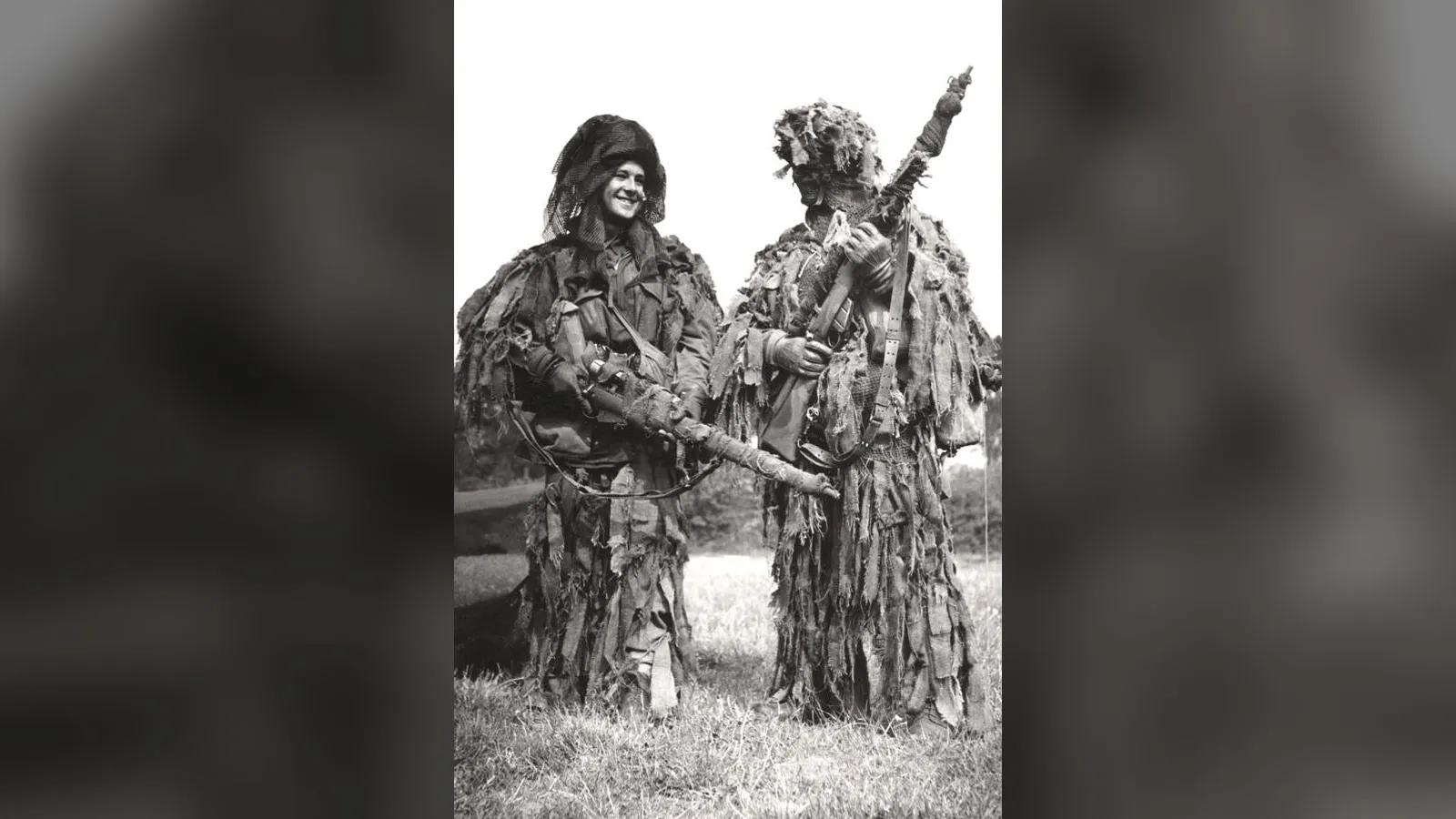

The Lovat Scouts: Highland Stalkers, Sniping Pioneers and the Ghillie-Suit Myth
Defence Series, Card #18 of 50 | ScottishInventions.com Editorial standard: accuracy over patriotism. Claims are tagged Documented, Traditional, or Legend/Myth throughout.
TL;DR
- [Documented] The Lovat Scouts were raised in January 1900 by Simon Fraser, 14th Lord Lovat, for the Second Boer War, recruited from Highland gamekeepers, deerstalkers, ghillies and shepherds whose deer-stalking fieldcraft — observation, concealment, marksmanship and hill-craft — made them exceptional battlefield scouts.
- [Documented] They were the first known military unit to use the ghillie suit, but [Legend/Myth as usually stated] they did not invent the garment: it was a pre-existing civilian tool of Scottish gamekeepers. The careful claim is "first military unit to wear/adapt," not "inventors."
- [Documented / needs precision] In 1916 the "Lovat Scouts Sharpshooters" were formed and are often called the British Army's first sniper unit — but their value lay chiefly in long-range observation, and the formal British sniping-school system was built separately by Major Hesketh Hesketh-Prichard.
- [Documented] They served at Gallipoli, in Egypt, Macedonia and France in WWI (becoming the 10th (Lovat's Scouts) Battalion, Queen's Own Cameron Highlanders), and in WWII garrisoned the Faroes, trained as mountain/ski troops in Canada, and fought in Italy.
- [Documented] Never absorbed into the SAS; the Scouts passed through the Royal Artillery and Highland infantry, were disbanded as a distinct TA unit by the late 1960s, and are perpetuated today by HQ (Lovat Scouts) Squadron, Scottish and North Irish Yeomanry, and an Orkney/Shetland cadet battery.
Key Facts
- Period covered: 1900–present (lineage)
- Key institution: Lovat Scouts (Scottish Highland Yeomanry); founder Simon Fraser, 14th Lord Lovat (1871–1933)
- Notable feature: Pioneering military use of the ghillie suit; elite reconnaissance/observation and stalking-derived fieldcraft; the British Army's first specialist sharpshooter formation (1916); WWII mountain-warfare specialists
- Motto: Je suis prest ("I am ready") — the Fraser of Lovat motto
- Current status/legacy: Perpetuated by HQ (Lovat Scouts) Squadron, Scottish and North Irish Yeomanry (Edinburgh), and the Orkney & Shetland cadet battery; regimental collection held at The Highlanders' Museum, Fort George
Scottish Impact Index (SI Score)
- Military Impact
- 7/10
- Enduring Significance
- 8/10
- Strategic Importance
- 7/10
- Military Distinctiveness
- 9/10
- Military Legacy
- 9/10
- Recognition
- 6/10
46/60
Ranked =32nd of 43 in Defence
Claim Status
- Established (Documented): Founding date (January 1900) and founder (14th Lord Lovat); recruitment from gamekeepers/stalkers/ghillies; the deer-stalking → fieldcraft rationale; service theatres in both World Wars; conversion to the 10th Cameron Highlanders battalion in 1916; WWII Faroes garrison, Canadian mountain training and Italian campaign; the post-war institutional trajectory through the Royal Artillery and Highland infantry.
- Shared/Traditional: That they were "the British Army's first sniper unit" — true in a qualified sense (the 1916 Sharpshooters), but requires the caveat that their principal value was observation and that the formal sniping doctrine/schools were Hesketh-Prichard's work.
- Disputed / Myth (flagged explicitly): The ghillie-suit "invention" claim. Careful sources — including the standard sniping historian Martin Pegler and the regiment's own museum — say the Scouts were the first military unit to wear/pioneer the ghillie suit, not that they invented it. The garment was a civilian gamekeeper's device predating military use. Treat any "Lovat Scouts invented the ghillie suit" claim as inaccurate.
Timeline
After "Black Week," Lord Lovat proposes a Highland scouting corps to the War Office.
Lovat Scouts raised; recruits assemble/train at Beaufort Castle, near Beauly.
First contingent sails for South Africa; attached to the Black Watch.
Second and third contingents raised; Scouts reorganised into Imperial Yeomanry companies (113th, 114th, later 178th).
War ends; companies return on SS Tintagel Castle and are disbanded.
Reformed as Lovat's Scouts Imperial Yeomanry.
Transferred to the new Territorial Force as 1st and 2nd Lovat's Scouts Yeomanry, based at Beauly.
1/1st Lovat's Scouts land dismounted at Gallipoli.
1/1st and 1/2nd merged (with a Scottish Horse company) into the 10th (Lovat's Scouts) Battalion, Queen's Own Cameron Highlanders; deployed to Salonika.
Lovat Scouts Sharpshooters formed for observation/sniping work on the Western Front.
10th Battalion moves to France as line-of-communication/observation troops.
Post-war cuts reduce the Lovat Scouts to a single regiment, retained (with the Scottish Horse) as mounted "Scouts."
Garrison the Faroe Islands.
Ski/mountain-warfare training at Jasper, Alberta, Canada, for a planned Norway invasion.
Italian campaign.
Denazification sweeps in Austria/Bavaria; then Greece during the civil unrest.
Reduced to a squadron of the Scottish Horse.
Converted to Royal Artillery (677 (Lovat Scouts) Mountain Regiment).
Amid defence cuts, reverts to a Highland infantry role.
Absorbed into the 3rd Bn Queen's Own Highlanders / 51st Highland Volunteers.
Lineage carried by cadets and by HQ (Lovat Scouts) Squadron, Scottish and North Irish Yeomanry.
Details
Origins in the Boer War and Lord Lovat's founding
The Second Boer War (1899–1902) exposed the British Army's weakness in reconnaissance. The Boer commandos — mounted farmers who could shoot accurately, ride hard, use ground and vanish — repeatedly outmanoeuvred conventional British forces, most humiliatingly during "Black Week" in December 1899. Simon Joseph Fraser, 14th Lord Lovat (1871–1933), 23rd Chief of Clan Fraser of Lovat, recognised that the men of his Highland estates possessed exactly the fieldcraft the Army lacked: stalkers, gamekeepers, ghillies and shepherds who spent their working lives observing, concealing themselves and shooting accurately in rough country while stalking red deer.
Lovat had genuine military credentials: commissioned into the Queen's Own Cameron Highlanders and later the 1st Life Guards before joining a Cameron Highlanders volunteer battalion. In December 1899 he proposed to the War Office a corps of Highland scouts skilled in "stalking, signalling, military tactics and marksmanship." The proposal was accepted, and the Scouts were raised in January 1900, mustering at Beaufort Castle near Beauly.
A note on the numbering: he is legally the 14th Lord Lovat but is often called the 16th Lord in Clan Fraser tradition, which disregards the 1747 attainder (following the execution of Simon Fraser, 11th Lord Lovat, for his part in the Jacobite rising). Sources using "16th Lord Lovat" for the founder refer to the same man. Lovat served initially as second-in-command; after the death of the commanding officer, the Hon. Andrew David Murray, in September 1901, Lovat took command aged 29 and was awarded the DSO.
The unit's Boer War role was primarily scouting, reconnaissance and long-range observation rather than set-piece combat: travelling on Highland ponies, using spyglasses/telescopes, and communicating by heliograph and semaphore. The American Frederick Russell Burnham, British Army Chief of Scouts under Lord Roberts, is traditionally credited with describing them as "half wolf and half jackrabbit" — a vivid quote, but one sourced to Burnham's biography and secondary compilations (including John Plaster's The Ultimate Sniper, Paladin Press, 2006, p. 5) rather than a verified primary document, and it should be presented as traditional.
The Boer War's contested legacy — honest context
Consistent with Card #17 (Scottish Horse), the Lovat Scouts were raised into a war whose later phases are among the most controversial in British imperial history. Faced with Boer guerrilla warfare, the British under Lord Roberts and then Lord Kitchener adopted a scorched-earth policy — burning farms, destroying crops and killing or removing livestock — and forcibly interned Boer and African civilians in concentration camps. Estimates of the death toll vary by source and method: World History Encyclopedia cites up to 28,000 Boers (about 80% of them children) and around 20,000 black Africans dead in the camps, against roughly 7,000 Boers killed as combatants; the widely cited Goldman figure is 27,927 Boer deaths, while more conservative verified-record research (associated with the Warwick University project and historians such as Fransjohan Pretorius and A. Wessels) puts the Boer camp total nearer 25,000, plus 14,154 deaths in the separate camps for black Africans first documented by Peter Warwick in 1983. Liberal opposition leader Sir Henry Campbell-Bannerman condemned the policy at a National Reform Union dinner at the Holborn Restaurant on 14 June 1901, asking: "When is a war not a war? When it is carried on by methods of barbarism in South Africa."
What is documented about the Lovat Scouts specifically is that they were a scouting/reconnaissance and observation force, whose work centred on intelligence-gathering rather than the farm-burning and camp administration that define the war's worst controversies. That distinction should not be overstated into a claim of moral distance: the Scouts were an integral part of the British war effort and served its overall aims. There is no basis for either singling them out for the war's civilian atrocities or presenting them as somehow separate from the campaign whose ends they served.
Sniping and scouting innovation — and the ghillie-suit myth examined
The Lovat Scouts' lasting military significance lies in fieldcraft: the translation of Highland deer-stalking skills — patient observation through a telescope ("glassing"), reading ground, concealment, stalking to within range, and precise shooting — into a military reconnaissance and marksmanship capability. This was genuinely distinctive at a time when the British Army had little formal scouting or sniping doctrine and, guided by Victorian notions of "sporting" warfare, had regarded aimed killing of individuals as faintly disreputable.
The ghillie suit. The popular claim that "the Lovat Scouts invented the ghillie suit" is inaccurate. The garment — a loose, hooded burlap/sacking outfit hung with irregular strips of cloth to break up the wearer's outline — was developed by Scottish gamekeepers and ghillies as a civilian portable hunting blind, and predated any military use. The word itself derives from the Scottish Gaelic gille ("lad/servant," especially a deer-stalking attendant), and may also allude to the Ghillie Dhu (Gille Dubh), a folklore forest spirit "clothed in leaves and moss." Martin Pegler, author of the standard history Out of Nowhere: A History of the Military Sniper (Osprey), does not credit the Scouts with inventing the garment; he describes them adapting an existing gamekeeper's item. The regiment's own institution, The Highlanders' Museum, carefully uses the verb "pioneering" rather than "inventing." The accurate formulation: the Lovat Scouts were the first known military unit to wear/adapt the ghillie suit — not its inventors. Camouflage hunting suits were, in any case, not unique to Scotland.
"First sniper unit." In late 1916 a specialist formation, the Lovat Scouts Sharpshooters, was raised and is frequently described as the British Army's first sniper unit. This requires precision. Major Hesketh Vernon Hesketh-Prichard, who created the formal British sniping-school system — the First Army School of Sniping, Observation and Scouting (SOS) at Linghem, founded in spring 1916 — wrote in his primary-source account Sniping in France (1920) that "this name turned out in a way really a misnomer, for the Lovats were found to be so invaluable with the telescope that they were in many cases forbidden to use the rifle." Describing their organisation, he recorded that "nine groups, each about twenty strong, and each under an officer, were attached to a certain Army Corps. Every man of these groups was a picked stalker and glassman, and they were used largely for long range observation. It fell to the First Army Sniping School to train their reinforcements. Keener men never lived, nor more dependable," adding: "If they reported a thing, the thing was as they reported it."
So the precise picture is: the Lovat Scouts supplied elite stalking and observation skill (and personnel and instructors), and were the Army's first dedicated sharpshooter/observer formation; Hesketh-Prichard built the doctrine and training apparatus that trained their reinforcements. Their principal battlefield value was reconnaissance and observation rather than kill-focused sniping. The tidy "first sniper unit" line is best qualified accordingly. (The oft-repeated claim that "one man in five" was decorated is regarded as unproven by the WWI researcher Chris Baker.)
Establishment as a Yeomanry/Territorial unit
Disbanded after the Boer War, the Scouts were reformed in February 1903 as Lovat's Scouts Imperial Yeomanry, and in April 1908 — under the Haldane reforms creating the Territorial Force — became the 1st and 2nd Lovat's Scouts Yeomanry, based at Beauly and brigaded in the Highland Mounted Brigade. The connection to the Queen's Own Cameron Highlanders (noted in Card #17) runs through both the founder's own commission and the 1916 conversion of the 1st-line Scouts into that regiment's 10th Battalion.
First World War (cross-referencing Card #17)
On mobilisation the Territorial Scouts split into 1st, 2nd and 3rd Line units. The 1/1st Lovat's Scouts, dismounted, landed at Gallipoli in September 1915, were evacuated to Egypt that December, and in September 1916 were merged — with the 1/2nd and, as noted on Card #17, a company of the Scottish Horse's 3rd Regiment — into the 10th (Lovat's Scouts) Battalion, Queen's Own Cameron Highlanders. This battalion served in Salonika/Macedonia (actions including Karajakois, Yenikoi and Tumbitza Farm) before moving to France in mid-1918 as observation/line-of-communication troops. The 2nd Line units served at home, converting to cyclists; the 3rd Line provided drafts. Separately, the Lovat Scouts Sharpshooters served on the Western Front from late 1916 in the observation/sniping role described above. This is the specific point at which the Lovat Scouts' and Scottish Horse's WWI paths intersect — see Card #17 for the Scottish Horse's own institutional story.
Casualty figures for the Lovat Scouts specifically are not cleanly separable, because personnel were dispersed across the 10th Cameron Highlanders, the Sharpshooters (attached to other corps and recorded under them), cyclist units and reserve battalions; this dispersal is well documented and means any single casualty total should be treated with caution.
Second World War and the specialised, commando-adjacent role
From May 1940 to June 1942 the Lovat Scouts garrisoned the Faroe Islands against a feared German invasion, under Lt-Col Sir Donald Cameron of Lochiel. On returning to Britain they became the reconnaissance regiment of the 52nd (Lowland) Division, which was earmarked for a mountain-warfare role. In December 1943 the regiment sailed to Canada for intensive ski and mountain training in Jasper National Park, Alberta — snow-holing, cross-country skiing under load, ice-axe and crampon work — reportedly the only British unit to undergo such formal high-altitude training, in preparation for a planned (and never executed) Allied invasion of Norway.
Instead they were sent to Italy, arriving at Naples in July 1944 after the fall of Monte Cassino, and served through the remainder of the Italian campaign to the German surrender in May 1945. Their specialised skills were, by several accounts, underused in Italy, where they suffered losses including to mines and booby-traps during the German withdrawal. After VE-Day the regiment moved north through the Brenner Pass into Austria and Bavaria to hunt Nazi and SS personnel, and in early 1946 deployed to Greece.
The founder's son, Simon Fraser, 15th Lord Lovat, was mobilised in 1939 as a captain in the Lovat Scouts before becoming a celebrated Commando leader (No. 4 Commando; 1st Special Service Brigade) — a family and clan link between the Scouts and the Commandos, though the Lovat Scouts as a regiment were mountain-reconnaissance specialists, not a Commando unit. David Stirling, founder of the SAS, was a nephew of the 14th Lord Lovat.
The post-war institutional endpoint (examined precisely)
The Lovat Scouts were not absorbed into the SAS. On the Territorial Army's reconstitution in 1947 the regiment was reduced to C (Lovat Scouts) Squadron of the Scottish Horse (Royal Armoured Corps); in 1949 it transferred to the Royal Artillery as 677 (Lovat Scouts) Mountain Regiment, RA (later, through amalgamations, 540 (Lovat Scouts) Light Anti-Aircraft Regiment). Through 1960s TA reorganisations the sub-units were absorbed into the Seaforth and Cameron Highlanders' Territorial battalions; a Lovat Scouts company/platoon persisted within the 3rd Bn Queen's Own Highlanders and then the 51st Highland Volunteers from the late 1960s. The name and cap badge have since been maintained by cadet units (latterly the Orkney & Shetland battery of 1 Highlanders ACF) and, from the 2020s, by HQ (Lovat Scouts) Squadron of the Scottish and North Irish Yeomanry in Edinburgh — a light-cavalry reconnaissance regiment, a fitting modern echo of the Scouts' founding purpose.
Did You Know?
- The recruits were older than typical soldiers — some accounts note the youngest of the original gamekeepers was 42, and later wartime rules were bent to let men aged 50 enlist as observers, because the skill mattered more than youth.
- The Scouts' WWII cap badge included the word "Jasper," commemorating the Jasper National Park in Canada where they trained for a Norway invasion that never happened.
- While garrisoning the Faroe Islands, the unit reportedly brought down a Luftwaffe bomber with Bren-gun fire and captured its crew.
- The founder's son, the 15th Lord Lovat, was one of the most famous Commandos of D-Day; the SAS founder David Stirling was the 14th Lord's nephew — but the regiment itself was never a Commando or SAS unit.
- Hesketh-Prichard rated the Scouts' observers so highly that many were "forbidden to use the rifle" — their eyes were worth more than their trigger fingers.
- B Squadron men from Uist reportedly brought their own Highland ponies to interwar summer camps, fitting them with bridles woven from marram grass.
- There is a Lovat Scouts memorial in the town square of Beauly, and a South African War memorial obelisk there commemorating those who fell in the Boer War.
- "The Lovat Scouts" is also a well-known Scottish pipe-style tune — a quickstep/strathspey in A major written by the fiddler-composer James Scott Skinner (1846–1927), printed in a Bayley & Ferguson folio in the 1920s and catalogued as JSS0705 in the University of Aberdeen's Scott Skinner collection.
FAQ
1Who founded the Lovat Scouts and when?
Simon Fraser, 14th Lord Lovat (1871–1933), Chief of Clan Fraser of Lovat, raised them in January 1900 for the Second Boer War. He proposed the corps to the War Office in December 1899 after British reconnaissance failures. Recruits mustered at Beaufort Castle near Beauly. Lovat first served as second-in-command, later commanding the regiment and earning the DSO.
2Why were gamekeepers and stalkers recruited?
Their livelihood — stalking red deer across open Highland terrain — demanded exactly the skills the Army lacked: patient observation through a telescope, concealment, reading ground, moving unseen and shooting accurately at long range. Lord Lovat realised these civilian fieldcraft skills could counter the elusive Boer commandos, and the results validated the idea.
3Did the Lovat Scouts invent the ghillie suit?
No — this is a common myth. The ghillie suit was a civilian garment developed by Scottish gamekeepers as a portable hunting blind, predating military use; the word comes from Gaelic gille (a stalking attendant). The accurate claim is that the Lovat Scouts were the first known military unit to wear and adapt it, not that they invented it.
4Were they really the British Army's first sniper unit?
Partly. The 1916 Lovat Scouts Sharpshooters were the Army's first dedicated sharpshooter/observer formation, but their value lay chiefly in long-range observation, and the formal sniping doctrine and schools were created separately by Major Hesketh-Prichard, whose First Army Sniping School trained their reinforcements. "First sniper unit" is true only with these qualifications.
5What did they do in the Boer War?
They served primarily as scouts, reconnaissance and observation troops rather than in set-piece combat — travelling on ponies, using spyglasses and signalling by heliograph and semaphore. Attached initially to the Black Watch, they were later reorganised into Imperial Yeomanry companies. Their intelligence-gathering was widely praised and led to the unit's revival after the war.
6How does the Boer War's dark side relate to them?
The war's later phases featured scorched-earth tactics and concentration camps in which tens of thousands of Boer and African civilians died. The Lovat Scouts were a scouting/observation force whose documented role centred on reconnaissance, not farm-burning or camp administration — but they were an integral part of the British war effort and shouldn't be presented as morally separate from it.
7What was their role in the First World War?
They fought dismounted at Gallipoli (1915), then in Egypt; in 1916 the 1st-line units merged into the 10th (Lovat's Scouts) Battalion, Queen's Own Cameron Highlanders, serving in Macedonia and later France. The Lovat Scouts Sharpshooters served on the Western Front in an observation/sniping role from late 1916.
8How do they connect to the Scottish Horse (Card #17)?
In 1916 a company of the Scottish Horse's 3rd Regiment was posted to the Lovat Scouts battalion of the Cameron Highlanders. Both were Highland yeomanry "Scouts" raised in the Boer War era, and both were among the few units kept mounted as "Scouts" after WWI. See Card #17 for the Scottish Horse's own story.
9What did they do in the Second World War?
They garrisoned the Faroe Islands (1940–42), became the 52nd (Lowland) Division's reconnaissance regiment, trained in mountain and ski warfare in Canada (Jasper, 1943–44) for a planned Norway invasion, then fought in the Italian campaign (1944–45), followed by denazification duties in Austria/Bavaria and a deployment to Greece.
10Were the Lovat Scouts absorbed into the SAS?
No. After WWII they passed through the Scottish Horse and the Royal Artillery (as a mountain, then anti-aircraft, regiment), and were later absorbed into Highland infantry Territorial units. The SAS connection is only that its founder, David Stirling, was a nephew of the 14th Lord Lovat.
11Do the Lovat Scouts still exist?
Not as a distinct regular regiment. The lineage is perpetuated by HQ (Lovat Scouts) Squadron of the Scottish and North Irish Yeomanry (a reconnaissance unit), and by an Orkney & Shetland cadet battery permitted to wear the name, badge and tartan. The regimental collection is held at The Highlanders' Museum, Fort George.
12Where can I see Lovat Scouts artefacts?
The Highlanders' Museum at Fort George near Inverness holds a substantial Lovat Scouts collection — diaries, photographs, slouch hats, bandoliers, medals and WWII mountain-warfare equipment. Memorials stand at Beauly and Inverness, and Jasper (Canada) preserves photographic archives of their wartime mountain training.
Sources
Primary / Institutional
- Major H. Hesketh-Prichard, Sniping in France (1920) — primary-source account of the Sharpshooters and WWI sniping, with the "picked stalker and glassman" and "keener men never lived" passages (full text at Project Gutenberg / Wikisource).
- The Highlanders' Museum (Fort George) — Lovat Scouts regimental collection and history pages.
- The Long, Long Trail (Chris Baker) — 1st and 2nd Lovat's Scouts Yeomanry and Sharpshooters entries; WWI order-of-battle detail.
- Imperial War Museum — Lovat Scouts photographs and memorial records.
- The London Gazette — 1903 reformation notice.
Scholarly
- Martin Pegler, Out of Nowhere: A History of the Military Sniper (Osprey, 2004/2006).
- Michael Leslie Melville, The Story of the Lovat Scouts 1900–1980 (Saint Andrew Press, 1981).
- Patrick Mileham, The Yeomanry Regiments: 200 Years of Tradition (Canongate Academic, 1994).
- Thomas Pakenham, The Boer War (1979); S. B. Spies, Methods of Barbarism? Roberts and Kitchener and Civilians in the Boer Republics — standard studies of the war's conduct, scorched earth and camps.
General further reading
- The Highlanders' Museum "Lovat Scouts" and "Lord Lovat" features.
- RETROactive / Jasper Yellowhead Museum — the Scouts' Canadian mountain training.
- Scottish and North Irish Yeomanry (official) — modern HQ (Lovat Scouts) Squadron.
- Royal United Services Institute / World History Encyclopedia — Boer War concentration-camp context.
Honest Caveats
- The ghillie-suit "invention" claim (Myth). The Lovat Scouts did not invent the ghillie suit. It was a civilian Scottish gamekeepers' garment; the Scouts were the first known military unit to wear/adapt it. Any source stating they "invented" it is repeating a popular exaggeration.
- "First sniper unit" (needs qualification). True only in the sense that the 1916 Sharpshooters were the Army's first dedicated sharpshooter/observer formation. Their principal value was observation, not kill-focused sniping, and the formal sniping-school system was Hesketh-Prichard's creation.
- Casualty/decoration figures (disputed/uncertain). Because Scouts personnel were dispersed across several units (the 10th Cameron Highlanders, the Sharpshooters recorded under other corps, cyclist and reserve units), clean casualty totals are hard to establish. The claim that "one man in five" was decorated is regarded as unproven. Boer War camp death tolls also vary by source — roughly 25,000–28,000 Boers and 14,000–20,000 black Africans — and are given here with that range.
- The "half wolf and half jackrabbit" quote (Traditional). Attributed to Frederick Russell Burnham but traceable only to secondary compilations (including Plaster's The Ultimate Sniper), not a verified primary document.
- The Boer War's legacy (contested). Presented honestly here: the war's scorched-earth policy and concentration camps caused mass civilian deaths, condemned at the time as "methods of barbarism." The Lovat Scouts' documented role was reconnaissance/observation, but they were part of the overall British war effort and should not be portrayed as morally detached from it.
- Distinct identity. Unlike the regular line regiments and the Scottish Horse (Card #17) covered earlier in this series, the Lovat Scouts' identity is specifically that of a specialised stalking-derived scouting/observation and marksmanship unit — later a mountain-warfare specialist — rather than a conventional combat regiment.
Card 018 · Defence