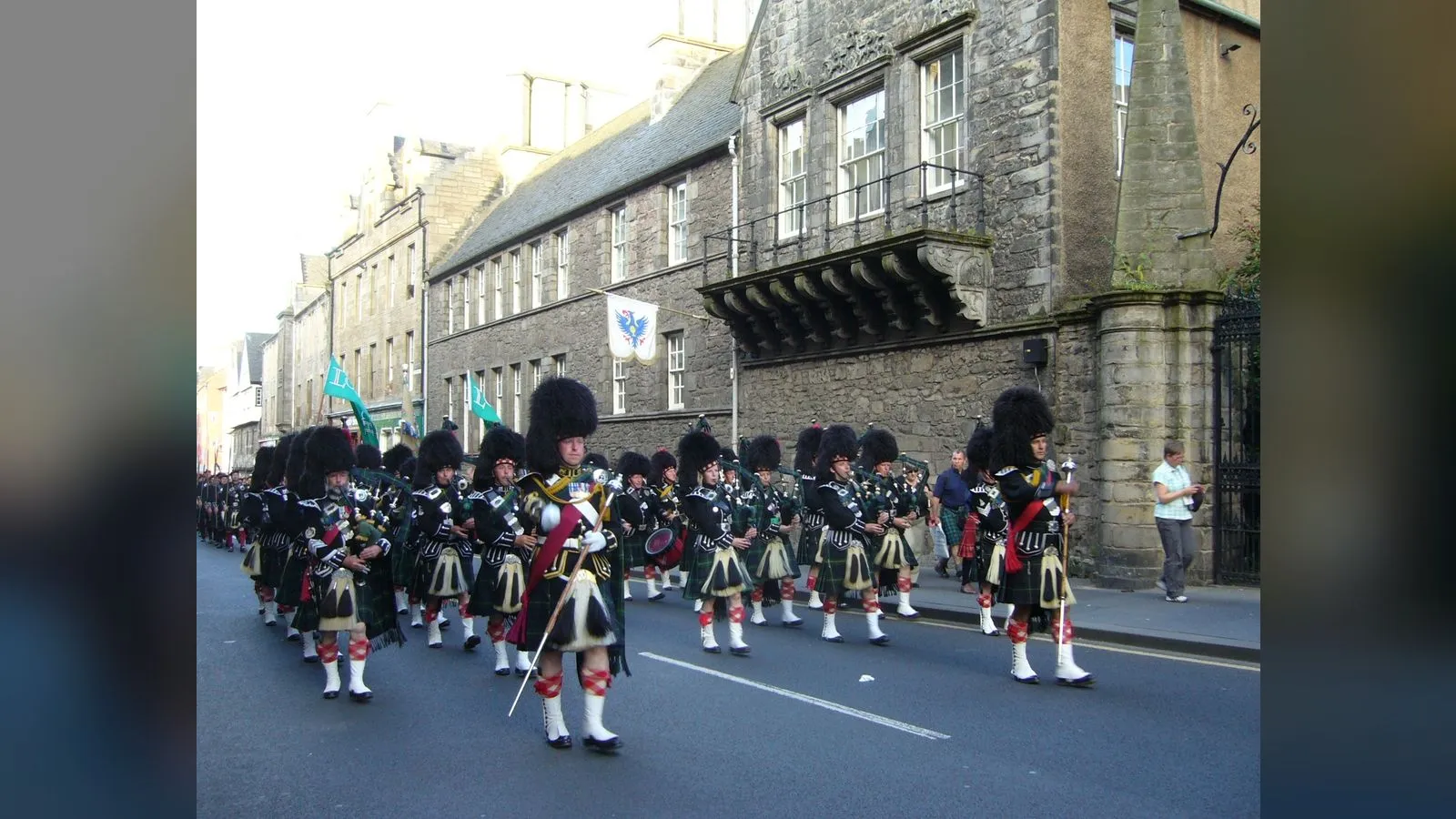

Pipes & Drums: The Military Piping and Drumming Traditions of the British Army
TL;DR
- This is the Defence series' dedicated thematic card on military piping and drumming — the origins, institutions, personalities and mythology of the Pipes & Drums — distinct from Card #44's detailed account of Piper Daniel Laidlaw at Loos and Card #46's treatment of Highland dress.
- established Pipers served with Scottish regiments from at least the early 17th century, but the formal institutionalisation of piping in the British Army is precisely dated — a War Office order of 28 January 1854 first placed one Pipe Major and five pipers on the official establishment of each Highland regiment. The pipe band (pipers plus drummers) developed in the 1850s–1870s.
- Documented battlefield heroism is real but narrow: three pipers won the Victoria Cross (Findlater at Dargai 1897; Laidlaw at Loos 1915; the Canadian James Richardson at Regina Trench 1916). Their VC citations are firmly documented; much of the surrounding retelling is embellished.
- Two popular claims require careful handling (Disputed/Traditional): the "500 killed, 600 wounded" WWI piper-casualty figure traces to a single 1920 fundraising book and is an unverified estimate; and the "War Office banned pipers from the front" story is folklore — no dated order has ever been produced. Piping was withdrawn by regimental and divisional discretion, not a central edict.
- Today the Pipes & Drums survive as a ceremonial and competitive tradition. Three regular battalions of the Royal Regiment of Scotland maintain pipes and drums carrying their antecedent regiments' tartans; the Army School of Bagpipe Music and Highland Drumming at Edinburgh Castle trains pipe majors, and the competitive world is governed by the RSPBA's World Pipe Band Championships.
Key Facts
- Period covered: c. 1400 (first firm evidence of bagpipes in Scotland) → 1854 (formal Army institutionalisation) → 1914–1945 (combat piping and its decline) → present (ceremonial/competitive).
- Key institutions: The Army School of Bagpipe Music and Highland Drumming (Edinburgh Castle); the Piobaireachd Society (founded 1902); the Royal Scottish Pipe Band Association (founded 1930); the National Piping Centre (Glasgow, 1996).
- Notable feature: The "Pipes and Drums" is a distinct musical body from the brass/reed "Military Band"; a pipe major's role is an appointment, not a rank.
- Current status/legacy: Living tradition within the Royal Regiment of Scotland and worldwide competitive piping; the pipe band is now more a symbol of Scottish identity than a battlefield instrument.
Scottish Impact Index (SI Score)
- Military Impact
- 7/10
- Enduring Significance
- 10/10
- Strategic Importance
- 6/10
- Military Distinctiveness
- 10/10
- Military Legacy
- 10/10
- Recognition
- 10/10
53/60
Ranked =12th of 43 in Defence
Claim Status
Consistent with the site's "accuracy over patriotism" standard and the three-tier framework used on Card #46:
- Established (documented): The 1854 War Office establishment order; the existence and dates of the three piper VCs and the exact wording of their citations; the founding dates of the Piobaireachd Society (1902), the Army piping class (1910), the RSPBA (1930) and the National Piping Centre (1996); the survival of pipes and drums in the Royal Regiment of Scotland.
- Shared / Traditional: Pre-1854 accounts of individual regimental pipers (e.g. Kenneth MacKay at Waterloo, 1815) — genuinely rooted in regimental record and tradition but embroidered over time; the deep clan-piping antecedents of military piping.
- Disputed / Requires caution: (1) The psychological effect of pipes on enemy troops — largely undocumented, and closely tied to the debunked "Ladies from Hell" story addressed on Card #46. (2) The "500 killed / 600 wounded" WWI casualty statistic — an unverified 1920 estimate. (3) The "War Office banned the pipes" narrative — folklore with no located order. (4) Pre-18th-century origins of Scottish military piping — evidentially thin before c. 1400.
Timeline
Earliest firm evidence of bagpipes in Scotland; the "warpipes" reference at the Battle of the North Inch, Perth (1396) and 15th-century carvings at Melrose Abbey and Rosslyn Chapel.
A French account records bagpipes ringing out at the Battle of Pinkie; the historian George Buchanan later wrote that pipes had replaced the trumpet as Scotland's battle instrument.
The Royal Scots hold records referring to pipers.
After Culloden, piper James Reid is executed for treason; the court rules that a Highland regiment never marched without a piper, so the pipes were "an instrument of war."
Piper Kenneth MacKay of the 79th (Cameron Highlanders) plays outside the regimental square at Waterloo.
War Office order places one Pipe Major and five pipers on the official establishment of each Highland regiment — the key institutionalisation date.
Drummers added; the modern pipe band emerges.
Piper George Findlater wins the VC at Dargai.
The Piobaireachd Society is founded.
First official Army piping class opens at Cameron Barracks, Inverness, under Pipe Major John MacDonald.
Piper Daniel Laidlaw (Loos, VC) and Piper James Richardson (Regina Trench, VC).
Publication of The Pipes of War, source of the famous casualty estimate.
The Scottish (later Royal Scottish) Pipe Band Association is founded.
Pipers lead companies at the Second Battle of El Alamein; heavy losses; the custom of piping into action is largely discontinued.
Bill Millin pipes on Sword Beach, D-Day.
Last combat use of the pipes — the Argyll and Sutherland Highlanders enter Crater, Aden.
The National Piping Centre opens in Glasgow.
The Royal Regiment of Scotland is formed; battalions retain their antecedent pipes and drums.
Details
Origins and early documented military function
The bagpipe is not native to Scotland; it appears in European art from the 13th century and is first firmly attested in Scotland around 1400. The earliest Scottish references place the instrument squarely in a military context: "warpipes" carried into the Battle of the North Inch of Perth in 1396, and, by the 16th century, the pipes functioning as the recognised sound of battle — a French source noting them at Pinkie (1547) and George Buchanan describing them as having supplanted the trumpet.
The deeper, pre-18th-century story must be labelled traditional rather than documented. Claims of bagpipes at Bannockburn (1314) rest on a disputed clan relic; legends of hereditary piping dynasties such as the MacCrimmons of Skye are culturally important but poorly evidenced in contemporary record. What can be said with confidence is that piping's functional battlefield roles — signalling, keeping time on the march, rallying and steadying troops, and providing a psychological lift to friendly soldiers — are genuine and long attested, and that these grew out of the clan system before being absorbed into formal regimental structures.
Crucially, William Donaldson's The Highland Pipe and Scottish Society 1750–1950 (Saltire Society joint Research Book of the Year) reframes much of the romantic origin story as "myth-making," insisting on contemporary documentary evidence over inherited legend — the scholarly posture this card adopts.
Institutional development: Pipe Majors, Pipe Sergeants and pipe bands
Pipers served with Scottish regiments long before they were formally recognised: they were often privately employed and paid by officers, or carried on strength as ordinary soldiers or drummers. The decisive institutional moment came on 28 January 1854, when the War Office ordered each Highland regiment to add one Pipe Major and five pipers to its establishment — an elite paid at special rates (1s 10d per day for the Pipe Major, 1s 1d for a piper). The order applied only to Highland regiments; the Guards, Lowland Scots and Irish battalions continued to hold pipers unofficially.
With the addition of drummers in the 1860s–1870s, the pipe band emerged as a body distinct from the individual regimental piper. Two roles crystallised:
- The Pipe Major, director of bagpipe music — an appointment, not a rank, requiring at least the rank of sergeant and (from the 20th century) success at the Army piping course. In the early 20th century the term "Sergeant Piper" was also used.
- The Pipe Sergeant, the pipe major's deputy, responsible for tuning the band and standing in when needed.
A remarkable feature of Army piping is that its teaching tradition was built not by the Army but by a private body. The Piobaireachd Society (founded 1902) organised competitions, published settings, and — led by Lord Lovat — pushed a reluctant War Office to fund an Army piping class, which opened at Cameron Barracks, Inverness, in October 1910 under Pipe Major John MacDonald, the Army's first "Professor of Piping." The Society retained the right that no man be promoted Pipe Major without its certificate. This tuition tradition evolved into today's Army School of Bagpipe Music and Highland Drumming at Edinburgh Castle, closely associated with the legendary teacher Pipe Major Willie Ross. Highland drumming developed its own demanding rudimental idiom; the introduction of rod-tension (later Kevlar-headed, high-tension) snare drums from 1932 transformed the drum corps sound.
Notable individual pipers and documented actions
Only three pipers have ever received the Victoria Cross, and their citations are the gold standard of documented piper heroism:
- Piper George Findlater (Gordon Highlanders), Dargai Heights, 20 October 1897. Shot through both feet and unable to stand, he propped himself up and continued playing the regimental march. His citation, published in the London Gazette of 20 May 1898, reads: "George Findlater, Piper, The Gordon Highlanders… after being shot through both feet, and unable to stand, sat up, under heavy fire, playing the Regimental March to encourage the charge of the Gordon Highlanders." Findlater became a Victorian celebrity — later drawing criticism for performing his "finest hour" on the music-hall stage.
- Piper Daniel Laidlaw (King's Own Scottish Borderers), Loos, 25 September 1915. Covered in full on Card #44; here noted only as the second piper VC — he mounted the parapet under gas and fire and piped his company out of the trench.
- Piper James Cleland Richardson (16th Canadian Scottish), Regina Trench, 8 October 1916. Scottish-born, Canadian-raised. Company Sergeant-Major Mackie's firsthand account, preserved in the Dictionary of Canadian Biography, recalls: "Things looked very bad, and then it was that the piper asked if he would play his pipes — 'Wull I gie them wund [wind]?'… I told him to go ahead, and as soon as he got them going I got what men I could together, we got through the wire and started cleaning up the trench." Richardson strode up and down before the uncut wire playing for some ten minutes and the company took the position; he was killed after turning back to recover his pipes, and was gazetted VC posthumously on 22 October 1918. The Dictionary of Canadian Biography notes he was "only the third piper within the imperial forces to receive the Victoria Cross since it was instituted in 1856."
Earlier and later actions belong to tradition and regimental record rather than to the formal honours system. Piper Kenneth MacKay of the 79th at Waterloo (1815) — stepping outside the square under cavalry attack to play Cogadh no Sith ("War or Peace") — is genuinely rooted in regimental history but has accreted embellishment. In the Second World War, pipers led companies at El Alamein (1942), and Bill Millin famously piped on Sword Beach on D-Day (1944) at Lord Lovat's request. Millin's own later account — that captured German snipers said they had not shot him because they thought he was mad — is a good example of a vivid but essentially anecdotal, uncorroborated story.
The psychological-warfare question, examined
Two distinct claims must be separated.
Effect on friendly troops — documented. There is solid evidence that pipes raised the morale of the soldiers who marched and fought to them: they steadied nerves, kept time, signalled, identified units in darkness, and rallied men at moments of crisis. Dr Yvonne McEwen of the University of Edinburgh describes the pipes as "a way of driving the men on and intrinsically linked to Scottish identity." The VC citations themselves record the effect on the pipers' own comrades ("The effect was instantaneous").
Effect on the enemy — largely undocumented. The popular idea that the skirl of the pipes struck terror into German or other enemy troops is far weaker. This is the direct cousin of the "Ladies from Hell" story mythbusted on Card #46: German-language sources do not use that nickname, and in 2007 the German historian Dr Benjamin Ziemann concluded that German soldiers were no more or less afraid of Scottish troops than of any other adversary — a finding corroborated by the researcher Rob Schäfer, who notes that "no written records, either personal or journalistic" show Germans using the term "Ladies from Hell." German propaganda in fact mocked the kilted piper — most strikingly a 1915 cast-iron medallion depicting "Death as a Scottish Piper," commemorating a German victory and portraying the pipers' advance as suicidal folly, not something to be feared. The honest verdict: pipes were a real morale weapon for the side that owned them, and their terror value against the enemy is a patriotic embellishment unsupported by enemy testimony.
The casualty figures and the "ban" — a rigorous look
Two of the most-repeated "facts" about WWI piping do not survive scrutiny.
The figure that "of 2,500 pipers in the Great War, 500 were killed and 600 wounded" originates from a single source: The Pipes of War (1920) by Sir Bruce Seton and Pipe Major John Grant, with a foreword by Field-Marshal Earl Haig. Its preface states plainly: "With 500 pipers killed and 600 wounded something must be done to raise a new generation of players; it is a matter of national importance… The Piobaireachd Society intend to institute a Memorial School of piping for this purpose, and all profits from the sale of this book will be handed over to their fund." That closing sentence is telling: the book was compiled from correspondence with commanding officers and pipe majors — a self-reported wartime tally, not an official casualty return — and it was explicitly a fundraiser, giving its authors reason to present a compelling, round-numbered case. The leading modern scholar of the subject, Dr M. J. Grant of the University of Edinburgh (in "Bagpipes at the Front," 2015), relies on the book but warns that "the information it contains is not always accurate." Competing figures in circulation (from "over 1,000 died" to one recent upward revision to "over 2,000 killed") confirm there is no single authoritative statistic. Treat 500/600 as a traditional 1920 estimate, not a documented fact.
The claim that the War Office "banned" pipers from the front line is weaker still. No dated order, Army Council Instruction, or regulation has ever been produced, and popular sources themselves hedge with "reputedly." What actually happened, documented in The Pipes of War and regimental histories, is that pipers — harder to replace than ordinary soldiers — were increasingly kept "in relative security" and reassigned as stretcher-bearers or runners, by battalion and divisional decision, as pipe bands were shattered by casualties. Colonel David Murray's history of the 51st Highland Division records that piping companies into action "had been discontinued after the early battles of the Great War" and that after El Alamein "it was decided that all pipers and drummers should be concentrated at Divisional Headquarters" — again a local decision, not a War Office edict. The Bill Millin / Lord Lovat exchange ("that's the English War Office… and that doesn't apply") attests to a belief among soldiers that restrictions existed, but is anecdote, not documentation. Verdict: the practice changed; the central "ban" is folklore.
Evolution to ceremonial and competitive piping today
As combat piping declined — its last operational use was the Argyll and Sutherland Highlanders piping into Crater, Aden, in 1967 — the Pipes & Drums moved decisively into ceremonial and competitive life. Competitive pipe-band culture had in fact been developing in parallel since the early 20th century: pipe-band contests are recorded from around 1905–1906 (the first "World" contest at the Cowal Highland Gathering, Dunoon, 1906), and the Scottish Pipe Band Association was founded in 1930 to bring order to the movement, gaining "Royal" status in 1980. The RSPBA now runs the World Pipe Band Championships each August in Glasgow. The event is vast: RSPBA chief executive Colin Mulhern noted that the 2025 Worlds "saw 204 bands from 13 countries taking part, and more than 7,000 pipers and drummers taking to the field at Glasgow Green," before crowds of over 35,000 across the two days.
Within today's British Army, three regular battalions of the Royal Regiment of Scotland (formed 2006) maintain their own pipes and drums, each wearing the ceremonial uniform and tartan of its antecedent regiment. These pipers and drummers have played at the highest state occasions — the Platinum Jubilee, the late Queen's funeral, and the coronation of King Charles III — and appear regularly at the Royal Edinburgh Military Tattoo. In 2026, marking its 20th anniversary, the regiment published its first Regimental Pipe Music Book. Institutions such as the National Piping Centre (Glasgow, 1996, incorporating the College of Piping since 2018) and the Museum of Piping preserve and teach the tradition, holding the Iain Dall MacKay chanter — the oldest surviving Highland bagpipe chanter in the world.
Did You Know?
- The bagpipe is not originally Scottish: it appears in European art from the 13th century and is first firmly attested in Scotland only around 1400.
- After Culloden, the piper James Reid was executed in 1746; the court rejected his defence that pipes were not a weapon, ruling that because no Highland regiment marched without a piper, the pipes were "an instrument of war."
- The Army did not create its own piping school — a private charity, the Piobaireachd Society, dragged a reluctant War Office into funding formal tuition from 1910, and for decades supplied the teacher, the equipment and even the blackboard.
- A pipe major is not a rank but an appointment; in the early 20th century the equivalent term was "Sergeant Piper."
- Only three pipers have ever won the Victoria Cross, and one of them — James Richardson — was killed only because he went back for the pipes he had left behind.
- Piper George Findlater became such a celebrity after Dargai that his music-hall performances caused a scandal in Parliament and prompted a rule granting future VC recipients an annuity so they need not "hire themselves out."
- Pipe bands played on rope-tension drums until 1932, when the Premier company's rod-tension drums — first used competitively by Dalziel Highland Pipe Band — transformed the sound of Highland drumming.
- German WWI propaganda mocked rather than feared the piper: a 1915 medallion depicted "Death as a Scottish Piper" to portray the Highlanders' advance as suicidal folly.
FAQ
1Why is this card separate from Cards #44 and #46?
Card #44 covers the Battle of Loos and Piper Daniel Laidlaw's VC in detail; Card #46 covers Highland dress and the "invention of tradition." Card #47 is the dedicated thematic treatment of military piping and drumming as a subject in itself — origins, institutions, personalities and mythology — referencing Laidlaw only briefly.
2When did piping become a formal part of the British Army?
The key date is 28 January 1854, when the War Office ordered each Highland regiment to add one Pipe Major and five pipers to its official establishment. Pipers had served unofficially for centuries before that, but this order created the recognised institutional structure.
3What is the difference between a Pipe Major and a Pipe Sergeant?
The Pipe Major is the director of bagpipe music, responsible for tune selection, standards and the band's discipline; the Pipe Sergeant is the deputy, tuning the band and leading it in the Pipe Major's absence. Both are appointments held by senior NCOs, not distinct ranks.
4How many pipers won the Victoria Cross?
Three: George Findlater (Dargai, 1897), Daniel Laidlaw (Loos, 1915) and James Cleland Richardson (Regina Trench, 1916). Their VC citations are firmly documented; many other pipers received the DCM or Military Medal.
5Did bagpipes really terrify the enemy?
There is little documentary support for this. Pipes demonstrably raised the morale of friendly troops, but enemy sources — especially German — do not record fear of the pipes; German propaganda mocked kilted pipers. The "terror weapon" idea is largely a patriotic embellishment, akin to the debunked "Ladies from Hell" story.
6Were pipers really banned from the front line?
No dated War Office order banning pipers has ever been found. After heavy WWI losses, pipers were increasingly kept in relative safety and reassigned by regimental and divisional decision, not by a central edict. The popular "the War Office banned it" story is folklore, often hedged with the word "reputedly."
7Is the "500 killed, 600 wounded" figure reliable?
It should be treated with caution. It comes from a single 1920 fundraising book, The Pipes of War, based on self-reported returns rather than official records. Competing figures circulate, and the leading modern scholar warns the book is "not always accurate."
8Who was Kenneth MacKay?
A piper of the 79th (Cameron Highlanders) who, at Waterloo in 1815, is traditionally said to have stepped outside the regimental square under French cavalry attack to play Cogadh no Sith. The story is rooted in regimental record but has been embellished over time.
9Who was Bill Millin?
Personal piper to Lord Lovat, who piped commandos ashore on Sword Beach on D-Day, 1944 — a rare wartime instance of combat piping after the practice had largely ended. His account that Germans spared him as a madman is a vivid but uncorroborated anecdote.
10What is piobaireachd?
Also called ceòl mòr or pibroch, it is the classical, solo, theme-and-variation art music of the Highland bagpipe — distinct from the marches, strathspeys and reels of the pipe band. Its preservation was the founding purpose of the Piobaireachd Society in 1902.
11Where can I see military piping today?
The Royal Regiment of Scotland's battalion pipes and drums perform at state ceremonies and the Royal Edinburgh Military Tattoo; competitive piping culminates at the RSPBA World Pipe Band Championships in Glasgow each August; and the National Piping Centre in Glasgow houses the Museum of Piping.
12Is the pipe band still used in combat?
No. The last operational use of the pipes in action was the Argyll and Sutherland Highlanders entering the Crater district of Aden in 1967. The Pipes & Drums are now a ceremonial and competitive body, though pipers may still be assigned other military duties.
Sources
Primary / Institutional
- National Army Museum, London — collections and VC records for Piper George Findlater (Dargai).
- The Highlanders' Museum (Fort George) — Kenneth MacKay and Cameron Highlanders material.
- Veterans Affairs Canada / Library and Archives Canada / Dictionary of Canadian Biography — Piper James Cleland Richardson VC.
- The Royal Regiment of Scotland and the British Army — Pipes and Drums / Band of the Royal Regiment of Scotland.
- Royal Scottish Pipe Band Association (RSPBA) — history and World Pipe Band Championships.
- The National Piping Centre / Museum of Piping, Glasgow.
- Seton, Sir Bruce, & Grant, John (Pipe Major), The Pipes of War (1920) — primary source of the WWI casualty estimate (use critically).
Scholarly
- Donaldson, William, The Highland Pipe and Scottish Society 1750–1950 (Tuckwell/Birlinn) — the standard critical history.
- Grant, M. J., "Bagpipes at the Front: Pipers and Piping during Combat in the Great War" (2015).
- Henderson, Diana M., history of the Army School of Piping (British Army Review, 1988; reprinted).
- Malcolm, C. A., The Piper in Peace and War (1927).
- Ziemann, Benjamin — on German soldiers' attitudes to Scottish troops (re "Ladies from Hell").
General further reading
- Piping Press — "The History of Army Piping and Regimental Pipe Bands" series.
- National Army Museum online features on Highland regiments and the Victoria Cross.
- Historic UK — "Scottish Piper War Heroes" (popular overview; use with caution).
Honest Caveats
- Psychological warfare against the enemy: The claim that pipes terrified opposing troops is largely undocumented and should be presented sceptically. Pipes were a genuine morale weapon for friendly troops; enemy testimony of fear is essentially absent, and German propaganda mocked the piper. This mirrors the "Ladies from Hell" mythbusting of Card #46.
- Pre-18th-century origins: Bagpipes are firmly attested in Scotland only from around 1400; earlier military-piping claims (Bannockburn relics, hereditary piping dynasties) are traditional, not documented.
- The "500 killed / 600 wounded" figure: An unverified 1920 estimate from a fundraising book, not an official statistic.
- The "War Office ban": Folklore; no dated order exists. Piping was withdrawn by regimental/divisional discretion as casualties mounted.
- Individual heroics: Distinguish the three firmly documented piper VC citations from embellished retellings (e.g. MacKay at Waterloo; Millin's "they thought I was mad").
- Thematic scope: This card deliberately does not re-narrate individual regimental histories (Cards #5–14), the Balaclava "Thin Red Line" (Card #27), the Laidlaw/Loos story (Card #44), or Highland dress (Card #46).
Card 047 · Defence