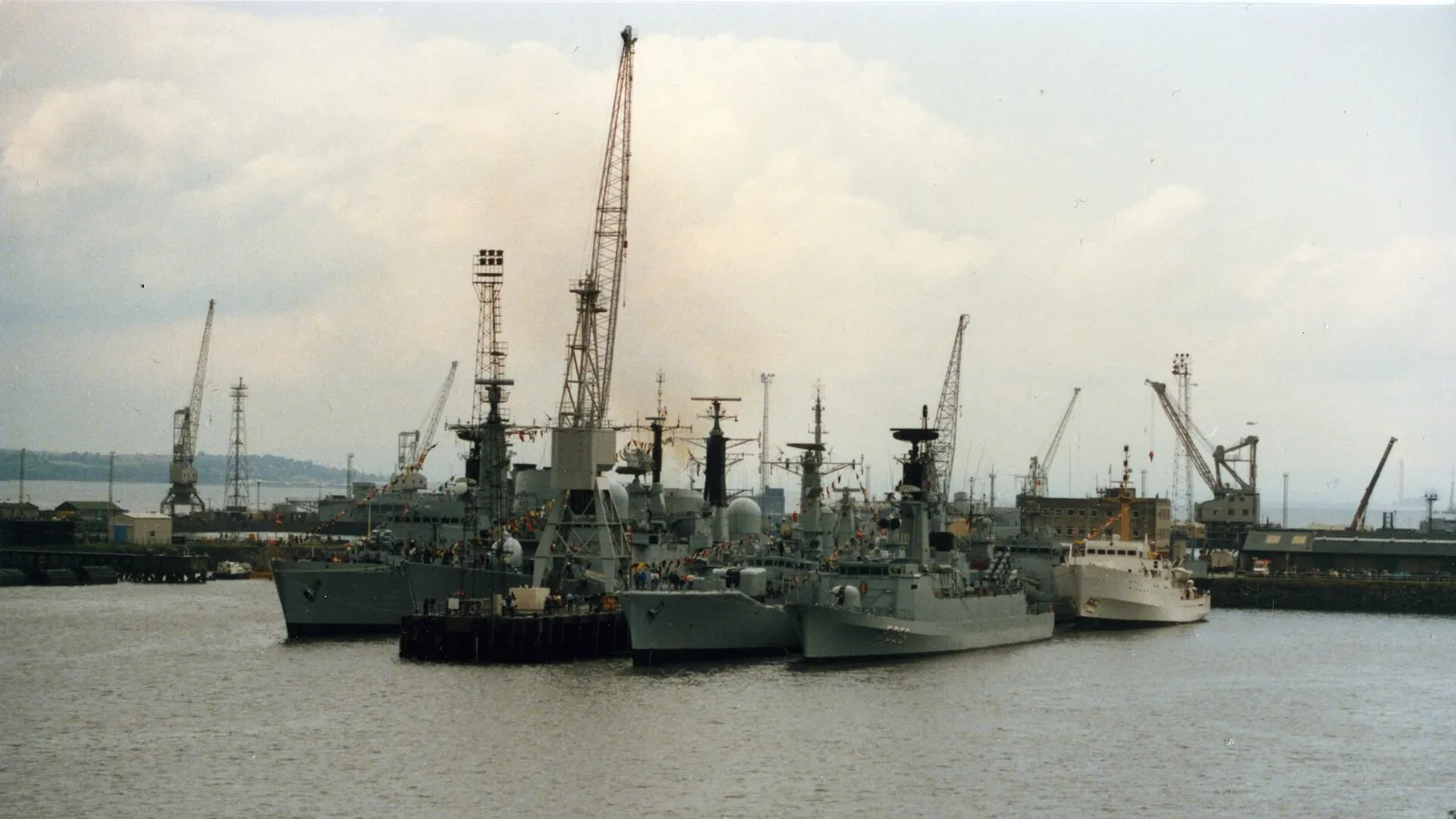

Rosyth Naval Base
Contents
Defence Series, Card #37 of 50 · ScottishInventions.com · Editorial standard: "accuracy over patriotism"
TL;DR
- This is the dedicated institutional card for Rosyth Naval Base itself. Card #35 ("Firth of Forth Defences") covered its 1903 decision, 1909–1916 construction and its WWI/WWII estuary-defence role; Card #36 ("Scapa Flow") handled the Rosyth-versus-Scapa comparison. This card concentrates on the institution's life story with new depth on the interwar/WWII operational role, the Cold War submarine era, privatisation, the laid-up nuclear submarines, and modern shipbuilding. established
- Rosyth was a Royal Navy submarine refitting base through the Cold War, handling all four Polaris (Resolution-class) ballistic-missile boats and numerous nuclear and conventional refits; its first nuclear refit (HMS Dreadnought) completed in 1970 and its last submarine refit (HMS Sceptre) ended in 2003. established
- In 1993 Rosyth lost the Trident/nuclear-submarine refit contract to Devonport, the operational naval base (HMNB Rosyth) closed in 1994–95, and in January 1997 Babcock bought the yard — Britain's first privatised naval dockyard. established
- Rosyth is a storage site for laid-up decommissioned nuclear submarines — seven boats, all now defuelled, some tied up since the 1980s — an issue repeatedly criticised by the National Audit Office and Public Accounts Committee and treated here honestly as an unresolved environmental/nuclear-legacy problem. [Established; contested in interpretation]
- Rosyth is now central to UK naval shipbuilding: final assembly of both Queen Elizabeth-class carriers (2009–2017) and construction of the five Type 31 (Inspiration-class) frigates, plus the world-first full dismantling of a nuclear submarine (HMS Swiftsure). established
Key Facts
- Period covered by this card
- Interwar (1925 closure) → present day (2026)
- Key institution
- Royal Naval Dockyard / HM Naval Base Rosyth; now Babcock International (Rosyth Royal Dockyard Ltd)
- Location
- Rosyth, Fife, on the north shore of the Firth of Forth
- Notable feature
- Britain's first privatised naval dockyard (1997); UK carrier assembly & Type 31 frigate build hall; nuclear-submarine storage and dismantling site
- Current status/legacy
- Active commercial shipyard (Babcock); Submarine Dismantling Project site; adjacent MoD/HMS Caledonia naval support base
Scottish Impact Index (SI Score)
- Military Impact
- 9/10
- Enduring Significance
- 9/10
- Strategic Importance
- 10/10
- Military Distinctiveness
- 8/10
- Military Legacy
- 9/10
- Recognition
- 8/10
53/60
Ranked =12th of 43 in Defence
Claim-status / evidence framing
This card applies the site's three-tier framework:
- Established (documented): The interwar closure (1925) and 1938 reopening; the Cold War submarine-refit role and its 1993 transfer to Devonport; the 1994–95 base closure; the 1987 management contract and 1997 outright privatisation to Babcock; the storage of seven laid-up submarines; the carrier assembly and Type 31 programme. These rest on Hansard, National Audit Office and Public Accounts Committee reports, Historic Environment Scotland (Canmore) records, the Office for Nuclear Regulation and Babcock/Royal Navy documentation.
- Shared/traditional: Popular shorthand such as calling Rosyth "Scotland's nuclear graveyard," or describing it simply as "the yard that builds carriers." Broadly fair but incomplete.
- Disputed / requiring honest treatment: The safety and environmental risk posed by the laid-up submarines, and the wisdom and cost of the UK's long-delayed disposal programme. The physical facts are documented; the interpretation (how serious the risk is) is genuinely contested between the MoD/regulators and campaigners. This card flags the laid-up submarines explicitly as an ongoing, unresolved issue rather than glossing over it.
Timeline
Dockyard closed after post-WWI rundown (short-time working from 1921).
Reopened as relations with Germany deteriorated; recommissioned as a naval base (HMS Cochrane).
Served as a repair/servicing hub for capital ships, cruisers and destroyers of the Home Fleet operating in the North Sea.
Designated the major refitting base for the Polaris (Resolution-class) SSBN fleet.
First nuclear refit completed: HMS Dreadnought (core refuelled).
Rosyth prepares and converts ships for the Falklands Task Force; 3rd Destroyer Squadron based there.
HMS Dreadnought towed in for lay-up — the first laid-up nuclear submarine at Rosyth.
Chosen as sole location for refitting the RN nuclear submarine fleet; major rebuilding from 1986.
Babcock Thorn awarded the management contract (government-owned, contractor-operated).
Nuclear/Trident refit contract awarded to Devonport instead; refit role lost.
Decommissioning of HMNB Rosyth as an operational naval base begins (formally closed 1995–96).
Babcock International buys the dockyard outright — Britain's first privatised naval dockyard.
HMS Sceptre leaves after a six-year refit — the last submarine refitted at Rosyth.
Final assembly of HMS Queen Elizabeth and HMS Prince of Wales.
Submarine Dismantling Project begins at Rosyth.
Public Accounts Committee condemns the "unacceptable and unnecessary" failure to dispose of the boats.
Type 31 frigate construction; HMS Swiftsure dismantling under way.
MoD Caledonia recommissioned as HMS Caledonia; future assured.
Details
Cross-reference to Card #35 (establishment)
The decision to build Rosyth (1903), its construction by Easton, Gibb & Son (1909–1916), the first ship to dry-dock (the pre-dreadnought HMS Zealandia, March 1916) and its role as a Grand Fleet base in the First World War are covered on Card #35 ("Firth of Forth Defences") as part of the estuary's wider coastal-defence story. Card #36 ("Scapa Flow") addressed the comparative significance of Rosyth versus Scapa as fleet anchorages. This card picks up the institution's story from the interwar rundown onward.
Interwar rundown and the Second World War
Rosyth's fortunes fell sharply after 1918. Short-time working was introduced in 1921 and the dockyard closed in 1925 as the Royal Navy contracted in the era of the Washington Naval Treaty and the "Ten Year Rule." It stood largely dormant until 1938, when deteriorating relations with Germany prompted reopening; the naval base was recommissioned as HMS Cochrane.
During 1939–1945 Rosyth's institutional role was that of a repair, refit and servicing yard rather than a shipbuilding one — a distinction worth stressing, because Rosyth has historically been a maintenance and refit dockyard, not a construction yard (unlike the Clyde builders). It serviced battleships, battlecruisers, cruisers and destroyers of the Home Fleet operating in the North Sea, and was strategically important during the German occupation of Norway. The broader Firth-of-Forth coastal-defence infrastructure (booms, batteries, the anti-submarine defences guarding the anchorage) belongs to Card #35.
The Cold War submarine-refit era — the core new content
After 1945 the base was retained to counter the Soviet Northern and Baltic Fleets, its northern location again an advantage. But with the decline in heavy surface ships the yard needed a new purpose, and it found one in nuclear submarines.
Following the major defence realignment of the late 1960s, Rosyth was designated the major refitting base for the Polaris (strategic ballistic-missile) nuclear submarine fleet — the four Resolution-class boats (HMS Resolution, Repulse, Renown, Revenge) that carried Britain's deterrent. Those boats were based at Faslane on the Clyde but refitted at Rosyth. Crucially, the dockyard was re-equipped to service the submarines and their reactors — but not their missiles or warheads.
Rosyth's first nuclear refit was that of HMS Dreadnought, Britain's first nuclear submarine, completed in September 1970, during which her reactor core was refuelled. Rosyth went on to carry out all of the refits of Britain's Polaris submarines — the rededication of HMS Renown, whose refit had run unusually long (around four years), took place in late 1992. During the Cold War, nuclear-submarine refitting was in fact split across three yards — Chatham, Rosyth and (from 1981) Devonport — with Chatham handling most of the early Valiant/Churchill-class fleet-submarine refuelling refits and Rosyth specialising in the SSBN fleet. In the 1990s Rosyth also refitted Swiftsure-class attack submarines (HMS Splendid, Spartan and Sceptre).
In 1984 Rosyth was chosen as the sole location for refitting the entire RN nuclear submarine fleet, and from 1986 extensive rebuilding began to create a new nuclear refitting complex, including covered docks for SSBN and SSN refits. This is where the story turns: in 1993, after a two-year, highly politicised contest, the government awarded the Trident and nuclear-submarine refit contract to Devonport Management Limited instead. Rosyth's half-built nuclear complex was stranded; critics in Scotland argued the decision was politically motivated to protect Conservative seats in the south-west (the government maintained it was on value-for-money grounds). The last submarine refitted at Rosyth was HMS Sceptre, which left in 2003 after a six-year refit, ending more than three decades of nuclear-submarine work.
The laid-up nuclear submarines — examined honestly
Rosyth has been a storage site for decommissioned nuclear submarines since 1983, when HMS Dreadnought — by then withdrawn (1980) — was towed in and laid up afloat. Over time the Polaris SSBNs and several attack submarines joined her. As of the most recent reporting, seven decommissioned nuclear submarines are laid up at Rosyth, all of them now defuelled — the four Resolution-class SSBNs (Resolution, Repulse, Renown, Revenge) and attack submarines including Dreadnought, Churchill and Swiftsure. A further set of boats (some still fuelled) are stored at Devonport.
This is a genuine, documented and unresolved problem, and the site's standard requires stating it plainly:
- The UK has never fully disposed of a nuclear submarine. HMS Dreadnought has now been laid up far longer than she was in active service.
- Storage is expensive. The National Audit Office's April 2019 report, Investigation into Submarine Defuelling and Dismantling, found that maintaining the laid-up units since 1980 had cost the Ministry of Defence about £500 million — roughly £30 million a year — and that in its most recently published accounts the department estimated the boats represented a total disposal liability of £7.5 billion.
- Oversight bodies have been scathing. The House of Commons Public Accounts Committee in June 2019 concluded that "the continual failure to progress submarine disposal has created an unacceptable and unnecessary problem for the department," noting that "the projects needed to allow disposal to happen have been beset by delays, with an 11-year delay to defuelling and a 15-year delay to dismantling." PAC chair Meg Hillier attacked the MoD's "dismal lack of progress" and warned it must act "before we run out of space."
- Regulators police the site. The Office for Nuclear Regulation (ONR) regulates nuclear safety and security and the Scottish Environment Protection Agency (SEPA) regulates radioactive-substance disposal. ONR has taken enforcement action at Rosyth (in 2015 over a building's readiness) and ordered a failed emergency exercise ("Nightstar") to be rerun. Anti-nuclear campaigners and local politicians have raised concerns about turning Fife into a "toxic dump" and about accident risk.
The MoD's and regulators' position is that the boats are safely maintained and monitored and pose no risk to the public or environment; campaigners argue the continuing storage represents an avoidable radiological risk and that no permanent disposal route (a Geological Disposal Facility) has yet been agreed. Both the documented facts and the contested interpretation are set out here rather than smoothed over.
The disposal effort is finally moving. The Submarine Dismantling Project (SDP) began at Rosyth in December 2016, and HMS Swiftsure is the "demonstrator" boat, brought into No. 2 dry dock on 27 July 2023 and due to be fully dismantled by the end of 2026 — the first pressurised-water-reactor submarine anywhere in the world to be fully dismantled rather than have its reactor compartment cut out and buried. Low-level waste has also been removed from Resolution, Revenge and Repulse; the Submarine Delivery Agency reports that HMS Resolution, with 50 per cent greater tonnage than Swiftsure, completed her first-stage cleaning in three-quarters of the time, with subsequent boats moving faster and at lower cost. Defuelling of decommissioned boats — halted since around 2003–04 because facilities no longer met modern standards — is planned to restart. Progress at Rosyth is described by specialists as encouraging but slow, and much of the backlog sits at Devonport.
Decommissioning as an operational base and the 1997 privatisation
Two separate things are often conflated: the closure of the operational naval base and the privatisation of the dockyard.
The operational naval base (HMNB Rosyth) was run down and closed in the mid-1990s. After the 1993 loss of the refit contract and the post-Cold-War "Options for Change" cuts, HMNB Rosyth and its tender establishment HMS Cochrane closed in 1994–95; the 3rd Destroyer Squadron moved to Portsmouth. No Royal Navy warships are now permanently based at Rosyth.
The dockyard's privatisation ran on a parallel but distinct track. In 1987 a management contract was awarded to Babcock Thorn (a Babcock/Thorn EMI consortium), making Rosyth a government-owned, contractor-operated yard — in parallel with Devonport Management Limited's contract at Plymouth. In 1993 the MoD announced plans to privatise Rosyth outright; Babcock (having bought out Thorn's share) was the only bidder, and after protracted negotiations purchased the yard in January 1997, with a new nuclear site licence granted to Rosyth Royal Dockyard Ltd on 30 January 1997. This made Rosyth the first privatised naval dockyard in Britain — Devonport followed later. Institutionally, this ended nearly a century of direct Admiralty/MoD ownership of the yard and set Rosyth on its path as a commercial shipyard competing for defence and civil work.
The modern naval-industrial role — carriers and Type 31 frigates
Privatisation and the loss of submarine work forced Rosyth to reinvent itself, and it did so spectacularly by becoming the UK's carrier-assembly site.
Queen Elizabeth-class carriers. Both HMS Queen Elizabeth and HMS Prince of Wales were built in a modular "blocks" approach across six UK shipyards (BAE Systems at Govan and Portsmouth, Babcock at Appledore and Rosyth, A&P Tyne at Hebburn, and Cammell Laird at Birkenhead), with final assembly and integration at Rosyth — the only UK dock big enough for the job. HMS Queen Elizabeth's keel was laid at Rosyth on 7 July 2009; giant hull blocks were barged to Rosyth (Lower Block 03 travelled around the north of Scotland from Govan in August 2011); she floated out in 2014. HMS Prince of Wales was named at Rosyth in September 2017 and floated out of No. 1 dock in December 2017. At its peak the carrier programme directly employed around 10,000 people across the six build yards, with the assembly of both ships at Rosyth accounting for roughly 1,600 jobs. The dockyard also received HMS Prince of Wales back for repairs in 2022 when a propeller-shaft coupling failed — a reminder that Rosyth remains the carriers' assembly-scale dry dock.
Type 31 (Inspiration-class) frigates. In November 2019 a Babcock-led team won the contract to build five Type 31 general-purpose frigates — HMS Venturer, Active, Formidable, Bulldog and Campbeltown — at Rosyth. The deal was struck at an average production cost of £250 million per ship, with an overall programme cost of £2 billion (£1.25 billion of value to Babcock). The design is the Arrowhead 140, itself based on the Danish Iver Huitfeldt class. Babcock built a new covered assembly hall (the "Venturer Building") capable of building two ships side by side. First steel was cut for Venturer in September 2021; she rolled out and floated in 2025; HMS Active rolled out in February 2026, the same day steel was cut for HMS Bulldog; HMS Formidable's keel was laid in December 2025. The ships are intended to enter service by the late 2020s / early 2030s, replacing the general-purpose Type 23 frigates. (Note: delivery has slipped from the original plan — in June 2026 the MoD adopted the less ambitious position that the lead ship, HMS Venturer, would be handed over "by the end of the 2020s.")
Broader significance. The Type 31 has become a notable UK naval-export success: the Arrowhead 140 design has been selected by Indonesia and Poland, and Babcock has pursued further campaigns (including in Scandinavia). This matters because it re-establishes a warship production line outside the established BAE yards on the Clyde, creating competition within UK shipbuilding — a stated aim of the National Shipbuilding Strategy. Rosyth today is therefore three things at once: a modern commercial shipbuilder, the UK's carrier-scale integration yard, and the site of the nation's first full nuclear-submarine dismantling — a striking reinvention for a yard that a generation ago faced closure.
Did You Know?
- Rosyth's first nuclear job was Britain's first nuclear submarine. HMS Dreadnought — which in 1971 became the first British submarine to surface at the North Pole — had her reactor core refuelled at Rosyth in 1970, and is now laid up in the same dockyard, tied up far longer than she ever spent at sea.
- Rosyth refitted every one of Britain's Polaris deterrent submarines — but never handled their missiles or warheads, which were serviced elsewhere.
- Rosyth is the only UK dockyard with a dock big enough to assemble the Queen Elizabeth-class carriers, which is why HMS Prince of Wales was towed all the way back there for repairs in 2022.
- Babcock was the only bidder when the government put Rosyth up for sale in the 1990s.
- HMS Swiftsure at Rosyth is set to be the first pressurised-water-reactor submarine in the world to be fully dismantled — rather than having its reactor compartment cut out and buried, as the US and Russia have done.
- The new Type 31 frigates are collectively the "Inspiration class," an unusual naming scheme with no shared initial letter — each name chosen to evoke a Royal Navy value or mission.
- The Type 31's Arrowhead 140 design is a Scottish-built descendant of a Danish frigate and has already been exported to Indonesia and Poland.
- The adjacent naval establishment, HMS Caledonia, was recommissioned under that name on 1 April 2023, securing a small Royal Navy presence at Rosyth after years of closure threat.
FAQ
1Is Rosyth still a Royal Navy base?
Not as an operational fleet base. HM Naval Base Rosyth closed in the mid-1990s and no warships are permanently based there. The dockyard is owned and run commercially by Babcock International. A small Royal Navy support presence remains next door at HMS Caledonia, recommissioned under that name in 2023, and warships still visit for docking and refit.
2When was Rosyth privatised, and why is it called Britain's first privatised naval dockyard?
Babcock took over management in 1987 (government-owned, contractor-operated) and bought the yard outright in January 1997. It was the first Royal Navy dockyard sold into full private ownership; Devonport followed later. The 1997 sale ended nearly a century of Admiralty/MoD ownership.
3What was Rosyth's Cold War role?
It was a Royal Navy submarine and warship refitting base. From the late 1960s it was the designated refit yard for the Polaris (Resolution-class) ballistic-missile submarines, and it refitted nuclear and conventional boats and surface ships. Its first nuclear refit (HMS Dreadnought) finished in 1970; its last submarine refit (HMS Sceptre) ended in 2003.
4Why did Rosyth stop refitting submarines?
In 1993, after a fiercely political two-year contest, the government awarded the Trident and nuclear-submarine refit contract to Devonport in Plymouth rather than Rosyth. Rosyth's partly built nuclear refit complex was left stranded, and submarine refitting there wound down, ending with HMS Sceptre in 2003.
5How many nuclear submarines are stored at Rosyth?
Seven decommissioned nuclear submarines are laid up at Rosyth, all of them now defuelled. They include the four Resolution-class Polaris boats and attack submarines such as Dreadnought, Churchill and Swiftsure. More decommissioned boats, some still fuelled, are stored at Devonport.
6Are the laid-up submarines dangerous?
The MoD and regulators (ONR and SEPA) say the boats are safely maintained, monitored and pose no risk to the public or environment. Campaigners and some local politicians argue the prolonged storage is an avoidable radiological risk. The submarines at Rosyth are defuelled, which reduces the hazard, but no permanent disposal route for the radioactive materials has yet been agreed.
7Is anything being done about them?
Yes. The Submarine Dismantling Project began at Rosyth in 2016. HMS Swiftsure is the "demonstrator" boat, in dry dock since July 2023 and due to be fully dismantled by the end of 2026 — a world first for a full PWR-submarine dismantling. Low-level waste has been removed from several other boats, and defuelling is due to restart.
8Why has disposal taken so long?
Successive governments deprioritised it on cost grounds. Defuelling stopped around 2003–04 because facilities no longer met modern standards; dismantling techniques and waste-storage sites had to be developed and consulted on. The National Audit Office and Public Accounts Committee have repeatedly criticised the delays and rising costs.
9What did Rosyth do in the carrier programme?
Rosyth was the final assembly and integration site for both Queen Elizabeth-class aircraft carriers. Hull blocks built at six UK yards were brought to Rosyth — the only UK dock large enough — and joined together there between roughly 2009 and 2017.
10What is Rosyth building now?
Five Type 31 (Inspiration-class) frigates for the Royal Navy — Venturer, Active, Formidable, Bulldog and Campbeltown — in a purpose-built covered hall, based on the Arrowhead 140 design. The first entered the water in 2025, with all five due in service by the early 2030s.
11Did Rosyth build the carriers or just assemble them?
It assembled and integrated them. Rosyth is historically a refit and assembly yard rather than a from-scratch builder; the carrier hull sections were fabricated at other UK shipyards and brought to Rosyth for final assembly.
12What was Rosyth's role in the Falklands War?
In 1982 Rosyth prepared and converted merchant and naval ships for the Task Force — in some cases fitting them out from scratch in days — and was the base for the 3rd Destroyer Squadron. This was an operational/support contribution distinct from the shipbuilding work of today.
Sources
Primary / institutional
- UK Parliament, Hansard — debates on Rosyth Naval Base (6 May 1994), the Trident refit decision (24 June 1993), and Military Radioactive Waste (20 May 2008).
- National Audit Office, Investigation into Submarine Defuelling and Dismantling (April 2019); House of Commons Public Accounts Committee report on submarine disposal (June 2019).
- Office for Nuclear Regulation (ONR) — Rosyth site licensing, inspection and Environmental Management Plan documents.
- Historic Environment Scotland — Canmore record for Rosyth, HM Dockyard (Canmore ID 79567).
- Royal Navy / Ministry of Defence — HMS Caledonia recommissioning (2023); Babcock International — Type 31 and Queen Elizabeth-class programme material.
Scholarly / specialist
- Walter Burt, Rosyth Dockyard and Naval Base Through Time (Amberley, 2016).
- Peter Hennessy & James Jinks, The Silent Deep: The Royal Navy Submarine Service Since 1945 (2015).
- Research on the Devonport/Rosyth Trident refit contest (naval-industrial history literature).
General further reading
- Navy Lookout — analyses of the submarine dismantling programme and the Type 31 frigate programme.
- Encyclopædia Britannica — "Rosyth."
- Institution of Civil Engineers — Rosyth Dockyard engineering profile.
Honest Caveats
- The laid-up submarines are a real, unresolved issue — not a footnote. The physical facts (seven defuelled boats, decades of afloat storage, ~£500m spent, a £7.5bn total disposal liability, no full disposal until the current Swiftsure demonstrator) are documented by the NAO, PAC and ONR. What is genuinely contested is the level of risk: the MoD and regulators state the boats are safe and monitored, while campaigners argue continued storage is an avoidable hazard and that no permanent waste route exists. This card presents both, consistent with "accuracy over patriotism."
- "Scotland's nuclear graveyard" is journalistic shorthand, not an official designation — accurate as a description of the storage role, but it should not imply the boats are abandoned or unmanaged; they are actively maintained under regulatory oversight.
- Distinguish the base closure from the privatisation. HMNB Rosyth (the operational naval base) closed in 1994–95; the dockyard was managed by Babcock from 1987 and privatised in 1997. These are frequently conflated.
- "Rosyth builds the carriers" is an oversimplification. It assembled and integrated them from blocks built elsewhere; it is historically a refit/assembly yard, not a from-keel builder. The Type 31 frigates, by contrast, are genuinely constructed at Rosyth.
- Distinct focus from Cards #35 and #36. The establishment, construction and WWI Grand Fleet role are on Card #35; the Rosyth-versus-Scapa Flow comparison is on Card #36. This card deliberately does not re-narrate them.
Card 037 · Defence