
The Royal Scots Greys: Scotland's Grey Cavalry, from Covenanter Country to Challenger Tanks
TL;DR
- The Royal Scots Greys were Scotland's senior cavalry regiment — and this card marks a deliberate break in the Defence series: Cards #5–15 all covered infantry (line regiments destined for the Royal Regiment of Scotland, plus the Foot Guards of the Scots Guards on Card #15), whereas the Greys were mounted troops with wholly different organisation, tactics and equipment — horses, sabres and carbines, and ultimately tanks and armoured cars.
- Founded as three independent troops of dragoons in 1678 and regimented in 1681 under Lieutenant-General Thomas "Tam" Dalyell of the Binns, the unit was raised amid the government campaign to suppress the Presbyterian Covenanters in south-west Scotland — the same founding-era context established for the Royal Scots Fusiliers (Card #6). (Documented.)
- The "grey horses" identity is partly documented, partly romanticised. It is a documented fact that at a royal inspection in 1693 the regiment was noted to be uniformly mounted on greys; the reason why (a deliberate policy, the availability of grey stock, or a legend of horses inherited from the Dutch Horse Guards) is not securely documented. This card flags that distinction explicitly. (Traditional / partly disputed.)
- Three centuries of service ran from Marlborough's wars (Blenheim, Ramillies) through Waterloo 1815 (treated briefly here — see Card #26 for the full charge and Eagle capture), the Charge of the Heavy Brigade at Balaclava in 1854, both World Wars, and conversion to tanks in 1941. (Documented.)
- A distinctive institutional endpoint: the Greys did not join the infantry Royal Regiment of Scotland. Instead, on 2 July 1971 they amalgamated with an English cavalry regiment, the 3rd Carabiniers (Prince of Wales's Dragoon Guards), to form the Royal Scots Dragoon Guards — which survives today as Scotland's only regular armoured/light-cavalry regiment, entirely separate from the RRS. (Documented.)
Key Facts
- Period/dates covered: 1678 (raising) / 1681 (regimenting) to 2 July 1971 (amalgamation); successor regiment continues to the present.
- Key institutions: Royal Regiment of Scots Dragoons → Royal North British Dragoons → 2nd Dragoons (Royal Scots Greys) → Royal Scots Dragoon Guards (Carabiniers and Greys).
- Notable features: Uniform grey horses; the only British cavalry regiment to wear the bearskin cap; the "Second to None" motto; capture of a French Imperial Eagle at Waterloo; the sole mounted charge remembered as the Charge of the Heavy Brigade.
- Current status / legacy: Lineage continues in the Royal Scots Dragoon Guards (SCOTS DG), a light-cavalry reconnaissance regiment based at Leuchars, Fife. Regimental collection held at the Royal Scots Dragoon Guards Museum, Edinburgh Castle. Through its 1681/1685 antecedents, the National Army Museum describes the successor regiment as the British Army's oldest line cavalry regiment.
Scottish Impact Index (SI Score)
- Military Impact
- 9/10
- Enduring Significance
- 10/10
- Strategic Importance
- 8/10
- Military Distinctiveness
- 10/10
- Military Legacy
- 10/10
- Recognition
- 10/10
57/60
Ranked =5th of 43 in Defence
Evidence framing note
Most of the core narrative here is established and well-sourced through the National Army Museum, the regiment's own museum (scotsdg.org.uk), and mainstream military scholarship: the 1678/1681 founding, the Covenanter-suppression context, the title changes, the campaign record, the Balaclava charge, the conversion to armour, and the 1971 merger.
Two areas require care. First, the origin of the grey-horse identity is Shared/Traditional and partly Disputed: the 1693 observation is documented, but why the regiment was uniformly grey is not. Even the regiment's own museum hedges ("perhaps originates… he may have been granted royal permission"). This card treats the celebrated Dutch-Horse-Guards story as unconfirmed tradition. Second, casualty figures vary by source and counting method, and are presented here with that caveat rather than as single hard numbers.
Timeline
Three independent troops of Scots dragoons raised (first two on 21 May under Captains John Strachan and John Inglis; a third in September); used to suppress Covenanter conventicles.
Three further troops added; regimented as The Royal Regiment of Scots Dragoons under Lt-Gen Thomas Dalyell of the Binns.
First action, against Argyll's Rising.
Went over to William III at the Glorious Revolution; ranked 4th Dragoons and confirmed "Royal" (1692).
Noted at a royal inspection to be mounted entirely on grey horses.
Nine Years' War service in Flanders.
War of the Spanish Succession under Marlborough: Schellenberg, Blenheim (1704), Ramillies (1706), Oudenarde (1708), Malplaquet (1709).
Renamed Royal North British Dragoons after the Union.
Renumbered 2nd Dragoons; origin of the "Second to None" motto.
Sheriffmuir, against the Jacobite rising.
War of the Austrian Succession: Dettingen, Fontenoy, Lauffeld.
Seven Years' War in Germany: Minden, Warburg.
Waterloo; Sergeant Charles Ewart captures the Eagle of the French 45e Ligne (see Card #26).
Crimean War; Charge of the Heavy Brigade at Balaclava (25 October).
"Royal Scots Greys" made official (1866), then styled 2nd Dragoons (Royal Scots Greys) (1877).
Second Boer War.
First World War, Western Front, mounted and dismounted.
Retitled The Royal Scots Greys (2nd Dragoons).
Converted to armour (mechanisation ordered May 1941) — the last British horsed cavalry regiment to mechanise.
El Alamein, Italy, Normandy (Juno Beach), North-West Europe.
2 July: amalgamated with 3rd Carabiniers to form the Royal Scots Dragoon Guards.
Successor regiment served in the Gulf War, Iraq and Afghanistan.
Details
A cavalry regiment — the break from Cards #5–15
Every previous regiment card in this series covered infantry. Cards #5–14 dealt with line and Highland infantry regiments whose lineages fed into the Royal Regiment of Scotland; Card #15 covered the Scots Guards, a Foot Guards regiment of the Household Division. The Royal Scots Greys are the first cavalry regiment in the series, and the difference is not cosmetic. Cavalry were organised in troops and squadrons rather than companies and battalions; they were trained for reconnaissance, screening, shock action and pursuit; their weapons were the carbine, pistol, sword and lance rather than the musket and bayonet; and their whole logistic tail was built around horses. In the twentieth century that mounted role translated directly into armour — tanks and reconnaissance vehicles — giving the regiment a completely different institutional trajectory from the infantry regiments, and a different endpoint (see below).
Seventeenth-century origins and the Covenanter context
The regiment's documented origins lie in 1678, when three independent troops of dragoons were raised in Scotland; the first two were commissioned on 21 May 1678 under Captains John Strachan and John Inglis, with a third added in September. These were the first mounted units raised for the Crown in Scotland, and their purpose was explicitly one of internal security: they were used to suppress the illegal open-air Presbyterian assemblies (conventicles) of the Covenanters in south-west Scotland, resistance to which culminated in the Battle of Bothwell Bridge in 1679. This mirrors the founding context of other regiments raised in this period — the Royal Scots Fusiliers (Card #6) were likewise raised in 1678 for service against the Covenanters — and the series' "accuracy over patriotism" standard requires that this suppression role be stated plainly rather than glossed.
In 1681 three further troops were added and the six troops were regimented as The Royal Regiment of Scots Dragoons, under the colonelcy of Lieutenant-General Thomas ("Tam") Dalyell of the Binns, Charles II's veteran commander-in-chief in Scotland. The National Army Museum dates the regiment's formal formation to 1681 for this reason, while the regiment and most other sources trace the beginning to the 1678 troops; both dates are correct at different levels (troops raised 1678; regiment constituted 1681).
"Dragoon" and the "grey horses" identity
The word dragoon is important to understanding what the regiment originally was. It derives from the French dragon — a short carbine or musket "so called from its breathing fire" like a dragon — and came to denote mounted infantry: soldiers who rode to battle but dismounted to fight on foot. The Greys began exactly this way. Their early armament was closer to the infantry's than the cavalry's: troopers carried matchlock muskets, sergeants and corporals halberds and pistols, and only officers carried swords. Over the eighteenth century the regiment evolved into heavy cavalry proper — drummers were replaced by trumpeters in 1766, and the tall bearskin cap adopted in 1768 — but the "dragoon" title records that mounted-infantry ancestry.
The grey horses are the regiment's most famous identifier, and the point where legend and record must be separated carefully. What is documented: when the regiment was inspected — variously placed in London in 1693 by King William III — it was noted to be uniformly mounted on grey horses, and it was soon being called the "Grey Dragoons" or "Scots Regiment of Grey Dragoons." What is not securely documented is why. The regiment's original uniform specified grey coats, and several sources note there is no early record requiring the horses to be a particular colour. One popular theory holds that the greys were inherited from the Dutch Horse Guards who returned to the Netherlands; the National Army Museum and Wikipedia both note this suggestion is unconfirmed. Another possibility, noted by historians including Brigadier Allan Mallinson, is that the 1693 greys simply reflected the horses then available. The regiment's own museum offers a further, hedged tradition: that in Tam Dalyell's time he "may have been granted royal permission… to wear grey cloth rather than the national colour red." The honest position — and the one this card takes — is that the grey-horse identity is a documented visual fact from the 1690s onward whose precise origin remains a matter of tradition rather than proof. The grey coats were replaced by scarlet with blue facings once the regiment's "Royal" status was confirmed, but the grey horses stayed.
Establishment, numbering and title evolution
The regiment's title history reflects the machinery of the Union and later reforms:
- 1692: ranked 4th Dragoons; "Royal" confirmed by William III.
- 1707: renamed The Royal North British Dragoons after the Acts of Union ("North Britain" being the then-fashionable term for Scotland).
- 1713: renumbered 2nd Dragoons. In the merged English–Scottish order of precedence the Scots Greys had a strong claim to be first, but placing both senior Scots regiments (the Greys and the Royal Scots) at the head provoked protest; the compromise placed one English dragoon regiment first and the Greys second. This is the documented origin of the regimental motto "Second to None."
- 1866: the nickname was officially recognised, the regiment being titled the "Royal Scots Greys."
- 1877: restyled 2nd Dragoons (Royal Scots Greys).
- 1921: inverted to The Royal Scots Greys (2nd Dragoons), the title held until 1971.
Marlborough's wars and the eighteenth century
The Greys built their early battle reputation in the War of the Spanish Succession (1702–13) as part of the Duke of Marlborough's army. Serving in Ross's dragoon brigade during the 1704 march to the Danube, they fought dismounted at Schellenberg and then at Blenheim (1704) — heavily engaged but, remarkably, suffering no fatalities though many wounded. At Ramillies (1706) the regiment captured the colours of the elite French Régiment du Roi, and at Malplaquet (1709) the standard of the French Household Cavalry. They also fought at Elixheim (1705) and Oudenarde (1708). Later eighteenth-century service included the Jacobite rising of 1715 (Sheriffmuir), the War of the Austrian Succession (Dettingen 1743, Fontenoy 1745, Lauffeld 1747 — where the regiment lost nearly 40% of its strength in Ligonier's celebrated charge), and the Seven Years' War in Germany (Minden 1759, Warburg 1760). At Willems in 1794, during the French Revolutionary Wars, the Greys broke a French infantry square unsupported — a rare feat not repeated by British cavalry until 1812.
Waterloo and the Eagle (brief — see Card #26)
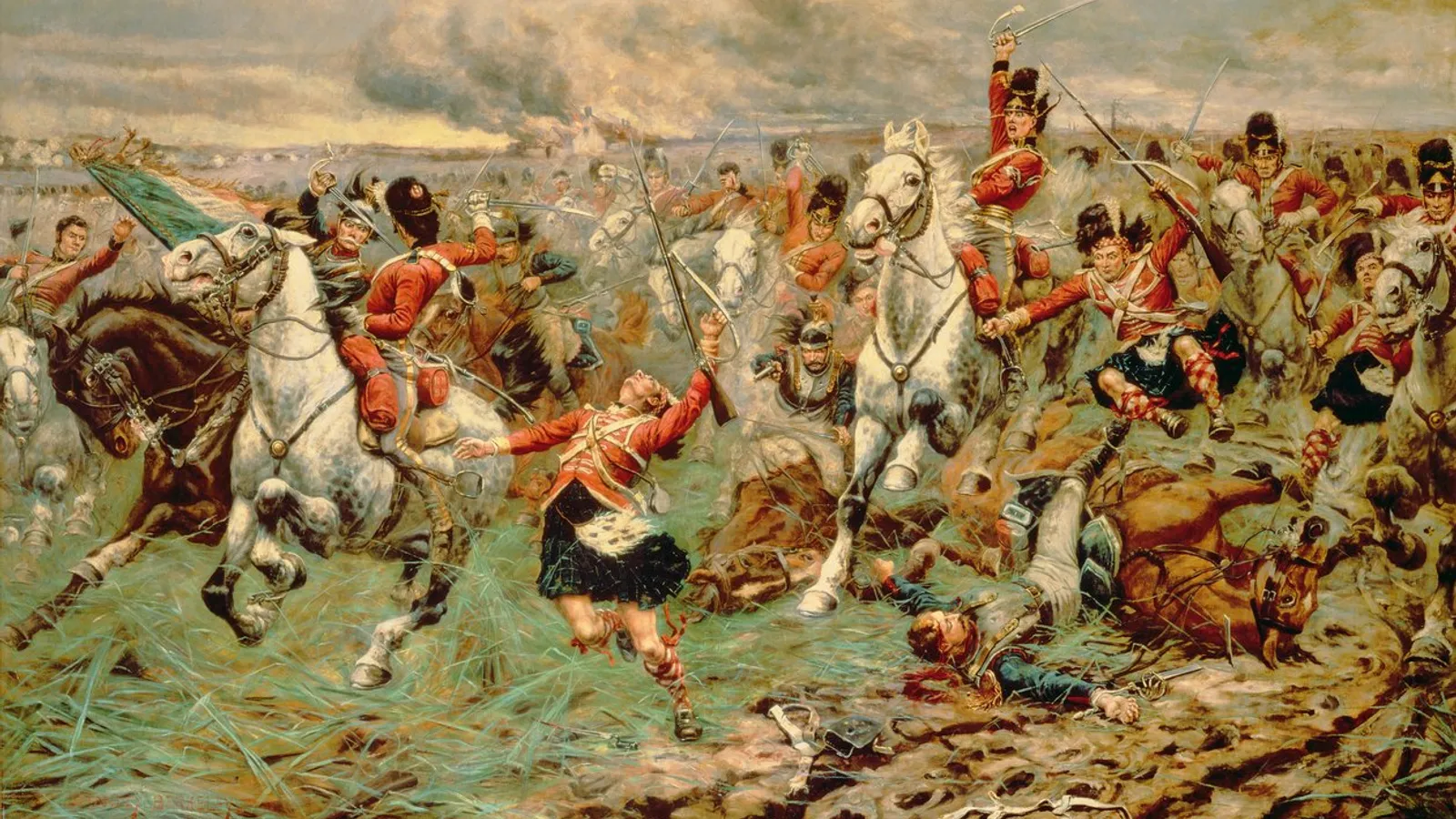
The Greys' single Napoleonic battle honour is Waterloo (18 June 1815), and it is the action for which they are most famous. As part of the Union Brigade (English Royals, Scots Greys, Irish Inniskillings) under Major-General Sir William Ponsonby, they charged d'Erlon's advancing French infantry, and Sergeant Charles Ewart captured the Eagle standard of the French 45e Régiment de Ligne — a trophy later incorporated into the regimental cap badge and the source of the nickname "the Bird Catchers." The charge was devastating but costly, and the exact losses vary by source: the regiment's own museum records that "from 391 men who went into battle 102 were killed and 98 wounded," while other standard accounts give 104 killed and 97 wounded and note the loss of 228 of the regiment's 416 horses (the National Army Museum cites 201 men and 228 horses killed, likely counting attached personnel and later deaths). Because Card #26 ("Scottish Regiments at Waterloo") is dedicated to the full story of the charge and Eagle capture, this card deliberately keeps the treatment brief and cross-references that card for the detail.
The Crimean War and the Charge of the Heavy Brigade — disambiguated
After nearly forty years of home service the Greys deployed to the Crimean War (1854–56), where on 25 October 1854 at the Battle of Balaclava they took part in the Charge of the Heavy Brigade. This must be carefully distinguished from two other famous actions on the same day at Balaclava:
- The Charge of the Heavy Brigade — the Greys' action. The British Heavy Brigade, about 800 strong in ten squadrons under Major-General the Honourable Sir James Yorke Scarlett (1799–1871), charged uphill into a halted mass of some 3,000 Russian cavalry and routed them within minutes. The opening charge was made by roughly 300 men — two Scots Greys squadrons plus one Inniskilling squadron, hence the action's nickname "Scarlett's 300" — the remaining seven squadrons coming on in support. This was a success. Two Scots Greys — Regimental Sergeant-Major John Grieve and Private Henry Ramage — were among the earliest recipients of the Victoria Cross.
- The Charge of the Light Brigade — a different action later the same day, when Lord Cardigan's light cavalry charged Russian guns down the "valley of death" through a misinterpreted order, suffering severe losses. The Greys were not part of this; they watched it.
- The "Thin Red Line" — a third, separate action, in which Sir Colin Campbell's 93rd (Sutherland) Highlanders stood in line (not square) and repelled Russian cavalry by musketry. This was infantry, not cavalry, and is covered in Card #27.
Conflating these three is one of the most common errors in popular accounts, and the series' accuracy standard requires they be kept distinct.
First World War
The Greys went to France in August 1914 and served on the Western Front throughout the war, with battle honours including Mons, the Marne, Ypres (1914), Neuve Chapelle (1915), Arras (1917) and Amiens (1918). Their experience illustrates the central dilemma of cavalry in the First World War: although raised, trained and hoped-for as mounted troops, they spent much of the war fighting dismounted as infantry in the trenches, because the static front offered almost no scope for mounted action. They did fight mounted at moments — early rearguard actions in 1914, patrolling and screening in 1918 — but at Ypres, the Somme and Cambrai they were repeatedly committed on foot. The grey horses proved a liability: BEF staff ordered them dyed a dark chestnut because the uniform grey made conspicuous targets and identified the regiment too easily. Casualty figures should be treated with care: the regiment's own memorial in the Scottish National War Memorial commemorates 154 Scots Greys who died in the Great War ("Second to none / in honoured memory / of 154 Scots Greys / who died fighting… 1914–1918"), while CWGC-derived databases list a larger number of named dead under "2nd Dragoons (Royal Scots Greys)." The discrepancy reflects different counting scope — the CWGC commemoration window runs to 31 August 1921 and includes deaths from disease and wounds, and reservists — so the two figures are not contradictory but measure different things.
Second World War
In 1939 the Greys were still, extraordinarily, a horsed regiment, stationed in Palestine on internal-security duties, where they had helped suppress the later stages of the Arab Revolt. They performed what is generally cited as one of the British Army's last mounted cavalry charges in February 1940, when the regiment was called out to quell Arab rioters. They were then ordered to mechanise in May 1941 — becoming a motorised and then an armoured unit — as the last British horsed cavalry regiment to give up the horse. Re-equipped with tanks (Stuarts, then Grants and Shermans), they fought with the Eighth Army in North Africa, including the Second Battle of El Alamein (1942) and the pursuit to El Agheila. After the Italian campaign (from the Salerno landings, September 1943), they returned to Britain, landed on Juno Beach on 7 June 1944, and fought through the Normandy campaign (Caen, Hill 112, the Falaise pocket), Operation Market Garden, and the drive into Germany, reaching Wismar on the Baltic just hours ahead of the Red Army in May 1945. A single published regiment-specific total of Scots Greys killed in the Second World War is not readily available in the standard summaries; the regiment's Second World War dead are recorded on its panel in the Scottish National War Memorial and are individually searchable via the Commonwealth War Graves Commission.
The 1971 merger and the Royal Scots Dragoon Guards
Under the post-war contraction of the cavalry — set in train by the 1957 Defence White Paper and continued in a 1969–71 round of cuts — the Royal Scots Greys were scheduled for amalgamation. On 2 July 1971, in a ceremony at Holyrood, Edinburgh, they merged with the 3rd Carabiniers (Prince of Wales's Dragoon Guards) — itself the product of a 1922 amalgamation of the 3rd Dragoon Guards and the 6th Dragoon Guards (Carabiniers) — to form The Royal Scots Dragoon Guards (Carabiniers and Greys). The Queen presented the new regiment with its first standard and a drum horse named Trojan; its first Colonel was Major-General Ralph Younger, a Carabiniers veteran of the Second World War.
This is a crucial institutional distinction from every earlier regiment card. The Greys did not merge into the infantry Royal Regiment of Scotland. They combined with an English cavalry regiment to create a new cavalry regiment that has remained continuously outside the RRS structure. The rationale for pairing these two specific regiments is not fully documented beyond the general reduction context. The strongest documented indication of why comes from a later House of Lords debate (Hansard, 1991), which records that "the Greys [preferred] the option of amalgamation with the Carabiniers" — that is, the pairing followed from the Greys' own choice among available options rather than from any deep shared heritage. The two regiments were in fact culturally distinct (the Carabiniers recruited in Cheshire, with their collection held at Chester). A shared-commander link existed — Field Marshal Viscount Allenby had commanded both the Carabiniers and the Scots Greys in the Boer War — but that is a connection rather than a documented cause. The result is analogous to the Scots Guards' separate status established in Card #15 — a Scottish regiment outside the RRS — but reached by an entirely different mechanism: a Scottish–English cavalry merger rather than a Foot Guards/Household Division distinction.
The Royal Scots Dragoon Guards inherited all its antecedents' battle honours and remains Scotland's senior regiment and the only regular Scottish cavalry regiment — indeed, through the Greys, the oldest surviving cavalry of the line in the British Army. As part of the Royal Armoured Corps it deployed 57 Challenger tanks in the Gulf War (1990–91); its Challengers crossed from Saudi Arabia into Iraq on 25 February 1991 in an advance described by the regiment as "one of the fastest" in the British Army's history, and one Challenger destroyed an Iraqi tank at a range of roughly 4,700 metres (about three miles), a distance record. In 1998 the regiment became the first unit to operate the Challenger 2 main battle tank. It served in Bosnia (1996–97) and Kosovo (2000–01), then in the Iraq War (from 2003, Operation Telic), taking part in the initial invasion and armoured fighting around Basra (including a notable large tank engagement south of the city), with further Iraq tours in 2005/06 and 2008, losing two soldiers on operations there. It deployed to Afghanistan (Operation Herrick) in 2008, 2011 and 2013–14. In 2013 it converted from main battle tanks to a light-cavalry reconnaissance role, exchanging Challengers for lighter vehicles such as the Jackal 2 and Coyote. The regiment is today based at Waterloo Lines, Leuchars, in Fife. Its pipes and drums remain world-famous: credited to "The Pipes and Drums and the Military Band of the Royal Scots Dragoon Guards," their recording of "Amazing Grace" reached No.1 in the UK singles chart on 15 April 1972 and stayed there for five weeks — the group's only UK number one.
Did You Know?
- The bearskin cavalry. The Scots Greys were the only British cavalry regiment to wear the tall bearskin cap rather than a helmet — a distinction adopted in 1768 and carried through to 1971.
- "Second to None" was a consolation prize. The motto arose because the Greys, arguably entitled to be the senior dragoon regiment, were placed second in the post-Union order of precedence in 1713 — so they proclaimed themselves second to none.
- The Eagle in the cap badge. The French Imperial Eagle captured by Sergeant Ewart at Waterloo became part of the regimental cap badge, and earned the Greys the nickname "the Bird Catchers."
- They dyed their famous horses — twice. The grey horses were dyed khaki in the Boer War and again dyed a dark chestnut in the First World War, because their conspicuous colour made them targets.
- Last of the horsed cavalry. The Greys retained their horses until 1941, making them the last regular British cavalry regiment to give up the horse for the tank.
- A chart-topping regiment. The Scots Greys' successor's 1972 pipes-and-drums recording of "Amazing Grace" reached No.1 in the UK on 15 April 1972 and held the top spot for five weeks.
- They sat down for the King. By tradition the Greys' officers remained seated for the loyal toast — a privilege said to date from George III, who because of ill health could not stand and so excused them.
- The oldest surviving line cavalry. Through the Greys, today's Royal Scots Dragoon Guards are described by the National Army Museum as the British Army's oldest line cavalry regiment.
FAQ
1When were the Royal Scots Greys founded?
Three independent troops of Scots dragoons were raised in 1678 (the first two on 21 May), and three more were added in 1681 when the six troops were regimented as The Royal Regiment of Scots Dragoons under Thomas Dalyell of the Binns. The National Army Museum dates formal formation to 1681; the regiment traces its beginning to 1678. Both are correct at different levels.
2Why were they raised?
For internal security in Scotland: the 1678 troops were used to suppress the illegal open-air assemblies (conventicles) of the Presbyterian Covenanters in the south-west, resistance to which led to the Battle of Bothwell Bridge in 1679. This is presented honestly as a suppression role, matching the founding context of the Royal Scots Fusiliers (Card #6).
3Why were they called the "Scots Greys"?
Because they were uniformly mounted on grey horses, noted at a royal inspection in 1693, after which they were called the "Grey Dragoons." The nickname became an official title in 1866/1877. The precise origin of the grey-horse practice is not securely documented — see the caveats below.
4Did the Scots Greys always ride grey horses by official policy?
Not demonstrably. Their original uniform specified grey coats, but several sources note no early record required the horses to be grey. The uniform grey mounts are documented from 1693 onward; whether this began as deliberate policy, from horse availability, or from horses inherited from the Dutch Horse Guards (an unconfirmed tradition) is not proven.
5What is a "dragoon"?
Originally mounted infantry — soldiers who rode to battle but fought on foot — armed with a carbine. The word comes from the French dragon, a type of firearm said to "breathe fire" like a dragon. The Greys began as dragoons (musket-armed) and evolved into heavy cavalry over the eighteenth century.
6What did they do at Waterloo?
As part of the Union Brigade they charged d'Erlon's French infantry on 18 June 1815, and Sergeant Charles Ewart captured the Eagle of the French 45th Line — hence the Eagle in their cap badge. The charge was famous but costly. The full story is covered in Card #26; this card treats it only briefly.
7Was the Scots Greys' charge at Balaclava the "Charge of the Light Brigade"?
No. The Greys took part in the Charge of the Heavy Brigade on 25 October 1854 — a successful uphill charge under Scarlett that routed a much larger Russian cavalry force. The Charge of the Light Brigade was a separate, disastrous action the same day, in which the Greys did not take part.
8What was the "Thin Red Line," and were the Greys in it?
The "Thin Red Line" was a third Balaclava action in which the 93rd (Sutherland) Highlanders — infantry — repelled Russian cavalry by musketry. The Greys were not part of it; it is covered in Card #27. Heavy Brigade, Light Brigade and Thin Red Line are three distinct actions on the same day.
9How were the Scots Greys used in the First World War?
They served on the Western Front from 1914 to 1918, but like most cavalry spent much of the war fighting dismounted in the trenches because static warfare gave little scope for mounted action. Their grey horses were dyed to reduce their visibility.
10When did the Scots Greys give up their horses?
Mechanisation was ordered in May 1941, when they converted to armour in the Middle East — the last regular British cavalry regiment to do so. They fought the rest of the Second World War in tanks, in North Africa, Italy and North-West Europe.
11What happened to the regiment in 1971?
On 2 July 1971 the Greys amalgamated with the 3rd Carabiniers (Prince of Wales's Dragoon Guards) to form the Royal Scots Dragoon Guards. Unlike the infantry regiments in this series, they did not join the Royal Regiment of Scotland; they formed a new, continuing cavalry regiment.
12Does the regiment still exist today?
Yes, as the Royal Scots Dragoon Guards (SCOTS DG) — Scotland's only regular cavalry regiment, now in a light-cavalry reconnaissance role, based at Leuchars in Fife. It served in the Gulf War, Iraq and Afghanistan. Its collection and the Greys' history are preserved at the Royal Scots Dragoon Guards Museum, Edinburgh Castle.
Sources
Primary / Institutional
- National Army Museum, "The Royal Scots Greys (2nd Dragoons)" and "The Royal Scots Dragoon Guards (Carabiniers and Greys)" (nam.ac.uk).
- The Royal Scots Dragoon Guards, regimental history and "Key Moments" (scotsdg.org.uk), including the regimental museum at Edinburgh Castle.
- The National Archives (Discovery), records of the 2nd (Royal North British) Dragoons / 2nd Dragoons (Royal Scots Greys).
- Commonwealth War Graves Commission (cwgc.org) — searchable records of regimental war dead.
- Scottish National War Memorial, Edinburgh Castle (snwm.org); Imperial War Museums War Memorials Register.
- Hansard (House of Lords), "Scottish Regiments: Reorganisation," 14 November 1991.
Scholarly / Specialist
- Edward Almack, The History of the Second Dragoons "Royal Scots Greys" (1908) — the standard early regimental history (available via Project Gutenberg).
- In the Finest Tradition: The Royal Scots Dragoon Guards (Carabiniers & Greys): Its History and Treasures (Mainstream, ISBN 1-85158-174-X).
- Brigadier Allan Mallinson, writings on the Scots Greys and the cavalry at Waterloo (e.g., in The Field, 2015).
- Society for Army Historical Research (sahr.org.uk) — essays on the Scots Greys at Waterloo.
- Borthwick Institute (University of York) — on the Charge of the Heavy Brigade.
General further reading
- National Army Museum online collection entries on the Charge of the Heavy Brigade (1854).
- Encyclopaedia Britannica, "dragoon" and "Battle of Balaklava."
Honest Caveats
- The origin of the grey horses. It is documented that the regiment was uniformly mounted on greys by 1693; it is not documented why. The romantic story that the horses were inherited from the Dutch Horse Guards is explicitly unconfirmed; the alternative that grey stock was simply what was available is equally plausible; and the regiment's own claim that Tam Dalyell was granted royal permission for grey cloth is hedged ("perhaps," "may have"). Treat the grey identity as a documented visual fact from the 1690s with an uncertain origin.
- Balaclava disambiguation. The Charge of the Heavy Brigade (the Greys' action, successful, "Scarlett's 300"), the Charge of the Light Brigade (a separate, disastrous action, without the Greys) and the "Thin Red Line" (the 93rd Highlanders' infantry stand) are three distinct events on 25 October 1854 and must not be conflated. The Thin Red Line is covered in Card #27.
- Casualty and battle figures. Waterloo losses are given variously — the regiment's museum states 102 killed and 98 wounded from 391 men; other accounts give 104 killed, 97 wounded and 228 of 416 horses lost; the National Army Museum cites 201 men and 228 horses killed. First World War dead are commemorated as 154 on the regimental memorial but appear as a larger figure in CWGC-derived lists because of differing counting scope, and a precise regiment-specific Second World War total is not readily available in published summaries. Numbers here should be read as best estimates, not exact totals.
- The 1971 pairing. The amalgamation was driven by general cavalry reductions (the 1957 Defence White Paper and the 1969–71 cuts) rather than a documented special affinity between the Greys and the Carabiniers; the surviving documentary evidence (Hansard, 1991) indicates the specific pairing reflected the Greys' own preference among the available options. Any claim of a deep historic bond between the two regiments should be avoided.
- Institutional status. Unlike Cards #5–14, the Greys did not feed into the Royal Regiment of Scotland. They remain, through the Royal Scots Dragoon Guards, a distinct cavalry/armoured regiment outside the RRS — a separateness comparable to the Scots Guards (Card #15) but achieved by a different mechanism.
Card 016 · Defence