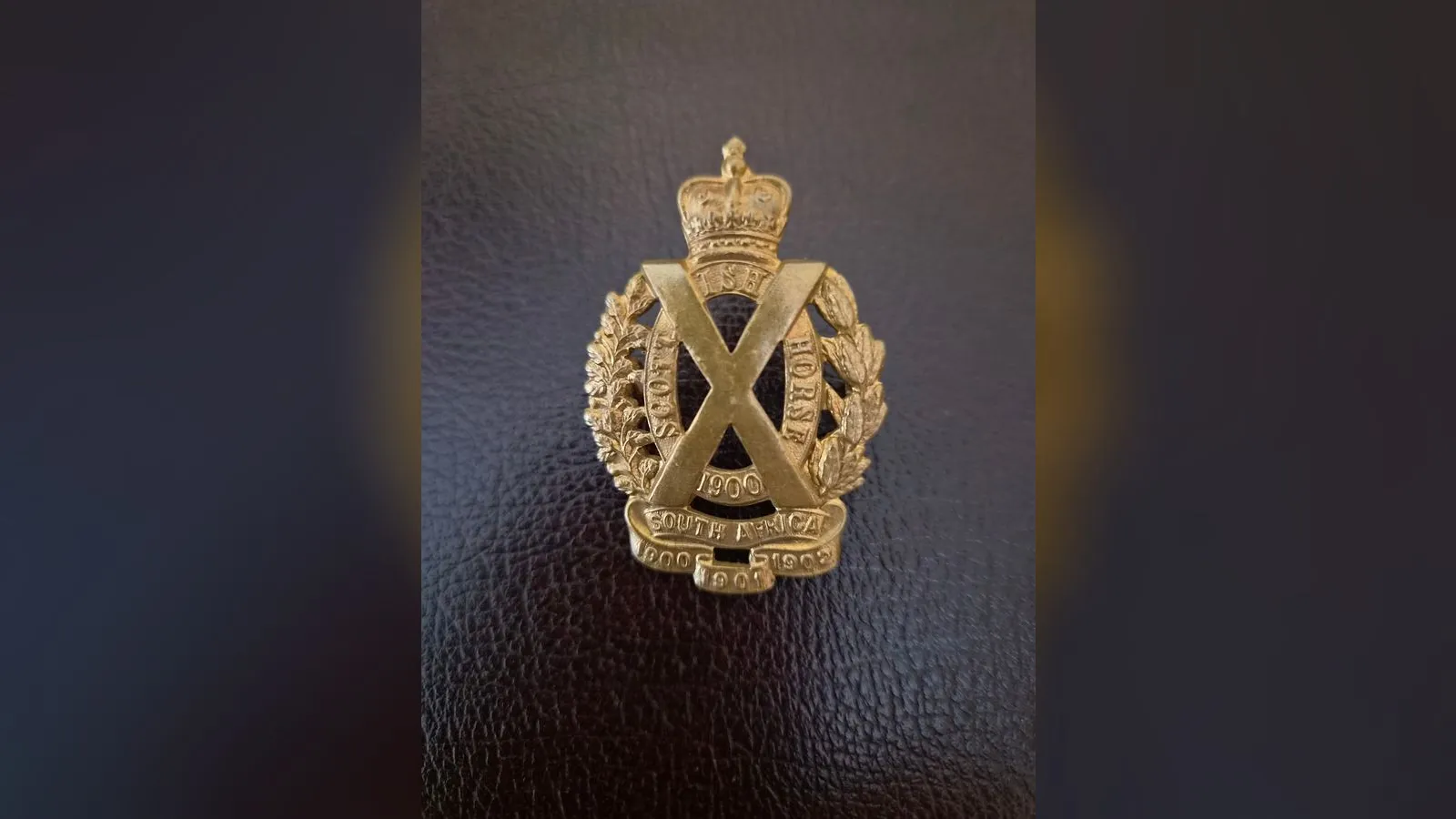

The Scottish Horse — Defence Series, Card #17
TL;DR
- The Scottish Horse was a yeomanry (volunteer, part-time mounted) regiment, not a regular regiment — making it a distinct institutional category from every unit covered on Cards #5–16 (the regular infantry, Foot Guards and regular cavalry). (Established.)
- It has a genuinely unusual origin: it was raised in South Africa itself in late 1900, among Scots and men of Scottish descent already in the colonies, at Lord Kitchener's request and under the Marquess of Tullibardine (later 8th Duke of Atholl), with later drafts from Scotland and Australia. (Established.)
- It was created during the Second Boer War (1899–1902), an imperial conflict now remembered as much for British scorched-earth tactics and concentration camps as for its battles; the regiment's own documented role was in mobile counter-guerrilla columns in the Transvaal. (Established, with honest context required.)
- In the First World War it served dismounted at Gallipoli (Suvla, 1915), in Egypt, and — reorganised as the 13th (Scottish Horse Yeomanry) Battalion, The Black Watch — in Salonika and finally on the Western Front in 1918. (Established.)
- It was never amalgamated into the Royal Regiment of Scotland or a regular cavalry regiment. Instead it followed the classic yeomanry path: reduced after 1918, converted to Royal Artillery in the Second World War, and finally amalgamated in 1956 with the Fife and Forfar Yeomanry — its lineage surviving today in the Scottish and North Irish Yeomanry. (Established.)
Key Facts
- Period covered: 1900–1956 (with lineage continuing to the present)
- Type: Yeomanry — volunteer/part-time mounted troops (Territorial Force from 1908; Territorial Army from 1921)
- Raised by: John Stewart-Murray, Marquess of Tullibardine (later 8th Duke of Atholl), at Lord Kitchener's request
- Home headquarters: Dunkeld, Perthshire (drill hall on the High Street); second regiment at Aberdeen
- Notable feature: One of very few British regiments first raised on foreign soil (South Africa), recruiting Scots and Scottish-descended colonials; distinctive slouch-hat uniform in "Atholl Grey" with black cock's-tail feathers
- Victoria Cross: Lt William John English (2nd Scottish Horse), Vlakfontein, 3 July 1901
- Current status/legacy: Perpetuated by "C" (Fife and Forfar Yeomanry/Scottish Horse) Squadron of the Scottish and North Irish Yeomanry, based at Yeomanry House, Cupar, Fife
Scottish Impact Index (SI Score)
- Military Impact
- 6/10
- Enduring Significance
- 7/10
- Strategic Importance
- 6/10
- Military Distinctiveness
- 8/10
- Military Legacy
- 7/10
- Recognition
- 5/10
39/60
Ranked =38th of 43 in Defence
Claim Status
The core narrative of this card rests on strong documentary evidence and is rated established: the founding by Tullibardine at Kitchener's request in late 1900; the raising in South Africa; the recruitment from Scotland and Australia; the Boer War column service; the Great War conversion into the 13th Black Watch; and the post-war yeomanry-to-artillery lineage are all corroborated by primary and institutional sources (official despatches reproduced by angloboerwar.com; the Long, Long Trail; Imperial War Museums; the regimental archive at Dunkeld; and the regimental histories by the Duchess of Atholl and Lt Col R M T Campbell-Preston).
A small number of points are Shared/Traditional or require caveats: precise aggregate casualty totals are not available in a single authoritative published figure (see Caveats); the exact framing of the regiment as "raised in Scotland versus raised in South Africa" is often oversimplified in popular accounts and is clarified below; and the broader Boer War context must be handled honestly rather than celebratorily, in line with the site's "accuracy over patriotism" standard.
Timeline
"Black Week" defeats prompt Britain to authorise volunteer mounted forces. On 13 December the War Office decided to allow volunteer forces to serve in the field, and a Royal Warrant of 24 December 1899 officially created the Imperial Yeomanry — organised as county service companies of about 115 men enlisted for one year and armed with the Lee–Metford rifle and bayonet.
Kitchener sanctions the raising of the Scottish Horse; the unit is gazetted 15 December 1900, depot at Johannesburg.
Tullibardine takes the field with three squadrons; recruitment extends to Scotland and Australia; a second regiment is formed.
Action at Vlakfontein; 3 July 1901 — Lt W J English wins the Victoria Cross at Vlakfontein.
Heavy losses at Moedwill (Delarey's surprise attack).
Brakenlaagte (Bakenlaagte): the 2nd Scottish Horse suffers severe casualties defending Benson's guns.
Capture of Sarel Alberts's laager at Gruisfontein.
Treaty of Vereeniging ends the war.
Both original regiments disbanded at Edinburgh Castle after repatriating Australians and discharging South Africans.
Reconstituted; the British Army regiment re-formed in 1903 as Scottish Horse Imperial Yeomanry, HQ Dunkeld; a separate Transvaal volunteer regiment is raised (disbanded 1907).
Transfers to the new Territorial Force; expanded to two regiments (eight squadrons), covering Perthshire, Aberdeenshire, Elgin, Nairn and Argyll.
Mobilised; a 3rd Regiment raised; Scottish Horse Mounted Brigade formed.
Dismounted landing at Suvla Bay, Gallipoli; evacuated December 1915.
Absorbed into 1st Dismounted Brigade, Suez Canal defences.
1st and 2nd Regiments form the 13th (Scottish Horse Yeomanry) Battalion, The Black Watch.
Salonika/Macedonian front.
Western Front; fighting at Beaurevoir, the Selle and the Sambre.
Reconstituted in the Territorial Army; reduced to a single regiment but uniquely retained as mounted "scouts."
Split into the 79th and 80th (Scottish Horse) Medium Regiments, Royal Artillery (served North-West Europe, Sicily and Italy, including Anzio).
Rejoins the TA; transferred to the Royal Armoured Corps.
Amalgamated with the Fife and Forfar Yeomanry to form the Fife and Forfar Yeomanry/Scottish Horse.
Lineage carried by "C" (Fife and Forfar Yeomanry/Scottish Horse) Squadron, Scottish and North Irish Yeomanry, Cupar.
Details
What "yeomanry" meant — and why this card is different
Cards #5–16 covered regular regiments: full-time professional soldiers of the line infantry, the Foot Guards and the regular cavalry (the Royal Scots Greys). The Scottish Horse belongs to a wholly different institutional category — the yeomanry. Yeomanry regiments were volunteer, part-time mounted troops with roots stretching back to 1794, when county gentlemen raised horsed units for home defence against the threat of French invasion. They were locally recruited, socially distinctive (traditionally drawing on farmers, estate workers and the landed classes who could ride and owned horses), and administered quite differently from the regular army.
The Boer War transformed the yeomanry. After the disasters of "Black Week" in December 1899, the British government realised that regular infantry could not counter the highly mobile, sharp-shooting Boer commandos. On 13 December 1899 the War Office decided to allow volunteer forces to serve in the field, and a Royal Warrant of 24 December 1899 created the Imperial Yeomanry — mounted infantry organised in county service companies of about 115 men, enlisted for a year and armed with rifle and bayonet rather than sword and carbine. After the war, the Militia and Yeomanry Act 1901 reorganised the whole force, and the Territorial and Reserve Forces Act 1907 folded the yeomanry into the new Territorial Force from 1908, as a home-defence force whose members could not be compelled to serve overseas. The Scottish Horse was born directly out of this moment — and it is the first yeomanry regiment in this Defence series.
Origins in South Africa and the Tullibardine connection
The Scottish Horse has one of the most distinctive origin stories of any regiment in this series: it was first raised not in Scotland but in South Africa. In late 1900 the Caledonian Society of Johannesburg proposed forming a corps of Scots, and Scottish-descended colonists, already living in the country. Lord Kitchener — then commander-in-chief — approved, and gave the task to Major John Stewart-Murray, Marquess of Tullibardine, of the Royal Horse Guards, who had served under Kitchener on the Omdurman/Sudan campaign. The unit was gazetted on 15 December 1900, with its depot at Johannesburg, and recruiting proceeded in Cape Town, Durban and Pietermaritzburg, with Natal an especially important source. Tullibardine took the field with three squadrons on 4 February 1901.
Recruitment then widened well beyond South Africa. As Tullibardine himself testified, the Highland Society of London "sent out 386 officers and men," and his father, the 7th Duke of Atholl, "personally raised 831 men before the war was over"; the Caledonian Society of Melbourne recruited enthusiastically in Australia, providing a strong contingent of Victorians. A second regiment was formed, so that the two regiments together drew on three distinct pools: Scots in South Africa, Scots from home, and Australians of Scottish descent. This genuinely trans-imperial, diaspora-based recruitment — pulling Scots from three continents — is what makes the regiment's origin so unusual, and it is why later accounts sometimes disagree about whether it was "a South African regiment" or "a Scottish regiment." The accurate answer is: it was raised in South Africa, but built from the wider Scottish diaspora.
The Tullibardine/Atholl connection is central and creates a direct cross-reference to Card #19 (the Atholl Highlanders). John Stewart-Murray was styled Marquess of Tullibardine until 1917, when he succeeded as the 8th Duke of Atholl. The same Atholl family maintains the Atholl Highlanders — the ceremonial private regiment based at Blair Castle, and the only legal private army in Europe. The two units are institutionally distinct, but the family thread is real and visible: the Scottish Horse wore the Murray of Atholl tartan, its pipers wore Murray of Tullibardine, its stable belt carried the black-and-gold colours of the Duke of Atholl's arms, and the regimental pipe band was substantially drawn from musicians of the Atholl Highlanders. The Scottish Horse's spiritual home became Dunkeld, in the heart of Atholl country in Perthshire.
The Boer War context, honestly stated
The Second Boer War (1899–1902) was a controversial imperial conflict, and the site's "accuracy over patriotism" standard requires it to be presented as such — with more explicit acknowledgement than shorter Victorian campaigns elsewhere in this series may have required. After conventional Boer resistance collapsed in 1900, the Boers turned to guerrilla warfare, and the British under Lord Roberts and then Lord Kitchener responded with what is today called a "total war" strategy. This included a scorched-earth policy: according to the Anglo-Boer War Museum, the policy "led to the destruction of about 30000 Boer farmhouses and the partial and complete destruction of more than forty towns," alongside the destruction of crops and slaughter of livestock. It also included the internment of Boer and African civilians in concentration camps, where conditions were catastrophic. The Anglo-Boer War Museum records that 26,370 Boer women and children — some 81% of them children — died in the camps; the National Army Museum states that "in all, 28,000 Boers, mainly women and children, died in the camps," and that around half that number of Black Africans died in separate, worse-provisioned camps (Encyclopaedia Britannica gives an estimate of 13,000–20,000 African deaths). The suffering became an international scandal, exposed most famously by the British humanitarian Emily Hobhouse. Kitchener also divided the veld with barbed wire and blockhouse lines and ran systematic "drives" to trap the commandos.
This is the essential backdrop against which the Scottish Horse operated, and it should not be softened. At the same time, honesty cuts both ways: what is specifically documented about the Scottish Horse's own role is that it functioned as a mobile mounted counter-guerrilla unit, brigaded into columns that pursued Boer commandos, captured laagers, prisoners, wagons, cattle and guns, and guarded remount depots. The scorched-earth clearances and camp administration were driven by overall British policy under Roberts and Kitchener; the surviving unit-level despatches for the Scottish Horse record its combat actions rather than describing its involvement in farm-burning or camp operations. It would be unsupported to claim the regiment was uniquely responsible for atrocities, and equally unsupported to claim mounted columns of this era were wholly separate from the clearance strategy that defined the war's final phase. The honest position is that the Scottish Horse was an effective fighting unit within a war whose methods are rightly remembered as among the most contested in British imperial history.
The regiment's documented service in South Africa
The Scottish Horse expanded rapidly — the first regiment to six squadrons, the second to five, ultimately reaching brigade strength. Historian John Price's study Southern Cross Scots found that some 3,500 men passed through the two regiments, 914 of them Australians and New Zealanders, with 126 dying in service. It was commanded successively by Tullibardine, Major A Blair (King's Own Scottish Borderers), Lt Col C E Duff (8th Hussars) and finally Lt Col H P Leader (6th Dragoon Guards). The 1st Regiment served mainly in the Western Transvaal under a succession of column commanders (Flint, Shekleton, Cunningham, Dixon and Kekewich); the 2nd Regiment served in the Eastern Transvaal, notably in Colonel Benson's celebrated column.
Documented actions include:
- Vlakfontein (29 May 1901) — the regiment helped drive off one of the fiercest Boer attacks of the war.
- Vlakfontein (3 July 1901) — Lieutenant William John English, aged 18, of the 2nd Scottish Horse, won the Victoria Cross. His citation in the London Gazette (4 October 1901) records: "This Officer with five men was holding the right of a position at Vlakfontein on the 3rd July, 1901… Two of his men were killed and two wounded, but the position was still held, largely owing to Lieutenant English's personal pluck. When the ammunition ran short he went over to the next party and obtained more; to do this he had to cross some 15 yards of open ground under a heavy fire at a range of from 20 to 30 yards."
- Moedwill (30 September 1901) — General Delarey surprised the camp; the Scottish Horse, weakened by detachments, lost 3 officers and 17 men killed and many wounded, and behaved with conspicuous steadiness.
- Brakenlaagte / Bakenlaagte (30 October 1901) — in the disaster that killed the column commander Colonel Benson, the 2nd Scottish Horse's rearguard squadrons fought almost to annihilation trying to save the guns; of about 93 engaged at the key point, only a handful were left unwounded.
- Gruisfontein (5 February 1902) — under Major Leader, the 1st Scottish Horse charged and captured Commandant Sarel Alberts's entire laager, taking 132 prisoners; Kitchener singled out the regiment for "great gallantry."
- Rooival (11 April 1902) — the regiment shared in one of the last big actions of the war.
At the peace, the Scottish Horse, with the Imperial Light Horse, Johannesburg Mounted Rifles and Kitchener's Fighting Scouts, marched past Kitchener at Pretoria on 17 June 1902. The regiment's dead are commemorated on twin memorials — a Celtic cross with a superimposed claymore, erected in 1905, standing both on the Esplanade of Edinburgh Castle and on Caledonia Hill in Kensington, Johannesburg. The Johannesburg memorial is notable for naming four Zulu Scouts who served and died with the regiment — a rare early instance of Black soldiers being commemorated on a South African war memorial.
Lieutenant English's later life closes his story: born in Cork on 6 October 1882, he rose to lieutenant-colonel and died on 4 July 1941 of a cerebral haemorrhage aboard ship off Egypt while on active service with the Royal Ulster Rifles. His Victoria Cross had been presented on 1 July 1902 by the Prince of Wales (later King George V) at Horse Guards Parade, London.
Establishment as a Yeomanry regiment
The two wartime regiments were disbanded at Edinburgh Castle on 1 September 1902, after repatriating the Australians and discharging the South Africans. The name and traditions were then carried in two directions. In South Africa, Tullibardine helped organise successor volunteer units, including the infantry Transvaal Scottish (raised 1902, still extant in the South African Army's reserve, wearing Murray of Atholl tartan) — so the regiment's overseas legacy did not vanish but transplanted itself into the South African military tradition.
In Scotland, the British Army regiment was re-constituted in 1903 as the Scottish Horse Imperial Yeomanry, with its headquarters at the drill hall on the High Street in Dunkeld. It became the county yeomanry regiment for Perthshire, Aberdeenshire, Elgin, Nairn and Argyll. When the Territorial Force was created in 1908, the Scottish Horse transferred into it, dropped the "Imperial" title, and had expanded to two regiments (eight squadrons in total): the 1st Scottish Horse (Perthshire) at Dunkeld and the 2nd Scottish Horse (Aberdeenshire, Elgin, Nairn and Argyll) at Aberdeen. The regiments were trained and equipped as dragoons. As a Territorial unit under the 1907 Act, its members were, in law, home-defence troops who could not be compelled to serve abroad — a defining feature of yeomanry status that mattered greatly when war came in 1914.
The First World War
On mobilisation in August 1914, the two peacetime regiments quickly raised a third, and the three formed the Scottish Horse Mounted Brigade in September 1914 under Tullibardine. After home-defence duties, the brigade sailed for the Mediterranean in August 1915. Diverted to Gallipoli, the men were dismounted and re-equipped as infantry, landing at Suvla Bay on 2 September 1915 — a striking illustration of how the Western Front and Gallipoli robbed mounted yeomanry of their horses. They served in the trenches until evacuated in December 1915, then moved to Egypt, where heavy losses led to the brigade's absorption into the 1st Dismounted Brigade on the Suez Canal defences in February 1916.
In autumn 1916 the regiment was permanently converted to infantry: on 1 October the 1st and 2nd Regiments were combined at Abbassia in Egypt, and on 15 October the unit became the 13th (Scottish Horse Yeomanry) Battalion, The Black Watch (Royal Highlanders). It moved to Salonika, serving on the Macedonian front (81st Brigade, 27th Division) from October 1916 to June 1918 — a theatre of comparatively lower intensity than the Western Front, dominated by disease, difficult terrain and static lines. In June–July 1918 the battalion transferred to France (149th Brigade, 50th (Northumbrian) Division) and took part in the final "Hundred Days" advance, fighting at Beaurevoir, the Selle and the Sambre in October and November 1918. Its heaviest concentrated loss came in these last two months: the regimental archive at Dunkeld preserves a notebook of the battalion padre, the Rev. Wilfred Callin, recording the names of ninety-three Scottish Horse soldiers who died in France in October and November 1918.
The 3rd Regiment had a different fate: converted into the 26th (Scottish Horse) Squadron, Machine Gun Corps, it served in Egypt, and provided a company to the Lovat Scouts battalion (10th Cameron Highlanders). The second-line regiments at home were converted to cyclists and later moved to Ireland.
Post-war lineage — examined precisely
Here the Scottish Horse diverges sharply from the regular regiments on earlier cards, which were amalgamated into the Royal Regiment of Scotland (the infantry) or into composite cavalry regiments. It was neither disbanded outright nor folded into a Royal-Regiment-of-Scotland structure. Instead it followed the distinctive post-1918 yeomanry trajectory.
After the war a commission reviewed the shape of the Territorial Force (renamed the Territorial Army from 1 October 1921). The lesson drawn from the war was that mass horsed cavalry was surplus: only the fourteen most senior yeomanry regiments were kept as horsed cavalry, and the great majority of the rest were converted — eight to armoured car companies of the Royal Tank Corps, and about twenty-five to brigades of the Royal Field Artillery between 1920 and 1922. The Scottish Horse was a special case. Reconstituted in the Territorial Army on 7 February 1920, it was reduced to a single regiment but uniquely retained as mounted "scouts", alongside the Lovat Scouts — a nod to the reconnaissance role at which both Highland units excelled.
In the Second World War the regiment finally lost its horses: in 1940 it was split to form the 79th and 80th (Scottish Horse) Medium Regiments, Royal Artillery. The 80th served in the Italian campaign (including Anzio) and the 79th in North-West Europe. This artillery conversion — exactly the fate the task flagged as common to yeomanry regiments — is the true institutional endpoint of the mounted Scottish Horse. In 1947 the regiment rejoined the TA and was transferred to the Royal Armoured Corps. Finally, on 31 October 1956, it amalgamated with the Fife and Forfar Yeomanry to form the Fife and Forfar Yeomanry/Scottish Horse, with headquarters at Yeomanry House, Cupar. Through a series of later reorganisations its lineage passes to today's Scottish and North Irish Yeomanry, whose "C" (Fife and Forfar Yeomanry/Scottish Horse) Squadron at Cupar carries the battle honours forward. The regiment's guidons are laid up in Dunkeld Cathedral, which also houses a memorial and the regimental archive.
Did You Know?
- The Scottish Horse was raised on foreign soil. Unusually for a British regiment, it began life in South Africa in 1900, formed at the suggestion of the Caledonian Society of Johannesburg from Scots and men of Scottish descent already in the colonies.
- Three continents, one regiment. Its ranks were filled from Scots in South Africa, drafts sent from Scotland (including 831 men raised personally by the 7th Duke of Atholl and 386 sent by the Highland Society of London), and Australians of Scottish descent recruited via the Caledonian Society of Melbourne.
- A teenage VC. Lieutenant William John English won the Victoria Cross at Vlakfontein on 3 July 1901 at just 18 years old; he later rose to lieutenant-colonel and died at sea off Egypt in 1941.
- Its founder became a duke — and ran Europe's only private army. John Stewart-Murray, the Marquess of Tullibardine who raised the regiment, succeeded as 8th Duke of Atholl in 1917; the Atholl dukes still maintain the Atholl Highlanders (Card #19), the only legal private army in Europe.
- Black soldiers named on a 1905 memorial. The Johannesburg Scottish Horse memorial records four Zulu Scouts who died with the regiment — a rare early example of Black soldiers commemorated on a South African war memorial.
- It lost its horses at Gallipoli. In 1915 the mounted Scottish Horse was dismounted and re-equipped as infantry to fight at Suvla Bay — and it never returned to a true cavalry role in the field.
- It became a Black Watch battalion. From October 1916 the regiment fought as the 13th (Scottish Horse Yeomanry) Battalion, The Black Watch, in Salonika and on the Western Front.
- It ended up firing guns, not riding horses. In 1940 the Scottish Horse was converted into two Royal Artillery medium regiments; one fought at Anzio. Its modern descendant is a squadron of the Scottish and North Irish Yeomanry.
FAQ
1Was the Scottish Horse a regular regiment like the Black Watch or the Royal Scots Greys?
No. It was a yeomanry regiment — volunteer, part-time mounted troops — not full-time regulars. This makes it a different institutional category from the regular infantry, Foot Guards and regular cavalry covered on Cards #5–16. From 1908 it belonged to the Territorial Force (later Territorial Army), whose members were legally home-defence soldiers unless they volunteered for overseas service.
2Where and when was the Scottish Horse actually raised?
It was raised in South Africa in late 1900, gazetted on 15 December 1900 with its depot at Johannesburg. Recruiting began among Scots and Scottish-descended men already in South Africa (especially Natal), then extended to Scotland and Australia. This overseas origin is one of the most distinctive features of any regiment in this series.
3Who founded it, and why is that important?
Lord Kitchener sanctioned it and gave command to John Stewart-Murray, Marquess of Tullibardine (later 8th Duke of Atholl), a Royal Horse Guards officer who had served under Kitchener in the Sudan. The Atholl/Tullibardine connection links this card to Card #19 (the Atholl Highlanders): the regiment wore Murray of Atholl tartan and its home became Dunkeld, in Atholl country.
4What did the Scottish Horse do during the Boer War?
It operated as a mobile mounted counter-guerrilla unit in the Transvaal, brigaded into flying columns that pursued Boer commandos and captured laagers, prisoners, wagons, livestock and guns. Documented actions include Vlakfontein, Moedwill, Brakenlaagte and the capture of Sarel Alberts's laager at Gruisfontein (1902), for which Kitchener praised its gallantry.
5How should the Boer War itself be remembered?
Honestly, as a deeply controversial imperial war. British forces under Roberts and Kitchener used a scorched-earth policy — the Anglo-Boer War Museum records about 30,000 farmhouses and more than forty towns destroyed — and interned Boer and African civilians in concentration camps where roughly 28,000 Boers (mostly children) and many thousands of Black Africans died. This context, exposed at the time by Emily Hobhouse, is established historical fact and frames the environment in which the regiment served.
6Was the Scottish Horse itself responsible for atrocities?
The documented unit-level record describes its combat actions in mobile columns, not farm-burning or camp administration, which were directed by overall British policy. It would be unsupported to single the regiment out for atrocities, but equally misleading to pretend mounted columns of this phase were unconnected to the wider clearance strategy. The honest verdict: an effective fighting unit within a war whose methods are rightly criticised.
7Did the regiment fight on horseback in the First World War?
Only briefly. Mobilised as the mounted Scottish Horse Brigade in 1914, it was dismounted in 1915 and fought as infantry at Suvla Bay, Gallipoli. It served in Egypt and then, as the 13th Black Watch, in Salonika and on the Western Front. Like most yeomanry, the war stripped it of its traditional cavalry role.
8What happened to the Scottish Horse after the First World War?
It was not disbanded or absorbed into an infantry regiment permanently. Reconstituted in 1920, reduced to one regiment but kept as mounted "scouts," it was converted in 1940 into the 79th and 80th (Scottish Horse) Medium Regiments, Royal Artillery. In 1947 it joined the Royal Armoured Corps, and in 1956 amalgamated with the Fife and Forfar Yeomanry.
9Does the Scottish Horse still exist today?
Its lineage survives. After the 1956 amalgamation into the Fife and Forfar Yeomanry/Scottish Horse, the tradition passes through later reorganisations to "C" (Fife and Forfar Yeomanry/Scottish Horse) Squadron of the Scottish and North Irish Yeomanry, an Army Reserve light-cavalry unit based at Cupar, Fife.
10What was its connection to Australia?
Substantial. The Caledonian Society of Melbourne recruited enthusiastically, and 914 Australians and New Zealanders passed through the two regiments. A dedicated study, Southern Cross Scots by John E. Price (1992), documents the Australian and New Zealand participation in Tullibardine's Scottish Horse.
11Where can the regiment's records and memorials be seen?
The regimental archive is held at the Chapter House Museum / Community Archive at Dunkeld, and its guidons and a memorial are in Dunkeld Cathedral. Twin 1905 memorials stand on Edinburgh Castle Esplanade and on Caledonia Hill, Johannesburg. Surviving artefacts also passed to the Fife and Forfar Yeomanry Museum in Cupar after the Scottish Horse Museum in Dunkeld closed in 1999.
12Why is it grouped with the "Defence" cards rather than treated as a purely colonial curiosity?
Because it became a permanent part of Britain's auxiliary (Territorial) defence structure — a Scottish county yeomanry regiment with home headquarters at Dunkeld and Aberdeen — and served in both world wars. Its story illustrates the whole arc of the part-time mounted soldier: from Boer War horsemen to Great War infantry to Second World War gunners.
Sources
Primary / Institutional
- Imperial War Museums — Scottish Horse collections, photographs of Suvla Bay (1915), and the IWM War Memorials Register entry for the Scottish Horse memorial.
- The National Archives (Discovery) — Scottish Horse Regimental Association records.
- Historic Dunkeld / Chapter House Museum & Community Archive — the digitised regimental archive of the Scottish Horse (with the Robert Ogilby Trust), including the Rev. Wilfred Callin notebook.
- Official despatches of Lord Kitchener, reproduced in J. Stirling, The Colonials in South Africa, 1899–1902 (via angloboerwar.com).
- The London Gazette — Victoria Cross citation for Lt W J English (4 October 1901, No. 27362).
- Historic Environment Scotland — listing for the Scottish Horse Memorial, Edinburgh Castle Esplanade.
- Anglo-Boer War Museum (Bloemfontein) and the National Army Museum — for camp and scorched-earth casualty figures.
Scholarly / Reference
- Katharine Stewart-Murray, Duchess of Atholl, The Scottish Horse (regimental history).
- Lt Col R M T Campbell-Preston, The Scottish Horse 1900–1956.
- Patrick Mileham, The Yeomanry Regiments: 200 Years of Tradition (Canongate Academic, 1994).
- Thomas Pakenham, The Boer War (1979) — standard scholarly account of the war and its scorched-earth/camp policies.
- Kevin Asplin, The Roll of the Imperial Yeomanry, Scottish Horse & Lovat's Scouts, 2nd Boer War 1899–1902.
- Brig E A James, British Regiments 1914–18; Richard A Rinaldi, Order of Battle of the British Army 1914.
- John E. Price, Southern Cross Scots (1992) — Australian and New Zealand participation.
General Further Reading
- Chris Baker, "The Scottish Horse," The Long, Long Trail (longlongtrail.co.uk).
- National Army Museum — background on the Black Watch and the yeomanry.
- Encyclopaedia Britannica and the World History Encyclopedia — for accessible overviews of the South African War and its concentration camps.
- The Heritage Portal (South Africa) — detailed articles on the Scottish Horse memorials in Edinburgh and Johannesburg.
Honest Caveats
- "Raised in Scotland and sent to South Africa" — a common oversimplification. The regiment was raised in South Africa, from Scots and Scottish-descended men already there, with later drafts from Scotland and Australia. Popular accounts that describe it simply as a Scottish home regiment shipped south get the origin backwards; conversely, calling it purely "a South African regiment" understates the home-Scotland and Australian contingents.
- Casualty figures are not available as a single authoritative total. For the Boer War, the twin memorials list roughly 124–125 names (the IWM War Memorials Register records 124; a photographic count of the Johannesburg plaques recorded 125, including four Zulu Scouts) covering deaths from combat, wounds, disease and accident. John Price's Southern Cross Scots recorded 126 deaths among the roughly 3,500 who served, and Tullibardine separately testified that of 157 officers, "14 were killed or died." No single published regimental death total beyond these figures was located. For the First World War, no precise full-war death total for the 13th (Scottish Horse Yeomanry) Battalion could be verified online; the best-documented figure is the padre's notebook recording 93 Scottish Horse men who died in France in October–November 1918, its heaviest concentrated loss. Treat any single "total casualties" figure with caution.
- The Zulu Scouts count varies. Sources differ on whether three or four Zulu Scouts are commemorated; the most specific account names four (Bayisana Noondo, Jele Butelezi, Theophilus and John Basuto). This is a genuine source discrepancy, noted here rather than resolved.
- The Boer War's contested legacy. The regiment's battlefield record was praised in contemporary despatches, but those despatches are self-interested imperial documents. The war's defining methods — scorched earth and concentration camps — killed tens of thousands of civilians and are properly remembered as among the darkest episodes of British imperial policy. Celebrating the regiment's gallantry without this context would breach the site's "accuracy over patriotism" standard.
- Distinct institutional status versus earlier cards. Unlike the regular infantry regiments (amalgamated into the Royal Regiment of Scotland) or the regular cavalry, the Scottish Horse was a yeomanry regiment that was reduced after 1918, converted to Royal Artillery in 1940, and amalgamated with the Fife and Forfar Yeomanry in 1956. Readers should not assume it followed the same lineage pattern as Cards #5–16; it did not.
- Two "Scottish Horse" successors after 1902. The name continued both as the British Territorial regiment (this card's subject) and as a short-lived Transvaal volunteer regiment (disbanded 1907); the related infantry Transvaal Scottish, also founded by Tullibardine, still exists in the South African Army reserve. These are related but separate institutions.
Card 017 · Defence