
The Black Watch: From Fontenoy to 3 SCOTS
Contents
Defence Series · Card #4 · Category: Defence
TL;DR
- The Black Watch is Scotland's senior Highland regiment (documented). Formed as the 43rd Regiment of Foot in 1739–40 from the Independent Highland Companies (covered fully on Card #3), it first fought overseas at Fontenoy in 1745, was renumbered the 42nd in 1748–49, became the "Royal Highland Regiment" in 1758, and had "Black Watch" made official in 1861. It amalgamated into the Royal Regiment of Scotland in 2006 as its 3rd Battalion (3 SCOTS).
- Its dark blue-green-black "Government" (Black Watch) tartan is one of the oldest surviving standardised military tartans still in use (documented, with disputed specifics). The Scottish Register of Tartans dates it to the Highland Companies of 1725 and the regiment of 1739, but the exact relationship to the Campbell, Grant, Munro and Sutherland clan setts is genuinely disputed.
- The regiment compiled a storied combat record across imperial and world wars (documented) that must be read as part of British imperial and colonial military power, not pure romance. Battle honours span Ticonderoga (1758), Egypt (1801), the Peninsula, Waterloo, Alma and Sevastopol, Tel-el-Kebir, the Boer War, both World Wars, and Korea.
- Casualty figures require care (documented variation). First World War regimental dead are cited between "over 8,000" (National Army Museum) and 8,390 (the regiment's own three-volume history), with a Commonwealth War Graves Commission total of about 8,681; specific battle losses (e.g. Ticonderoga 1758) also vary by source, so we flag ranges rather than assert single figures.
- The red hackle is the regiment's signature insignia (traditional origin, documented adoption). Worn from the late 18th century and made its exclusive privilege by an Adjutant General's order in August 1822; the popular Geldermalsen gallantry story, and even the exact date and place of first issue, are contested tradition rather than firmly documented fact.
Key Facts
- Period covered
- 1739/40 (regimenting) → 1745 (Fontenoy) → 2006 (amalgamation) → present
- Key institution
- The Black Watch (Royal Highland Regiment); now The Black Watch, 3rd Battalion, Royal Regiment of Scotland (3 SCOTS)
- Notable feature
- The dark "Government"/Black Watch tartan; the red hackle; Red Hackle Day (5 January)
- Home / museum
- Balhousie Castle, Perth — The Black Watch Castle & Museum (Regimental HQ)
- Recruiting heartland
- Perthshire, Angus (Forfarshire), Fife and Dundee
- Motto
- Nemo me impune lacessit ("No one provokes me with impunity")
- Current status
- Serving light-role infantry battalion of the British Army
Scottish Impact Index (SI Score)
- Military Impact
- 9/10
- Enduring Significance
- 10/10
- Strategic Importance
- 9/10
- Military Distinctiveness
- 10/10
- Military Legacy
- 10/10
- Recognition
- 10/10
58/60
Ranked =3rd of 43 in Defence
Claim-status / Evidence framing
Following the site's "accuracy over patriotism" standard, we label claims as established (documented in primary/institutional and scholarly sources), Shared/Traditional (widely repeated regimental tradition with weak or contested documentation), or disputed (conflicting evidence).
- established the regiment's formation lineage, its renumbering (43rd → 42nd in 1748–49; "Royal" in 1758; "Black Watch" official in 1861), its major battle honours and campaigns, the 1881 amalgamation with the 73rd, and the 2006 amalgamation into the Royal Regiment of Scotland.
- Shared/Traditional: the Geldermalsen gallantry story behind the red hackle; the "Ladies from Hell" nickname; the Ticonderoga "ghost of Inverawe" legend; the French eye-witness's "Highland Furies" quotation from Fontenoy.
- disputed the precise origin and dating of the standardised tartan sett and its relationship to clan tartans; the exact date/place of the first red hackle issue (1775 vs 1795); several exact casualty figures (Ticonderoga 1758; WWI regimental dead); and superlative "firsts" sometimes made in regimental literature.
Timeline
Independent Highland Companies re-established under General Wade; wore a dark "government" tartan (Card #3).
Royal Warrant amalgamates the companies into the 43rd Highland Regiment of Foot.
First muster near Aberfeldy on the Tay (Card #3).
The Black Watch Mutiny; three soldiers executed at the Tower of London (Card #3).
First overseas battle: Fontenoy (War of the Austrian Succession).
Renumbered the 42nd Regiment of Foot on the disbanding of Oglethorpe's Regiment.
Costly assault on Fort Carillon (Ticonderoga); regiment titled "Royal" later that month.
American War of Independence: Battle of Long Island.
Red hackle first issued (date and place contested — see Details); parade at Royston, Hertfordshire.
Battle of Alexandria, Egypt; awarded the Sphinx and "Egypt" honour.
Quatre Bras and Waterloo (see Card #26).
The 42nd marches into Edinburgh after Waterloo to vast crowds; the Caledonian Mercury calls the scene the most extraordinary ever witnessed in the city.
Adjutant General's order confirms the red hackle as the regiment's exclusive privilege.
Crimean War: Battle of the Alma; Siege of Sevastopol.
Indian Mutiny/Rebellion: Cawnpore and Lucknow.
"Black Watch" incorporated in the official title.
Ashanti campaign, West Africa.
Childers Reforms: 42nd + 73rd become The Black Watch (Royal Highlanders).
Egypt and Sudan: Tel-el-Kebir, El Teb, Tamai, Kirbekan.
Second Boer War: Magersfontein, Paardeberg.
First World War: 25 battalions raised; over 8,000 dead.
Second World War: France, North Africa, Crete, Sicily, Italy, North-West Europe, Burma (Chindits).
Korea: Second Battle of the Hook (151st and final battle honour).
Final British garrison unit in Hong Kong; the pipes and drums of the Black Watch close the handover ceremonial with "Auld Lang Syne".
Operation Bracken: 1st Battalion Battle Group at Camp Dogwood, Iraq.
Amalgamated into the Royal Regiment of Scotland as 3 SCOTS (Card #23).
Details
Origins: a one-paragraph recap (see Card #3)
The Black Watch grew out of the Independent Highland Companies — the Am Freiceadan Dubh — raised from loyalist clans (Campbell, Fraser, Grant, Munro) to police the Highlands after the 1715 Jacobite rising. General Wade's 1725 reorganisation, the disputed etymology of "Black Watch," the blackmail/cattle-protection controversy, the Disarming Acts, the 1739 Royal Warrant creating the 43rd Highland Regiment of Foot, the 1740 muster near Aberfeldy, and the 1743 mutiny and executions at the Tower of London are all covered in full on Card #3 (Independent Highland Companies). This card picks up the story from the regiment's first deployment overseas.
Fontenoy (1745) and the renumbering to the 42nd
The regiment's first major overseas action was the Battle of Fontenoy on 11 May 1745 (30 April Old Style), during the War of the Austrian Succession. Fighting under the Duke of Cumberland's allied army against Marshal Saxe's French forces, the Highlanders were engaged on the right of the line near the Barri wood and later in an assault toward Fontenoy village led by Lieutenant-Colonel Sir Robert Munro. Fontenoy was an allied defeat (Established) — the French held the field — but the regiment gained a considerable reputation for its aggressive Highland style of fighting, using a tactic of firing, dropping to the ground to avoid the return volley, then charging with the broadsword. The much-quoted description of the Highlanders as "Highland Furies who rushed in on us with more violence than ever did the sea driven by tempest" is attributed to a French eye-witness and is quoted by the regiment's own history (theblackwatch.co.uk); it was popularised by the war correspondent Archibald Forbes, who described "Highland Furies" as "the complimentary description which a French eye-witness gave" (The Spectator, 26 June 1897). The wording is a Shared/Traditional flourish; the underlying reputation is well attested.
Numbering in the line then shifted. The regiment was ranked the 43rd Foot, and on the disbanding of Oglethorpe's Regiment of Foot it was renumbered the 42nd — most sources give 1749, though the standard reference (the 42nd Regiment of Foot entry) states the change followed the disbandment "in 1748." It was formally titled the 42nd (Highland) Regiment of Foot in 1751. The famous byname "The Black Watch" became official later — the regiment was titled the Royal Highland Regiment in 1758, "Black Watch" was incorporated in the official title in 1861, and it became The Black Watch (Royal Highlanders) at the 1881 amalgamation with the 73rd.
The tartan and dress traditions
The regiment's most enduring cultural legacy is the dark blue, green and black "Government" tartan, also called the Black Watch, 42nd, or Government Sett No. 1. The Scottish Register of Tartans (a division of National Records of Scotland) records the sett under the name Black Watch (Government) (register ref. 277; STA/STWR ref. 207), and its register note states that "this was the tartan appointed for the Highland Companies in 1725 and later for the Black Watch in 1739." The National Army Museum likewise ties the "dark green government-issue tartan" to the Independent Companies and their Gaelic nickname.
How old is it, really? The Black Watch/Government sett is best described as one of the oldest surviving standardised regimental tartans still in use (Established, with careful wording) rather than simply "the oldest military tartan." Specialist scholarship (summarised in the tartan-history literature drawing on Peter Eslea MacDonald and J. Telfer Dunbar) notes that earlier uniform tartans existed — for example the Royal Company of Archers had a uniform tartan by 1713 — and that the 42nd "had its own consistent uniform tartan (known as Black Watch, 42nd, or Government tartan) by 1749 or 1757 at the latest." So the popular kilt-trade claim that it is flatly "the oldest military tartan" should be qualified.
The disputed clan relationship (Disputed). Because three of the six original companies were Campbell, the sett is often equated with the Campbell tartan, and it has also been claimed by the Grant, Munro and Sutherland families. Wilsons of Bannockburn's 1819 Key Pattern Book — the leading commercial weaver's reference — hedged that the pattern "is said to be the Munro Tartan — but it is far more probable that it is the Campbell Tartan." The current scholarly view broadly reverses the romantic story: the military sett almost certainly came first, and the clan tartans (Campbell, Grant, Munro, Sutherland, and derivatives such as Gordon and Mackenzie with added over-stripes) were adopted or adapted from it once the idea of clan tartans became general in the early 19th century. D. C. Stewart, in The Setts of the Scottish Tartans, cautioned that "there seem to be no very good grounds for the commonly held view that the Black Watch tartan is actually an old Campbell sett, though perhaps it is descended from one." Major-General David Stewart of Garth, writing in 1822 on the basis of soldiers who had served in 1739, recorded that a "new" tartan "distinct from all others" was introduced when the regiment was formed. In short: the sett's colours and 1725/1739 military use are documented; its ultimate origin and clan precedence are not settled.
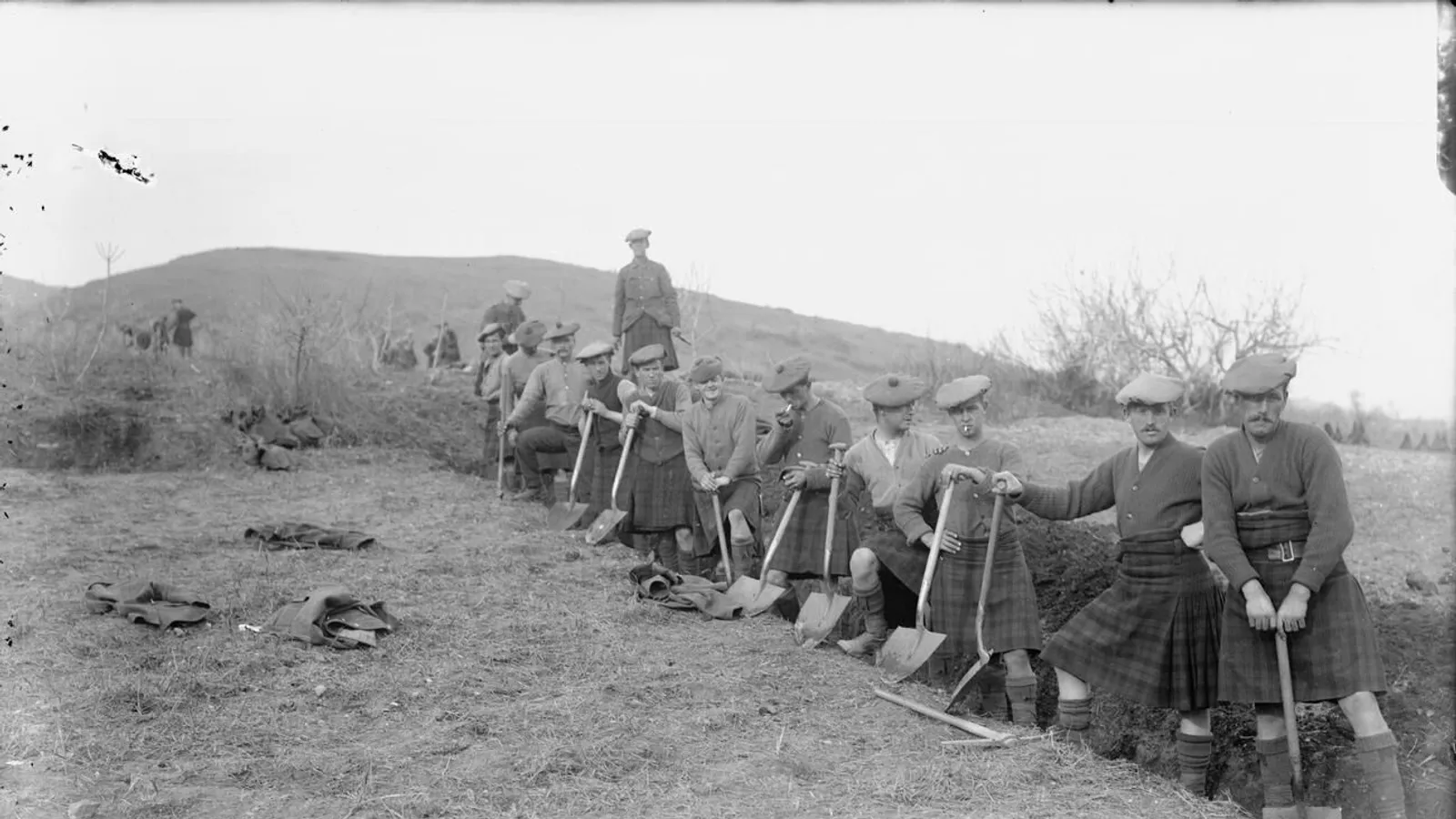
Other dress elements. The regiment wore the kilt as everyday uniform until 1940. Its single most distinctive badge of identity is the red hackle worn in the bonnet. The exact circumstances of its first issue are contested: the Imperial War Museums records that "a red hackle was issued to each man in the Regiment at a parade at Royston, Hertfordshire, on King George III's birthday, 5 June 1775," while the regiment's own association and museum give the King's-birthday parade at Royston as 4 June 1795 — so even the year is disputed. What is firmly documented is that an order issued by the Adjutant General in August 1822 confirmed that only the Black Watch would have the privilege of wearing the red "vulture feathers." The popular story that the hackle was awarded for gallantry recovering two field guns at Geldermalsen (1795) in the Netherlands is a Shared/Traditional account: the regiment's own museum notes the origin is "uncertain," and there is evidence hackles were worn in North America in the 1770s. Red Hackle Day is celebrated on 5 January (formalised by the Black Watch Association in 1919). The regiment's pipers wear the Royal Stewart tartan by virtue of the "Royal" designation, and the Sphinx badge commemorates Egypt (1801).
Eighteenth-century campaigns: the Seven Years' War and America
The 42nd was among the first Highland regiments sent to North America, arriving in 1756. Its defining action of the Seven Years' War (French and Indian War) was the disastrous assault on Fort Carillon (Ticonderoga) on 8 July 1758. In General Abercromby's uncoordinated frontal attacks on the French abatis and breastworks, the Black Watch pressed home with extraordinary determination — some men reached the parapet — but could not dislodge Montcalm's defenders. Losses were severe and are reported with variation (Disputed specifics): Abercromby's report of 12 July 1758 recorded the 42nd's loss as roughly 8 officers, 9 sergeants and 297 rank-and-file killed, and about 17 officers, 10 sergeants and 306 soldiers wounded — "over half of its men," in the words of the surviving regimental records. Some accounts round this to "over 300 killed (including 8 officers)" or phrase it as "nearly half the regiment." The regiment was titled "Royal" later that July, and a second battalion was authorised. (The romantic "ghost of Inverawe / I will meet you at Ticonderoga" story attached to Major Duncan Campbell of Inverawe is a Shared/Traditional legend.)
During the American War of Independence (1775–83) the 42nd served through the New York campaign, taking part in the British victory at the Battle of Long Island (Brooklyn) in August 1776 and subsequent operations. This was hard fighting against fellow British subjects turned revolutionaries; the regiment claims no battle honour for the American war.
The Napoleonic era (brief — see Card #26 for Waterloo)
Against Revolutionary and Napoleonic France the regiment served in the Low Countries, the West Indies, and then Egypt in 1801, where at the Battle of Alexandria it captured a French colour and won the right to bear the Sphinx and the honour "Egypt". It earned numerous honours in the Peninsular War (1808–14), including the retreat to and action at Corunna (1809) and later Salamanca, Pyrenees, Nivelle, Nive, Orthes and Toulouse.
In Napoleon's final 1815 campaign both the 42nd and the 73rd (later the 1st and 2nd Battalions of the Black Watch) were engaged — the 42nd fought hard at Quatre Bras on 16 June, where it was caught by French cavalry before it could complete a defensive square, and the 73rd was heavily engaged at Waterloo on 18 June. Waterloo and the Scottish regiments there are treated in full on Card #26 (Scottish Regiments at Waterloo); we keep the detail brief here by design.
Heroes in Edinburgh, and who was really in the ranks
established The historian T. M. Devine, in To the Ends of the Earth (2011), opens his chapter on Scottish soldiers with the 42nd's return to Edinburgh in March 1816. The Caledonian Mercury reported that nothing could exceed the welcome in every town and village on the route, and described crowds wedged across the whole breadth of the street, with house-tops and windows packed, as the regiment marched with tattered colours to the Castle. A poem, "Caledonia's Welcome to the Gallant 42nd", hailed the men as heroes of "the land of the moor and the mountain". Devine's point is how remarkable this was only two generations after the '45: the Highlander, once a Lowland byword for rebellion, was now celebrated as Scotland's national warrior. Walter Scott's Waverley (1814), he argues, set the seal on that rehabilitation.
established The reality behind the image was more mixed. Devine records that at least a third of the Black Watch who fought at Waterloo were drawn from the Lowlands, the Borders and even England, because clearance, emigration and decades of heavy recruitment had exhausted the Highland supply by about 1800. The 42nd was one of only five Highland regiments that kept the kilt and survived the post-war cuts, alongside the 78th, 79th, 92nd and 93rd.
shared Devine sets the regiment's Victorian fame inside what other historians call "the Victorian cult of the Highlander": kilted regiments drew a share of press, art and advertising out of all proportion to their numbers, partly because their officers were energetic self-publicists. He quotes Alexander Somerville's verdict of the 1840s that the writing "quite as much as the fighting" of the Scotch regiments distinguished them. In the first year of the First World War, he notes, The Scotsman and the Glasgow Herald reported the Black Watch, Camerons and Gordons in such detail that the Highland regiments seemed to be Scotland's only soldiers.
established Devine closes on Hong Kong. When the colony was handed to China in June 1997, it was the pipes and drums of the Black Watch that ended the ceremonial with "Auld Lang Syne", a fitting end, he suggests, for regiments that had been among the spearheads of empire and now acted as its pallbearers.
The Crimean War and Victorian imperial campaigns
In the Crimean War (1854–56) the 42nd formed part of Sir Colin Campbell's Highland Brigade. Its most notable action was at the Battle of the Alma (20 September 1854), where — on the order "Forward, the 42nd" — it advanced up the heights against Russian positions; it then endured the long Siege of Sevastopol, where disease and winter cold caused losses far exceeding those in battle.
A necessary non-conflation (accuracy note): the famous "Thin Red Line" at Balaclava (1854) — a two-deep line repelling Russian cavalry — was the 93rd (Sutherland) Highlanders under Campbell, not the Black Watch/42nd. The Black Watch was not the Thin Red Line regiment. The 93rd's Thin Red Line is covered on Card #27; it should never be attributed to the Black Watch.
The regiment then fought in the Indian Mutiny/Rebellion (1857–59) at Cawnpore and the relief of Lucknow (Victoria Crosses were won). Later Victorian service was explicitly imperial and colonial in character and should be named as such: the Ashanti campaign (1874) in West Africa; Egypt (1882), where the 1st Battalion took part in the Highland Brigade's dawn bayonet assault at Tel-el-Kebir, defeating Urabi Pasha's Egyptian nationalist army and opening the way to a British occupation of Egypt; the Sudan/Mahdist War (1884–85) at El Teb, Tamai and Kirbekan; and the Second Boer War (1899–1902), where the 2nd Battalion suffered heavy losses in the disastrous night attack at Magersfontein (11 December 1899) before the war moved on to Paardeberg. These campaigns were instruments of imperial expansion and control; the regiment's courage is not in doubt, but the causes it served were those of empire.
The First World War
The Black Watch expanded enormously. The National Army Museum records that the regiment "raised 25 battalions for service in France and Flanders, Palestine and Mesopotamia." Regular, Territorial and New Army battalions fought at Neuve Chapelle (1915), Aubers Ridge, Festubert, Loos (1915), on the Somme, at Arras and Third Ypres, and in the Middle East; the 2nd Battalion served in Mesopotamia after the Indian Corps was withdrawn from France.
Casualty figures should be presented with source-variation care (Disputed specifics). The National Army Museum states that "By the time of the Armistice in November 1918 over 8,000 members of the regiment had lost their lives." The Commonwealth War Graves Commission total (for the qualifying dates 1914–1921) is recorded by researchers at 8,681. The regiment's own three-volume history states in its foreword: "Thirty thousand served in the Regiment in France, Belgium, Salonika, Palestine and Mesopotamia and of these 8,390 died." These differ because of counting conventions (dates, attached units, and the separate Canadian Black Watch battalions). We therefore report a range of roughly 8,000–8,700 dead rather than a single figure.
The Second World War (see Card #21 for the 51st Highland Division)
Black Watch battalions served in almost every major theatre: France with the BEF in 1940, North Africa (the 2nd Battalion in the Tobruk breakout of 1941; the reformed 1st, plus 5th and 7th Battalions, at El Alamein, Mareth and Wadi Akarit), Sicily and Italy, North-West Europe from Normandy to the Rhine, and Burma, where the 2nd Battalion fought as Chindits behind Japanese lines in 1944. Several Black Watch battalions served within the 51st (Highland) Division, whose story — including its capture at St Valéry in 1940 and its reconstitution — is covered in full on Card #21 (51st Highland Division); we cross-reference rather than duplicate it. The regiment's distinct WWII contribution beyond the Division includes the 2nd Battalion's Somaliland, Crete (Heraklion) and Burma service.
Post-war service
Major post-war engagements included Korea (1950–53), where in November 1952 the 1st Battalion held "The Hook" against repeated Chinese assaults — the regiment's 151st and final battle honour — and the Kenya (Mau Mau) Emergency (1952–60). The regiment served repeatedly in Northern Ireland (1969–2007) and was the final British garrison battalion in Hong Kong before the 1997 handover to China.
The 2006 amalgamation (see Card #23)
Under the 2004 "Future Army Structure" reorganisation of the infantry, Scotland's single-battalion regiments were merged into one large regiment. On 28 March 2006 the Black Watch became The Black Watch, 3rd Battalion, The Royal Regiment of Scotland (3 SCOTS). The decision was highly controversial (Established): it was announced while the 1st Battalion was on active service in Iraq, prompting a well-organised "Save the Black Watch" campaign backed by veterans, politicians and the public, and public "dismay" from the regiment's then Colonel-in-Chief. The formation of the Royal Regiment of Scotland itself is covered in full on Card #23; here it suffices that the Black Watch name, red hackle and identity were preserved as the battalion's primary title. In its modern role the battalion has deployed to Iraq — including Operation Bracken at Camp Dogwood south of Baghdad in late 2004, where the 1st Battalion Battle Group took fatal casualties — and to Afghanistan (Helmand), among other operations.
Did You Know?
- The kilt went to war until 1940. The Black Watch wore the kilt as everyday uniform from its origins until 1940, when Highland regiments moved to battledress trousers for modern warfare.
- "Ladies from Hell." According to tradition, German troops on the Western Front nicknamed the kilted Highlanders "the Ladies from Hell" for their ferocity; this is a widely repeated but traditional attribution.
- A gong that tells the time. At Cawnpore in 1857 the regiment is said to have captured a gong that afterwards tolled the hours in the regimental guardroom — a durable regimental tradition.
- The Sphinx on the badge. The Egyptian Sphinx worn by the regiment commemorates the 1801 Egyptian campaign and the Battle of Alexandria, where the 42nd captured a French colour.
- The red "vulture feather." The 1822 order describing the red hackle referred to the red "vulture feathers"; the hackle is treated by the regiment almost as a battle honour in its own right.
- The pipers wear Royal Stewart. Because of the "Royal" in its title, the Black Watch's pipers wear the Royal Stewart tartan rather than the Government sett.
- Its own commemorative day. Red Hackle Day, fixed on 5 January by the Black Watch Association in 1919, is still marked with "Gunfire" (tea laced with rum served to the ranks at reveille).
- A castle for a museum. The regiment's home and museum, Balhousie Castle in Perth, was bought by the Regimental Trustees in 2009 and holds a "Recognised Collection of National Significance."
FAQ
1When was the Black Watch formed?
Its companies date to 1725, but the regiment proper was created by Royal Warrant on 25 October 1739 as the 43rd Highland Regiment of Foot, first mustering near Aberfeldy in May 1740. The full origin story — companies, mutiny and etymology — is on Card #3.
2Why is it called the "Black Watch"?
The name (Gaelic Am Freiceadan Dubh) is usually traced to the dark government tartan the companies wore and/or their policing "watch" role. The exact origin is uncertain and is discussed in detail on Card #3.
3When did it become the 42nd?
It was ranked the 43rd Foot, then renumbered the 42nd (in 1748–49) after the previous 42nd, Oglethorpe's Regiment, was disbanded. It became the "Royal Highland Regiment" in 1758, and "Black Watch" became official in 1861.
4What was the regiment's first overseas battle?
Fontenoy, on 11 May 1745, in the War of the Austrian Succession. It was an allied defeat, but the regiment earned a formidable reputation for its Highland charge.
5Is the Black Watch tartan the same as the Campbell tartan?
They are effectively the same dark "Government" sett, but which came first is disputed. Modern scholarship holds that the military sett almost certainly came first and was later adopted by the Campbells, Grants, Munros and Sutherlands.
6What is the red hackle and where did it come from?
It is the red feather plume worn in the bonnet, the regiment's signature. It has been worn since the late 18th century (sources differ between a 1775 and a 1795 first issue at Royston) and was made the regiment's exclusive privilege by an Adjutant General's order in August 1822. The popular story links it to gallantry at Geldermalsen (1795), but the origin is officially "uncertain."
7Did the Black Watch fight at Waterloo?
Yes — the 42nd at Quatre Bras and the 73rd (later its 2nd Battalion) at Waterloo in 1815. The dedicated treatment is on Card #26 (Scottish Regiments at Waterloo).
8Was the Black Watch the "Thin Red Line"?
No. The Thin Red Line at Balaclava (1854) was the 93rd (Sutherland) Highlanders, not the Black Watch. See Card #27. The two must not be conflated.
9How many Black Watch soldiers died in the First World War?
Sources vary: the National Army Museum says "over 8,000," the CWGC total is about 8,681, and the regimental history gives 8,390 (of some 30,000 who served). We report a range of about 8,000–8,700.
10Was the Black Watch at Waterloo entirely Highland?
No. T. M. Devine (2011) records that at least a third of the men who fought at Waterloo came from the Lowlands, the Borders and England, as Highland recruitment had largely dried up by 1800.
11What part did the Black Watch play in the Hong Kong handover?
It was the last British garrison battalion, and its pipes and drums closed the June 1997 handover ceremonial with "Auld Lang Syne".
12Where did the regiment serve in the Second World War?
France (1940), North Africa (Tobruk, El Alamein, Mareth), Sicily, Italy, North-West Europe, and Burma (as Chindits). Several battalions served within the 51st Highland Division — see Card #21.
13What happened to the Black Watch in 2006?
On 28 March 2006 it became the 3rd Battalion, Royal Regiment of Scotland (3 SCOTS). The change was controversial, announced while the regiment was fighting in Iraq. The Royal Regiment of Scotland formation is covered on Card #23.
14Where can I see the regiment's history?
At The Black Watch Castle & Museum, Balhousie Castle, Perth — the regimental headquarters and museum, run by the Black Watch Regimental Trust, covering the regiment "from their formation in 1739 to their amalgamation in 2006" and beyond.
Sources
Primary / Institutional
- National Army Museum, "The Black Watch (Royal Highlanders)"; and object records (e.g. Tel-el-Kebir, 1882; Camp Dogwood, Iraq, 2004).
- The Black Watch Castle & Museum, Balhousie Castle, Perth (regimental history pages and collection).
- Scottish Register of Tartans (National Records of Scotland), "Black Watch (Government)" record (ref. 277 / STA ref. 207).
- Imperial War Museums, film and object records of Operation Bracken (the Black Watch south of Baghdad, 2004) and the red hackle.
Scholarly
- David Stewart of Garth, Sketches of the Character, Manners and Present State of the Highlanders of Scotland (Edinburgh, 1822).
- D. C. Stewart, The Setts of the Scottish Tartans (1950; rev. 1974).
- T. M. Devine, To the Ends of the Earth: Scotland's Global Diaspora, 1750–2010 (Allen Lane, 2011)
- Peter Eslea MacDonald, research on early tartans and the republished Wilsons of Bannockburn 1819 Key Pattern Book.
- A History of the Black Watch in the Great War, 1914–1918 (3 vols).
- Standard British military histories of the Seven Years' War, Napoleonic Wars, Crimea and the World Wars.
General further reading
- Commonwealth War Graves Commission (regimental casualty records).
- American Battlefield Trust (Fort Carillon / Ticonderoga, 1758).
- Standard reference entries on the 42nd Regiment of Foot and the Royal Regiment of Scotland.
Honest Caveats
- The Thin Red Line is not the Black Watch. The most common error is to attribute the 1854 Thin Red Line to the Black Watch; it was the 93rd (Sutherland) Highlanders (Card #27).
- Tartan origin and dating. The claim that the Black Watch sett is flatly "the oldest military tartan" over-reaches; it is best described as the oldest surviving standardised regimental tartan still in use. Its ultimate origin and its precedence over the Campbell/Grant/Munro/Sutherland clan setts are genuinely unresolved.
- The red hackle's origin story is contested. The Geldermalsen gallantry award is a tradition; the regiment's own museum calls the origin "uncertain," and even the date of first issue at Royston is disputed (the IWM records 5 June 1775, while the Black Watch Association gives 4 June 1795).
- Casualty figures vary. Both the WWI regimental death toll (roughly 8,000–8,700, depending on source and counting rules) and the Ticonderoga 1758 losses ("over 300 killed" / "over half the regiment") are reported with variation; single figures should be treated as approximate.
- The "Highland Furies" quotation and similar vivid regimental sayings are traditional flourishes attributed to a French eye-witness and popularised in later writing; the underlying reputation is documented, the exact wording is not verifiable.
- Imperial context. The regiment's 18th- and 19th-century service in North America, India, Egypt, Sudan and South Africa was part of British imperial and colonial military power; the men's courage is well documented, but the campaigns served the expansion and defence of empire and should be described as such rather than as pure heroism.
- "Pure Highland" ranks. Do not describe the Napoleonic or Victorian regiment as a body of Gaelic clansmen: by Waterloo at least a third of its men were Lowlanders, Borderers or English (Devine, 2011), and later recruits came increasingly from Scottish towns.
- Multiple "Black Watches." The Black Watch (Royal Highland Regiment) of Canada is a separate, allied regiment; Canadian battalion casualty figures (e.g. the 13th Battalion) should not be merged with the British regiment's totals.
Card 004 · Defence