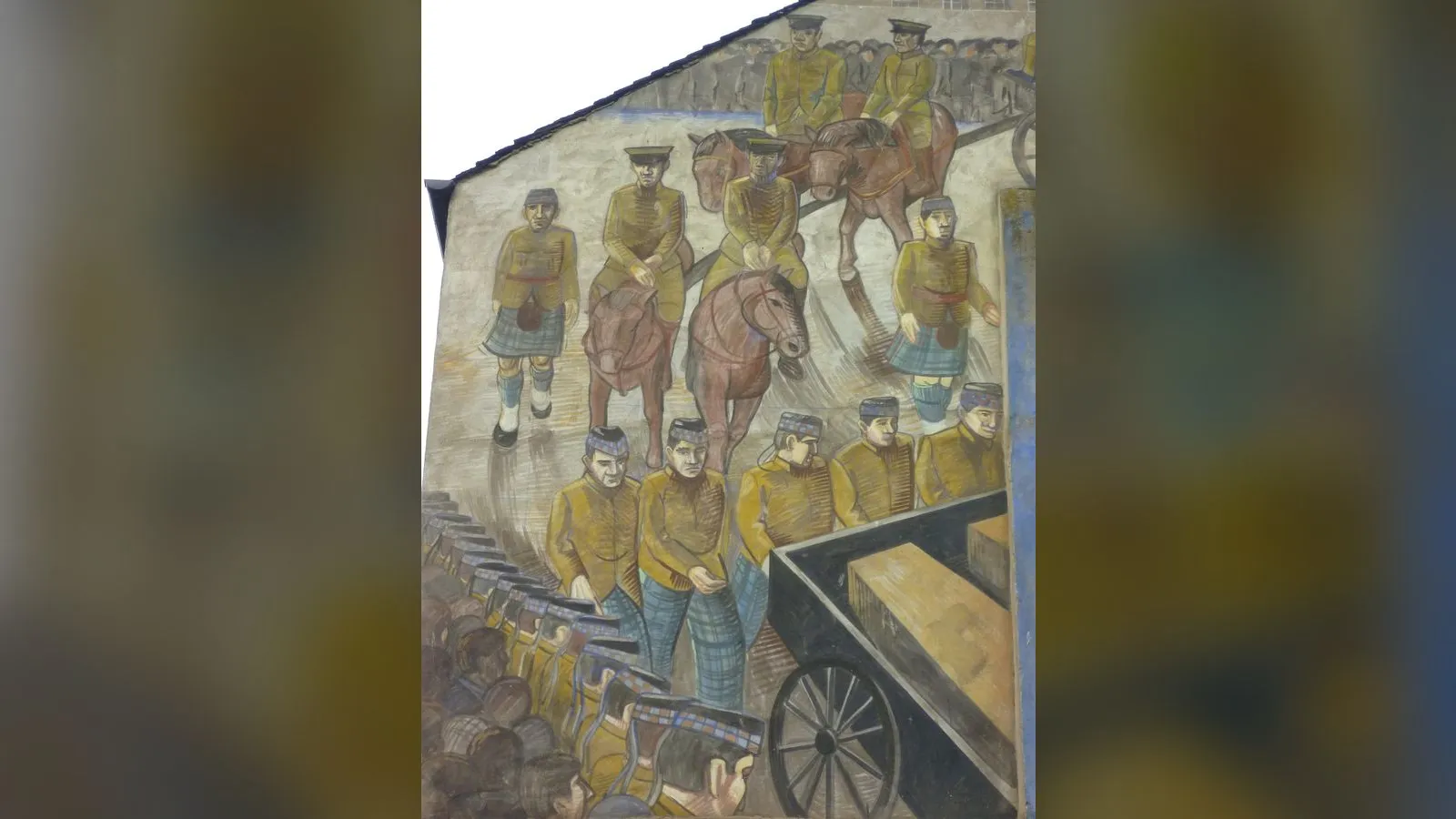

The Quintinshill Rail Disaster, 1915
Contents
On the morning of 22 May 1915 a troop train carrying half of the 1/7th (Leith) Battalion of the Royal Scots, bound for Gallipoli by way of Liverpool, ran head-on into a stationary local train at Quintinshill, a set of passing loops on the Caledonian Railway just north of Gretna. About a minute later a double-headed sleeping-car express from London ran into the wreckage, and gas from the troop train's lighting set its old wooden carriages alight. Between 226 and 230 people died, most of them young Territorial soldiers from Leith and Musselburgh. It remains the deadliest rail disaster in British history. Two signalmen were jailed for it. This card sets out what the official record shows, how the death toll is counted, and the later argument that the inquiries never looked beyond the signal box.
TL;DR
- established At about 6.49 am on 22 May 1915 the southbound troop special from Larbert hit the local train, which had been crossed onto the southbound main line at Quintinshill. About a minute later the northbound London to Glasgow sleeper ran into the wreckage, which spilled onto two goods trains standing in the loops.
- established The troop train's fifteen borrowed, gas-lit, wooden-bodied coaches were destroyed by fire. The wreckage burned through the day and smouldered into the next.
- shared Lieutenant Colonel Edward Druitt's Board of Trade report gave 227 dead. The Army later cut its soldier count by one, giving the often-quoted 226. National Records of Scotland gives 230, a total that includes four unidentified victims thought to have been on the express.
- established Signalmen James Tinsley and George Meakin had broken the rules on shift changes, lever collars and blocking back. The High Court in Edinburgh convicted both of culpable homicide in September 1915; both were freed on 15 December 1916.
- shared Jack Richards and Adrian Searle, in The Quintinshill Conspiracy (2013), argue that the Caledonian Railway and the authorities kept the company's own failings, and a possible illness of Tinsley's, out of the inquiries. This is their interpretation, not an official finding.
Key Facts
- Date and time
- 22 May 1915, about 6.49 am (first collision)
- Place
- Quintinshill passing loops, Caledonian Railway main line, just north of Gretna Junction, Dumfriesshire
- Troop train
- 3.42 am Larbert to Liverpool; 498 officers and men of the 1/7th Royal Scots; Caledonian 4-4-0 no. 121; 21 vehicles
- Local train
- Carlisle to Beattock stopping train; Cardean class 4-6-0 no. 907 and four coaches
- Express
- Midnight Euston to Glasgow sleeper, running late; 4-4-0s nos. 140 and 48
- Goods trains
- Northbound goods in the down loop; southbound empty coal wagons in the up loop
- Deaths
- 227 official (215 soldiers, nine other passengers, three railwaymen); 226 after Army revision; 230 per National Records of Scotland
- Injured
- 246 (official figure)
- Signalmen
- James Tinsley (day shift) and George Meakin (night shift)
- Board of Trade inquiry
- Lt-Col Edward Druitt; public hearing at Carlisle, 25 May; report forwarded 17 June 1915
- Trial
- High Court, Edinburgh, 14–15 September 1915 (some sources say 24 September)
- Sentences
- Tinsley three years' penal servitude; Meakin 18 months' imprisonment
- Released
- 15 December 1916
- Burial
- Mass grave, Rosebank Cemetery, Leith, 24 May 1915
A Note on Claims and Evidence
Each major claim carries one of three labels. established means supported by primary records, official bodies or several independent reliable sources. shared means the core fact is sound but sources disagree on details, dates or interpretation, or the claim is one author's argument. traditional means widely repeated but not traceable to a primary or independent source.
The disaster is unusually well documented. The record includes Druitt's Board of Trade report (The National Archives, MT6/2423), the depositions for the Carlisle inquest, Crown Office precognitions, trial reports, prison files and the Dumfries Fatal Accident Inquiry, many of them held by National Records of Scotland. The local press, above all the Dumfries & Galloway Standard, reported the hearings in detail. Jack Richards and Adrian Searle used all of these for The Quintinshill Conspiracy, a well-researched popular history with a strong thesis. Where this card relies on records they cite, the facts are marked Established; their reading of those records is marked Shared.
The exact death toll cannot be fixed. The battalion roll was lost in the fire, many bodies could not be identified, and four unidentified victims were left out of the official count. Sources also disagree on the date of the trial and on the number of soldiers who answered the roll call.
Timeline
George Meakin begins a ten-hour night shift in Quintinshill signal box.
The troop special leaves Larbert with A and D companies and the headquarters of the 1/7th Royal Scots.
Meakin puts a late-running northbound goods train into the down loop.
The local train arrives from Carlisle with James Tinsley on the footplate and is crossed onto the southbound main line; a train of empty coal wagons waits to enter the up loop.
The coal empties are in the up loop and "train out of section" is sent to Kirkpatrick box. No blocking-back signal is sent and no lever collar is used.
The first northbound express, for Edinburgh and Aberdeen, passes safely.
Kirkpatrick box offers the troop train and Tinsley accepts it.
Tinsley accepts the Glasgow sleeper from Gretna Junction and clears his signals for the troop train.
The troop train hits the stationary local train.
The express runs into the wreckage and fire spreads through the troop train.
A Caledonian emergency train with doctors arrives from Carlisle.
The Carlisle fire brigade starts work, pumping water from the River Sark.
The surviving soldiers are mustered in a field beside the line; the remnant leaves for Carlisle at 4.30 pm.
The wreckage still smoulders; the line reopens that evening.
The soldiers' funeral procession in Leith and mass burial at Rosebank Cemetery.
Druitt holds his one-day public hearing at the County Hotel, Carlisle; the Carlisle coroner's inquest opens and is adjourned.
Unidentified remains are buried at Glasgow's Western Necropolis.
A first attempt to arrest Tinsley is halted on medical grounds; he is arrested the next day, brought before the sheriff at Dumfries and bailed.
Druitt forwards his report to the Board of Trade.
The Carlisle inquest finds gross negligence against Tinsley, Meakin and fireman George Hutchinson.
High Court trial in Edinburgh; Hutchinson is acquitted and the signalmen are convicted.
Fatal Accident Inquiry at Dumfries.
Senior Caledonian officials meet in Glasgow to review the rule breaches.
Lord Rosebery dedicates the Royal Scots memorial at Rosebank.
Tinsley and Meakin are released.
A memorial near Gretna Green is unveiled.
A plaque is unveiled at Blacksyke Bridge, overlooking the site.
Centenary services at Gretna and Rosebank.
Details
The trains
established The setting. Quintinshill signal box, opened in 1903, stood on the Caledonian Railway's main line between Carlisle and Glasgow, about ten miles north of Carlisle. It controlled a passing loop on each side of the double track, where slow trains could stand while faster ones ran through, and a crossover between the two main lines. Wartime traffic on the route had risen by about forty per cent, while the companies tried to keep their express services close to peacetime timings.
established The troop special. The train left Larbert at 3.42 am with 15 officers and 483 other ranks of the 1/7th Royal Scots, a Territorial battalion of the 52nd (Lowland) Division bound for Gallipoli. It was made up of fifteen elderly non-corridor coaches borrowed from the Great Central Railway, most of them six-wheelers with wooden bodies and gas lighting, plus six Caledonian wagons and vans at the rear carrying stores and ammunition. At its head was Caledonian 4-4-0 no. 121, driven by Francis Scott with fireman James Hannah, both from Carlisle. The train was running late and came down the long falling gradient from Beattock summit at speed.
established The local and the express. The stopping train for Beattock was sent out of Carlisle ahead of two late-running overnight expresses from London, so that its engine, a Cardean class 4-6-0, could reach Beattock in time for another working. Its crew were driver David Wallace and fireman George Hutchinson. Behind it came the 11.45 pm from Euston to Edinburgh and Aberdeen, then the midnight sleeper from Euston to Glasgow, which left Carlisle more than half an hour late behind two Caledonian 4-4-0s.
established The goods trains. By 6.30 am both loops were taken. A northbound goods train stood in the down loop. A train of empty coal wagons, returning south after delivering coal for the Grand Fleet, was being put into the up loop because there was no room for it in Kingmoor yard at Carlisle.
The signal box and the shift change
established An unofficial arrangement. The day shift at Quintinshill began at 6 am. Meakin and Tinsley had an unauthorised arrangement by which the man coming on duty could arrive up to half an hour late. The night man noted the train times on a slip of paper, and the day man copied them into the train register so that the book showed a 6 am handover. On 22 May the Gretna Junction signalman, Roger Kirkpatrick, passed word that the local would stop at Quintinshill, and Tinsley rode there on its footplate.
established The local is crossed over. To keep the main line clear for the expresses, Meakin stopped the local at Quintinshill and reversed it through the crossover onto the southbound main line, the line the troop train would use. The same move had been made several times before that year. His plan was to let the first express pass and then send the local on ahead of the second.
established Handover and forgetting. Tinsley entered the box at about 6.32 am. Witnesses said Meakin briefed him on the position of every train. Tinsley then began copying the notes into the register while Meakin sat reading a newspaper. At 6.42 he accepted the troop train from Kirkpatrick box, and at about 6.46 he cleared his signals for it, with the local standing on the same line some thirty yards from the box. At the Board of Trade hearing he said: "I forgot about it after I jumped off the engine and it never entered my mind again until after the accident happened."
shared Distraction or something else. Druitt and the courts blamed the late handover and the copying of entries for diverting Tinsley's attention. Later accounts added a lively conversation about war news among railwaymen in the box. Richards and Searle argue that the evidence places no more than four men in the box at one time and that Tinsley took little part in any talk. They also point out that the box's lever frame faced away from the line, so signalmen worked with their backs to the track and checked trains through the end windows.
The rules that were broken
established Rule 55. When a train was held at a signal, a member of its crew had to go to the box, remind the signalman, see that the train was protected and sign the register. Fireman Hutchinson went up, signed the book with "Rule 55" and his engine number, but did not check that a lever collar was in place. The signature went onto the wrong page of the register.
established The lever collar. Company rules required a collar to be placed on the lever of the signal protecting a standing train, so that it could not be cleared by mistake. Neither signalman used it. Evidence at the hearings showed that collars were seldom used at Quintinshill or at other boxes in the district.
established Blocking back and the block instrument. No blocking-back signal was sent to Kirkpatrick to stop trains entering the occupied section. When the coal empties were safely in the loop, "train out of section" was sent and the block indicator was returned to normal, which showed the line as clear. Each signalman said the other had done it, and the copied register could not settle the point.
shared Could Meakin have blocked back? The Caledonian's officers told every hearing that Meakin should have blocked back. Richards and Searle argue that the full text of Regulation 13 required the signal to be sent before the line was obstructed, with the permission of the box in the rear, and that this was impossible while the coal empties were still in the section. They say the company sent Druitt only parts of the rule. The technical appendix in their book treats the regulation as poorly framed for this situation.
The two collisions
established The first impact. The troop train's crew saw the local only as they came under a road bridge, less than 200 yards away. The local's crew jumped clear. The troop train struck the engine of the local at an estimated 40 mph. Scott and Hannah were killed. The leading coaches rode over the wrecked engine and most of the rest broke up, so that a train more than 200 yards long was crushed into about 67 yards. Two passengers in the local's leading coach were killed.
established The second impact. The local's guard and the coal train's crew ran south to warn the express, but it was too close. Meakin threw the signals to danger, but the sleeper struck the wreckage at about 40 mph roughly a minute after the first crash. Wreckage was flung into the goods trains in both loops. The express's steel-framed coaches largely held together, but eight people on board died, among them three officers of the 9th Argyll and Sutherland Highlanders and two naval officers. Four further unidentified victims are thought to have been on the express.
Fire and rescue
established The fire. Gas escaping from the troop train's ruptured cylinders was lit by coals from the engines' fireboxes. The wooden coaches burned fiercely and many trapped men could not be reached. Soldiers uncoupled the ammunition vans at the rear and pushed them clear. Railwaymen, soldiers, sailors from the express, local farm workers and doctors from Carlisle worked in the field beside the line. Several men were freed only by amputation in the wreckage.
shared A slow response. The Carlisle fire brigade was not told of the fire for some time and did not begin pumping water from the River Sark, half a mile away, until around 10 am. Accounts differ over who finally raised the alarm. The fire burned for most of the day and the wreckage smouldered until the next. Stories that officers shot trapped men to spare them burning come from survivors' accounts; there is no official record of it.
Leith and the 1/7th Royal Scots
established The battalion. The 1/7th Royal Scots, known as the Leith Battalion, drew its men from Leith and Musselburgh. Its commanding officer, Lieutenant Colonel William Carmichael Peebles, survived and led the battalion's part in the rescue. Three officers were killed: Major James Hamilton, Captain John Mitchell and Lieutenant Christian Salvesen. The battalion's other two companies, on a second train, were diverted round the blocked line and sailed from Liverpool as planned.
shared The roll call. The unhurt survivors were mustered in the field during the day. The most widely quoted figure, from a 4 pm roll call, is 58 men and seven officers. The regimental museum gives 62 unhurt survivors. Peebles recorded seven officers and 57 other ranks on the special train that took the remnant from Carlisle to Liverpool. Only the officers sailed; the men were sent home to Edinburgh.
established Leith's funeral. On 24 May the soldiers' coffins were taken from the battalion's drill hall in Dalmeny Street to Rosebank Cemetery in a procession that took three hours to pass. About a hundred coffins were laid in a single long grave, many holding unidentified or mingled remains. More burials followed later in the week.
Counting the dead
shared Competing totals. Druitt's report counted 227 dead: 215 soldiers, nine other passengers and three railwaymen (the troop train's driver and fireman and a sleeping-car attendant). The Army later reduced its soldier count by one, hence 226. National Records of Scotland gives 230, including three officers and 207 other ranks of the Royal Scots. The regiment records 216 of its men dead, and the bronze panels at Rosebank name 214. Richards and Searle's own casualty list also reaches 230.
established The unidentified victims. Two coffins of unidentifiable remains, one thought to hold the bodies of children, were sent to Glasgow on 24 May in the hope that someone would claim them. No one did, and the Caledonian buried them at the Western Necropolis. These four victims are outside the official 227.
The Board of Trade inquiry
established Druitt's hearing. Lieutenant Colonel Edward Druitt of the Railway Inspectorate opened the inquiry at the County Hotel, Carlisle, on 25 May. Tinsley gave evidence in public against his solicitor's advice. Druitt's report, forwarded on 17 June, found that the collision was due to "want of discipline on the part of the signalmen". He listed the unauthorised shift change, Meakin's lax handover and the neglect of rules framed to guard against forgetfulness. He doubted the Gretna stationmaster, Alexander Thorburn, could have been unaware of the arrangement. He made no new recommendations, instead repeating earlier calls for steel coaches, electric lighting and fire-fighting equipment on trains.
shared A one-day public hearing. Richards and Searle argue that the Carlisle hearing was only adjourned, that later evidence was taken in private with the Caledonian in control, and that the archived report is typed on Caledonian notepaper. They note that it omits press-reported exchanges about Tinsley's health and Thorburn's vague evidence on his inspections.
Arrest, inquests and the Carlisle coroner
established Tinsley's arrest. The Dumfriesshire procurator fiscal's office named Tinsley as the cause within two days of the crash. Police went to arrest him on 28 May but were told by his doctor that he had suffered fits since the collision. He was arrested the next day after examination by the county medical officer, appeared in tears before the sheriff at Dumfries, and was bailed at £300, guaranteed by the National Union of Railwaymen.
established The Carlisle inquest. The city coroner, Thomas Slack Strong, inquired into the 27 victims who died in Carlisle. At the resumed hearing on 23–24 June the jury found gross negligence against Tinsley, Meakin and Hutchinson, the vote on Hutchinson being 12 to 7, and all three were committed for trial for manslaughter at the Cumberland Assizes. The defence solicitor protested that the offence had happened in Scotland. After protests from Scotland, the case went to the Scottish courts. A second inquest, at Penrith, covered one soldier who died there.
The trial in Edinburgh
established Trial and verdict. The trial opened at the High Court in Edinburgh on 14 September 1915 before the Lord Justice General, Lord Strathclyde. The Lord Advocate, Robert Munro, prosecuted, and James Condie Sandeman KC defended all three men. Nearly all the technical evidence came from Caledonian officials. The Crown dropped the case against Hutchinson, who was formally acquitted. The defence led no evidence. On 15 September the jury took only minutes to find both signalmen guilty. Tinsley received three years' penal servitude and Meakin 18 months' imprisonment.
shared The trial date. National Records of Scotland and Richards and Searle give 14 September. The Royal Scots' regimental account and some other sources give 24 September.
established The Dumfries inquiry. The Fatal Accident Inquiry opened at Dumfries on 4 November 1915. Two jurors pressed the Caledonian's assistant superintendent of the line, Robert Killin, on how the late shift change had gone undetected for months. The finding still placed the cause on the signalmen's breach of the rules.
Prison and release
established Release. Meakin served his sentence in Barlinnie and Tinsley in Peterhead. Railwaymen's branches, nine of the trial jurors and Edinburgh citizens petitioned for clemency, and the NUR's J.H. Thomas MP pressed successive Scottish Secretaries, at one point warning of industrial action. In December 1916 Harold Tennant agreed to free Tinsley a year early. Both men were released on 15 December 1916, Meakin on his normal remission date. Both went back to work for the Caledonian, but neither worked as a signalman again.
The Richards and Searle thesis
shared The argument. Jack Richards and Adrian Searle, in The Quintinshill Conspiracy (2013), argue that the signalmen were made scapegoats. In their account, the Caledonian presented selective rules to every hearing, covered for weak supervision at Gretna, and shaped the official report. They also argue that the wartime government, already in crisis in May 1915, had reasons to keep the story narrow. They point to documented failings: the stationmaster kept no written inspection reports, collars were widely ignored, and the troop train was unfit to run at express speed.
shared Epilepsy. Their most striking claim is that Tinsley may have had epilepsy. It rests on a police note recording his doctor's report of epileptic fits after the crash, a newspaper report that he was "subject to fits", and Sandeman's remark to the jury: "It would not be criminal negligence if he fell down in an epileptic fit." No medical record confirms it, and the official findings attribute the crash to negligence. A 2015 BBC documentary also raised the possibility. It remains a hypothesis.
Remembrance
established Memorials. Lord Rosebery, honorary colonel of the battalion, dedicated a Celtic cross of Peterhead granite at Rosebank in May 1916, with the soldiers' names on bronze panels. A memorial near Gretna Green was unveiled in 1995, a plaque was placed at Larbert station the same year, and another was fixed to Blacksyke Bridge above the site in 2010. A memorial to the unidentified dead was erected at the Western Necropolis in 2011. The centenary was marked by services at Gretna on 22 May 2015 and at Rosebank the next day. A remembrance service is held at Rosebank each year.
Did You Know?
- Five trains were caught up in the disaster: the troop special, the local, the Glasgow sleeper and two goods trains.
- Tinsley rode to work on the footplate of the very train he forgot.
- The troop train's coaches were borrowed from the Great Central Railway, and some were around fifty years old.
- Soldiers uncoupled the ammunition vans at the rear of the troop train and pushed them away from the fire.
- The Carlisle coroner committed the signalmen for trial in England, even though Tinsley had already been charged in Scotland.
- The jury at the Edinburgh trial took only minutes to convict, yet nine of its members later petitioned for the men's early release.
- Both signalmen went back to work for the Caledonian after prison, though never again as signalmen.
- The signal box was demolished in the 1970s, but the passing loops are still in use.
FAQ
1What happened at Quintinshill?
A southbound troop train ran into a local train standing on the same line, an express then ran into the wreckage, and the troop train's gas-lit coaches caught fire.
2When and where did it happen?
At about 6.49 am on Saturday 22 May 1915, at the Quintinshill passing loops on the Caledonian Railway just north of Gretna, in Dumfriesshire.
3How many people died?
Between 226 and 230, depending on the count. The official figure was 227, later revised to 226; National Records of Scotland gives 230.
4Who were the soldiers?
Officers and men of the 1/7th (Leith) Battalion of the Royal Scots, a Territorial unit from Leith and Musselburgh, travelling from Larbert to Liverpool to embark for Gallipoli.
5Why was the local train on the main line?
Both loops were occupied by goods trains, so Meakin crossed the local onto the southbound line to let two late-running expresses pass, intending to move it on before the troop train arrived.
6Why did the signalman forget it?
Tinsley said simply that he forgot. The inquiries blamed his late arrival and the copying of register entries. Richards and Searle suggest he may have been ill, possibly with epilepsy, but this is unproven.
7What safety rules were broken?
The shift change was unauthorised, no lever collar was placed on the signal lever, no blocking-back signal was sent, and the fireman did not complete Rule 55. Whether blocking back was possible at all is disputed.
8Why was the fire so deadly?
The troop train's old wooden coaches were lit by gas stored under the floors. The gas was lit by coals from the engines, and the fire brigade arrived late.
9Who was prosecuted?
Tinsley, Meakin and fireman George Hutchinson. Hutchinson was acquitted. The two signalmen were convicted of culpable homicide at the High Court in Edinburgh in September 1915.
10What sentences did they receive, and when were they freed?
Tinsley received three years' penal servitude and Meakin 18 months' imprisonment. Both were released on 15 December 1916.
11Did the railway company share the blame?
No official body blamed the Caledonian. Druitt doubted the stationmaster's evidence, and the company later tightened its own rules. Richards and Searle argue that its failings were deliberately kept out of the record.
12Where are the soldiers buried?
Most lie in a mass grave at Rosebank Cemetery, on the Edinburgh and Leith boundary, beneath a granite memorial dedicated in 1916.
13Is it still Britain's worst rail disaster?
Yes. No British rail accident before or since has killed more people.
Sources and Further Reading
Primary/Institutional
- National Records of Scotland, "Quintinshill disaster, 22 May 1915" (nrscotland.gov.uk), consulted for the 230 total, Royal Scots casualty figures and the 14 September trial date
- The Royal Scots regimental museum, "The Quintinshill (Gretna) train crash, 22 May 1915" (theroyalscots.co.uk), consulted for the 498 on board, 62 unhurt and 216 dead
- The National Archives, "The centenary of the Quintinshill rail disaster", blog post, 2015 (blog.nationalarchives.gov.uk)
- Board of Trade, Lt-Col E. Druitt, report on the Quintinshill collision, 1915 (The National Archives, MT6/2423), cited via Richards and Searle
- National Railway Museum, "Remembering Quintinshill", 21 May 2015 (railwaymuseum.org.uk)
Scholarly/Critical
- David Howell, Respectable Radicals: Studies in the Politics of Railway Trade Unionism (Ashgate, 1999), on railway accident inquiries and the unions (not consulted directly)
Specialist
- Jack Richards and Adrian Searle, The Quintinshill Conspiracy: The Shocking True Story Behind Britain's Worst Rail Disaster (Pen & Sword Transport, 2013; 2015 edition), including a casualty list and a technical appendix on the signalling by Keith Walter
- John Thomas, Gretna: Britain's Worst Railway Disaster (1915) (David & Charles, 1969)
- J.A.B. Hamilton, Britain's Greatest Rail Disaster: The Quintinshill Blaze of 1915 (Allen & Unwin, 1969)
General
- Wikipedia, "Quintinshill rail disaster" (en.wikipedia.org), consulted for the centenary events and later memorials
Further reading
- Gordon Routledge, The Sorrows of Quintinshill (2002)
Caveats: Myths and Disputed Claims
- Do not give a single exact death toll as certain; quote 227 (official), 226 (revised) and 230 (National Records of Scotland) with their sources.
- Do not leave out the four unidentified victims, and do not state as fact that they were children or that they were stowaways on the troop train.
- Do not say there were five men chatting about the war in the signal box; the evidence suggests no more than four at once.
- Do not state that Tinsley had epilepsy; it is a hypothesis drawn from a police note and later inference, with no surviving medical record.
- Do not present the cover-up thesis as an established finding; it is the argument of Richards and Searle.
- Do not state as fact that officers shot trapped soldiers; the accounts come from survivors and are not confirmed by official records.
- Do not repeat the stories of an officer trying to shoot the signalmen, enemy sabotage, or a premonition of the crash; none is supported by evidence.
- Do not blame the fire on the soldiers or the train crews; it came from the gas lighting and the engines' fires.
- Do not give a single date for the trial without noting that some sources say 24 September rather than 14–15 September.
Card 045 · Defence