
The Shetland Bus
Contents
TL;DR
The "Shetland Bus" was the secret sea link between Shetland and Nazi-occupied Norway during the Second World War. Norwegian fishermen who had escaped the occupation sailed small wooden fishing boats across the North Sea in the dead of winter. They landed agents, radio sets and weapons for the Norwegian resistance and brought refugees back. The service was run by a small base staffed by British officers, first at Lunna on Shetland's east coast and from 1942 at Scalloway on the west. It paid a heavy price: ten boats and more than forty men were lost, most of them in the winter of 1942–43. In autumn 1943 the United States supplied three fast submarine chasers, and from then on the run was made without further loss. In Norway, "taking the Shetland bus" became a byword for escape, and the link between Shetland and Norway it forged is still marked today.
Key Findings
- It was a Norwegian operation in Scotland. The boats and their crews were Norwegian. The base that sent them was run by a handful of British officers for a London headquarters, and Shetland supplied the harbours, workshops and much of the goodwill.
- Winter was its season. The boats needed darkness to reach the Norwegian coast unseen, so for three years every crossing was made in the sub-Arctic winter, in boats 50 to 75 feet long that sailed alone.
- The sea was as dangerous as the enemy. According to David Howarth, the base's second-in-command, the boats steamed about 90,000 miles in the last four winters of the war and sighted only four other ships. Hurricanes, icing and engine failure killed as many men as German aircraft did.
- The cost was heavy. Ten boats were lost over the war. In the winter of 1942–43 alone, Howarth records the loss of five boats and 42 of the roughly 100 men who sailed regularly.
- Fast boats ended the losses. From autumn 1943 three American-built submarine chasers, Hessa, Hitra and Vigra, took over the run. Howarth counts 34 operations in their first winter and 80 in the last winter of the war, without a single casualty.
- Its best-known skipper became a legend. Leif Larsen, elected skipper by his own crew, won the Conspicuous Gallantry Medal, the Distinguished Service Order, the Distinguished Service Cross and the Distinguished Service Medal and Bar. Howarth wrote that no other man, British or foreign, had received all of these British honours.
Key Facts
- Period
- 1941–1945 (first return trips in winter 1940–41)
- Bases
- Lunna House, Lunna Ness (1941–42), then Scalloway (from 1942). Headquarters at Flemington, Weisdale, and an office in Lerwick
- British officers
- Major L. H. Mitchell (commanding until autumn 1942); Sub-Lieutenant David Howarth RNVR (second-in-command); Captain "Rogers" (Arthur Sclater), later commanding
- Crews
- Norwegian fishermen and merchant seamen; about 30 at first, a "private navy" of about 150 by the end
- Pay (1941)
- £4 a week plus a £10 bonus for each trip to Norway, as civilian volunteers
- Purpose
- Landing agents, radio operators, weapons and explosives; bringing out refugees and agents in danger
- First winter (1941–42)
- 40 trips; 43 agents landed, 9 picked up; 130 tons of arms and equipment landed; 46 refugees brought out (Howarth)
- Whole war
- Nearly 400 tons of arms carried and about 350 refugees brought out (Howarth); about 200 voyages in all by other counts
- Losses
- 10 boats; more than 40 crew, plus passengers and refugees
- Subchasers
- Hessa, Hitra and Vigra, from autumn 1943: 110 feet long, cruising at 17 knots
- Memorial
- Shetland Bus Memorial, Scalloway; Scalloway Museum
Claim Status
established
- the operation, its bases and its purpose;
- the move from Lunna to Scalloway in 1942;
- the arrival of the submarine chasers in 1943 and the absence of losses afterwards;
- Leif Larsen's British decorations;
- the major losses described below (Blia, Aksel, Brattholm, Bergholm).
shared
- voyage and loss totals. Sources count differently: whether trips that failed to reach Norway are included, whether boats captured with their crews alive count as losses, and whether passengers and refugees are added to crew deaths. Howarth's figures are those of an insider writing in 1950 from the unit's records, but they are not the only count.
- the unit's command status. Howarth, who was there, says British officers ran the base throughout. A 1942 attempt to put the boats and crews under Norwegian naval command collapsed within about three months. Other accounts stress the unit's later formal standing as a Norwegian naval unit.
traditional
- the idea that "the Shetland Bus" was an official name. It was an informal nickname. Howarth credits the Norwegians themselves with it; his 1951 book made it famous in Britain.
Escape Across the North Sea
Germany invaded Norway in April 1940. By June the king and government had left for Britain, and thousands of Norwegians followed them across the North Sea in fishing boats, yachts, small steamers and even rowing boats. Many landed in Shetland, which lies about 180 miles west of Bergen, closer to Norway than to London.
The exiled government and the British wanted to rebuild an army inside occupied Norway, which meant regular transport for messengers, instructors, radio operators, saboteurs and weapons. Howarth explains why fishing boats were chosen. In 1941 Britain had no aircraft or naval vessels to spare for work that brought no immediate results. Norway's mountains and weather made parachute drops unreliable. No warship was both seaworthy enough for the winter North Sea and small enough to approach an enemy coast unseen. Norwegian fishing boats, by contrast, could cross the North Sea in winter, and on arrival they were indistinguishable from the thousands of boats still fishing there.
In the winter of 1940–41 several refugee crews agreed to sail back, land a passenger and return. All of these trips succeeded, and at the end of 1940 an army officer, Major L. H. Mitchell, was sent to Shetland to set up a permanent base. In the spring of 1941 he was joined by David Howarth, a young naval sub-lieutenant who spoke some Norwegian and knew the coast from pre-war holidays. In his history Howarth refers only to "our London headquarters". The base worked for Britain's secret services, chiefly the Special Operations Executive.
Lunna: the Smugglers' Haunt
Mitchell set up his headquarters at Flemington, a farmhouse in the valley of Weisdale, famous in treeless Shetland for the tree in front of it. The boats first lay at Cat Firth and in Lerwick. Neither was right: Lerwick was too public, and Cat Firth had no deep-water pier and no shelter ashore.
In July 1941 Mitchell and Howarth found Lunna, on a remote isthmus 27 miles from Lerwick along a moorland track. It had a large, gaunt house that could sleep 35 men, a stone quay left over from the days of herring curing, outhouses for explosives, and a nearly landlocked bay where boats could come and go unseen, even by the coastguards. The only other buildings in sight were a farmhouse, a manse and an ancient church. Howarth admitted that the place's resemblance to "the smugglers' haunt of fiction" had appealed to them. The crews moved in at the end of July 1941, took off their caps on the doorstep, and asked whether the King of Shetland lived there.
The first operation of the new season sailed on 30 August 1941: the cutter Aksel, carrying a messenger to the islands north of Bergen. She came back on 5 September decorated with heather and birch boughs. Her crew had spent two days ashore in Norway, gone to a dance and been given a regal send-off.
It was an odd unit. The Norwegians were civilian volunteers who could give a week's notice, and each man decided for himself whether to sail on each trip. The British officers were forbidden to sail at all, because they knew too much to risk capture. Howarth concluded that fishermen "cannot be driven". Orders without reasons simply went undone, so he and Mitchell led by persuasion, explanation and practical help. He took this far enough to go about in a collarless shirt and ragged trousers. He describes looking up, waist-deep in the sea with cement in his hair, to see an admiral on the beach asking where he might find a naval officer called Howarth.
The Winter Run
Crossings ran from late August to April, when the long nights hid the boats from German aircraft. The usual pattern was to reach the edge of the German-patrolled 50-mile fishing zone at night, pass the day inside it disguised as an ordinary fishing boat, and approach the coast at dusk. Once among the islands and sounds of the inner lead, the sheltered channel that runs the length of the coast, success depended, in Howarth's words, on "luck, bravado, and a good look-out". Each boat carried a forged registration number, borrowed from a real boat of similar type from a port not too near its destination.
The weapons were concealed. Twin machine guns sprang out of what looked like an ordinary 40-gallon oil drum lashed to the deck; Howarth designed the mounting, and it was ready to fire in three seconds. Wheelhouses were lined with concrete, and bulwarks backed with steel plate. Cargoes went in crates bearing the markings of real Norwegian firms, or in paint drums with a tube of paint down the middle, so that anyone dipping a stick through the bung found only paint, not the Sten guns packed around it.
The first winter cost dearly. In September 1941 Vita was ambushed at a compromised rendezvous near Trondheim, and her crew spent the rest of the war as prisoners. In October Siglaos was attacked by an aircraft on the way home, and Nils Nesse, "little more than a boy", who had stayed at the wheel throughout, became the unit's first man killed. He was buried in the old churchyard at Lunna. A Norwegian crew sang their national anthem over his grave after a Scottish service they could hardly understand. The same month the minelayer Nordsjon foundered off the Norwegian coast after laying her mines. Her crew walked, rowed and bluffed their way more than a hundred miles down the coast past German patrols, then stole a fishing boat, the Arthur, from under the Gestapo's noses during an RAF air raid and sailed her back to Shetland.
Then, on 10 November 1941, a hurricane struck Shetland and blew for five days, often at well over 100 miles an hour. Salt spray from the voe broke over Lunna House. Seven boats laid up in Shetland's anchorages were wrecked in a single night. At sea, Larsen's Arthur was swamped off Unst and lost a man overboard, then rode out four days of storm with her crew crammed into a six-by-four-foot wheelhouse before reaching home. Blia, homeward bound from the coast south of Bergen with between 40 and 45 people aboard a 55-foot boat (seven crew and an escaping resistance group with their families), was never seen again. It was the worst single loss of the war.
Yet the work went on. By the end of the first winter the base had made 40 trips to Norway. Its crews knew the politics of shopkeepers, ferry skippers and fishermen all along the coast, and as Howarth put it, "every man, woman and child in Norway knew about us, and referred to our route as the Shetland Bus".
Scalloway and the Shetlanders
For the second winter the base moved to Scalloway, the ancient capital of Shetland, on the west side of the islands. Lunna's remoteness no longer protected a secret the Germans already knew, and it made repairs a constant problem. What decided the move was the engineering firm of William Moore and Son in Scalloway. Its owners agreed to let the Norwegian engineers work alongside their own men in a waterside workshop that Howarth said reminded him of a witch's kitchen. Jack Moore, its working head, would rather "hammer and weld till midnight" than shut up shop at teatime.
The unit spread through the village: crews in an old net factory, offices in a rented house, stores in a weaving shed and a herring-curing station. With a budget of £750 it built its own slipway, using a second-hand winch carried down a hill on Fair Isle, an engine from a wrecked fishing boat, and rails from Aberdeen. Crown Prince Olav allowed it to be named the Prince Olav Slipway. The unit also built an all-welded pier from a disused army water tower. When Howarth wrote in 1950, both were still in daily use by Shetland fishermen.
Shetland craftsmanship also went across the sea. The unit commissioned two boatbuilders on an outlying island to build a regular supply of 17-foot Shetland boats, the double-ended type descended from Viking craft, which Norwegians agreed would pass without comment anywhere in Norway. Fitted with small engines in watertight boxes, they were landed with agents and shipped over in large numbers for the resistance to move cargoes.
The welcome mattered. The people of Scalloway were, in Howarth's words, "hospitable by nature and well disposed by tradition to Norwegians", and the Norwegians, cut off from their own homes, found family life much like their own. Lifelong friendships followed. Howarth himself became engaged to a woman whose great-uncle, he discovered, owned the derelict slipway he had stripped for parts.
The Attempt on the Tirpitz
In autumn 1942 the unit took on its most daring task, Operation Title: an attack on the German battleship Tirpitz, lying behind nets far up Trondheimfjord. The weapons were two Chariots, the Royal Navy's two-man "human torpedoes", ridden by divers in rubber suits. The Arthur was to carry them across the North Sea on deck, then tow them underwater through the German controls to within striking distance.
The preparations were meticulous. A false bulkhead in the hold, built with old timber and old nails and deliberately dirtied, hid the six British Chariot men. The ostensible cargo was peat, the one thing Shetland could supply in quantity. Forged passes were stamped with rubber stamps copied from German originals, then carried in dirty trouser pockets until they looked authentic. The Arthur practised attacks on the battleship Nelson in a Scottish sea loch, then sailed from Lunna at the end of October 1942 under Leif Larsen.
The deception worked. At the entrance to Trondheimfjord a German naval officer examined Larsen's papers for a quarter of an hour in the cabin. He wrote the unfamiliar word "peat" on the pass and waved them on, while the Chariots hung on their wires beneath the hull. Then, in the open water of the fjord, a sudden head sea snapped both Chariots from their towing wires, barely five miles from the Tirpitz. The crew scuttled Arthur and made for neutral Sweden on foot. All but one got through. Able Seaman Robert Evans was wounded in a gunfight with Norwegian police near the border, nursed back to health by the Germans, and then executed. Howarth records that his killing was among the charges raised at the Nuremberg trials.
The Black Winter of 1942–43
The second winter was the worst. In December 1942 Aksel, under the much-loved Bard Grotle, sent a five-group signal ending "SEND HELP" from 200 miles north of Shetland. A Catalina found the crew in their dinghy and a rubber float, but the sea was too rough to land, and despite a four-day search by aircraft, fishing boats and a destroyer, no one was found. Sandoy was lost to air attack off Traena, and Feie vanished on a 24-hour crossing without sending any signal at all.
In March 1943 Brattholm sailed for the far north of Norway with a team of saboteurs. She was betrayed after an unlucky contact with a shopkeeper, cornered by a German warship in Toftefjord near Tromsø, and blown up by her own crew. The only survivor of the eleven men aboard, Sergeant Jan Baalsrud, escaped wounded and frostbitten, sheltered by local people. He spent days lying in the snow on a mountainside before a Sámi reindeer herder took him to Sweden by sledge. Howarth later told his story in We Die Alone (1955).
The same month Larsen's Bergholm was attacked by two seaplanes 75 miles off the coast. She fought them off for half an hour, but five of her eight men were wounded, and one died in the lifeboat. Larsen and the two unwounded men then rowed the patched lifeboat for four days and nights to the islands near Ålesund, about 150 miles away. Local people hid them through a week-long German search until a motor torpedo boat came from Shetland to take them off.
By spring, Howarth wrote, the losses had become too high for the planning to be "worth while". The crews were still willing, but the Germans were on the alert, and a fuel shortage in Norway had left so few large boats fishing that the unit's own boats now stood out.
The Subchasers
The answer came from America. In August 1943 the US Navy agreed to send three of its 110-foot submarine chasers. Howarth's text credits Admiral Nimitz, but this appears to be a slip. The US naval commander in Europe was Admiral Harold Stark, whom Howarth also mentions. The boats were shipped from Miami and handed over in the Clyde. They had a cruising speed of 17 knots and luxuries undreamed of in a fishing boat, including central heating and refrigerators. Manned by the fishing-boat crews under Leif Larsen, Petter Salen and Lieutenant Eidsheim, Hessa, Hitra and Vigra began operating at the end of September 1943. They were often inspected by German aircraft but never attacked, and Howarth records 34 operations that winter and 80 in the next without a casualty.
When Germany capitulated in May 1945, armed Norwegian resistance forces appeared in every town to take the surrender. In Bergen alone 3,000 men carried Sten guns that had come through the stores at Scalloway. The three subchasers made their last crossing openly, to a jubilant reception in Bergen and Ålesund.
Shetlands-Larsen
Leif Larsen came from Bergen and had skippered a ferry there before the war. He arrived in Shetland in the autumn of 1941 as one of the party trained for the Nordsjon minelaying trip. When the crews were invited to elect their own skippers, he was the first chosen, and Howarth calls him "the finest leader of them all". He was quiet and modest, with a broken nose and a soft voice. He would talk a German examination officer round over a cargo of peat, or stand unscratched at the wheel while his wheelhouse was shot to pieces around him. He had to be made a sub-lieutenant so that he could be issued with ciphers, despite refusing to attend an officers' school and being colour blind. Howarth later admitted that Larsen had once told him he had been "scared stiff". In Norway he became known as "Shetlands-Larsen".
Legacy
Howarth's own verdict was measured. The arms the unit carried armed the Norwegian home forces that took the German surrender. Its radio operators helped keep the Allies informed, with some 60 transmitters operating in Norway by the end of the war. It rescued around 350 refugees, "a work of mercy which would have justified much of our effort". And by sustaining the resistance it helped persuade Germany to keep a garrison of about 284,000 men in Norway until the end of the war. He was equally clear about the cost, refusing to "ascribe glory to the violent death of any young man loving life".
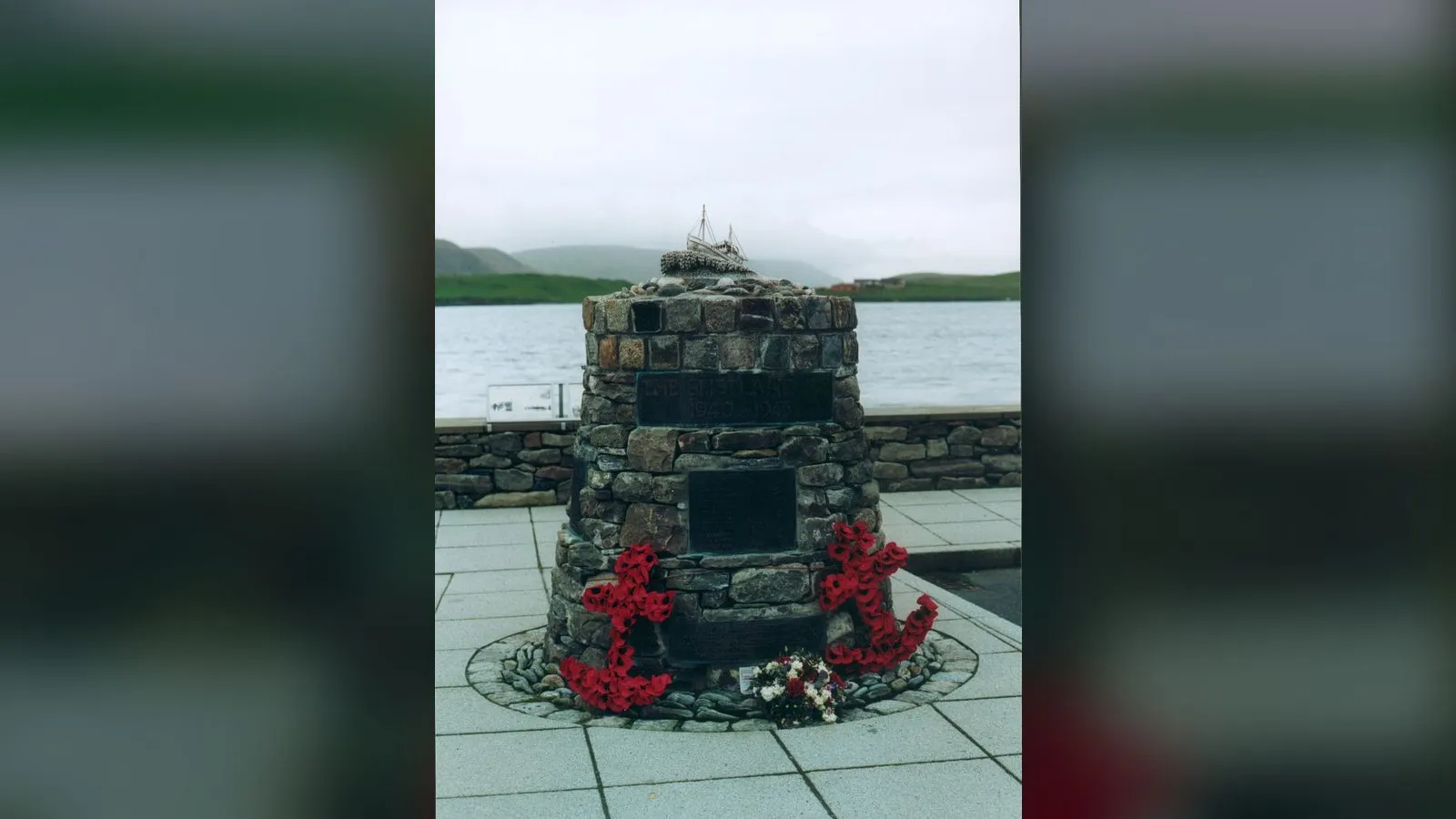
The Shetland Bus is commemorated by a memorial in Scalloway, unveiled in 2003, which lists the men who died, and the story is told at Scalloway Museum. The link between Shetland and Norway was already a thousand years old, and the war deepened it. Exchanges and anniversaries still mark it today.
Timeline
Germany invades Norway — Refugees begin reaching Shetland
First return trips by refugee crews — Major Mitchell sent to organise a base
Lunna leased as operational base — Headquarters at Flemington, Weisdale
Aksel sails on the first trip of the season —
Vita captured; Nils Nesse killed; Nordsjon lost — Arthur stolen from Norway by Nordsjon's crew
Great hurricane — Blia lost with 40–45 people aboard
First winter ends: 40 trips — Decision to move to Scalloway
Brief attempt at Norwegian naval command — Reversed after about three months
Blystad and Berge captured on a reconnaissance in the open boat Sjo — Later executed
Operation Title against the Tirpitz — Chariots lost; Arthur scuttled
Aksel, Sandoy and Feie lost —
Brattholm destroyed at Toftefjord; Bergholm sunk by aircraft — Jan Baalsrud the sole survivor of Brattholm
Subchasers Hessa, Hitra, Vigra begin operations — No further losses
Liberation of Norway — Subchasers sail openly to Bergen and Ålesund
David Howarth's The Shetland Bus published — Popularises the name in Britain
Scalloway memorial unveiled —
Did You Know?
- The unit's first headquarters, Flemington in Weisdale, was famous in Shetland for having a tree. The operational base was a separate house at Lunna, 27 miles from Lerwick.
- Howarth once found a suitcase that had been under his bed for six months. It held 300 bottles of chloroform and some detonators left by trainee saboteurs.
- One skipper broke the strictest rule of the base by posting a letter in Norway, proposing marriage and naming his next rendezvous. She was waiting there and came back to Shetland with him.
- The unit bought spare engine parts in occupied Norway, ordering them on one trip and collecting them on the next, from German-run factories.
- One boat's forged registration number turned out to belong to a vessel requisitioned by the Gestapo. Norwegian fishermen gave her such a wide berth that the unit kept the number all winter.
- At Christmas 1941 Bard Grotle's crew brought Christmas trees back from the enemy coast for the base.
- Hitra, one of the three American subchasers, was later found, restored and returned to service as a museum ship in Norway.
Honest Caveats
- Voyage and loss totals vary between sources depending on what is counted. Howarth's first-winter figures and his whole-war totals come from an insider with access to the unit's records, but they were written in 1950 and cannot be checked against them here.
- Howarth's book is a memoir. He was second-in-command and could not sail, so much of what happened at sea is the skippers' account as they told it to him. He also changed some details for security or clarity (he says he edited Baalsrud's report, and he used the cover name "Rogers" for Arthur Sclater).
- Howarth names Admiral Nimitz as the American officer who obtained the subchasers. This appears to be an error for Admiral Harold Stark, commander of US naval forces in Europe.
- Command arrangements changed over time and are described differently by British and Norwegian sources.
- The wider strategic effect (the German garrison of about 284,000 men held in Norway) had many causes; Howarth presents the base as "an essential link in a chain", not the sole reason.
FAQ
1What was the Shetland Bus?
A secret wartime sea link between Shetland and occupied Norway, run by Norwegian crews from a small British-run base, carrying agents and supplies out and refugees back.
2Where was it based?
First at Lunna, on Lunna Ness in the north-east of Mainland Shetland (1941–42), then at Scalloway on the west coast. Its headquarters were at Flemington in Weisdale, with an office in Lerwick.
3Why did the boats sail in winter?
They needed darkness. In summer that far north there is almost continuous daylight, which made secret landings impossible.
4Who ran it?
British officers: Major L. H. Mitchell, David Howarth and later Captain "Rogers" (Arthur Sclater), working for a London headquarters, chiefly the Special Operations Executive. The crews were Norwegian volunteers.
5How many men were lost?
More than 40 crew and ten boats, plus passengers and refugees; most were lost before autumn 1943. The single worst loss was Blia, which disappeared in November 1941 with between 40 and 45 people aboard.
6Why did the losses stop?
In autumn 1943 the unit received three fast American submarine chasers, which made well over 100 trips without a casualty.
7Who was Shetlands-Larsen?
Leif Larsen, a Bergen ferry skipper who became the unit's most famous skipper. He led the attempt on the Tirpitz and won four different British gallantry awards.
8Who wrote The Shetland Bus?
David Howarth, the unit's British second-in-command, published in 1951. He also wrote We Die Alone (1955), about Jan Baalsrud's escape.
Related
- Shetland Islands
- Scapa Flow
- Scottish Forces in the Second World War
- The Arctic Convoys and Scotland
Sources
Primary/Institutional
- Vest-Agder Museum, The Liberation Convoy 2025 (brochure). https://vestagdermuseet.no/wp-content/uploads/2025/01/The-Liberation-Convoy-2025-Brochure-English.pdf
- Scalloway Museum, Shetland Bus collections.
General
- Warsailors.com, "The Shetland Bus". https://warsailors.com/shetlandbus/index.html
- Wikipedia, "Leif Larsen". https://en.wikipedia.org/wiki/Leif_Larsen
- War History Online, "The Shetland Bus". https://www.warhistoryonline.com/world-war-ii/the-shetland-bus-escape-survival-adventure.html
Further reading
- David Howarth, The Shetland Bus: A WWII Epic of Escape, Survival, and Adventure (first published Thomas Nelson, 1951; later editions with a note on the salvage of Arthur). The principal source for this article.
- David Howarth, We Die Alone (1955), on Jan Baalsrud.
Card 042 · Defence