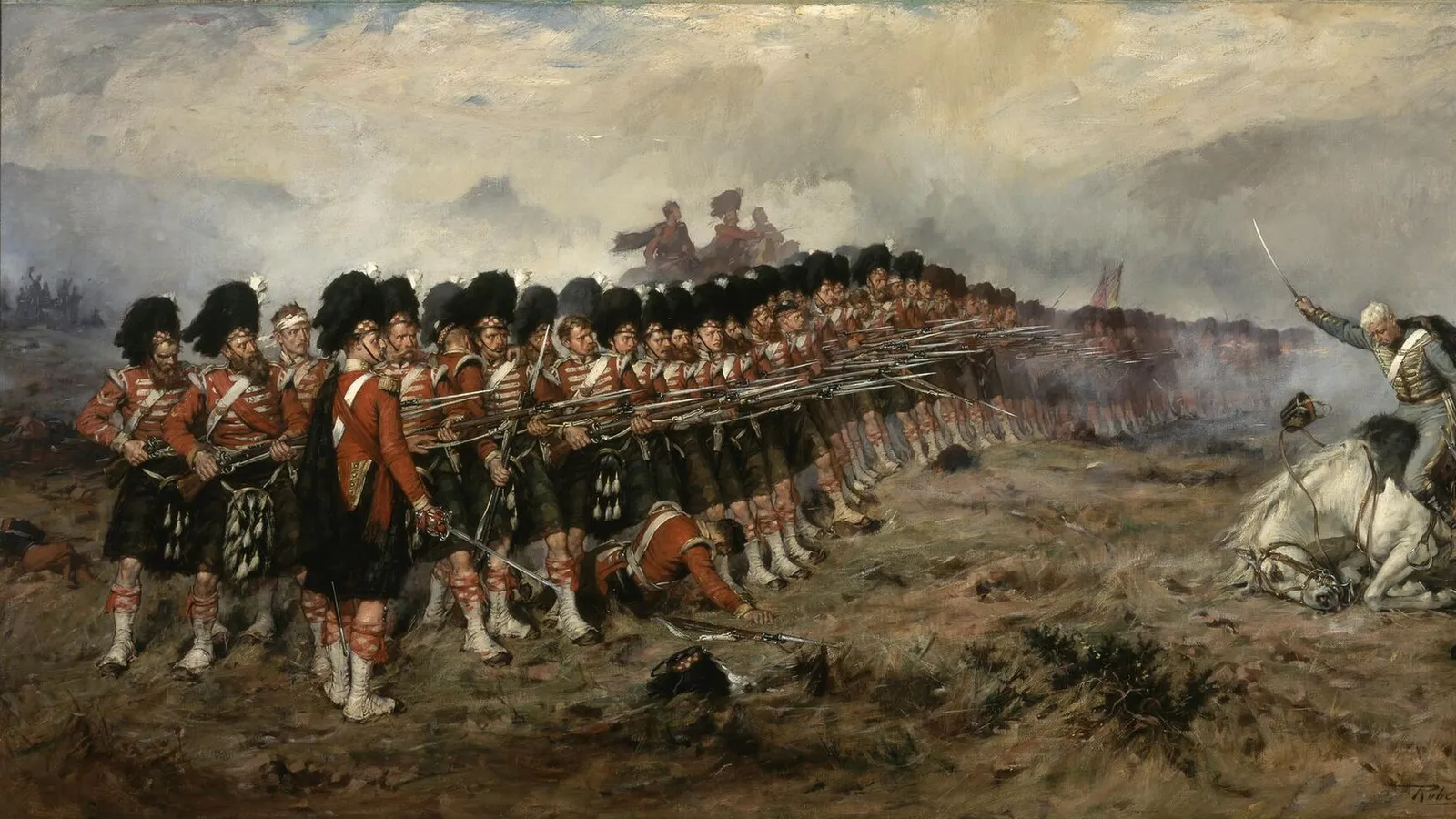

The Thin Red Line (Battle of Balaclava, 25 October 1854)
Defence Series, Card #27 of 50 · The dedicated convergence card for the 93rd (Sutherland) Highlanders' stand at Balaclava
TL;DR
- This is the dedicated convergence card for the "Thin Red Line." Card #13 (Argyll & Sutherland Highlanders) deferred full treatment here; Card #16 (Royal Scots Greys) disambiguated the Thin Red Line from the Charge of the Heavy Brigade and the Charge of the Light Brigade. This card delivers the comprehensive account of the 93rd Sutherland Highlanders' infantry stand specifically.
- The event is documented and real: on 25 October 1854, roughly 500 men of the 93rd — aided by about 100 walking wounded, 40 detached Guardsmen and a body of Turkish infantry — deployed two ranks deep rather than in the conventional square and turned back a Russian cavalry detachment with disciplined rifle volleys, losing no men killed in the action itself.
- The famous phrase is a later refinement — flag this as the card's key mythbusting task. The Times correspondent William Howard Russell actually wrote "that thin red streak tipped with a line of steel" (published 14 November 1854). The crisp "thin red line" is a popular condensation; Russell himself only adopted "thin red line tipped with steel" in his 1877 book.
- Campbell's "die where you stand" speech is traditional, not contemporaneously documented. The words trace to Alexander Kinglake's history (1860s), not to any 1854 dispatch; contemporaries who knew Campbell thought his real language "stronger and franker."
- The Thin Red Line, the Charge of the Heavy Brigade, and the Charge of the Light Brigade were three separate actions on the same morning. Only the first two were Scottish-associated (the Greys rode with the Heavy Brigade — see Card #16). The Light Brigade was not a Scottish action.
Key Facts
- Period/date covered: 25 October 1854 (the Thin Red Line action, roughly 09:00–09:30), during the Crimean War (1854–56).
- Key institution/theme: The 93rd (Sutherland Highlanders) Regiment of Foot, commanded by Major-General Sir Colin Campbell; later 2nd Battalion, Argyll and Sutherland Highlanders.
- Notable feature: First occasion in which a British infantry line, unsupported by a square, broke a cavalry advance by musketry alone; origin of one of the most enduring phrases in the English language.
- Current status/legacy: "Balaklava" is a battle honour carried on the colours of the Argyll & Sutherland Highlanders — the only infantry regiment permitted this distinction. The phrase survives as a general metaphor for a thin defensive force holding against odds. The lineage continues today in the Royal Regiment of Scotland.
Scottish Impact Index (SI Score)
- Military Impact
- 6/10
- Enduring Significance
- 9/10
- Strategic Importance
- 5/10
- Military Distinctiveness
- 10/10
- Military Legacy
- 9/10
- Recognition
- 10/10
49/60
Ranked =25th of 43 in Defence
Claim Status
Consistent with the site's "accuracy over patriotism" principle and the three-tier framework applied on Card #21 (Churchill/St Valery) and Card #26 (Ewart's Eagle/stirrups), the core claims here are graded as follows:
- Established (documented): The date, location and outcome; the 93rd's roughly 500-strong two-deep line and its small supporting force; the flight of the Turkish flankers; the repulse of the Russian horse by rifle volleys at long range; the near-absence of British casualties; Russell's eyewitness reporting; the battle honour and cultural afterlife.
- Shared/Traditional: Campbell's exact spoken words ("There is no retreat from here, men. You must die where you stand.") and Private John Scott's reply; Campbell's later "not worth the trouble of forming a square" remark. These are widely repeated and plausible but rest on post-war histories and regimental tradition, not contemporary transcripts.
- Disputed/Refined: The precise phrase "Thin Red Line" (a condensation of Russell's actual "thin red streak tipped with a line of steel"); how dangerous and decisive the moment genuinely was (modern scholarship regards it as a brief, minor skirmish relative to its romantic reputation); whether it was rifle- or artillery-fire that turned the Russians.
The two flagged mythbusting tasks — the exact origin of the phrase and Campbell's exact words — are given full treatment in the Details and Caveats sections below.
Timeline
Russian forces under General Pavel Liprandi (some 23,000–25,000 men) assault the Turkish-held redoubts on the Causeway Heights. Number 1 redoubt on Canrobert's Hill falls; the others are abandoned. The British supply base at Balaclava is now exposed.
About 2,500 Russian cavalry under Lieutenant General Ivan Ivanovich Ryzhov push forward; a detachment of about 400 turns towards Balaclava. The 93rd, sheltering behind a hillock near Kadikoi, forms a two-deep line on the crest. The Turkish flankers fire once and flee. The 93rd delivers volleys at long range; a flanking attempt is met by the grenadier company; the Russians veer off and retreat. (This card's subject.)
General Scarlett's heavy cavalry — including the 2nd Dragoons (Royal Scots Greys) — charge uphill into the main Russian cavalry mass and rout it. (See Card #16.)
Following a fatally ambiguous order, Lord Cardigan's light cavalry charge down the North Valley into Russian artillery, suffering heavy losses. (A separate, non-Scottish action.)
The battle ends inconclusively; the Russians hold the Causeway Heights and the Woronzoff Road, complicating British supply through the winter.
Details
The tactical situation and Campbell's decision to form a line
Balaclava was the British army's supply harbour, feeding the siege lines outside Sevastopol. Its outer defence lay along the Causeway Heights, garrisoned by Turkish troops in a chain of redoubts. When those fell on the morning of 25 October, the last organised force between the Russian cavalry and the harbour was the 93rd (Sutherland Highlanders) — around 500 men under Major-General Sir Colin Campbell, aided by a small force of about 100 walking wounded and 40 detached Guardsmen, supported by a substantial body of Turkish infantry and by field artillery (W Battery and C Troop, Royal Artillery).
Campbell had first sheltered his men from Russian artillery fire behind a low hillock north of Kadikoi, ordering them to lie down. When about 2,500 Russian cavalry under Ryzhov pushed forward to probe the approaches at around 9 a.m., a detachment of roughly 400 broke off and made for Balaclava (identified by some sources as hussars of the Ingermanland regiment, by others as Cossacks). Campbell brought the 93rd up onto the crest to meet them.
The orthodox defence of infantry against cavalry was the square, conventionally four ranks deep, which presented a hedge of bayonets on every face. Campbell instead drew his men up in a line only two ranks deep, doubling the frontage. This is the "thin" of the Thin Red Line: the line was thin because convention prescribed four ranks and Campbell used two. Sources differ on his reasoning — Wikipedia and some accounts suggest he doubted his supporting troops were sufficiently trained to manoeuvre into square, while the regimental tradition holds that he simply held the Russian cavalry in low regard and trusted the range and accuracy of his men's new Minié rifles. What is not in dispute is the tactical result: a two-deep line of riflemen, firing at a range at which cavalry could not close, proved able to stop a mounted advance without a square — the first time a British infantry line is credited with doing so.
The exact origin of the phrase "Thin Red Line" — examined rigorously
This is the card's headline mythbusting point, and the record is unusually clear.
The phrase derives from William Howard Russell, The Times' war correspondent, who watched the action from the heights near Lord Raglan's command post on the Sapoune ridge. What Russell actually wrote in his dispatch — datelined late October and published in The Times on 14 November 1854 — was that the Russians charged towards "that thin red streak tipped with a line of steel" of the 93rd. Multiple authoritative institutions quote this original wording, including the National Army Museum and National Museums Scotland. The National Army Museum gives it as "They dashed on towards that thin red streak tipped with steel."
The crisp phrase "the thin red line" was therefore not Russell's original words. It is a popular condensation. Crucially, the shortening happened almost immediately: the Oxford English Dictionary's earliest located citation of the exact phrase is from The Times of 24 January 1855, reporting a House of Lords debate in which the Earl of Ellenborough referred to "the services of that 'thin red line' which had met and routed the Russian cavalry." So within roughly ten weeks of the dispatch, the polished form was already in public circulation.
Russell himself only later adopted the smoother version: in his book The British Expedition to the Crimea (1877) he rewrote the line as "that thin red line tipped with steel." In other words, the author of the original image eventually replaced his own "streak" with the popular "line" — a case, as the OED's researchers and language historians have noted, of a writer amending his own words towards the better-sounding version that the public had already adopted. (The OED's research history on this phrase, described by its then online-publication manager Yvonne Warburton, is itself a well-documented episode in lexicography: the phrase was long assumed to have an 1854 origin, but the exact form could not be found before 1877 until digital searching turned up the January 1855 Lords citation.)
Bottom line: Russell coined the image ("thin red streak tipped with a line of steel") in 1854; the phrase "thin red line" is a near-contemporary condensation, in print by January 1855, which Russell himself later embraced. Anyone who quotes "thin red line" as Russell's original 1854 wording is repeating a refinement, not the documented text.
Campbell's alleged exact words — examined rigorously
The second flagged mythbusting task concerns Sir Colin Campbell's address to his men, universally quoted as: "There is no retreat from here, men. You must die where you stand." It is often paired with the reply of his right-hand man, Private John Scott: "Aye, Sir Colin. If needs be, we'll do that."
These words are genuinely traditional but are not contemporaneously documented. The only strong contemporary source for the episode is Russell's Times dispatch, which records the visual scene but no speech by Campbell and no reply from Scott. The direct-speech exchange first appears substantially in Alexander Kinglake's The Invasion of the Crimea (the multi-volume history published between 1863 and 1887, with Balaclava treated in the volume devoted to that battle) — that is, roughly nine or more years after the event.
There is, moreover, explicit period testimony that Kinglake's version was a literary tidying. Edward Gilliat, quoting "Kinglake's version" of the speech and Scott's reply, adds that "those who knew Sir Colin remarked that his language would have been stronger and franker" — a near-contemporary acknowledgement that the elegant published wording smoothed over Campbell's blunter actual speech. The instability of the quotation across otherwise reputable sources reinforces this: Campbell's line appears as "There is no retreat from here, men…", "Remember there is no retreat…", and "Men, there is no retreat from here…", while Scott's reply appears variously as "If needs be, we'll do that," "we'll do that and a'," and "and needs be, we'll dae that!" — and Scott is described inconsistently as a private, a "right-hand man," and an "aide." Textual instability of this kind is the signature of an oral-tradition/reconstructed quotation rather than a transcript.
A second Campbell remark is also widely repeated: asked afterwards why he had not formed square, he is said to have replied "I knew the 93rd, and I did not think it worth the trouble of forming a square" (a variant runs "I did not think it worthwhile to form them even four deep"). This is best anchored in Lawrence Shadwell's authorised biography The Life of Colin Campbell, Lord Clyde (2 vols., 1881), which drew on Campbell's own journals; it should be treated as a reported post-battle reflection rather than a verified contemporaneous transcript.
Bottom line: the sentiment is almost certainly genuine and the words are firmly embedded in the regimental tradition, but the exact phrasing is a post-war literary reconstruction (Kinglake, 1860s), and contemporaries thought Campbell's real speech was blunter. This should be presented as traditional, not Established.
The actual engagement and its outcome
When the 93rd rose onto the crest, the Turkish troops on the flanks fired once and fled, leaving the Highlanders' flanks exposed. The 93rd delivered disciplined volleys with their Minié rifles. Accounts differ on the exact number and ranges: the Wikipedia summary gives two volleys at about 800 and 500 yards; the regimental museum and other accounts describe three volleys (roughly 600, 350 and around 200 yards); the National Army Museum states the rifle fire turned the Russians at a range of about 230 metres, without close combat. When part of the Russian body swung left as if to turn the 93rd's right flank, Campbell threw forward the grenadier company (under Captain Ross), whose flanking volley decided the matter. Some of the younger Highlanders started forward as if to charge with the bayonet, and Campbell checked them with the celebrated rebuke, "93rd! 93rd! Damn all that eagerness!" The whole affair lasted only about five minutes.
Two points are essential for an honest account. First, on casualties: the 93rd suffered essentially no losses in this action — contemporary battle summaries record "no casualties" for the 93rd at Balaclava (as distinct from the Alma, where the regiment lost about six killed and forty-odd wounded). The Russians lost relatively few killed but many wounded; one Russian officer recalled, in a line quoted by the historian Patrick Mercer, "few of us were killed, but almost every man and horse was wounded… Our horses could not stand the fire and we sheered off."
Second, on how decisive and dangerous it really was: modern scholarship deflates the romantic reputation. The cavalry never came to close quarters — the range and accuracy of the Minié rifle turned them back well before contact. Patrick Mercer, writing in Military History Matters (republished at The Past), is blunt: "Much has been made of the 'Thin Red Line', but it was simply two or three volleys fired by the 93rd at the advancing hussars, the effect of which was to empty a few saddles," after which the regiment "played no further part in the battle." He also notes that "it will never be known whether it was artillery- or rifle-fire that made the Russians turn back." There is even a dissenting reading, recorded by the Canadian cavalry historian George T. Denison, that the Russian squadrons never intended a full charge at all but were making a demonstration and withdrew once the line revealed itself (Wikipedia flags this view as dubious). A further factor consistently reported is that Ryzhov, seeing so thin and unsupported a line, assumed a larger force must be concealed behind it and held back the remainder of his cavalry. The stand was real and creditable, but it was a brief, small-scale skirmish whose fame owes as much to Russell's prose, Gibb's painting and Victorian sentiment as to its military weight.
Disambiguation from the Heavy Brigade and Light Brigade charges (cross-reference Card #16)
The single battle honour "Balaklava" covers three distinct actions on the morning of 25 October 1854, separate in time and space. Patrick Mercer's summary is useful: the day "was really three small engagements separate in time and space: the brief stand of the 93rd Highlanders just north of Kadikoi; the Charge of the Heavy Brigade nearby (in the South Valley); and the Charge of the Light Brigade (in the North Valley)."
- The Thin Red Line (this card). Infantry action. The 93rd (Sutherland Highlanders), a Scottish regiment, on foot, repelling a Russian cavalry detachment by musketry, near Kadikoi, around 09:00–09:15.
- The Charge of the Heavy Brigade (see Card #16). Cavalry action. General Scarlett's heavy dragoons — including the 2nd Dragoons (Royal Scots Greys), the Scottish unit — charged uphill into the main Russian cavalry mass and routed it, around 09:30. This was a genuinely Scottish-associated action through the Greys and is given detailed treatment on Card #16; it is not duplicated here. It was distinct from the Thin Red Line in both arm (cavalry, not infantry) and location (South Valley, not the Kadikoi knoll).
- The Charge of the Light Brigade. Cavalry action, around 11:10. Lord Cardigan's light cavalry — English and other regiments, not a Scottish unit's action — charged down the North Valley against Russian artillery after a fatally ambiguous order, suffering catastrophic losses (immortalised in Tennyson's poem). This is the most famous event of the day but has no Scottish regimental dimension and is included here only to prevent the common conflation.
The persistent public confusion of these three — and especially the tendency to blur the Thin Red Line into "the charge" at Balaclava — is precisely why Cards #13 and #16 cross-referenced this dedicated card.
The phrase's later cultural legacy
Few battlefield phrases have travelled so far. "The thin red line" became, within a generation, a general figure of speech for any thinly stretched force holding firm against heavy odds, and by extension a metaphor for the barrier that a country's limited armed forces present to attackers.
Its journey through culture is well-documented:
- Literature: Rudyard Kipling invoked it in "Tommy" (from Barrack-Room Ballads, 1892): "But it's 'Thin red line of 'eroes' when the drums begin to roll."
- Art: Robert Gibb's celebrated 1881 oil painting The Thin Red Line, now associated with the National War Museum at Edinburgh Castle, fixed the image in the Scottish national imagination — though, as institutions including the National Army Museum note, Gibb painted the Russian cavalry far closer to the line than they ever actually came.
- Music: the regimental march "The Thin Red Line," written in 1908 by Major Frederick J. Ricketts (under the pen-name Kenneth J. Alford) for the Argyll and Sutherland Highlanders and dedicated to the 93rd; published in 1925.
- Later derivations: the phrase spawned the "thin blue line" (police) and a firefighters' "thin red line," and lent its title to James Jones's 1962 Second World War novel and the two films (1964 and 1998) based on it — though these use the phrase in a distinct, generalised sense unconnected to the 93rd.
Why a five-minute skirmish became a national legend
The historian T. M. Devine, in To the Ends of the Earth (2011), places the Thin Red Line within a wider change in how Victorians saw soldiers. established He names "the men of the 'Thin Red Line', the 93rd Highlanders at Balaclava" alongside Sir Colin Campbell in the Indian Mutiny and General Gordon at Khartoum as new national heroes manufactured through press reports, children's comics, regimental histories and biographies. The Crimean War, he argues, was the turning point: Russell's reports in The Times generated unprecedented sympathy for men suffering before Sevastopol, recasting the rough soldiery of the past as patient, often pious victims of incompetent command. That image appealed strongly to the church-going middle classes and fed the later "Christian militarism" of bodies such as the Boys' Brigade.
shared Devine argues that the Highland regiments gained most from this shift. Only five kilted regiments had survived the cuts after 1815, the 93rd among them, yet they attracted a share of publicity far beyond their numbers. Their dress made them stand out: the battle painter Lady Elizabeth Butler remarked that "these splendid troops are so essentially pictorial", and Gibb's 1881 canvas belongs to that tradition. Their officers were also tireless self-publicists, and Devine quotes Alexander Somerville's observation of the 1840s that it was "the writing quite as much as the fighting" of the Scotch regiments that distinguished them. On this reading, the outsized fame of the Thin Red Line compared with its military weight, noted by Mercer and others above, is exactly what one would expect. Balaclava duly joined Waterloo, Lucknow and Dargai as a stock reference in Scottish recruiting rhetoric in 1914.
Most importantly for this series, the phrase is not merely generic British-military shorthand: it is, properly, the nickname of the regiment itself. The 93rd earned the sobriquet "The Thin Red Line" at Balaclava, carried it into the Argyll and Sutherland Highlanders, and the regiment is — per the Argylls' own regimental history and Military History Matters — the only infantry regiment permitted to commemorate "Balaklava" on its colours. That specific Scottish/Highland regimental identity — not the diffuse metaphor — is the phrase's true home.
Did You Know?
- The line was "thin" for a precise tactical reason: convention called for four ranks to receive cavalry, and Campbell used only two, doubling his frontage.
- Russell never wrote "thin red line" in 1854 — he wrote "thin red streak tipped with a line of steel." He only adopted the smoother "thin red line tipped with steel" in his 1877 book.
- The 93rd suffered no men killed in the Thin Red Line action; it was over in about five minutes.
- The 500 Highlanders were reinforced by about 100 walking wounded and 40 detached Guardsmen, plus Turkish infantry — a detail often lost in the heroic retelling of "500 men alone."
- The Turkish troops on the 93rd's flanks fired one volley and fled, leaving the Highlanders' flanks exposed.
- A soldier's wife reportedly set about the fleeing Turks with a frying pan as they ran through the 93rd's camp.
- Ryzhov is thought to have held back his main body of some 2,500 cavalry because he assumed a stronger force must be hidden behind so thin a line.
- The Argyll and Sutherland Highlanders are the only British infantry regiment permitted to carry "Balaklava" as a battle honour on their colours.
- The phrase seeded the modern "thin blue line" (police) and the firefighters' "thin red line" — both ultimately trace back to the 93rd at Balaclava.
FAQ
1What was the Thin Red Line?
The Thin Red Line was the stand of the 93rd (Sutherland Highlanders) Regiment at the Battle of Balaclava on 25 October 1854, during the Crimean War. Around 500 Scottish infantrymen under Sir Colin Campbell, formed only two ranks deep, turned back a Russian cavalry advance towards the British supply base by disciplined rifle fire, without forming the traditional defensive square.
2Who coined the phrase "thin red line"?
It derives from William Howard Russell, The Times' correspondent, who watched the action. His original 1854 dispatch described "that thin red streak tipped with a line of steel." The condensed phrase "thin red line" was a near-contemporary popularisation, in print by January 1855, and Russell himself only adopted "thin red line tipped with steel" in his 1877 book.
3Did Russell actually write "thin red line"?
Not originally. In 1854 he wrote "thin red streak tipped with a line of steel." The crisp "thin red line" is a shortened, better-sounding version that the public adopted almost at once and that Russell later took up himself. Quoting "thin red line" as his 1854 words is a common error.
4Did Sir Colin Campbell really say "You must die where you stand"?
Probably in substance, but the exact words are traditional rather than documented. No 1854 source records the speech; it first appears in Alexander Kinglake's history in the 1860s, and contemporaries who knew Campbell said his real language was "stronger and franker." Treat the polished quotation as regimental tradition, not verified transcript.
5Why did Campbell form a line instead of a square?
The square, usually four ranks deep, was the standard defence against cavalry. Campbell used a two-deep line to cover more ground. Accounts differ on his reasoning — either doubt about his supporting troops' training, or confidence in his veterans and the range of their Minié rifles. Either way, the rifles stopped the cavalry before it could close.
6How many casualties did the 93rd suffer?
Essentially none. Contemporary battle summaries record no casualties for the 93rd in the Thin Red Line action. The whole engagement lasted only about five minutes and never came to hand-to-hand fighting.
7How close did the Russian cavalry actually get?
Not close. The Minié rifle's range and accuracy turned the Russians back at roughly 200–230 metres, well before contact. Robert Gibb's famous 1881 painting shows the cavalry far nearer than they ever actually came — a deliberate dramatic licence noted by the National Army Museum.
8Was the Thin Red Line really decisive?
Its reputation exceeds its military weight. Modern historians such as Patrick Mercer describe it as a brief skirmish — "two or three volleys" that "emptied a few saddles" — after which the 93rd took no further part in the battle. It was creditable and disciplined, but its fame owes much to Russell's reporting, Gibb's painting and Victorian sentiment.
9How is the Thin Red Line different from the Charge of the Heavy Brigade?
The Thin Red Line was an infantry action by the 93rd near Kadikoi. The Charge of the Heavy Brigade was a cavalry action, about fifteen minutes later, in the South Valley, in which Scarlett's dragoons — including the Scottish Royal Scots Greys — routed the main Russian cavalry. They were separate engagements. See Card #16 for the Heavy Brigade.
10How is it different from the Charge of the Light Brigade?
The Charge of the Light Brigade was a later cavalry action (around 11:10) in the North Valley, in which English and other light-cavalry regiments — not a Scottish unit — charged Russian artillery after a bungled order and were cut to pieces. It is the most famous event of the day but has no Scottish regimental connection; it is entirely distinct from the 93rd's stand.
11Which regiment "owns" the phrase today?
The 93rd earned the nickname "The Thin Red Line," which passed to the Argyll and Sutherland Highlanders and continues in the Royal Regiment of Scotland lineage. The Argylls are the only British infantry regiment permitted to carry "Balaklava" as a battle honour. Although the phrase is often applied to the British Army generally, it is properly the regiment's own.
12Why did the Thin Red Line become so famous in Scotland?
T. M. Devine (2011) links it to the Crimean War's transformation of the soldier's public image through Russell's reporting, and to a Victorian "cult of the Highlander" in which the kilted regiments, the 93rd among them, received far more press and artistic attention than their numbers warranted. The 93rd's stand was one of several Scottish martial episodes turned into national legend.
13Where can I see the Thin Red Line commemorated?
Robert Gibb's 1881 painting The Thin Red Line is associated with the National War Museum at Edinburgh Castle. A regimental diorama is held at Stirling Castle, and the National Army Museum in London holds related works and objects. The regimental march "The Thin Red Line" (1908) is still played today.
Sources
Primary / Institutional
- William Howard Russell, dispatch to The Times, published 14 November 1854 (the "thin red streak tipped with a line of steel").
- William Howard Russell, The British Expedition to the Crimea (1877) — the revised "thin red line tipped with steel."
- National Army Museum, London — "Battle of Balaklava," "Colin Campbell: A soldier of coolness and precision," and online collection records for Gibb's The Thin Red Line.
- National Museums Scotland / National War Museum, Edinburgh Castle — records for Robert Gibb's The Thin Red Line (1881).
- Argyll and Sutherland Highlanders Museum, Stirling Castle — "'The Thin Red Line': The 93rd Sutherland Highlanders at Balaklava."
- Lawrence Shadwell, The Life of Colin Campbell, Lord Clyde (2 vols., 1881).
Scholarly
- Alexander W. Kinglake, The Invasion of the Crimea (8 vols., 1863–1887) — the origin of the Campbell speech tradition.
- Trevor Royle, Crimea: The Great Crimean War, 1854–56 (1999).
- T. M. Devine, To the Ends of the Earth: Scotland's Global Diaspora, 1750–2010 (Allen Lane, 2011)
- Patrick Mercer, "Balaklava: a battle or three skirmishes?" and "The 93rd Highlanders and the 'Thin Red Line'," Military History Matters / Military History Monthly.
- Oxford English Dictionary, entry and research history for "thin red line" (Yvonne Warburton's investigation; January 1855 first citation).
General Further Reading
- Encyclopaedia Britannica, "Battle of Balaklava (1854)."
- Alfred, Lord Tennyson, "The Charge of the Light Brigade" (1854) and "The Charge of the Heavy Brigade at Balaclava" (1882).
- Rudyard Kipling, "Tommy," in Barrack-Room Ballads (1892).
Honest Caveats
1. The phrase "thin red line" was not Russell's original wording. Russell wrote "that thin red streak tipped with a line of steel" in his dispatch published 14 November 1854. The condensed "thin red line" is a popularisation that was already in print by January 1855 (the OED's earliest located citation is the Earl of Ellenborough's use in a Lords debate reported in The Times, 24 January 1855). Russell himself only adopted "thin red line tipped with steel" in his 1877 book. Status: Established that "thin red line" is a refinement of the original.
2. Campbell's "die where you stand" speech is traditional, not documented. The words — and Private John Scott's reply — do not appear in any 1854 source; they first appear substantially in Kinglake's history (1860s), and near-contemporary testimony held that Campbell's actual language was "stronger and franker" than Kinglake's polished version. The wording is unstable across reputable sources. Status: Shared/Traditional.
3. The "not worth the trouble of forming a square" remark is a reported post-battle reflection, best anchored in Shadwell's 1881 authorised biography rather than a contemporary transcript. Status: Shared/Traditional.
4. The danger and decisiveness are romanticised. The cavalry never closed to contact; the action lasted about five minutes; the 93rd suffered no men killed; and it is unclear whether rifle- or artillery-fire turned the Russians. Some sources even suggest the Russians were only making a demonstration and never intended a full charge. Gibb's 1881 painting deliberately places the cavalry far nearer than reality. Status: Disputed/refined reputation.
5. Disambiguation. The Thin Red Line (93rd infantry), the Charge of the Heavy Brigade (Scarlett's dragoons, including the Scots Greys — Card #16) and the Charge of the Light Brigade (English and other light cavalry) were three distinct actions on the same morning. Only the first two had a Scottish dimension; the Light Brigade was not a Scottish unit's action. Status: Established.
Card 027 · Defence