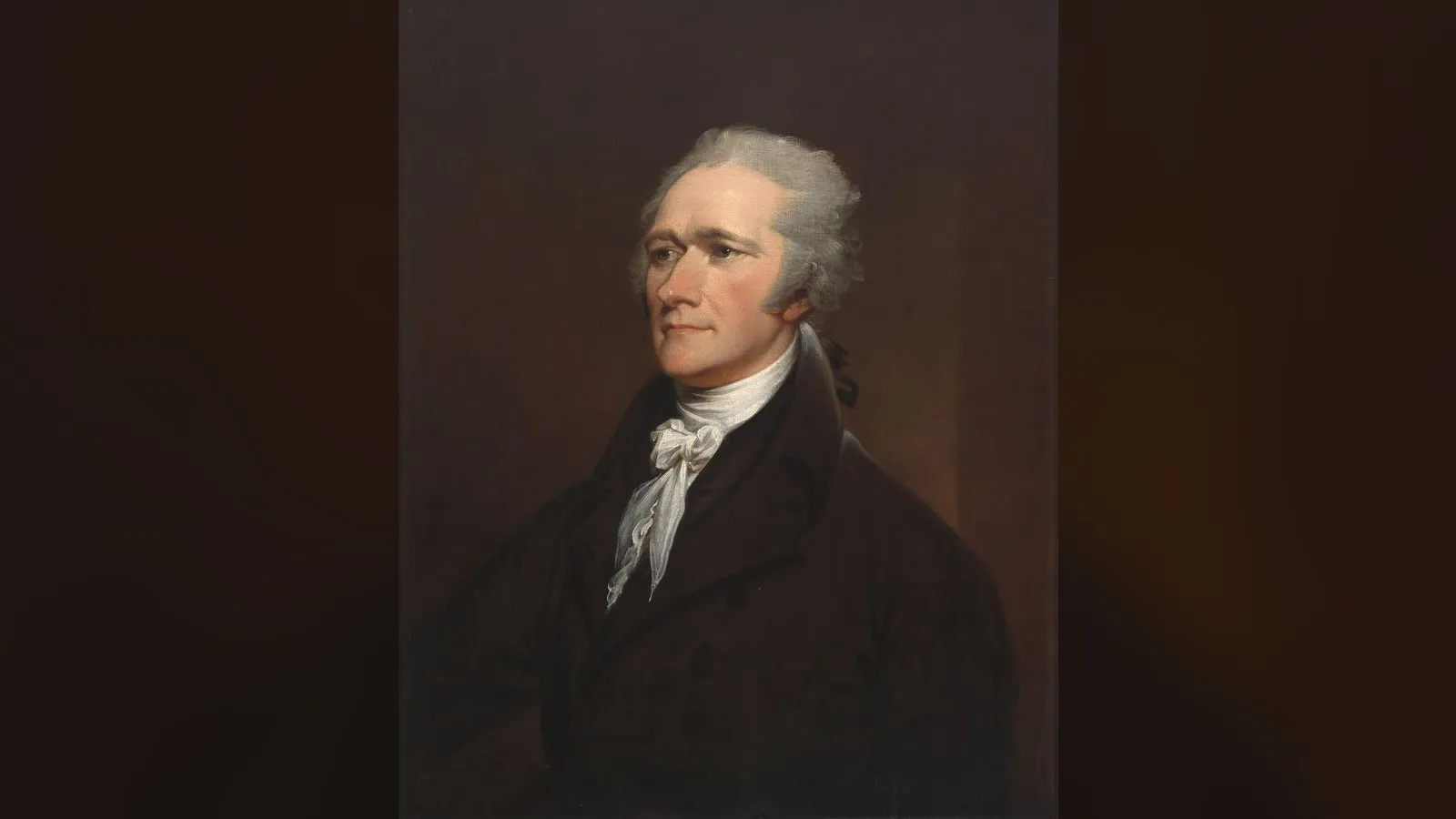

Alexander Hamilton (1755 or 1757–1804)
Contents
TL;DR
- established Alexander Hamilton's Scottish ancestry is documented with real specificity: his father, James A. Hamilton, was the fourth son of Alexander Hamilton, the laird of Grange, Ayrshire, a named Scottish estate and title — this article states this specific, documented paternal origin directly, a connection considerably more precise than many figures in this series.
- established Hamilton was born out of wedlock in Charlestown, Nevis, to James Hamilton and Rachel Faucette Lavien, and faced severe, well-documented childhood hardship, including his mother's death from yellow fever in 1768 that left him orphaned — this article names this specific adversity directly, as the genuine foundation of Hamilton's famously self-made rise rather than a minimised footnote.
- established As the first US Secretary of the Treasury (1789–1795), Hamilton established the nation's financial architecture through specific, documented mechanisms: a public credit system honouring the national debt at full value, the First Bank of the United States, a decimal-based currency system, and the Revenue Cutter Service, precursor to the US Coast Guard — this article names these specific institutions directly rather than crediting Hamilton with a vague "founding the economy."
- disputed Hamilton's 1797 public confession of an affair with Maria Reynolds, published in the self-authored "Reynolds Pamphlet" to clear himself of unrelated financial misconduct allegations, remains a genuinely significant and documented personal scandal — this article names this episode directly rather than omitting it from an otherwise achievement-focused account.
- established Hamilton died on 12 July 1804, a day after being mortally wounded in a duel with Vice President Aaron Burr in Weehawken, New Jersey, a specific, documented and consequential end to a long-running political rivalry — this article states this directly as a defining, violent conclusion to Hamilton's public life.
Key Facts
- Born
- 11 January 1755 or 1757, Charlestown, Nevis, British West Indies
- Died
- 12 July 1804, New York City, USA
- Category
- Statesmen, Politicians & Public Figures
- Scottish ancestry
- Documented, specific — father's family: lairds of Grange, Ayrshire
- Key achievement
- First US Secretary of the Treasury; architect of the American financial system
- Other key achievement
- Author of 51 of the 85 Federalist Papers
- Death
- Killed in a duel with Aaron Burr, 1804
Scottish Impact Index (SI Score)
- Global Influence
- 10/10
- Enduring Connection
- 8/10
- Material Contribution
- 10/10
- Scottish Diaspora Distinctiveness
- 9/10
- Diaspora Legacy
- 10/10
- Recognition
- 10/10
57/60
Ranked =2nd of 45 in Diaspora
A Note on Claims and Evidence
Family background and the specific, documented Scottish ancestral connection to the lairds of Grange, Ayrshire, are drawn from Wikipedia's published biographical record. Childhood, education, Revolutionary War service, the Constitutional Convention and Federalist Papers, Treasury Secretary achievements, the Reynolds affair, and the 1804 duel and death are drawn from Wikipedia's published research record. Hamilton's exact birth year (1755 or 1757) remains genuinely disputed among historians, and this article states that uncertainty directly rather than asserting a single date as settled.
Timeline
Alexander Hamilton is born in Charlestown, Nevis, to unmarried parents James A. Hamilton, a Scotsman and the fourth son of Alexander Hamilton, laird of Grange, Ayrshire, and Rachel Faucette Lavien, of French Huguenot descent.
Hamilton's mother dies of yellow fever, leaving him orphaned; he had already been abandoned by his father some years earlier.
A hurricane-account letter written by Hamilton impresses local community leaders, who fund his passage to North America for formal education.
Hamilton attends King's College (now Columbia University) and becomes an influential anonymous pamphleteer supporting American independence.
Hamilton is commissioned captain of the New York Provincial Company of Artillery.
Hamilton serves as a key aide-de-camp to General George Washington, handling critical correspondence and strategic duties throughout the Revolutionary War.
Hamilton marries Elizabeth Schuyler.
Hamilton commands troops at the decisive Siege of Yorktown.
Hamilton authors 51 of the 85 Federalist Papers essays defending the proposed Constitution, becoming instrumental in securing New York's ratification.
As the first US Secretary of the Treasury, Hamilton establishes the nation's public credit system, the First Bank of the United States, a decimal currency system, and the Revenue Cutter Service.
Hamilton accompanies Washington in suppressing the Whiskey Rebellion, sparked partly by his own excise tax policy.
Hamilton conducts an affair with Maria Reynolds, whose husband subsequently blackmails him for over $1,300.
Hamilton publicly confesses the affair in the self-published "Reynolds Pamphlet," to clear himself of separate allegations of Treasury misconduct.
Hamilton serves as a major general during the Quasi-War with France.
Hamilton publicly opposes Aaron Burr's New York gubernatorial bid, intensifying their long-running rivalry.
Hamilton is mortally wounded by Aaron Burr in a duel in Weehawken, New Jersey.
Hamilton dies from his wound in New York City, at age 47 or 49.
Details
A specific, named ancestral title stated with real documentation
This article names Alexander Hamilton's Scottish ancestry with real precision rather than a vague claim of general heritage: his father, James A. Hamilton, is documented as the fourth son of Alexander Hamilton, laird of Grange, Ayrshire, a specific, named Scottish estate and hereditary title. This article states this directly because it represents a documented connection considerably more specific than many figures in this series receive, fitting for a man whose own life became emblematic of the American self-made success story.
Severe childhood hardship named as the real foundation of his rise
This article states Hamilton's documented early adversity plainly rather than smoothing it into a generic "humble beginnings" framing: his birth out of wedlock, his father's abandonment, and his mother's death from yellow fever leaving him orphaned by age thirteen. This article names this specific hardship because it is the real, documented foundation of Hamilton's later achievements, central to his enduring reputation as the most self-made of the Founding Fathers.
Specific financial institutions named rather than a vague economic legacy
This article names the precise, documented mechanisms behind Hamilton's Treasury legacy rather than a generalised claim that he "founded the economy": the public credit system honouring debt at full value, the First Bank of the United States, decimal currency, and the Revenue Cutter Service. This article states these specific institutions because they represent the real, documented, and still-traceable foundations of the modern American financial system.
The son of a Scot in a time of anti-Scottish feeling
established An unusual patriot. Hamilton's Scottish father matters more against the background of the Revolution than it might seem. The literary historian Andrew Hook, in Scotland and America (1975), shows that Scots were among the most unpopular groups in revolutionary America, widely seen as loyalists and as agents of the Earl of Bute's supposed "Scotch influence" over the King. A common toast called for "a free exportation to Scotchmen and Tories". The Scots whom later Scottish-American tradition celebrates as patriots, such as John Witherspoon, James Wilson and Hugh Mercer, were exceptions rather than the rule. Hook also notes that King's College, where Hamilton studied, was among the colonial colleges that had appealed successfully for money in Scotland before the war, and that its Anglican president, Myles Cooper, attacked the alliance between Congress and the "Presbyterian republicans".
established Whiskey in Scots verse. Hamilton's excise on spirits left a small mark on Scottish-American literature. After the Whiskey Rebellion of 1794, David Bruce, a Federalist poet from Caithness living in western Pennsylvania, wrote "To Whiskey" in Scots, in the manner of Burns, arguing that the drink was worth any tax. It drew a reply in Scots from "Aqua Vitae", in fact Hugh Henry Brackenridge, a Campbeltown-born judge and novelist, and the two kept up the exchange in further poems.
A genuine personal scandal named without minimising it
This article states the Reynolds affair and Hamilton's public confession directly, rather than omitting it from an otherwise achievement-focused account: his affair with Maria Reynolds, the resulting blackmail, and his unusual decision to confess publicly to protect his financial integrity at the cost of his personal reputation. This article names this episode because it represents a real, documented and consequential event in Hamilton's life, not a minor footnote to his institutional achievements.
Did You Know?
- Alexander Hamilton's father was documented as the fourth son of the laird of Grange, Ayrshire, a specific, named Scottish estate and hereditary title.
- Hamilton was born out of wedlock and orphaned by his early teens, making him one of the most genuinely self-made of all the American Founding Fathers.
- Hamilton authored 51 of the 85 Federalist Papers essays, far more than any other contributor.
- As Treasury Secretary, Hamilton established the First Bank of the United States and the predecessor of today's US Coast Guard.
- In 1797, Hamilton publicly confessed to an extramarital affair in a self-published pamphlet, specifically to clear himself of separate, unrelated financial misconduct allegations.
- Hamilton's exact birth year is genuinely disputed by historians — either 1755 or 1757.
- Hamilton was killed in a duel with sitting US Vice President Aaron Burr in 1804.
- Hamilton's whiskey excise prompted a Caithness-born poet in Pennsylvania to write "To Whiskey" in Scots, in imitation of Burns.
FAQ
1Was Alexander Hamilton actually of Scottish descent?
Yes, documented with real specificity — his father was the fourth son of the laird of Grange, Ayrshire, a named Scottish estate and title.
2Was Alexander Hamilton born into wealth?
No — he was born out of wedlock in the Caribbean, abandoned by his father, and orphaned by his early teens after his mother's death.
3What did Hamilton actually do as Treasury Secretary?
He established the US public credit system, founded the First Bank of the United States, introduced decimal currency, and created the Revenue Cutter Service, precursor to the Coast Guard.
4What was the Reynolds affair?
A documented extramarital affair Hamilton had with Maria Reynolds in 1791–1792, which led to blackmail; in 1797, he publicly confessed to it in print to clear himself of separate financial misconduct accusations.
5How did Alexander Hamilton die?
He was mortally wounded in a duel with Vice President Aaron Burr on 11 July 1804, dying the following day.
6When was Alexander Hamilton actually born?
It's genuinely disputed — historians give either 1755 or 1757.
7Were most Scots in America patriots like Hamilton?
No. Andrew Hook shows that Scots in revolutionary America were widely regarded as loyalists, and loyalist compensation claims bear this out. Hamilton, the Caribbean-born son of a Scot, belongs with a minority of Scottish-connected patriots.
8What is Hamilton's most lasting legacy?
The architecture of the modern American financial system, including the national bank and public credit structures he established as Treasury Secretary.
Sources and Further Reading
Primary/Institutional
Scholarly/Critical
- Andrew Hook, Scotland and America: A Study of Cultural Relations, 1750–1835 (Blackie, 1975), chapters 2, 3 and 5
- When was James Hamilton (Alexander Hamilton's Father) Born? — Discovering Hamilton
- Alexander Hamilton — Biography, Facts, Significance — American History Central
General
Caveats: Myths and Disputed Claims
- disputed This article does not state Alexander Hamilton's birth year as settled fact; historians genuinely disagree between 1755 and 1757.
- Content note: This article names the Reynolds affair and Hamilton's public confession of it directly, consistent with this series' standard of presenting the full, documented record rather than an individually flattering simplification.
Card 016 · Diaspora