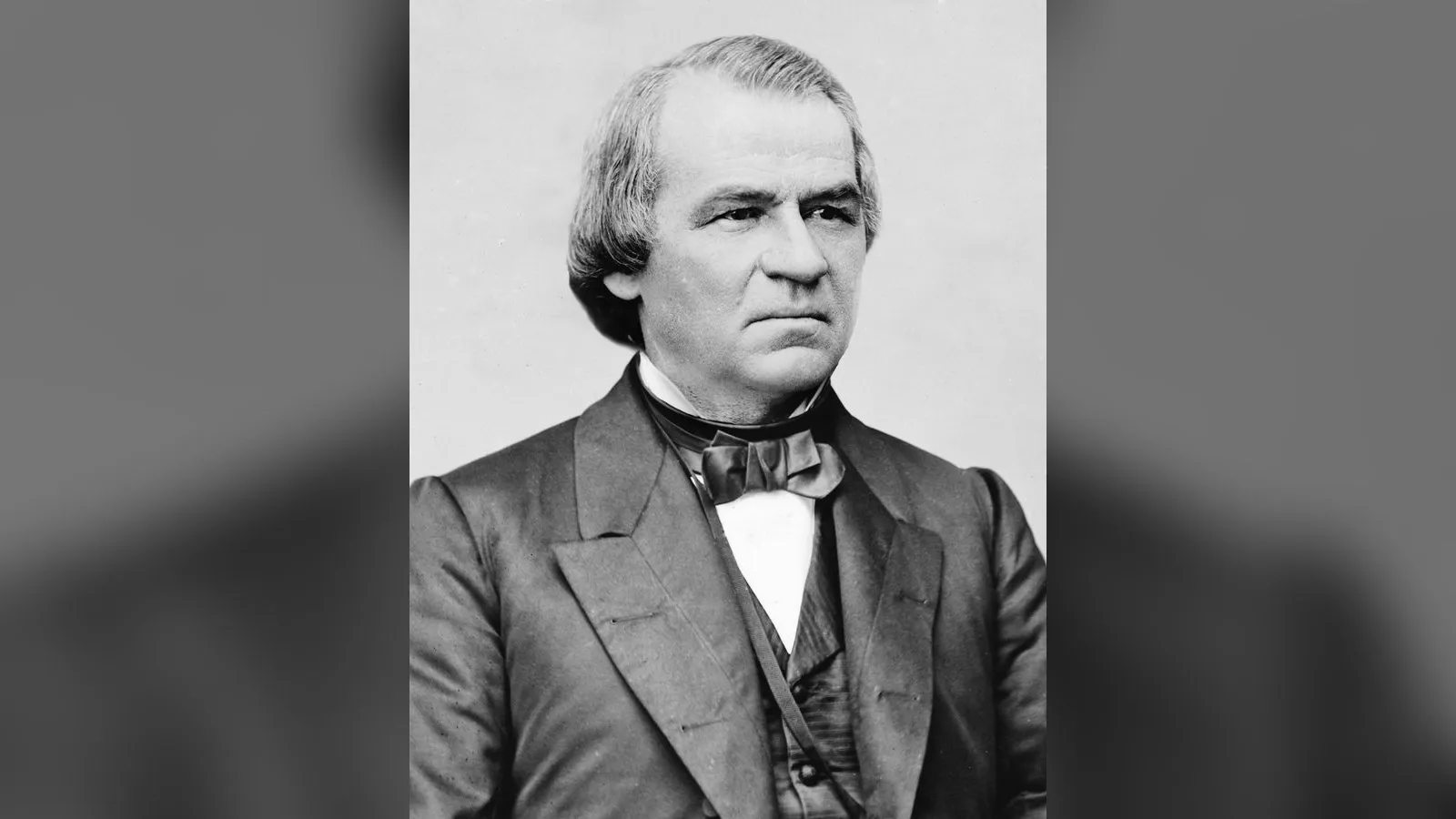

Andrew Johnson (1808–1875)
Contents
TL;DR
- established Andrew Johnson's family background is documented as a mix of English, Scots-Irish, and Scottish lineage, though no source consulted for this article names a specific ancestor, emigration date, or place of origin — this article states this general, documented connection directly rather than inventing specificity the record does not support.
- established Johnson's childhood poverty was extreme and well documented: his father died when Johnson was three, his mother worked as a washerwoman, both parents were illiterate, and Johnson himself never attended formal school, instead being apprenticed to a tailor at age ten — this article names this specific, documented hardship directly as the real foundation of his self-made political identity.
- established As the only senator from a seceding state to remain loyal to the Union, Johnson's position made him Lincoln's choice for vice president in 1864, and he succeeded to the presidency after Lincoln's assassination in April 1865 — this article states this specific, documented path to the presidency directly.
- disputed Johnson's Reconstruction policies favored rapid, lenient restoration of Southern states, prioritized pardoning former Confederates, opposed the Fourteenth Amendment, and permitted Southern states to pass restrictive Black Codes limiting African Americans' freedoms — this article states this full, documented record directly, as central to his historical reputation, rather than presenting his Reconstruction approach as a reasonable moderate course.
- disputed Johnson was impeached by the House in 1868, primarily for violating the Tenure of Office Act, and the Senate acquitted him by a single vote, 35–19 for conviction, one short of the two-thirds majority required for removal — this article names this specific, documented near-removal directly.
Key Facts
- Born
- 29 December 1808, Raleigh, North Carolina, USA
- Died
- 31 July 1875, Carter's Station, Tennessee, USA
- Category
- Statesmen, Politicians & Public Figures
- Scottish ancestry
- Documented but general — described as English, Scots-Irish, and Scottish lineage, no named ancestor or place found
- Key distinction
- Only Southern senator to remain loyal to the Union during secession
- Documented controversy
- Lenient Reconstruction policy; Black Codes; impeached and acquitted by one vote
- Historical reputation
- Consistently ranked among the worst US presidents
Scottish Impact Index (SI Score)
- Global Influence
- 8/10
- Enduring Connection
- 8/10
- Material Contribution
- 8/10
- Scottish Diaspora Distinctiveness
- 8/10
- Diaspora Legacy
- 9/10
- Recognition
- 8/10
49/60
Ranked =31st of 45 in Diaspora
A Note on Claims and Evidence
Family background and ancestry are drawn from Wikipedia's published biographical record, which describes Johnson's lineage as English, Scots-Irish, and Scottish without naming a specific ancestor, emigration date, or place of origin; this article states the connection at the level of generality the sources actually support, consistent with this series' standard of applying "accuracy over patriotism" to its own inclusion claims. Early life, political career, presidency, Reconstruction policy, impeachment, and legacy are drawn from Wikipedia's published research record.
Timeline
Andrew Johnson is born in Raleigh, North Carolina, to Jacob Johnson and Mary McDonough, a family of documented English, Scots-Irish, and Scottish lineage; both parents are illiterate.
Johnson's father, Jacob, dies when Andrew is three years old; his mother becomes the family's sole provider, working as a washerwoman.
Johnson, having never attended formal school, is apprenticed to tailor James Selby at age ten.
After running away from his apprenticeship, Johnson settles in Greeneville, Tennessee, and establishes a successful tailoring business.
Johnson marries Eliza McCardle, who helps further his education.
Johnson begins his political career as a Greeneville town alderman.
Johnson serves five consecutive terms in the US House of Representatives, championing the Homestead Bill and advocating for common laborers.
Johnson serves as governor of Tennessee.
Johnson serves as a US Senator from Tennessee, remaining loyal to the Union after Tennessee secedes — the only senator from a seceding state to do so.
Johnson is selected as Abraham Lincoln's vice-presidential running mate.
Johnson becomes president following Lincoln's assassination, implementing lenient Reconstruction policies favoring rapid restoration of Southern states and prioritizing pardons for former Confederates.
Southern states, under Johnson's lenient Reconstruction framework, pass restrictive Black Codes limiting African Americans' freedoms; Johnson vetoes congressional civil rights legislation, which Congress overrides for the first time on major legislation.
Johnson's "Swing Around the Circle" campaign tour damages his political standing considerably.
The House impeaches Johnson, primarily for violating the Tenure of Office Act by dismissing Secretary of War Edwin Stanton without Senate approval; the Senate acquits him by a single vote, 35–19 for conviction.
Johnson leaves office.
Johnson dies at Carter's Station, Tennessee.
Details
An ancestry stated at the level of generality the record supports
This article names Andrew Johnson's family background directly as a documented mix of English, Scots-Irish, and Scottish lineage, while stating plainly that no source consulted identifies a specific ancestor, emigration date, or place of origin. This article states this because presenting a vague, general ancestral description as though it carried the same specificity as a named emigrant ancestor and documented hometown would overstate the real state of the evidence.
Extreme documented poverty named as the real foundation of a self-made career
This article states Andrew Johnson's childhood hardship directly and in full: his father's early death, his illiterate parents, his lack of formal schooling, and his tailoring apprenticeship beginning at age ten. This article names this because it represents the real, documented foundation of Johnson's self-made political identity and his later advocacy for common laborers.
A singular wartime loyalty that shaped his path to the presidency
This article states precisely what made Johnson exceptional among Southern politicians: he was the only senator from a seceding state to remain loyal to the Union, a position that directly led to his selection as Lincoln's running mate and, after Lincoln's assassination, to the presidency. This article names this because it represents the specific, documented basis for an otherwise unlikely path to national leadership.
A presidency's defining failures named without softening
This article states the full, documented record of Johnson's Reconstruction policy and its consequences: his lenient restoration of Southern political power, his prioritization of pardons for former Confederates over protections for freedmen, his veto of civil rights legislation, and the Black Codes his policies permitted. This article names these because they represent the specific, documented basis for historians' consistent ranking of Johnson among the worst US presidents, alongside his impeachment and near-removal from office.
Did You Know?
- Andrew Johnson's family background is documented as a mix of English, Scots-Irish, and Scottish lineage, though no specific ancestor or place of origin is identified in the sources consulted.
- Johnson never attended formal school and was apprenticed to a tailor at age ten; his wife later helped further his education after their marriage.
- Johnson was the only US senator from a seceding Southern state to remain loyal to the Union.
- Johnson became president after Lincoln's assassination in 1865, having been selected as vice president specifically for his Southern Unionist credentials.
- Johnson's lenient Reconstruction policies permitted Southern states to pass restrictive Black Codes limiting African Americans' freedoms.
- Johnson was impeached by the House in 1868 and survived removal by a single Senate vote.
- Historians have consistently ranked Johnson among the worst US presidents, largely due to his obstruction of Reconstruction.
FAQ
1Was Andrew Johnson actually of Scottish descent?
Documented but general — his family background includes English, Scots-Irish, and Scottish lineage, though no source consulted names a specific ancestor or place of origin.
2How did Andrew Johnson become president?
He was Lincoln's vice president and succeeded to the presidency after Lincoln's assassination in April 1865.
3What made Johnson's Reconstruction policy controversial?
It favored rapid, lenient restoration of Southern states, prioritized pardoning former Confederates, and allowed Southern states to pass restrictive Black Codes limiting African Americans' freedoms.
4Was Andrew Johnson removed from office?
No — the House impeached him in 1868, but the Senate acquitted him by a single vote, one short of the two-thirds majority required for removal.
5Why do historians rank Johnson so poorly?
His obstruction of Reconstruction, his prioritization of former Confederates over the rights of formerly enslaved people, and his near-removal from office are central to his consistently low historical ranking.
6Did Johnson have much formal education?
No — he never attended formal school and was apprenticed to a tailor at age ten; he was largely self-taught with his wife's later help.
7When did Andrew Johnson die?
31 July 1875, at Carter's Station, Tennessee.
Sources and Further Reading
Caveats: Myths and Disputed Claims
- Clarification: This article does not assert a specific, named Scottish ancestral connection for Andrew Johnson; his documented family background is a general mix of English, Scots-Irish, and Scottish lineage, without a named ancestor, emigration date, or place of origin.
- Content note: This article states Andrew Johnson's documented Reconstruction-era record, including his support for lenient restoration and the Black Codes it enabled, directly and in full, consistent with this series' standard of giving uncomfortable findings full weight.
Card 035 · Diaspora