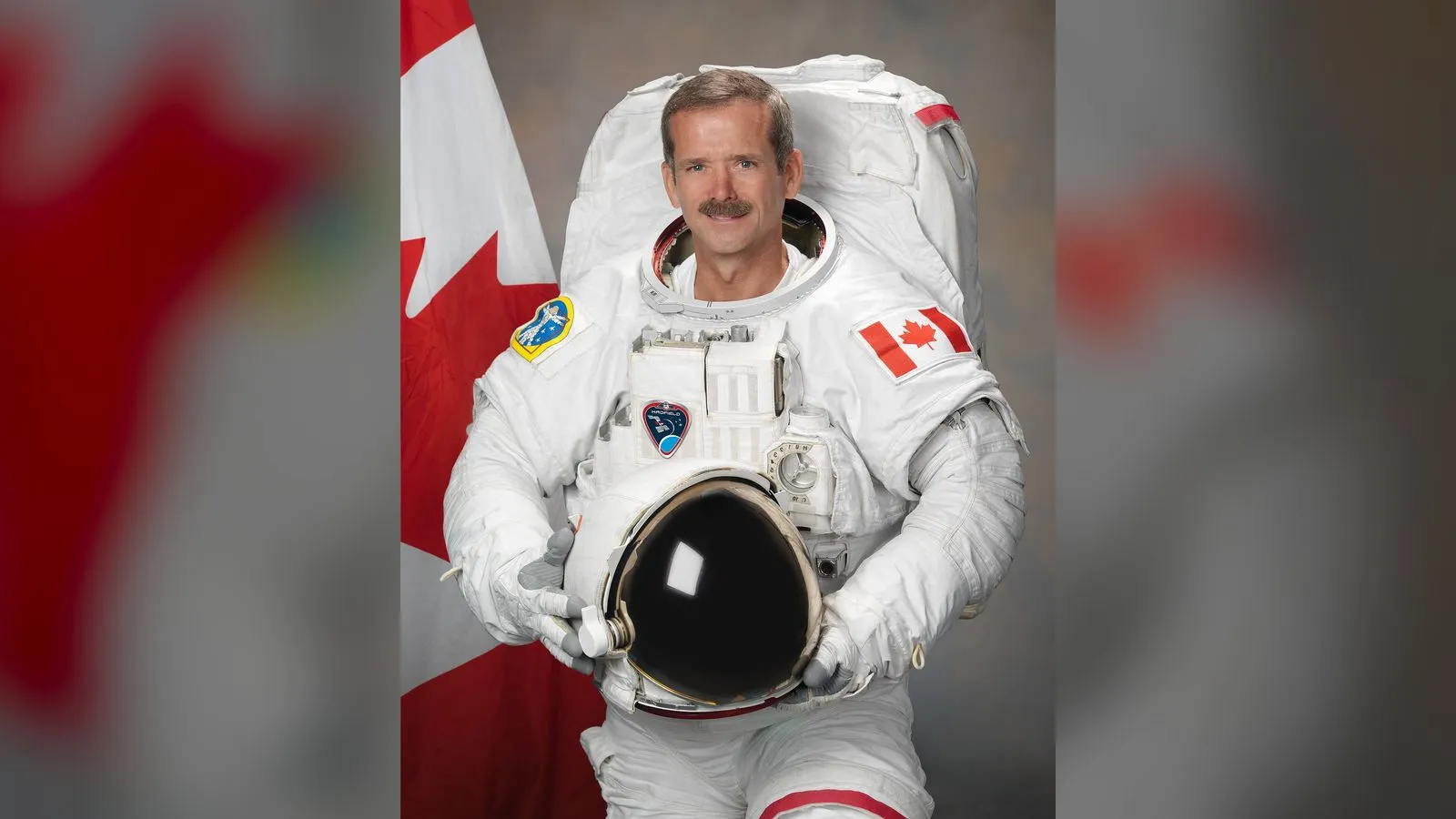

Chris Hadfield (b. 1959)
Contents
TL;DR
- established Chris Hadfield's documented ancestry is described as "northern English and southern Scottish descent" — a real but regionally general claim this article states at the level of specificity the record actually supports, rather than inventing a named town, clan, or more precise ancestral seat the available sources do not provide.
- established Hadfield's path to space ran through a substantial, documented military career: 25 years in the Canadian Armed Forces as a CF-18 fighter pilot, including the first interception of a Soviet Tupolev Tu-95 bomber in the Canadian Arctic, and a US Air Force Test Pilot School course where he won the Distinguished Graduate award — this article names this specific record directly rather than presenting Hadfield's astronaut career as his sole notable achievement.
- established During the April 2001 STS-100 mission, Hadfield became the first Canadian to perform a spacewalk, installing the Canadian-built Canadarm2 robotic arm on the International Space Station, and experienced severe, documented temporary blindness during the spacewalk after anti-fog solution irritated his eyes — this article names this specific hazard directly rather than presenting the mission as having gone entirely smoothly.
- established In March 2013, Hadfield became the first Canadian to command the International Space Station, overseeing Expedition 35's five-person crew, a specific, documented milestone this article states directly as distinct from his earlier, separate "first Canadian spacewalk" achievement.
- established Hadfield's May 2013 music video performing David Bowie's "Space Oddity" aboard the ISS, filmed before his departure, became a global viral phenomenon, accumulating tens of millions of views and raising genuine, documented questions about copyright law for creative works performed in Earth orbit — this article names this specific cultural legacy directly alongside Hadfield's technical achievements.
Key Facts
- Born
- 29 August 1959, Sarnia, Ontario, Canada
- Category
- Science, Technology & Invention
- Scottish ancestry
- Documented but general ("northern English and southern Scottish descent")
- Key achievement
- First Canadian to command the International Space Station (2013)
- Other key achievement
- First Canadian to perform a spacewalk (STS-100, 2001)
- Military career
- 25 years, Canadian Armed Forces; retired as colonel, 2003
Scottish Impact Index (SI Score)
- Global Influence
- 8/10
- Enduring Connection
- 6/10
- Material Contribution
- 8/10
- Scottish Diaspora Distinctiveness
- 7/10
- Diaspora Legacy
- 8/10
- Recognition
- 9/10
46/60
Ranked =38th of 45 in Diaspora
A Note on Claims and Evidence
Family background and ancestry are drawn from Wikipedia's published biographical record, which states a general regional claim of northern English and southern Scottish descent without naming a specific town or clan; this article states the ancestry at that level of generality rather than inventing further precision. Military career, astronaut selection, the STS-74 and STS-100 missions, the Expedition 35 ISS command, the "Space Oddity" video, and post-retirement career are drawn from Wikipedia's published research record.
Timeline
Chris Austin Hadfield is born in Sarnia, Ontario, to Eleanor and Roger Hadfield, growing up on a corn farm in Southern Ontario; his documented ancestry is described as northern English and southern Scottish.
Hadfield watches the Apollo 11 Moon landing on television, sparking his lifelong ambition to go to space.
Hadfield enlists in the Canadian Armed Forces.
Hadfield earns a B.Eng. with honours in mechanical engineering, having studied at Royal Roads Military College and the Royal Military College of Canada.
Hadfield trains as a fighter pilot, flying CF-18 Hornets, and becomes the first CF-18 pilot to intercept a Soviet Tupolev Tu-95 bomber in the Canadian Arctic.
Hadfield attends US Air Force Test Pilot School at Edwards Air Force Base, winning the Distinguished Graduate award and the Liethen-Tittle Award in 1988.
Hadfield is selected as one of four new Canadian astronauts from 5,330 applicants.
Hadfield serves as mission specialist on STS-74, flying to the Russian space station Mir and operating the Canadarm.
During STS-100, Hadfield becomes the first Canadian to perform a spacewalk, installing the Canadarm2 robotic arm on the ISS over two spacewalks totalling nearly 15 hours; during the first, anti-fog solution temporarily blinds him.
Hadfield retires from the Canadian Armed Forces as a colonel, after 25 years of service.
Hadfield launches aboard Soyuz TMA-07M for a five-month ISS assignment.
Hadfield becomes the first Canadian to command the International Space Station, leading Expedition 35's crew of five.
Hadfield releases a music video of himself performing David Bowie's "Space Oddity" aboard the ISS, which becomes a global viral phenomenon.
Hadfield retires from the Canadian Space Agency.
Hadfield joins the University of Waterloo as a professor.
Hadfield publishes the bestselling memoir An Astronaut's Guide to Life on Earth, followed by the fiction series beginning with The Apollo Murders (2021).
Details
An ancestry claim stated at its real, documented level of generality
This article names Hadfield's ancestry honestly rather than inflating it: the documented record describes "northern English and southern Scottish descent," a real but regionally general claim, not a traceable connection to a specific town, clan, or ancestral seat. This article states this distinction because presenting a general regional claim with invented specificity would misrepresent the real strength of the available evidence.
A substantial military career named before the astronaut fame that followed it
This article states Hadfield's 25-year Canadian Armed Forces career directly, rather than presenting his astronaut selection as the start of his notable achievements: his CF-18 combat flying, including the first interception of a Soviet bomber in the Canadian Arctic, and his distinguished performance at US Air Force Test Pilot School. This article names this record because it represents the real, documented foundation of Hadfield's selection as an astronaut, not an incidental prelude.
A genuine hazard named within a celebrated spacewalk
This article states directly that Hadfield's historic first Canadian spacewalk included a serious, documented safety incident: anti-fog solution in his helmet caused temporary blindness during the activity. This article names this hazard because omitting it would present an inaccurately trouble-free account of a real, documented emergency during a celebrated mission.
Two distinct "first Canadian" milestones named separately
This article states precisely which specific "first" belongs to which mission, rather than blurring Hadfield's achievements together: his 2001 STS-100 flight made him the first Canadian to spacewalk, while his 2013 Expedition 35 assignment made him the first Canadian to command the ISS, a separate and later milestone. This article names this distinction because conflating the two would misstate the real, documented sequence of his career.
Did You Know?
- Chris Hadfield's documented ancestry is described as northern English and southern Scottish descent, though no specific town or clan is named in the sources consulted.
- Before joining the astronaut corps, Hadfield spent 25 years in the Canadian Armed Forces, including becoming the first CF-18 pilot to intercept a Soviet bomber in the Canadian Arctic.
- During his historic first Canadian spacewalk in 2001, anti-fog solution in his helmet temporarily blinded him.
- Hadfield became the first Canadian to command the International Space Station in March 2013.
- His May 2013 "Space Oddity" video, filmed aboard the ISS, became a global viral sensation and raised genuine copyright questions about performing music in orbit.
- Hadfield watched the Apollo 11 Moon landing as a nine-year-old, which sparked his lifelong ambition to go to space.
- After retiring from the Canadian Space Agency, Hadfield became a professor at the University of Waterloo and a bestselling author.
FAQ
1Was Chris Hadfield actually of Scottish descent?
Yes, documented but general — his ancestry is described as northern English and southern Scottish descent, without a specific named town or clan.
2What was Chris Hadfield's first "first Canadian" achievement in space?
Becoming the first Canadian to perform a spacewalk, during the STS-100 mission in April 2001.
3Did anything go wrong during Hadfield's famous spacewalk?
Yes — anti-fog solution in his helmet caused severe eye irritation and temporary blindness during the activity.
4When did Hadfield command the International Space Station?
From March 2013, during Expedition 35, becoming the first Canadian to hold that role.
5What is Chris Hadfield best known for in popular culture?
His May 2013 music video performing David Bowie's "Space Oddity" aboard the ISS, which became a global viral phenomenon.
6What did Hadfield do before becoming an astronaut?
He spent 25 years as a fighter and test pilot in the Canadian Armed Forces, retiring as a colonel in 2003.
7What has Chris Hadfield done since retiring from spaceflight?
He became a professor at the University of Waterloo, wrote a bestselling memoir and several novels, and continues to advocate for space exploration.
Sources and Further Reading
Caveats: Myths and Disputed Claims
- Clarification: This article does not present Chris Hadfield's Scottish ancestry as tied to a specific town or clan; the documented record states only a general "southern Scottish" regional descent.
- Clarification: This article does not conflate Hadfield's 2001 "first Canadian spacewalk" milestone with his later, separate 2013 "first Canadian to command the ISS" achievement; these are two distinct, documented firsts from different missions.
Card 014 · Diaspora