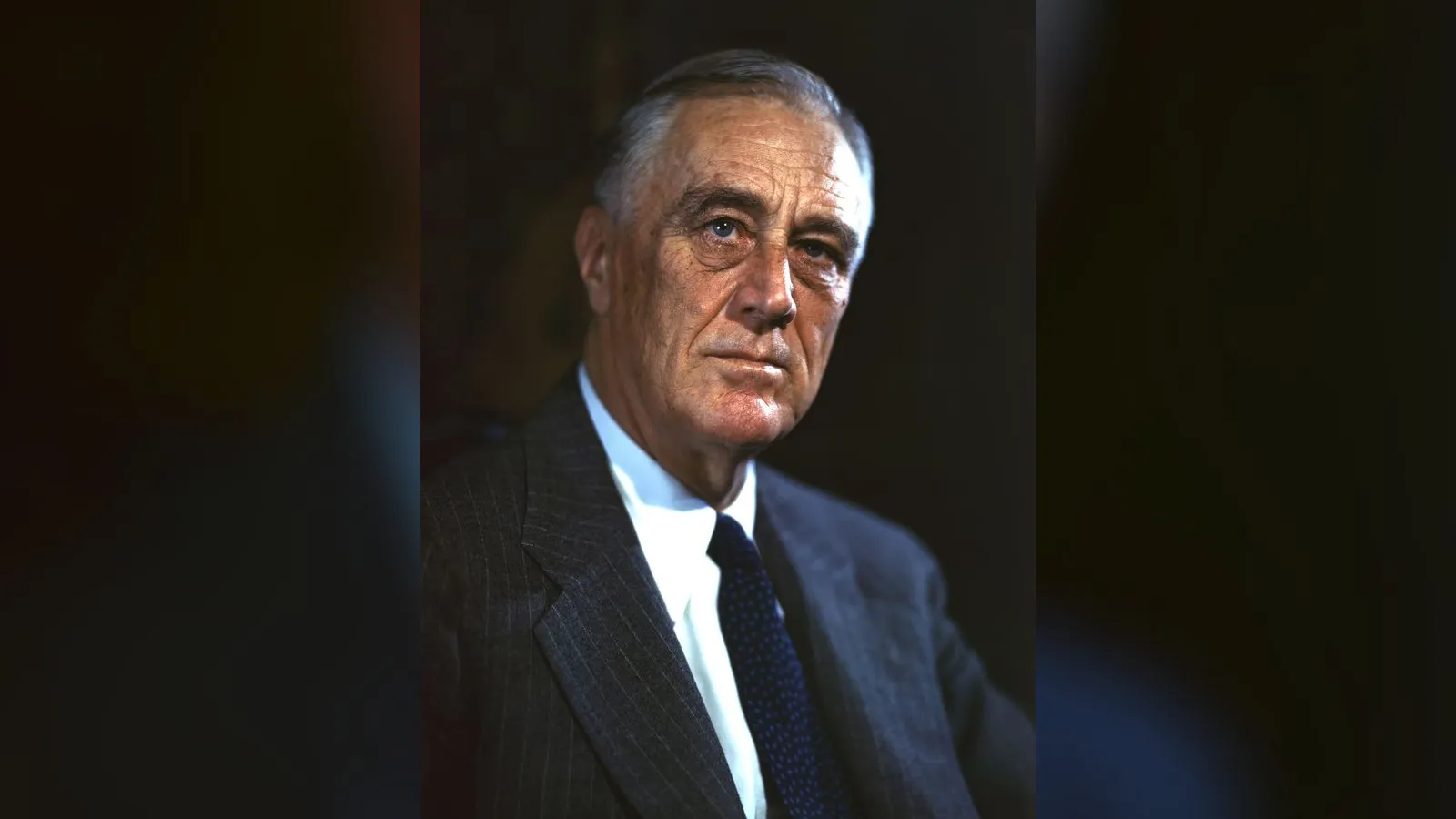

Franklin D. Roosevelt (1882–1945)
Contents
Legend/Myth
- No rigorously documented Scottish ancestry has been found for Franklin D. Roosevelt; the family's two well-established ancestral lines are Dutch and French Huguenot, not Scottish. His paternal Roosevelt line descends from Claes Maartenszen van Rosenvelt, a Dutch immigrant to New Amsterdam in the 1640s, while his mother's Delano family descends from Philippe de la Noye, a French Huguenot who arrived in Plymouth Colony in 1621. The popular name of Roosevelt's famous Scottish Terrier, Fala — formally registered as "Murray, the Outlaw of Falahill" — references a family tradition holding that the Roosevelts descended from a legendary Scottish Borders reiver associated with Falahill in the Scottish Borders; this article states plainly that this is a repeated family naming tradition rather than a rigorously sourced genealogical claim, since the documented primary ancestral lines are Dutch and French Huguenot. Roosevelt is included here on the strength of his historic presidency rather than a verified Scottish ancestral claim.
TL;DR
- established Roosevelt contracted a paralytic illness in 1921, widely understood at the time and for decades afterward to be polio, that left him permanently unable to walk unaided — this article states this specific, documented disability directly as central to understanding his subsequent political career.
- established Roosevelt's New Deal programs, enacted in response to the Great Depression, fundamentally reshaped the role of the federal government in American economic life, including Social Security, the Securities and Exchange Commission, and large-scale public works programs — this article names these specific, documented achievements directly.
- established Roosevelt remains the only US president to be elected to four terms, serving from 1933 until his death in 1945, a specific, documented distinction this article states directly.
- disputed Roosevelt's 1942 Executive Order 9066 authorized the forced relocation and incarceration of approximately 120,000 Japanese Americans, the majority US citizens, in internment camps during World War II — this article states this full, documented episode directly rather than presenting Roosevelt's wartime leadership as uncomplicated.
- established Roosevelt led the United States through most of World War II, working closely with Winston Churchill and Joseph Stalin, and died in office in April 1945, less than a month before Germany's surrender — this article names this specific, documented timeline directly.
Key Facts
- Born
- 30 January 1882, Hyde Park, New York, USA
- Died
- 12 April 1945, Warm Springs, Georgia, USA
- Category
- Statesmen, Politicians & Public Figures
- Documented ancestry
- Dutch (Roosevelt line) and French Huguenot (Delano line); no rigorously documented Scottish ancestry found
- Key achievement
- New Deal programs; leadership through the Great Depression and most of World War II
- Documented controversy
- Executive Order 9066, authorizing Japanese American internment
- Presidency
- 32nd US President (1933–1945); only president elected to four terms
Scottish Impact Index (SI Score)
- Global Influence
- 10/10
- Enduring Connection
- 6/10
- Material Contribution
- 10/10
- Scottish Diaspora Distinctiveness
- 7/10
- Diaspora Legacy
- 10/10
- Recognition
- 10/10
53/60
Ranked =18th of 45 in Diaspora
A Note on Claims and Evidence
Family background and ancestry are drawn from Wikipedia's published biographical record of the Roosevelt and Delano families, which document the paternal Roosevelt line as Dutch, descending from Claes Maartenszen van Rosenvelt, and the maternal Delano line as French Huguenot, descending from Philippe de la Noye; the popular tradition behind Fala's full name, "Murray, the Outlaw of Falahill," is drawn from published accounts of Roosevelt's dog but is stated here as a family tradition rather than a documented genealogical fact, since no rigorous source consulted confirms a direct Scottish ancestor. Early life, the 1921 paralytic illness, political career, presidency, the New Deal, World War II leadership, Japanese American internment, death, and legacy are drawn from Wikipedia's published research record.
Timeline
Claes Maartenszen van Rosenvelt, a Dutch immigrant, settles in New Amsterdam, founding the paternal Roosevelt line in America.
Philippe de la Noye, a French Huguenot, arrives in Plymouth Colony, founding the maternal Delano line.
Franklin Delano Roosevelt is born in Hyde Park, New York, to James Roosevelt I and Sara Delano.
Roosevelt enters Harvard College.
Roosevelt marries his distant cousin Eleanor Roosevelt.
Roosevelt serves in the New York State Senate.
Roosevelt serves as Assistant Secretary of the Navy.
Roosevelt runs unsuccessfully as the Democratic vice-presidential nominee.
Roosevelt contracts a paralytic illness, widely understood at the time to be polio, leaving him permanently unable to walk unaided.
Roosevelt serves as Governor of New York.
Roosevelt is elected president amid the Great Depression.
Roosevelt launches the New Deal, a sweeping set of federal relief, recovery, and reform programs.
Roosevelt signs the Social Security Act.
Roosevelt is reelected to a second and then an unprecedented third term.
Following the attack on Pearl Harbor, the United States enters World War II under Roosevelt's leadership.
Roosevelt signs Executive Order 9066, authorizing the forced relocation and incarceration of approximately 120,000 Japanese Americans.
Roosevelt is elected to an unprecedented fourth term.
Roosevelt dies in Warm Springs, Georgia, less than a month before Germany's surrender ends the war in Europe.
Details
A naming tradition stated honestly as legend rather than documented genealogy
This article states directly that Franklin D. Roosevelt's two well-established ancestral lines are Dutch and French Huguenot, not Scottish, while naming the popular family tradition behind his dog Fala's full registered name, "Murray, the Outlaw of Falahill," which holds that the Roosevelts descended from a legendary Scottish Borders outlaw. This article names this because presenting a repeated naming tradition as though it were rigorously documented genealogy would misrepresent the real, better-documented state of the Roosevelt family's Dutch and Huguenot ancestry.
A documented disability named as central to Roosevelt's political story
This article states directly that Roosevelt's 1921 paralytic illness left him permanently unable to walk unaided, a fact central to understanding both his personal resilience and the considerable effort made to conceal the extent of his disability from the American public during his presidency. This article names this because it represents a real, documented circumstance inseparable from Roosevelt's public life.
Transformative domestic achievements named with precision
This article states the specific, documented scope of the New Deal rather than a general claim of reform: Social Security, the Securities and Exchange Commission, and large-scale public works programs that reshaped the federal government's role in American economic life. This article names these because they represent concrete, lasting institutional changes rather than a vague characterisation of crisis leadership.
A full, unminimised accounting of Japanese American internment
This article states directly that Roosevelt's Executive Order 9066 authorized the forced relocation and incarceration of approximately 120,000 Japanese Americans, the majority US citizens, during World War II. This article names this because minimising or omitting it would misrepresent a serious, documented civil liberties violation that occurred under Roosevelt's wartime leadership, consistent with this series' standard of giving uncomfortable findings full weight.
Did You Know?
- Franklin D. Roosevelt's two well-documented ancestral lines are Dutch (Roosevelt) and French Huguenot (Delano); no rigorously documented Scottish ancestor has been found, despite a family naming tradition behind his dog Fala's full name, "Murray, the Outlaw of Falahill."
- Roosevelt contracted a paralytic illness in 1921 that left him permanently unable to walk unaided, a disability whose extent was carefully concealed from the public during his presidency.
- Roosevelt remains the only US president elected to four terms.
- Roosevelt's New Deal programs, including Social Security, fundamentally reshaped the federal government's role in American economic life.
- Roosevelt signed Executive Order 9066 in 1942, authorizing the forced incarceration of approximately 120,000 Japanese Americans, most of them US citizens.
- Roosevelt married his own distant cousin, Eleanor Roosevelt, in 1905.
- Roosevelt died in office in April 1945, less than a month before Germany's surrender ended the war in Europe.
FAQ
1Was Franklin D. Roosevelt actually of Scottish descent?
No rigorously documented Scottish ancestry has been found; his two well-established ancestral lines are Dutch (Roosevelt) and French Huguenot (Delano), though a family tradition behind his dog Fala's name claims a legendary Scottish ancestor.
2Did Franklin D. Roosevelt really have polio?
He contracted a paralytic illness in 1921 widely understood at the time and for decades afterward to be polio, leaving him permanently unable to walk unaided.
3What is Roosevelt best known for as president?
The New Deal programs enacted in response to the Great Depression, and his leadership of the United States through most of World War II.
4How many terms did Roosevelt serve as president?
Four — he remains the only US president elected to four terms, serving from 1933 until his death in 1945.
5Did Roosevelt's wartime leadership have a serious civil liberties cost?
Yes — his 1942 Executive Order 9066 authorized the forced relocation and incarceration of approximately 120,000 Japanese Americans, most of them US citizens.
6Was Eleanor Roosevelt related to Franklin before their marriage?
Yes — she was his distant cousin.
7When did Franklin D. Roosevelt die?
12 April 1945, in Warm Springs, Georgia, less than a month before Germany's surrender.
Sources and Further Reading
Primary/Institutional
Scholarly/Critical
General
Caveats: Myths and Disputed Claims
- Myth/gap flagged: This article does not assert a rigorously documented Scottish ancestral connection for Franklin D. Roosevelt; his well-established ancestral lines are Dutch and French Huguenot, and the popular tradition behind his dog Fala's name is stated as family legend rather than documented genealogy.
- Content note: This article states Roosevelt's documented authorization of Japanese American internment directly and in full, consistent with this series' standard of giving uncomfortable findings full weight.
Card 043 · Diaspora