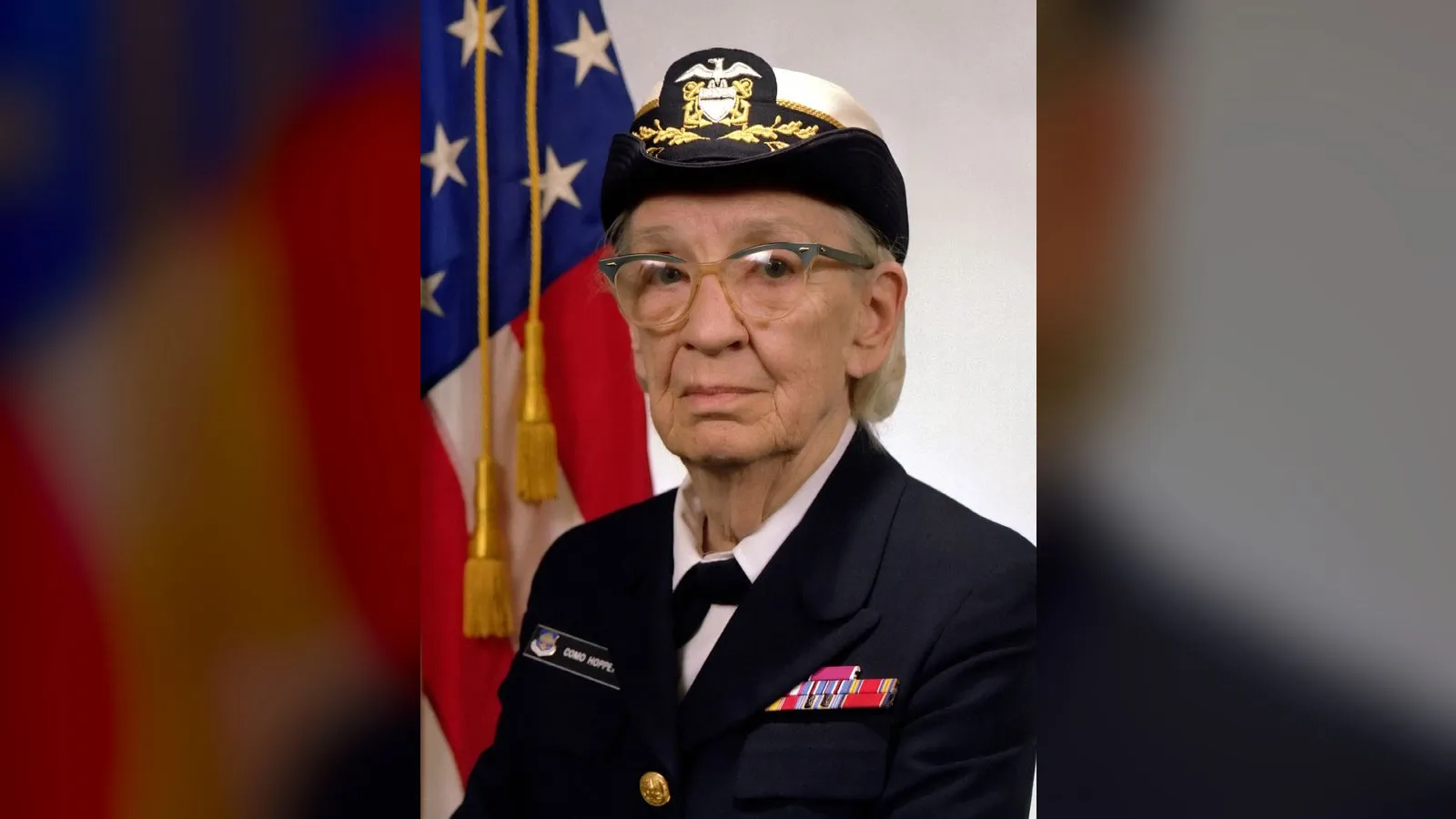

Grace Hopper (1906–1992)
Contents
TL;DR
- established Grace Hopper's documented Scottish ancestry is real but general rather than traceable to a specific clan or place: her parents, Walter Fletcher Murray and Mary Campbell Van Horne, are recorded as being of Scottish and Dutch descent — this article states this honestly as a documented but comparatively thin genealogical connection, rather than inflating it into a specific ancestral-seat story of the kind documented for other diaspora figures in this series.
- established Hopper is credited as a pioneering figure in computer science for championing and helping build the first compiler and the first English-language-based programming languages, work that directly underpins the modern practice of writing code in human-readable language rather than raw machine instructions, having been told early in her career that "computers could only do arithmetic" and that "computers didn't understand English" — a specific, documented technical breakthrough this article states directly rather than a vague claim that she "worked with computers."
- established Hopper played a central role in developing COBOL (Common Business-Oriented Language) through the CODASYL consortium beginning in 1959, a language that became, in her own documented words reflecting her underlying design philosophy, built on the principle that "it's much easier for most people to write an English statement than it is to use symbols," and which went on to become the most widely used business programming language of its era — a specific, documented contribution this article names directly rather than crediting her only with a general reputation for innovation.
- established Hopper served in the US Navy from 1943 to 1986, retiring as a rear admiral at age 79 as the oldest active-duty commissioned officer in the Navy at the time, having initially been rejected for a Navy commission due to age and weight requirements before obtaining an exemption — a specific, documented career arc this article states directly rather than a vague summary of a long military career.
- established The popular computing term "bug," referring to a software defect, is historically associated with a real documented 1947 incident in which Hopper's team found a literal moth trapped in a relay of Harvard's Mark II computer, taping it into their logbook with the notation "First actual case of bug being found" — this article states the documented incident directly while noting that Hopper is credited with popularising the term rather than coining the underlying concept, which predates this specific event.
Key Facts
- Born
- 9 December 1906, New York City, USA
- Died
- 1 January 1992, Arlington County, Virginia, USA
- Category
- Science, Technology & Invention
- Scottish ancestry
- Documented but general (parents "of Scottish and Dutch descent")
- Key achievement
- Pioneered the first compiler; central to COBOL's development
- Navy service
- 1943–1986; retired as rear admiral
- Key honour
- Presidential Medal of Freedom (posthumous, 2016)
Scottish Impact Index (SI Score)
- Global Influence
- 10/10
- Enduring Connection
- 4/10
- Material Contribution
- 10/10
- Scottish Diaspora Distinctiveness
- 6/10
- Diaspora Legacy
- 8/10
- Recognition
- 10/10
48/60
Ranked =34th of 45 in Diaspora
A Note on Claims and Evidence
Family background and ancestry, education, Navy career, compiler and COBOL work, the 1947 "bug" incident, and later recognition are drawn from Wikipedia's published research record. This article states her Scottish ancestry at the level of specificity the documented record actually supports, general descent rather than a traceable clan or ancestral-seat connection, rather than presenting it with false precision.
Timeline
Grace Brewster Murray is born in New York City, the eldest of three children of Walter Fletcher Murray and Mary Campbell Van Horne, documented as being of Scottish and Dutch descent.
Hopper graduates Phi Beta Kappa from Vassar College with degrees in mathematics and physics, after an initial rejection the previous year over low Latin scores.
Hopper completes her PhD in mathematics at Yale under Øystein Ore.
After initially being rejected for a Navy commission due to age and weight requirements, Hopper obtains an exemption and trains at Smith College's Naval Reserve Midshipmen's School, graduating first in her class in 1944.
Commissioned as a lieutenant, junior grade, Hopper is assigned to Harvard's Bureau of Ships Computation Project, working on the Mark I computer team under Howard H. Aiken; in 1947, her team discovers a literal moth trapped in a relay of the Mark II computer, taping it into the logbook as the "first actual case of bug being found."
Hopper joins Eckert–Mauchly Computer Corporation, working on the UNIVAC I team; by 1952 she completes an operational linker for the A-0 System, having been told repeatedly that computers could not understand English; in 1954 she becomes the company's first director of automatic programming, developing FLOW-MATIC and MATH-MATIC.
Hopper participates in the CODASYL consortium, helping create COBOL, built on her documented design principle that English-based programming is more accessible than symbolic code; the language becomes the most widely used business programming language of its era.
Hopper directs the Navy Programming Languages Group, developing COBOL validation software and establishing standards influencing programming language standardisation industry-wide.
Hopper retires from the Navy as a rear admiral at age 79, the oldest active-duty commissioned officer in the Navy at the time, receiving the Defense Distinguished Service Medal.
Hopper dies in her sleep in Arlington County, Virginia, at age 85, and is interred in Arlington National Cemetery with full military honours.
Hopper is posthumously awarded the Presidential Medal of Freedom, among numerous honours including the USS Hopper destroyer, Grace Hopper College at Yale, and the annual Grace Hopper Celebration of Women in Computing conference.
Details
An ancestry claim stated at its real, documented level of specificity
This article names Hopper's Scottish ancestry honestly rather than inflating it: her parents are documented as being of Scottish and Dutch descent, a real but general genealogical record, not a traceable connection to a specific clan, town, or ancestral seat of the kind documented for other figures in this series. This article states this distinction because presenting a general descent claim with invented specificity would misrepresent the real strength of the documented evidence.
A technical breakthrough named with its real documented resistance
This article names Hopper's pioneering compiler work with real specificity rather than a vague claim that she "worked with computers": she championed and built the first operational compiler and early English-language-based programming languages, despite being told early on that "computers could only do arithmetic" and "didn't understand English." This article states this documented resistance directly because it clarifies that her contribution was a genuine conceptual breakthrough against real scepticism, not an incremental technical improvement.
A specific language contribution named rather than general innovation credit
This article names Hopper's central role in developing COBOL through the CODASYL consortium from 1959 directly, quoting her own documented design philosophy that English-based programming is more accessible than symbolic code. This article states this specific contribution because COBOL became the most widely used business programming language of its era, a concrete, documented legacy distinct from a general reputation for innovation.
A military career stated with its real documented arc
This article names Hopper's Navy career with real specificity rather than a vague summary: initially rejected for a commission due to age and weight requirements, she served from 1943 to 1986, retiring as a rear admiral at age 79, the oldest active-duty commissioned officer in the Navy at the time. This article states this specific arc because it represents a genuinely documented, unusual career trajectory, not a generic long military service record.
A famous story named accurately, crediting popularisation rather than invention
This article states the 1947 "bug" incident directly, Hopper's team finding a literal moth in a Mark II computer relay and logging it as the "first actual case of bug being found," while noting that Hopper is credited with popularising the term "bug" in computing rather than coining the underlying concept, which predates this specific documented event. This article states this distinction because crediting her with inventing a term already in informal engineering use before 1947 would overstate the real documented history of the incident.
Did You Know?
- Grace Hopper's parents are documented as being of Scottish and Dutch descent, though her Scottish ancestry isn't traceable to a specific clan or place.
- She was initially rejected for a Navy commission for being too old and underweight, before obtaining an exemption.
- Colleagues told her early on that computers "could only do arithmetic" and "didn't understand English" — she built the first operational compiler anyway.
- She played a central role in creating COBOL, which became the most widely used business programming language of its era.
- In 1947, her team found a literal moth trapped in a computer relay, logging it as the "first actual case of bug being found."
- She retired from the Navy in 1986 at age 79, the oldest active-duty commissioned officer in the Navy at the time.
- She was posthumously awarded the Presidential Medal of Freedom in 2016.
FAQ
1Was Grace Hopper actually Scottish?
Her ancestry is documented as part Scottish and part Dutch, though the record is general rather than tied to a specific clan or place.
2What is Grace Hopper most famous for?
Pioneering the first operational compiler and playing a central role in developing COBOL, one of the most influential early programming languages.
3Did Grace Hopper invent the term "computer bug"?
She's credited with popularising it — her team's famous 1947 discovery of a literal moth in a computer relay is well documented, but the underlying concept predates that specific incident.
4How long did Grace Hopper serve in the Navy?
From 1943 to 1986, retiring as a rear admiral at age 79, the oldest active-duty commissioned officer in the Navy at the time.
5What was Hopper's key design philosophy?
That it's easier for most people to write programs in plain English-based statements than in symbolic code — a principle that shaped COBOL's design.
6What major honour did Hopper receive after her death?
The Presidential Medal of Freedom, awarded posthumously in 2016.
7When did Grace Hopper die?
1 January 1992, in Arlington County, Virginia, at age 85.
Sources and Further Reading
Primary/Institutional
Scholarly/Critical
General
Caveats: Myths and Disputed Claims
- Clarification: This article does not present Grace Hopper's Scottish ancestry as tied to a specific clan or ancestral place; the documented record states only that her parents were of Scottish and Dutch descent.
- Clarification: This article does not credit Hopper with inventing the term "computer bug"; she is credited with popularising it through a well-documented 1947 incident, while the underlying concept predates that event.
Card 002 · Diaspora