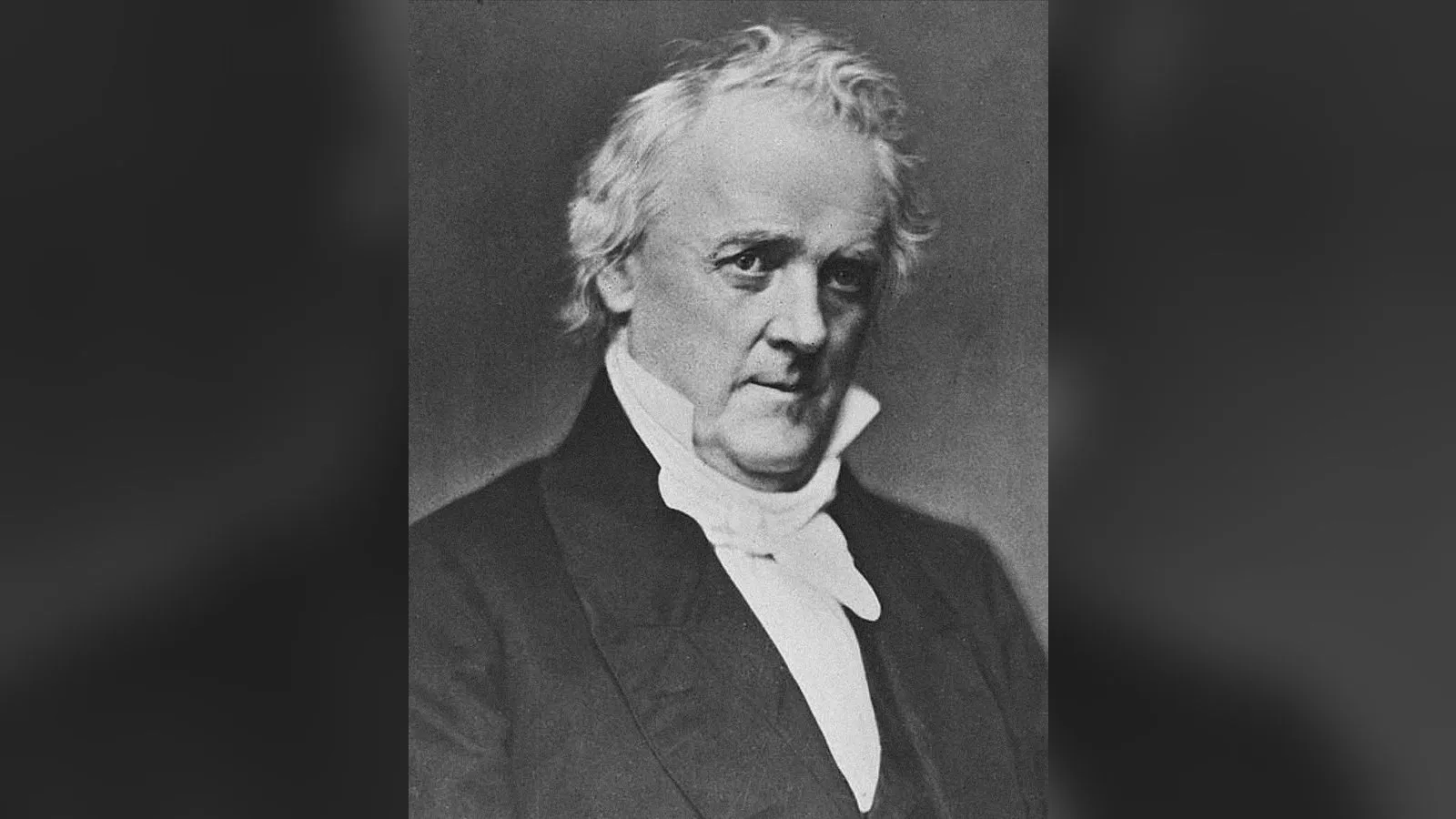

James Buchanan (1791–1868)
Contents
TL;DR
- established James Buchanan's Scots-Irish ancestry is documented with real specificity: his father, James Buchanan Sr., was an Ulster-Scot who left Ulster for America in 1783, with sources identifying the family's home as Deroran, near Omagh, County Tyrone (one Ulster-Scots heritage source places the specific townland, while Wikipedia's broader account describes the family as from County Donegal) — this article states this documented connection directly, including Buchanan's own quoted pride in it: "My Ulster blood is my most priceless heritage."
- established Buchanan remains the only US president never to marry, and his decades-long close living arrangement with Senator William Rufus DeVane King — mocked by contemporaries including Andrew Jackson, who called the pair "Miss Nancy" and "Aunt Fancy" — is a subject modern historians remain divided on, with some suggesting a romantic relationship and his biographer Jean Baker describing it as "the affection of a special friendship" — this article states this documented ambiguity directly rather than asserting a settled conclusion either way.
- disputed Before his inauguration, Buchanan improperly communicated with Supreme Court Justice Robert Cooper Grier to help secure the pro-slavery majority behind the 1857 Dred Scott decision, a specific, documented act of pre-inauguration interference this article names directly rather than presenting the ruling as unconnected to Buchanan's incoming administration.
- disputed Buchanan supported the pro-slavery Lecompton Constitution for Kansas despite documented evidence of electoral fraud, and punished fellow Democrats who opposed it by stripping their patronage, fracturing his own party in the process — this article states this full, documented episode directly.
- disputed Facing the secession crisis after Lincoln's 1860 election, Buchanan held that states had no right to secede while simultaneously maintaining the federal government had no power to stop them, a documented position historians have consistently identified as a central cause of his consistent ranking among the worst US presidents — this article names this directly rather than presenting his passivity as a defensible, neutral stance.
Key Facts
- Born
- 23 April 1791, Cove Gap, Pennsylvania, USA
- Died
- 1 June 1868, Lancaster, Pennsylvania, USA
- Category
- Statesmen, Politicians & Public Figures
- Scots-Irish ancestry
- Documented, specific — father an Ulster-Scot who left Ulster (Tyrone/Donegal sources vary) for America in 1783
- Key distinction
- Only US president who never married
- Documented controversy
- Pre-inauguration Dred Scott interference; Lecompton Constitution support; passivity during secession crisis
- Historical reputation
- Consistently ranked among the worst US presidents
Scottish Impact Index (SI Score)
- Global Influence
- 8/10
- Enduring Connection
- 8/10
- Material Contribution
- 8/10
- Scottish Diaspora Distinctiveness
- 8/10
- Diaspora Legacy
- 9/10
- Recognition
- 8/10
49/60
Ranked =31st of 45 in Diaspora
A Note on Claims and Evidence
Family background and the documented Ulster-Scots ancestral connection are drawn from Wikipedia's published biographical record (which identifies County Donegal) and the Ulster-Scots Agency's published heritage booklet (which identifies the specific townland of Deroran, near Omagh, County Tyrone); this article names both sources' slightly differing accounts rather than resolving the discrepancy, since both agree on the family's Ulster-Scots origin and 1783 emigration date. Education, political career, presidency, the Dred Scott and Lecompton episodes, the secession crisis, personal life, death, and historical reputation are drawn from Wikipedia's published research record.
Timeline
James Buchanan Sr., an Ulster-Scot, departs Londonderry for America, along with his wife Elizabeth Speer Buchanan and some of their children; sources place the family's Ulster home at either Deroran, near Omagh, County Tyrone, or County Donegal.
James Buchanan Jr. is born near Cove Gap, Pennsylvania, the second of eleven children and eldest son.
Buchanan graduates with honors from Dickinson College, Carlisle, Pennsylvania, after nearly facing expulsion the previous year for disorderly conduct.
Buchanan passes the Pennsylvania bar, having trained as a lawyer in Lancaster.
Buchanan serves in the Pennsylvania House of Representatives as a Federalist.
Buchanan's engagement to Anne Caroline Coleman is broken off amid rumors about his financial motivations; she dies shortly afterward.
Buchanan serves five terms in the US House of Representatives, shifting toward the Democratic Party.
Buchanan serves as US Minister to Russia under President Andrew Jackson.
Buchanan serves in the US Senate, chairing the Foreign Relations Committee; from 1834–1844, he shares a close living arrangement with Senator William Rufus DeVane King, drawing contemporary mockery.
Buchanan serves as Secretary of State under President James K. Polk, overseeing major US territorial expansion.
Buchanan serves as US Minister to Britain under President Franklin Pierce.
Buchanan is inaugurated as the 15th US president, having improperly communicated with Justice Robert Cooper Grier before taking office to help secure the pro-slavery Dred Scott ruling, delivered two days after his inauguration.
Buchanan supports the pro-slavery Lecompton Constitution for Kansas despite evidence of electoral fraud, and punishes Democratic opponents of it through patronage removal, fracturing his party.
Following Lincoln's election, Buchanan's message to Congress holds that states cannot lawfully secede while denying the federal government any power to prevent secession.
Buchanan sends the Star of the West to reinforce Fort Sumter; the mission fails.
Buchanan leaves office, passing the unresolved secession crisis to incoming President Lincoln.
Buchanan publishes a memoir defending his administration, blaming Northern abolitionists for the crisis rather than his own record.
Buchanan dies of respiratory failure at his Wheatland estate in Lancaster, Pennsylvania, at age 77.
Details
A documented Ulster-Scots origin, named with its minor source discrepancy intact
This article states James Buchanan's Scots-Irish ancestry directly rather than smoothing over a minor inconsistency between sources: Wikipedia identifies his father's Ulster home as County Donegal, while the Ulster-Scots Agency's own heritage research names the specific townland of Deroran, near Omagh, County Tyrone. This article names both rather than silently picking one, because the underlying Ulster-Scots origin and 1783 emigration date are consistent across sources even where the exact home parish is not, and Buchanan's own quoted pride in his "Ulster blood" reflects a connection he himself considered central to his identity.
A unique personal distinction and its genuinely unresolved historical question
This article states directly that Buchanan remains the only US president never to marry, and names the real, documented ambiguity around his decades-long close relationship with Senator William Rufus DeVane King, including contemporary mockery and modern historians' divided interpretations. This article presents this as a genuinely unresolved historical question rather than adjudicating a definitive answer, consistent with this series' standard of representing contested evidence from multiple documented sides.
A pre-inauguration act of judicial interference named directly
This article states plainly that Buchanan's involvement in the Dred Scott decision began before he even took office, through improper communication with a sitting Supreme Court justice to help secure the ruling's pro-slavery majority. This article names this because it represents a specific, documented act that implicates Buchanan directly in one of the most consequential and criticized Supreme Court decisions in American history.
A presidency's defining failures named without softening
This article states the full, documented record of Buchanan's response to the era's central crises: his support for a fraud-tainted pro-slavery constitution in Kansas, his fracturing of his own party through patronage retaliation, and his contradictory legal position during the secession crisis that left the Union's fate for his successor to resolve. This article names these because they represent the specific, documented basis for historians' consistent ranking of Buchanan among the worst US presidents, rather than presenting his presidency as merely unlucky in its timing.
Did You Know?
- James Buchanan's father was an Ulster-Scot who left Ulster for America in 1783; Buchanan himself later said, "My Ulster blood is my most priceless heritage."
- Buchanan remains the only US president who never married.
- Buchanan's decades-long close living arrangement with Senator William Rufus DeVane King drew mockery from contemporaries, including Andrew Jackson, who nicknamed the pair "Miss Nancy" and "Aunt Fancy."
- Before taking office, Buchanan improperly communicated with a sitting Supreme Court justice to help secure the pro-slavery Dred Scott ruling, delivered just two days after his inauguration.
- Buchanan's support for a fraud-tainted pro-slavery constitution in Kansas fractured his own Democratic Party.
- During the secession crisis, Buchanan held that states could not legally secede while also maintaining the federal government had no power to stop them.
- Despite predicting that "history will vindicate my memory," historians have consistently ranked Buchanan among the worst US presidents.
FAQ
1Was James Buchanan actually of Scottish descent?
Scots-Irish, documented — his father was an Ulster-Scot who left Ulster for America in 1783; sources vary slightly on whether the family's home was in County Tyrone or County Donegal.
2Was Buchanan really the only president who never married?
Yes — he remains the only US president who never married, with his orphaned niece Harriet Lane serving as his White House hostess.
3Was Buchanan involved in the Dred Scott decision before becoming president?
Yes — he improperly communicated with a sitting Supreme Court justice before his inauguration to help secure the pro-slavery ruling.
4Why is James Buchanan ranked so poorly among US presidents?
Historians cite his support for a fraud-tainted pro-slavery constitution in Kansas, his fracturing of his own party, and his passivity and contradictory legal stance during the secession crisis that preceded the Civil War.
5Did Buchanan try to stop Southern states from seceding?
He held that secession was illegal but also that the federal government lacked the power to prevent it, taking only limited action, including a failed attempt to resupply Fort Sumter.
6What did Buchanan do after leaving the presidency?
He published a memoir in 1866 defending his administration and blaming Northern abolitionists for the crisis rather than his own record.
7When did James Buchanan die?
1 June 1868, at his Wheatland estate in Lancaster, Pennsylvania, at age 77.
Sources and Further Reading
Primary/Institutional
Scholarly/Critical
- James Buchanan, 15th President, Foreign Minister, Soldier — American History Central
- Presidency of James Buchanan — Wikipedia
General
Caveats: Myths and Disputed Claims
- Source discrepancy noted: This article does not resolve a minor inconsistency between sources on James Buchanan's father's specific Ulster home parish (Tyrone vs. Donegal); both agree on the family's Ulster-Scots origin and 1783 emigration.
- disputed This article does not assert a settled conclusion about the nature of Buchanan's relationship with Senator William Rufus DeVane King; modern historians remain divided, and this article presents that division directly rather than adjudicating it.
Card 034 · Diaspora