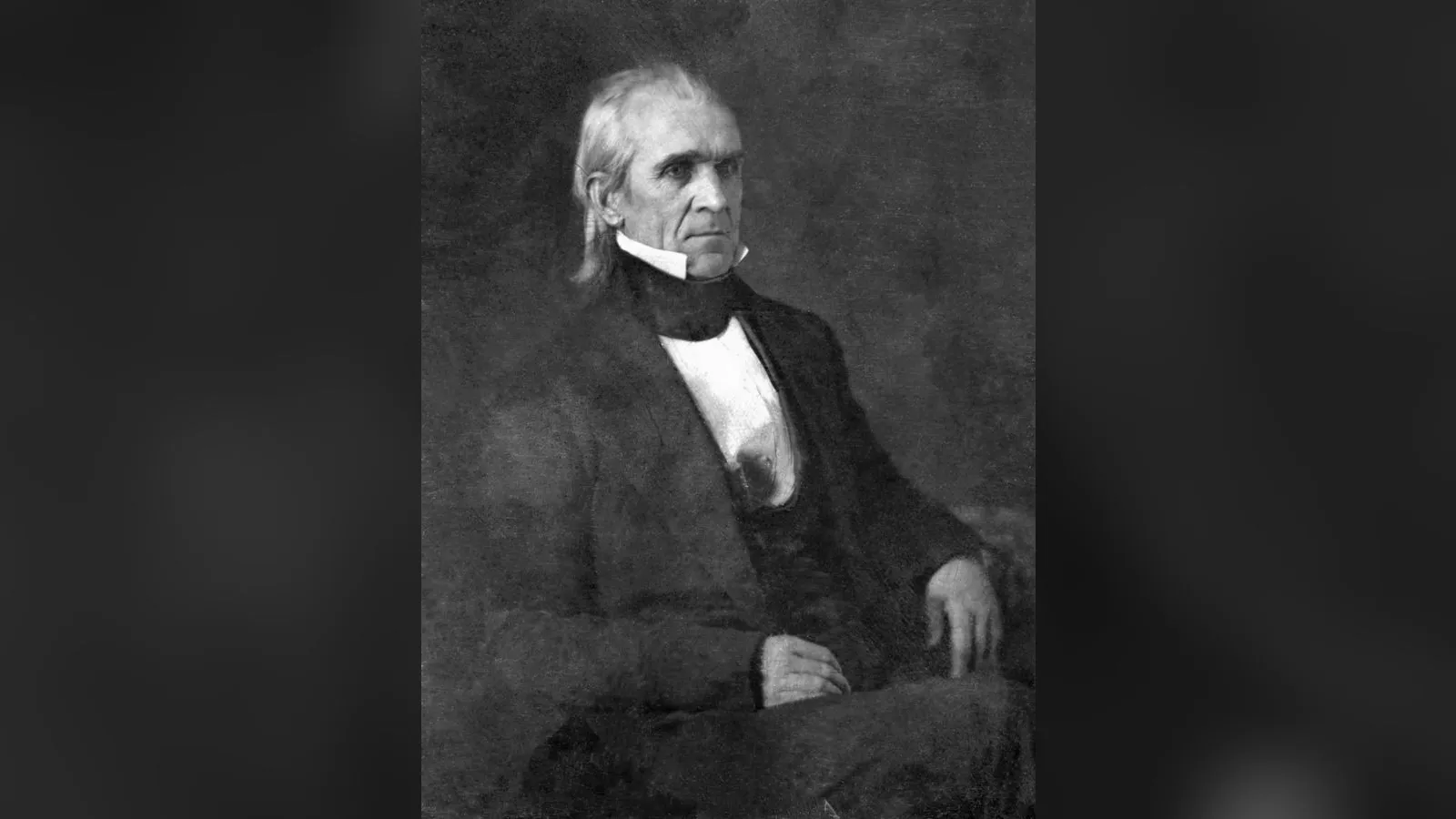

James K. Polk (1795–1849)
Contents
TL;DR
- established James K. Polk's ancestry is documented with real specificity: the family founder in America, Robert Bruce Polk (originally Pollok/Pollock), was born around 1625 in County Donegal, part of the Ulster-Scots settlement of northern Ireland, before the family migrated through Maryland, Pennsylvania, and the Carolinas to Tennessee by around 1806 — this article states this specific Scots-Irish origin directly rather than a vague general claim of "Scottish heritage."
- established Polk remains the only person in American history to have served as both Speaker of the House and President of the United States, a specific, documented and historically unusual political distinction this article names directly.
- established As president, Polk accomplished all four of his stated major goals: securing the Oregon Territory boundary at the 49th parallel, overseeing US victory in the Mexican-American War and the acquisition of the American Southwest, establishing the Independent Treasury system, and reducing tariffs through the Walker Tariff of 1846 — this article names these specific, documented achievements directly, a notably rare instance of a president accomplishing his entire stated agenda.
- established Polk was a documented slaveholder who personally purchased more than thirty enslaved people, primarily to work his Mississippi cotton plantation, a record historians note contradicts more paternalistic popular portrayals of his character — this article states this uncomfortable finding directly rather than minimising it in favour of his political achievements.
- disputed Historians broadly credit Polk with accomplishing his expansionist agenda, yet also hold that this same agenda gravely exacerbated the sectional divisions between free and slave states that set the stage for the American Civil War — this article presents both the achievement and its documented longer-term consequence together rather than praising one without naming the other.
- shared The historian David Hackett Fischer, in Albion's Seed (1989), presents the "Polks of Mecklenburg" as a leading example of a backcountry elite descended from people of standing in Ulster, a clan that intermarried with other prominent families across North Carolina and Tennessee. The family's early genealogy, however, rests partly on tradition.
Key Facts
- Born
- 2 November 1795, Pineville, North Carolina, USA
- Died
- 15 June 1849, Nashville, Tennessee, USA
- Category
- Statesmen, Politicians & Public Figures
- Scots-Irish ancestry
- Documented, specific — family founder Robert Bruce Polk (Pollok), born c. 1625, County Donegal, Ulster
- Key achievement
- Accomplished all four of his stated presidential goals (1845–1849)
- Political distinction
- Only person to serve as both Speaker of the House and US President
- Documented record
- Slaveholder; purchased over 30 enslaved people for his Mississippi plantation
Scottish Impact Index (SI Score)
- Global Influence
- 9/10
- Enduring Connection
- 8/10
- Material Contribution
- 10/10
- Scottish Diaspora Distinctiveness
- 9/10
- Diaspora Legacy
- 10/10
- Recognition
- 9/10
55/60
Ranked =10th of 45 in Diaspora
A Note on Claims and Evidence
Family background and the specific, documented Scots-Irish ancestral origin — tracing to Robert Bruce Polk, born around 1625 in County Donegal, Ulster — are drawn from Wikipedia's published biographical record and supporting genealogical research. His political career, presidency and its four stated achievements, his documented record as a slaveholder, and his death shortly after leaving office are drawn from Wikipedia's published research record and the James K. Polk Museum's published account of his death. Material on the wider Polk clan in Mecklenburg County comes from David Hackett Fischer's Albion's Seed (1989), which draws on a 1923–24 genealogical study of the Polks of North Carolina and Tennessee. Early Polk genealogy is uneven, and Fischer's own text and notes give two different emigrant ancestors.
Timeline
Robert Bruce Polk (originally Pollok or Pollock), the family's American founder, is born in County Donegal, part of the Ulster-Scots settlement of northern Ireland.
The Polk family emigrates to colonial America, eventually migrating through Maryland and Pennsylvania. Fischer dates the emigration of Captain Robert Polk from County Donegal to about 1680 and his death to 1699.
Descendants of Robert Polk's son William settle in Mecklenburg County, North Carolina, where the Polks become one of the leading backcountry families.
James Knox Polk is born in Pineville, North Carolina, to Samuel Polk and Jane Knox, who names him after her father.
The Polk family settles in Maury County, Tennessee.
Polk marries Sarah Childress, an educated woman from a prominent Tennessee family who actively assists his political career.
Polk serves as Speaker of the US House of Representatives.
Polk becomes the 11th President of the United States, having already completed the annexation of Texas initiated by his predecessor.
Polk negotiates the Oregon Territory boundary with Britain at the 49th parallel and signs the Walker Tariff, reducing tariffs.
The United States wins the Mexican-American War under Polk's presidency, resulting in the acquisition of the American Southwest.
Polk establishes the Independent Treasury system.
Polk leaves office, having accomplished all four of his stated presidential goals.
Polk contracts cholera while travelling through Tennessee during an outbreak.
Polk dies in Nashville, Tennessee, approximately three months after leaving office, the shortest retirement of any US president.
Details
A specific Scots-Irish ancestral origin named with real precision
This article names James K. Polk's ancestry with specificity rather than a vague general claim: the family's American founder, Robert Bruce Polk, was born around 1625 in County Donegal, part of the documented Ulster-Scots settlement of northern Ireland, before his descendants migrated through several colonies to reach Tennessee. This article states this specific origin because it reflects the real, traceable Scots-Irish lineage behind Polk's Scottish heritage, correctly distinguished from a direct-Scotland ancestry claim.
The Polks of Mecklenburg in Albion's Seed
shared The historian David Hackett Fischer, in Albion's Seed (1989), uses the Polks as his chief example of a backcountry "ascendancy": families who had held some rank in Ulster and who emigrated, in his argument, to keep their status rather than to escape poverty. He names the American progenitor as Captain Robert Polk, who left County Donegal about 1680 and died in 1699, and records that Robert and his wife Magdalen had seven sons. One son, David, settled in Maryland, where his children married into Chesapeake gentry families. Another, William, moved south, and his children settled mostly in Mecklenburg County, North Carolina, where James K. Polk was born.
traditional Fischer repeats a family claim that Magdalen Tasker Porter Polk was the daughter of a Lord Chancellor of Ireland who lived at Bloomfield Castle near Londonderry, and that she inherited an Irish estate called Moneen. This comes from family genealogy and should not be treated as established. Fischer's own endnotes give a different account, deriving the future president from William and Margaret Pollock, emigrants from Londonderry in 1698.
shared By the end of the eighteenth century, Fischer argues, the Mecklenburg Polks had married into many leading backcountry families, among them Alexanders, Caldwells, Campbells, Donelsons, Knoxes and Shelbys. Polk's own mother was a Knox. The clan produced Leonidas Polk, Episcopal bishop of Louisiana and a Confederate lieutenant general. Fischer adds that Andrew Jackson and Zachary Taylor were related to the clan by marriage. He also names the Alexander and Polk clans as leaders of the Mecklenburg protests after London disallowed, in 1773, the charter of Queen's College, a Presbyterian college founded in the county.
shared Fischer's broader claim is that Polk's ideals of honour and loyalty were shaped by this border inheritance. That is interpretation: it cannot be tested from the genealogy alone, and critics of Albion's Seed argue that Fischer reads too much continuity into such family histories.
A rare presidential achievement named with its real documented scope
This article names the specific, documented scope of Polk's presidential accomplishments directly, rather than a vague claim of "effective leadership": he set four explicit goals before taking office and accomplished all four, a documented achievement historians consider rare among US presidents. This article states this because it reflects the real, unusual completeness of Polk's presidential record.
A documented slaveholding record stated without minimising it
This article states Polk's documented record as a slaveholder directly and plainly: his purchase of over thirty enslaved people, primarily to labour on his Mississippi cotton plantation, a record that contradicts more flattering, paternalistic historical portrayals. This article names this because omitting or softening it would misrepresent a serious and well-documented part of Polk's personal history, consistent with this series' standard of giving uncomfortable findings full weight.
A presidential legacy's longer consequence named alongside its achievement
This article states directly that Polk's expansionist achievements and their documented destabilising consequence belong together: the same territorial gains historians credit him for achieving also gravely exacerbated the sectional divisions between free and slave states that set the stage for the American Civil War. This article names both because praising the achievement without its consequence, or vice versa, would each give an incomplete account of Polk's genuinely two-sided historical legacy.
Did You Know?
- James K. Polk's ancestry traces to Robert Bruce Polk, born around 1625 in County Donegal, part of the Ulster-Scots settlement of northern Ireland.
- Polk is the only person in American history to have served as both Speaker of the House and President of the United States.
- Polk set four specific goals before becoming president and accomplished every one of them, a rarity among US presidents.
- Polk personally purchased more than thirty enslaved people to work his Mississippi cotton plantation.
- Historians credit Polk's territorial expansion with also having gravely deepened the sectional divisions that led to the Civil War.
- Polk had the shortest post-presidential retirement in American history, dying of cholera just three months after leaving office.
- Contemporary medical treatments, including bloodletting and laxatives, likely worsened Polk's final illness rather than treating it.
- Polk's clan included Leonidas Polk, who was at once Episcopal bishop of Louisiana and a Confederate lieutenant general.
- Polk was nicknamed "Young Hickory", after Andrew Jackson's "Old Hickory"; Fischer notes that Jackson was also connected to the Polk clan by marriage.
FAQ
1Was James K. Polk actually of Scottish descent?
Yes, documented with real specificity — his family's American founder, Robert Bruce Polk, was born around 1625 in County Donegal, part of the Ulster-Scots settlement of northern Ireland.
2What makes James K. Polk's presidency historically unusual?
He set four specific goals before taking office — Oregon, the Mexican-American War, tariff reduction, and the Independent Treasury — and accomplished all four, a rare completeness among US presidents.
3Was James K. Polk a slaveholder?
Yes — he personally purchased more than thirty enslaved people, primarily for his Mississippi cotton plantation, a documented fact that complicates more flattering portrayals of his character.
4Did Polk's presidency contribute to the Civil War?
Historians argue yes — while his territorial expansion achieved his stated goals, it also deepened the sectional divisions between free and slave states that set the stage for the conflict.
5How did James K. Polk die?
He died of cholera on 15 June 1849, roughly three months after leaving office, making his the shortest post-presidential retirement in American history.
6Did Polk serve in any other major political role?
Yes — he is the only person in US history to have served as both Speaker of the House (1835–1839) and President.
7When did Polk become president?
In 1845, as the 11th President of the United States, serving a single term until 1849.
8Who were the "Polks of Mecklenburg"?
The branch of the family settled in Mecklenburg County, North Carolina, from the mid-eighteenth century. David Hackett Fischer's Albion's Seed (1989) treats them as a leading backcountry elite family, intermarried with the Alexanders, Knoxes, Donelsons and others.
9Was Polk's family really aristocratic in Ireland?
Not proven. Fischer repeats a family claim that the emigrant's wife was the daughter of a Lord Chancellor of Ireland, but this is genealogical tradition, and Fischer's own notes give a different emigrant ancestor. What is reasonably clear is that the family was Ulster Presbyterian and well established in colonial America before the Revolution.
Sources and Further Reading
Primary/Institutional
Scholarly/Critical
- James K. Polk: Life Before the Presidency — Miller Center
- Capt. Robert Bruce Polk, "the Immigrant" — genealogical research
- David Hackett Fischer, Albion's Seed: Four British Folkways in America (Oxford University Press, 1989)
General
Caveats: Myths and Disputed Claims
- Content note: This article states James K. Polk's documented record as a slaveholder, including his purchase of over thirty enslaved people, directly and without minimising it, consistent with this series' standard of giving uncomfortable findings full weight.
- disputed This article does not present Polk's territorial expansion as an uncomplicated achievement; it names both the goals he accomplished and the documented role that same expansion played in deepening the sectional tensions that led to the Civil War.
- Do not present the claim that Magdalen Tasker Porter Polk was a Lord Chancellor's daughter as fact; it is family tradition.
- Do not present Fischer's borderland thesis, or his claim that Polk's values were shaped by a "border ascendancy", as settled; it is a contested interpretation.
Card 024 · Diaspora