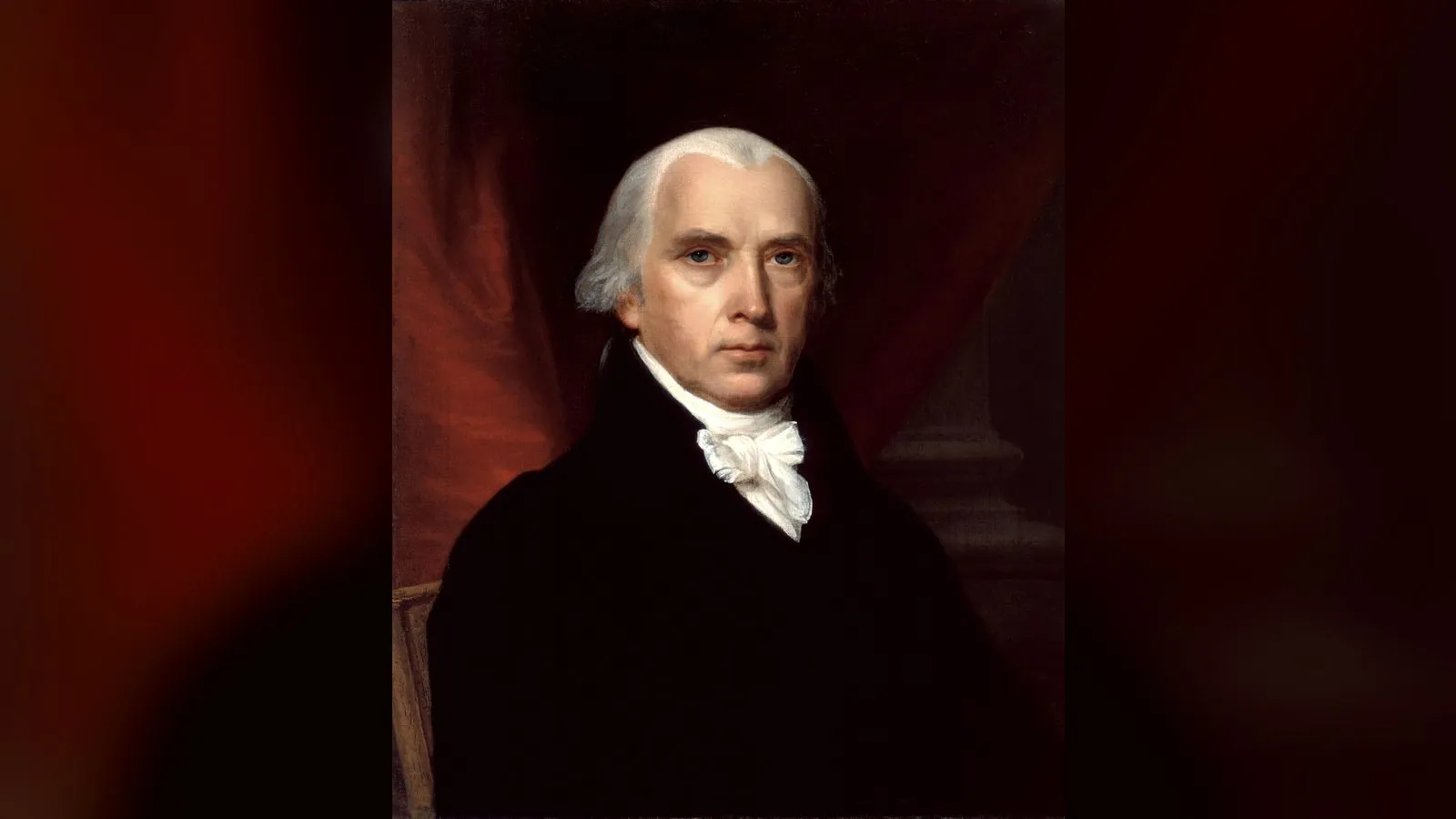

James Madison (1751–1836)
Contents
Legend/Myth
- No documented Scottish ancestry has been found for James Madison. His paternal Madison line traces to Isaac Madison, born in London, England, in 1590, who emigrated to Jamestown in 1608 — one of the earliest English settlers in colonial Virginia — with his own parents documented as John Isaac Madison of Aycliffe and Rebecca St. Leger Horsmanden of Lenham, both English locations. Madison's maternal grandfather, Francis Conway, was a Virginia tobacco merchant and planter, and his paternal great-grandfather, James Taylor, served in the Virginia House of Burgesses — a family rooted entirely in colonial Virginia's planter aristocracy since the mid-17th century. No source consulted for this article identifies a Scottish or Scots-Irish immigrant ancestor anywhere in Madison's documented family tree. This article states this absence directly rather than assuming a Founding Father with deep Virginia roots must carry Scottish ancestry, and includes Madison on the strength of his foundational constitutional work rather than a verified Scottish ancestral claim.
TL;DR
- established Madison is widely credited as the "Father of the Constitution" for drafting the Virginia Plan, which became the foundational framework for the 1787 Constitutional Convention, and for his central authorship of the Bill of Rights — this article names these specific, documented achievements directly.
- established Madison co-authored The Federalist Papers with Alexander Hamilton and John Jay, including Federalist No. 10 on factionalism and Federalist No. 51 on separation of powers, two of the most influential essays in American political philosophy — this article states this specific, documented contribution directly.
- disputed Madison inherited Montpelier and approximately 100 enslaved people from his father, freed only one enslaved person during his lifetime to prevent rebellion, and freed none in his will, despite his documented public advocacy for individual liberty — this article states this full, documented contradiction directly rather than minimising it in favour of his constitutional legacy.
- established As president, Madison led the United States into the War of 1812, during which British forces captured and burned Washington, D.C., including the White House, forcing Madison to flee — this article names this specific, documented military humiliation directly rather than presenting the war as an uncomplicated American success.
- established Madison's real Scottish connection is intellectual, not ancestral. He studied at the College of New Jersey under its Scottish president John Witherspoon, and in 1782 he drew up a list of books for Congress that included the main works of the Scottish Enlightenment, as the literary historian Andrew Hook sets out in Scotland and America (1975).
- disputed Unconfirmed oral history suggests Madison may have fathered a child with an enslaved half-sister named Coreen, though no DNA evidence is available to confirm or refute this claim — this article states this genuinely unresolved historical question directly rather than silently omitting it.
Key Facts
- Born
- 16 March 1751, Belle Grove plantation, Port Conway, Virginia, USA
- Died
- 28 June 1836, Montpelier, Virginia, USA
- Category
- Founding Figures & Revolutionary Era
- Documented Scottish ancestry
- None found — paternal line documented as English, from London, since 1608
- Key achievement
- "Father of the Constitution"; principal author of the Bill of Rights; Federalist Papers co-author
- Documented controversy
- Enslaved approximately 100 people; freed none in his will; War of 1812 led to Washington's capture and burning
- Presidency
- 4th US President (1809–1817)
Scottish Impact Index (SI Score)
- Global Influence
- 10/10
- Enduring Connection
- 8/10
- Material Contribution
- 10/10
- Scottish Diaspora Distinctiveness
- 9/10
- Diaspora Legacy
- 10/10
- Recognition
- 10/10
57/60
Ranked =2nd of 45 in Diaspora
A Note on Claims and Evidence
Family background and ancestry are drawn from Wikipedia's published biographical record and the Wikipedia entry for Madison's ancestor Ambrose Madison, which traces the paternal Madison line to Isaac Madison, an English immigrant born in London in 1590 who settled in Jamestown in 1608; no source consulted identifies a Scottish or Scots-Irish connection anywhere in Madison's documented family tree. Education, Revolutionary-era political career, the Constitutional Convention and Federalist Papers, his congressional career and the Bill of Rights, his service as Secretary of State, his presidency and the War of 1812, his documented record on slavery, personal life, death, and legacy are drawn from Wikipedia's published research record.
Timeline
Isaac Madison, James Madison's earliest documented American ancestor, is born in London, England, to John Isaac Madison of Aycliffe and Rebecca St. Leger Horsmanden of Lenham.
Isaac Madison emigrates to Jamestown, Virginia, one year after its founding.
James Madison is born at Belle Grove plantation near Port Conway, Virginia, the eldest of twelve children, to a family rooted in Virginia's planter aristocracy since the mid-17th century, with no documented Scottish ancestry.
Madison attends the College of New Jersey (later Princeton), completing a three-year degree in two years alongside Aaron Burr.
Madison joins the Patriot cause, serving on Virginia's Committee of Safety and receiving a colonel's commission in the Orange County militia, though he never sees combat.
Madison serves in the Continental Congress, becoming an expert on financial matters.
Appointed with John Witherspoon and John Lowell to list books to be imported for the use of Congress; Madison's report names about 550 titles, a dozen or so by Scottish authors.
Madison helps secure passage of the Virginia Statute for Religious Freedom alongside Thomas Jefferson.
Madison drafts the Virginia Plan at the Constitutional Convention, earning him recognition as the "Father of the Constitution."
Madison co-authors The Federalist Papers with Alexander Hamilton and John Jay, defending the Constitution's ratification.
Madison introduces the amendments that become the Bill of Rights in the First Congress.
Ten constitutional amendments, the Bill of Rights, are ratified.
Madison marries Dolley Payne Todd, a 26-year-old widow.
Madison serves as Secretary of State under President Thomas Jefferson, playing a central role in the Louisiana Purchase.
Madison becomes the 4th US president.
Madison asks Congress for a declaration of war against Britain.
Receives Francis Jeffrey, editor of the Edinburgh Review, in Washington during the war.
Major General William Hull's unconditional surrender of Fort Detroit marks an early disaster in the War of 1812.
British forces capture and burn Washington, D.C., including the White House; Madison flees to Virginia while Dolley Madison secures George Washington's portrait.
Andrew Jackson's victory at the Battle of New Orleans restores American morale after the Treaty of Ghent had already ended the war inconclusively.
Madison retires from public office and returns to Montpelier.
Madison dies at Montpelier, at age 85, having inherited approximately 100 enslaved people from his father and freeing none in his will.
Details
An ancestry gap stated directly rather than assumed
This article states plainly that no documented Scottish ancestry has been found for James Madison: his paternal line traces to an English immigrant, Isaac Madison, who settled in Jamestown in 1608, and his broader family is rooted entirely in colonial Virginia's planter aristocracy. This article names this absence directly, rather than assuming that a prominent Founding Father with deep American roots must carry Scottish ancestry, consistent with this series' standard of applying "accuracy over patriotism" to its own inclusion claims.
A Scottish education without Scottish ancestry
established Princeton under Witherspoon. Madison's link to Scotland runs through his schooling. The literary historian Andrew Hook, in Scotland and America (1975), notes that Madison, like Jefferson and John Marshall, had a Scottish schoolteacher, and that he entered the College of New Jersey in 1769, a year after the Paisley minister John Witherspoon arrived as its president. Witherspoon brought the Scottish teaching of moral philosophy and rhetoric to Princeton; Samuel Miller wrote in 1803 that he was believed to be the first man in America to teach the substance of the philosophy of the mind that Thomas Reid later developed.
established The 1782 book list. In 1782 Congress appointed Madison, Witherspoon and John Lowell of Massachusetts to prepare a list of books to be imported for its use. Madison wrote the report. Of about 550 titles, only a dozen or so were by Scots, but they were the central works of the Scottish Enlightenment: Hutcheson's System of Moral Philosophy; Ferguson's Institutes of Moral Philosophy and Essay on Civil Society; Robertson's Charles V, History of Scotland and History of America; Hume's History of England and Essays; John Millar's Origin of the Distinction of Ranks; and Adam Smith's Wealth of Nations.
shared What the list shows. Hook reads it as defining the extent of well-informed American interest in Scottish thought at the end of the Revolution, and as evidence that these books were still not widely available in America in 1782, rather than as a Witherspoon-inspired bias. Later scholars have argued about how far Scottish thinkers, Hume above all, shaped Madison's own constitutional arguments; that question goes beyond Hook's evidence and is not settled here.
established Meeting the Edinburgh Review. In 1813, in the middle of the war, Madison and his Secretary of State James Monroe received Francis Jeffrey, editor of the Edinburgh Review, in Washington and discussed the war and the disputed right of search with him. Hook takes the welcome given to the editor of an enemy country's magazine as a measure of the Review's standing in America.
Foundational constitutional achievements named with precision
This article states the specific, documented scope of Madison's contributions to American constitutional government: his authorship of the Virginia Plan, his central role in drafting the Bill of Rights, and his co-authorship of The Federalist Papers. This article names these because they represent the real, concrete basis for Madison's reputation as the "Father of the Constitution," rather than a vague characterisation of founding-era importance.
A full, unminimised accounting of Madison's personal record on slavery
This article states Madison's documented record on slavery directly and in full: his inheritance of approximately 100 enslaved people, his freeing of only one person during his lifetime, and his freeing of none in his will. This article names this because it represents a central and inseparable contradiction in the life of a man whose political philosophy helped shape American ideas of individual liberty, consistent with this series' standard of giving uncomfortable findings full weight.
A presidential humiliation named without softening
This article states directly that Madison's leadership during the War of 1812 included the capture and burning of the nation's capital, forcing Madison himself to flee. This article names this because presenting the war only through its eventual morale-boosting conclusion at New Orleans would omit a genuine, documented low point of Madison's presidency.
Did You Know?
- No documented Scottish ancestry has been found for James Madison; his paternal line traces to an English immigrant who settled in Jamestown in 1608.
- Madison completed a three-year degree at Princeton in just two years, studying alongside future vice president Aaron Burr.
- Madison is credited as the "Father of the Constitution" for drafting the Virginia Plan, the framework adopted at the 1787 Constitutional Convention.
- Madison was the principal author of the Bill of Rights, including the Second Amendment.
- During the War of 1812, British forces captured and burned Washington, D.C., including the White House, forcing Madison to flee the city.
- Madison inherited approximately 100 enslaved people and freed none of them in his will.
- Unconfirmed oral history suggests Madison may have fathered a child with an enslaved half-sister, though no DNA evidence is available to confirm or refute this.
- In 1782 Madison's list of books for Congress included Adam Smith's Wealth of Nations, published only six years earlier.
- During the War of 1812 Madison received the editor of the Edinburgh Review, Francis Jeffrey, in Washington.
FAQ
1Was James Madison actually of Scottish descent?
No documented Scottish ancestry has been found; his paternal line traces to an English immigrant who settled in Jamestown, Virginia, in 1608.
2Why is James Madison called the "Father of the Constitution"?
He drafted the Virginia Plan, which became the foundational framework for the 1787 Constitutional Convention, and was the principal author of the Bill of Rights.
3What happened during the War of 1812?
Early American campaigns into Canada failed, and British forces captured and burned Washington, D.C., in 1814, though the war ended with the Treaty of Ghent and a morale-boosting American victory at New Orleans.
4Did James Madison own enslaved people?
Yes — he inherited approximately 100 enslaved people from his father and freed only one during his lifetime, none in his will.
5Is there any truth to claims Madison fathered a child with an enslaved person?
Unconfirmed oral history suggests this possibility involving an enslaved half-sister named Coreen, but no DNA evidence is available to confirm or refute it.
6What was Madison's role before becoming president?
He served in the Continental Congress, the Virginia House of Delegates, the US House of Representatives, and as Secretary of State under Thomas Jefferson.
7Did Madison have any real connection to Scotland?
Yes, an intellectual one. He was educated at Princeton under the Scottish president John Witherspoon, had a Scottish schoolteacher, and in 1782 put the major works of the Scottish Enlightenment on his list of books for Congress.
8Which Scottish books did Madison recommend to Congress?
Works by Hutcheson, Ferguson, Robertson, Hume, John Millar and Adam Smith, about a dozen of roughly 550 titles.
9When did James Madison die?
28 June 1836, at Montpelier, Virginia, at age 85.
Sources and Further Reading
Primary/Institutional
Scholarly/Critical
- Andrew Hook, Scotland and America: A Study of Cultural Relations, 1750–1835 (Blackie, 1975), chapters 2 and 4, drawing on The Papers of James Madison, vol. 6 (1969)
- James Madison Sr. — Wikipedia
- Ancestral background of presidents of the United States — Wikipedia
General
Caveats: Myths and Disputed Claims
- Myth/gap flagged: This article does not assert a Scottish ancestral connection for James Madison; his documented ancestry traces to English colonial settlers in Virginia since 1608, with no Scottish or Scots-Irish connection found in any source consulted.
- Do not read Madison's 1782 book list as proof that Scottish books were widely read in America. Andrew Hook argues the opposite: they were listed because they were respected but still hard to obtain.
- Content note: This article states James Madison's documented ownership of enslaved people, and the unresolved oral history regarding a possible enslaved child, directly, consistent with this series' standard of giving uncomfortable findings full weight.
Card 041 · Diaspora