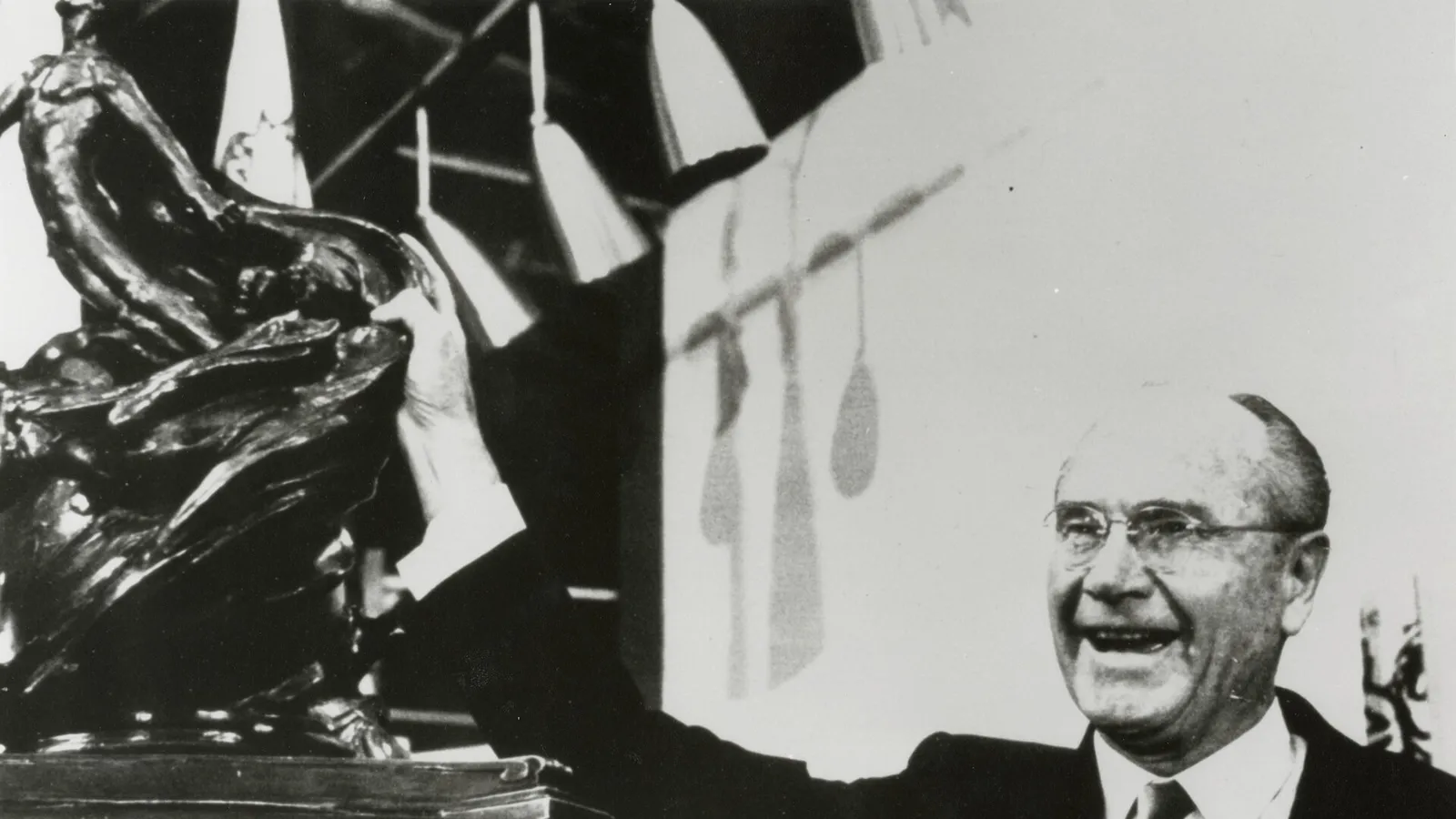

James Smith McDonnell
Contents
James Smith McDonnell, known to his employees as "Mr Mac", founded the McDonnell Aircraft Corporation in St Louis in 1939. His company built the first jet to fly from an American aircraft carrier, the Mercury and Gemini spacecraft that carried America's first astronauts, and the F-4 Phantom II. In 1967 it merged with Douglas Aircraft to form McDonnell Douglas. This card tests his achievements, and how much is actually known about the Scottish connection that puts him in this collection.
TL;DR
- established McDonnell was born in Denver, Colorado, on 9 April 1899, and grew up in central Arkansas. He graduated in physics from Princeton in 1921 and took a master's in aeronautical engineering at MIT.
- established He founded the McDonnell Aircraft Corporation in St Louis in 1939, at the age of 40.
- established His company's FH-1 Phantom became the first jet to operate from an American carrier in 1946. It built the Mercury and Gemini spacecraft and the F-4 Phantom II, and won the 1966 Collier Trophy.
- established In 1967 McDonnell Aircraft merged with Douglas Aircraft to form McDonnell Douglas, with McDonnell as chairman. He died on 22 August 1980.
- shared His Scottish connection rests on his surname and family background. None of the biographical sources consulted for this card documents it, and the McDonnell name is found in both Scotland and Ireland.
Key Facts
- Born
- 9 April 1899, Denver, Colorado
- Raised
- Central Arkansas
- Education
- Princeton (physics, 1921); MIT (master's, aeronautical engineering)
- Parachute test
- 1923, Brooks Field, Texas
- Founded McDonnell Aircraft
- 6 July 1939, St Louis
- First US carrier jet
- FH-1 Phantom, 21 July 1946
- Mercury capsule
- Development began 1959
- F-4 Phantom II
- 1958
- Collier Trophy
- 1966, for the F-4 and Gemini
- McDonnell Douglas formed
- 28 April 1967
- James S. McDonnell Foundation
- 1950
- Died
- 22 August 1980
Scottish Impact Index (SI Score)
- Global Influence
- 9/10
- Enduring Connection
- 6/10
- Material Contribution
- 10/10
- Scottish Diaspora Distinctiveness
- 8/10
- Diaspora Legacy
- 9/10
- Recognition
- 8/10
50/60
Ranked =27th of 45 in Diaspora
A Note on Claims and Evidence
Each major claim carries one of three labels. established means supported by primary records, official bodies or several independent reliable sources. shared means the core fact is sound but sources disagree on details, dates or interpretation. traditional means widely repeated but not traceable to a primary or independent source.
McDonnell's career is documented by the National Aviation Hall of Fame and by the foundation he created. His company's aircraft and spacecraft are matters of public record. His Scottish ancestry is not documented in any of the sources consulted; it is an inference from his name and family that this card cannot confirm.
Timeline
James Smith McDonnell is born in Denver, Colorado.
Aged five, he spends a month at the St Louis World's Fair.
He graduates from Princeton with honours in physics.
He volunteers to test an early parachute design at Brooks Field, Texas.
He designs the Doodle Bug for the Guggenheim safe aircraft competition.
He founds McDonnell Aircraft in St Louis.
The FH-1 Phantom becomes the first jet to operate from a US carrier.
He establishes the James S. McDonnell Foundation.
The F-4 Phantom II is created; McDonnell writes a company code of ethics.
NASA chooses McDonnell as prime contractor for the Mercury capsule.
McDonnell is contracted to build the Gemini spacecraft.
McDonnell receives the Collier Trophy for the F-4 and Gemini.
McDonnell Douglas is formed.
He is inducted into the National Aviation Hall of Fame.
McDonnell dies.
Details
Engineer and aviator
established McDonnell was born in Denver on 9 April 1899 and raised in central Arkansas. At five he spent a month at the St Louis World's Fair. He graduated from Princeton with honours in physics in 1921 and took a master's degree in aeronautical engineering at MIT in 1925. He worked for Stout Metal Airplane, part of Ford, and for Glenn L. Martin, and in 1929 designed the Doodle Bug, an entry in the Guggenheim safe aircraft competition. In 1923 he was one of six volunteers to test an early parachute design at Brooks Field in Texas.
McDonnell Aircraft
established On 6 July 1939, aged 40, McDonnell founded the McDonnell Aircraft Corporation in St Louis. His employees called him "Mr Mac". On 21 July 1946 the company's FH-1 Phantom took off from the USS Franklin D. Roosevelt, the first jet to operate from an American carrier. In 1958 the company produced the supersonic F-4 Phantom II, which became one of the most important fighters of the Cold War.
Mercury and Gemini
established In January 1959 NASA chose McDonnell Aircraft as prime contractor for the Mercury capsule, the spacecraft that carried America's first astronauts, and in December 1961 the company was contracted to build the two-man Gemini spacecraft. In 1966 McDonnell received the Collier Trophy, one of the highest awards in American aviation, for the F-4 Phantom and the Gemini spacecraft.
McDonnell Douglas
established In 1967 McDonnell Aircraft merged with Douglas Aircraft to form the McDonnell Douglas Corporation, with McDonnell as chairman and chief executive. The company later produced the F-15 Eagle, first introduced in 1969. McDonnell was inducted into the National Aviation Hall of Fame in 1977 and died on 22 August 1980.
Ethics and philanthropy
established In 1958 McDonnell wrote a nine-point code of ethics for his company, and McDonnell Aircraft became the first American company to make United Nations Day a paid holiday. In 1950 he set up the James S. McDonnell Foundation, which had given more than $600 million by its 75th anniversary in 2025.
The Scottish question
shared McDonnell is included in this collection as a figure of Scottish descent. None of the sources consulted for this card mentions his ancestry. The surname McDonnell occurs in both Scotland and Ireland, so his family origins should not be stated as Scottish without further evidence.
Did You Know?
- McDonnell was called "Mr Mac" by his employees.
- He tested an early parachute design in 1923.
- He founded his company at the age of 40.
- His FH-1 Phantom was the first jet to fly from an American carrier.
- His company built the Mercury capsules that carried America's first astronauts.
- He won the Collier Trophy in 1966.
- His company made United Nations Day a paid holiday.
- His foundation has given away more than $600 million.
FAQ
1Who was James Smith McDonnell?
An American aircraft engineer who founded McDonnell Aircraft in 1939.
2Where was he born?
In Denver, Colorado, on 9 April 1899.
3What did his company build?
The FH-1 and F-4 Phantom fighters and the Mercury and Gemini spacecraft, among others.
4What was McDonnell Douglas?
The company formed in 1967 when McDonnell Aircraft merged with Douglas Aircraft.
5Why was he called "Mr Mac"?
It was his employees' affectionate nickname for him.
6What was the Collier Trophy?
A leading American aviation award, which he received in 1966 for the F-4 and Gemini.
7Was he Scottish?
He was American. His Scottish descent is not documented in the sources used for this card.
8When did he die?
On 22 August 1980.
9What is the James S. McDonnell Foundation?
A charitable foundation he set up in 1950 to support science and, more recently, economic mobility in St Louis.
Sources and Further Reading
Primary/Institutional
- National Aviation Hall of Fame, "James Smith McDonnell" (nationalaviation.org)
- James S. McDonnell Foundation, "About Mr. Mac" (jsmf.org)
General
- MigFlug, "James Smith McDonnell: the man behind McDonnell Aircraft" (migflug.com)
Caveats: Myths and Disputed Claims
- Do not state that McDonnell was of Scottish descent as established fact.
- Do not say McDonnell was born in Scotland; he was born in Denver.
- Do not credit McDonnell personally with designing the Mercury and Gemini spacecraft; his company built them for NASA.
Card 049 · Diaspora