
Neil Armstrong: The Border Reivers' Descendant Who Walked on the Moon
Contents
TL;DR
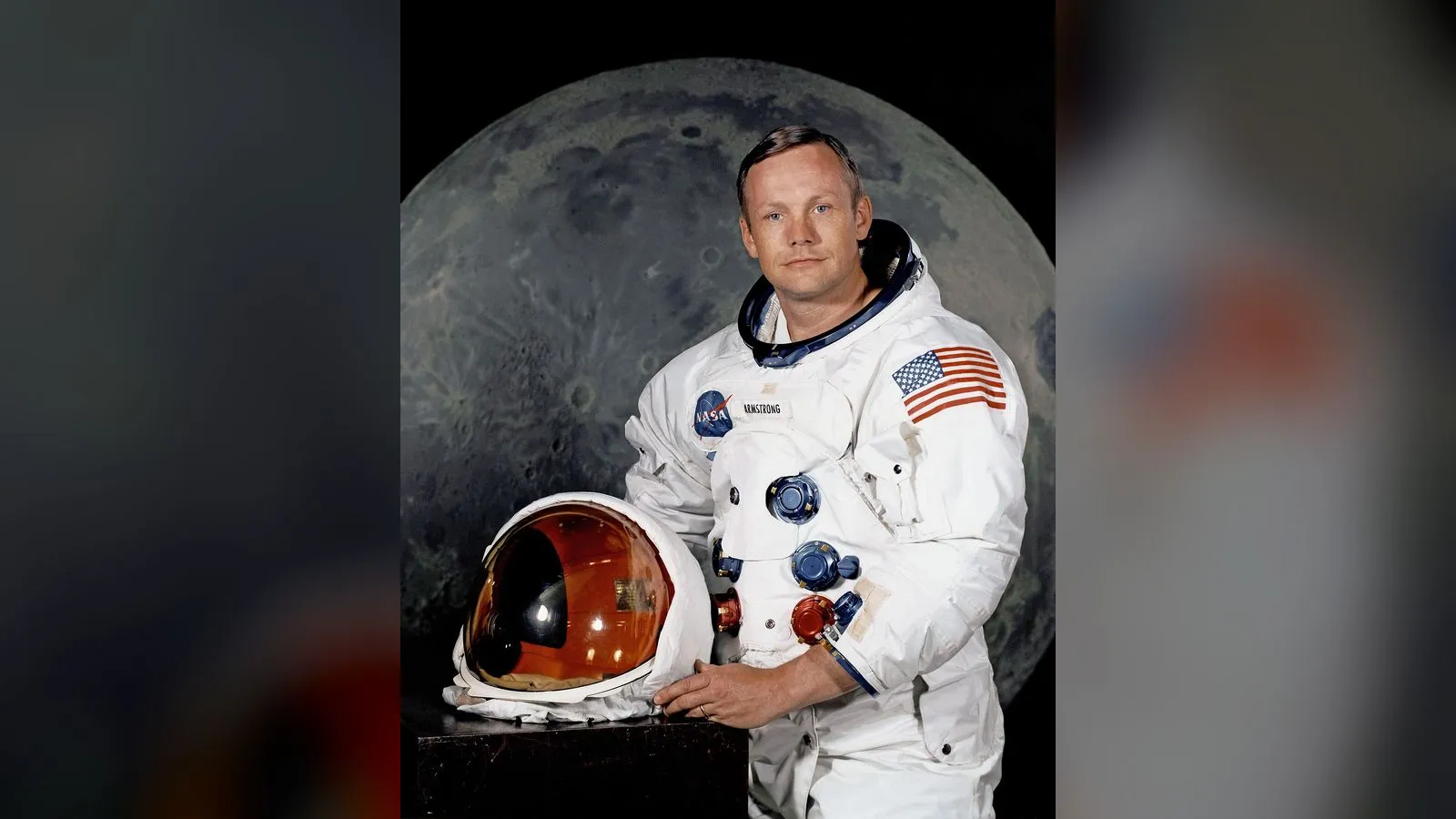
Neil Alden Armstrong (1930–2012) was a naval aviator, a test pilot and the first human being to set foot on the Moon, on 20 July 1969 (21 July by Greenwich time). He was born in Ohio, and his family had been American since the 1730s. His surname, though, leads straight back to the Anglo-Scottish Border. His biographer James R. Hansen traces Armstrong's paternal line ten generations back to an Adam Armstrong, born in the Borderlands in 1638, and identifies the family's roots in the Armstrong clan, the most formidable reiving family of the sixteenth-century Border.
In 1972 Armstrong was made the first Freeman of Langholm, in the old Armstrong heartland of Eskdale and Liddesdale. His Scottish link is ancestral, at a distance of three centuries, and it ran partly through Cumbria on the English side of the Border. But it is real, documented and one he chose to honour.
Key Findings
- His paternal line is documented to the Borders. Hansen traces it back to Adam Armstrong (1638–1696), "born in the Borderlands", ten generations before Neil.
- The line passed through England. Adam's son, Adam Armstrong II, was born in Cumbria in 1685. The family emigrated to Pennsylvania between 1736 and 1743. The connection is to the Border Armstrongs as a whole, not to a particular Scottish parish.
- The clan was the Border's most powerful reiving family. In the sixteenth century the Armstrongs were, in Hansen's words, "unquestionably the Borders' most robust family of reivers". In 1530 James V moved against their leader, Johnnie Armstrong of Gilnockie.
- His mother's side was German. Viola Engel's grandfather, Frederick Wilhelm Kötter, emigrated from Westphalia to Ohio in 1864.
- He was first a combat pilot and a test pilot. He flew 78 combat missions in Korea and made seven flights in the rocket-powered X-15.
- He survived two near-disasters before Apollo. One was the violent tumbling of Gemini VIII (1966). The other was the crash of a lunar landing training vehicle, from which he ejected on 6 May 1968.
- He stepped onto the Moon at 02:56:15 GMT on 21 July 1969, 10:56 p.m. US Eastern time on 20 July.
- He became the first Freeman of Langholm in 1972.
Key Facts
- Born
- 5 August 1930, near Wapakoneta, Ohio
- Died
- 25 August 2012, Cincinnati, Ohio, after complications following heart surgery
- Burial
- At sea, Atlantic Ocean, off Jacksonville, Florida, 14 September 2012
- Parents
- Stephen Koenig Armstrong; Viola Louise Engel
- Earliest known ancestor
- Adam Armstrong (1638–1696), born in the Borderlands
- Emigration
- Between 1736 and 1743, to Pennsylvania
- Education
- Purdue University (aeronautical engineering); MSc, University of Southern California
- Korea
- 78 combat missions with fighter squadron VF-51
- X-15
- Seven flights; peak altitude 207,500 feet (20 April 1962)
- Astronaut selection
- September 1962 ("the New Nine")
- Gemini VIII
- 16 March 1966; the first docking of two spacecraft in orbit
- Apollo 11
- Launched 16 July 1969; landed 20 July; first step 02:56:15 GMT on 21 July
- Freedom of Langholm
- March 1972
Scottish Impact Index (SI Score)
- Global Influence
- 10/10
- Enduring Connection
- 5/10
- Material Contribution
- 10/10
- Scottish Diaspora Distinctiveness
- 7/10
- Diaspora Legacy
- 8/10
- Recognition
- 10/10
50/60
Ranked =27th of 45 in Diaspora
Claim Status
established
- his career, the Apollo 11 landing and the dates of his life, as documented in Hansen's authorised biography and NASA records;
- his paternal descent from Border Armstrongs, as traced by Hansen;
- his German maternal ancestry;
- the Langholm freedom.
shared
- the link from his ancestors to Johnnie Armstrong of Gilnockie. Hansen reports that Sir Walter Scott identified a William Armstrong as a descendant of Johnnie, and that historians have inferred Will's parentage. This is genealogical inference, not a proven line to Neil.
disputed
- how "Scottish" the connection is. The earliest known ancestor was born in the Borderlands, but the next generation was born in Cumbria, England. The Armstrongs straddled the frontier, and many lived on the English side. This card presents Armstrong as a descendant of the Border Armstrongs, with Langholm as the clan's recognised heartland, rather than as a man of simple Scottish descent.
traditional
- the legend that the Armstrong name came from a warrior called Fairbairn, who lifted a fallen Scottish king back onto his horse and was rewarded with Border lands and the name "strong arm". Neil's mother recorded this family story. It is a legend.
- the story, told at Langholm in 1972, that an old law ordering any Armstrong found in the town to be hanged was still on the books. It is local folklore told for laughs.
- the claim that the sixteenth-century Armstrongs could put 3,000 mounted men in the field. George MacDonald Fraser reports it in The Steel Bonnets, and David Hackett Fischer repeats it in Albion's Seed (1989), but it is a reputation, not a muster roll.
Strong of Arm: The Border Armstrongs
The Armstrong name, Hansen notes, "meant what it said, 'strong of arm'". By the 1400s the family was a power in the Borders, the lawless frontier country of Liddesdale, Eskdale and the Debatable Land, where family loyalty counted for more than either crown. In the sixteenth century the Armstrongs were the most formidable reiving family of all: raiders, rustlers and blackmailers who rode across the frontier as it suited them. Hansen records claims that they burned dozens of Scottish churches and that the clan numbered between 12,000 and 15,000 people by the late 1520s. These are traditional figures and should be treated with caution.
Their power provoked the Crown. In 1530 James V marched south against the clan's leader, Johnnie Armstrong of Gilnockie, who was seized and hanged with his followers. The event became one of the great Border ballads. After the Union of the Crowns in 1603, James VI and I set out to "pacify" the Borders. Reiving families were broken up, hanged, transported or scattered, and many Armstrongs went to Ulster and, later, to America.
Neil's own ancestors stayed in the Borderlands longer. Hansen names Adam Armstrong, born there in 1638 and died there in 1696, as "Generation No. 1", ten generations before the first man on the Moon. His son, also Adam, was born in Cumbria in 1685 and married Mary Forster, another great Border surname. In the mid-1730s Adam II and his twenty-year-old son, Adam Abraham Armstrong, crossed the Atlantic. They were the first of Neil's line in America.
The Armstrongs and the Backcountry
The historian David Hackett Fischer, in Albion's Seed (1989), argues that the people who left the borders of England and Scotland, the Scottish Lowlands and Ulster in the eighteenth century carried a shared "borderland" culture into the American backcountry. He uses the Armstrongs as an example of how formidable the old Border clans were, describing them as "one of the largest clans on the Cumbrian border in the sixteenth century" and repeating Fraser's figure of 3,000 mounted men. Fischer's "Cumbrian" is loose: the clan's heartland was Liddesdale and Eskdale on the Scottish side, though Armstrongs lived on both sides of the line, and Neil's own line passed through Cumbria.
Neil's ancestors fit Fischer's pattern closely in outline. They crossed in the 1730s or early 1740s, in the earlier waves of a movement that Fischer finds peaked in the decade before the Revolution, and they settled in what became Cumberland County, Pennsylvania. This was part of the western "back parts" where, Fischer records, the Penn family's agent James Logan told the proprietors in 1731 that he was deliberately planting the new arrivals "as a frontier in case of any disturbance". From there the family followed the classic backcountry route west into the Ohio Country.
That is as far as the evidence goes. Fischer's thesis is influential but contested: critics argue that he treats Lowland Scots, Ulster Presbyterians and English borderers as one people and leans heavily on English Cumbrian evidence. It describes a broad migration stream; it says nothing specific about the Armstrong family's own beliefs or habits, and this card does not claim that it does.
Pioneers to Ohio
The Armstrongs became frontier farmers. Adam Abraham Armstrong settled in the Conococheague region of Pennsylvania, in what became Cumberland County, and died there in 1779. His son John surveyed land at Muddy Creek, farther west. In March 1799 John's son, another John, took his family by flatboat down to Pittsburgh and the Ohio River and into the new Ohio Country. In 1818 they settled on the western bank of the St Marys River, where their 150-acre holding became, Hansen writes, the oldest farm in Auglaize County.
Neil's father, Stephen Koenig Armstrong, was born in 1907 into a family that had known both prosperity and hard luck. He passed the civil service examination and became an assistant county auditor for the state of Ohio, a job that moved the family from town to town. His mother, Viola Louise Engel, came from German stock. Her grandfather, Frederick Wilhelm Kötter, had left Westphalia in 1864, at eighteen, to escape conscription into the Prussian army, and settled among the German farmers of western Ohio. Viola was deeply religious and musical, and Hansen credits her with passing on to her son the qualities of concentration, organisation and perseverance. Stephen and Viola married in October 1929, two weeks before the Wall Street crash.
Neil was born on 5 August 1930 at his mother's parents' farmhouse near Wapakoneta.
A Boy Who Wanted to Fly
His first flight came as a small boy in a Ford Trimotor, the "Tin Goose", a twelve-seat monoplane with wicker chairs. He built model aircraft from balsa wood and tissue paper, and as a teenager he worked odd jobs to pay for flying lessons at a grass airfield outside Wapakoneta. On his sixteenth birthday, 5 August 1946, he earned his student pilot's certificate, before he had a driving licence. His father joked that Neil "never had a girl. He didn't need a car. All he had to do was get out to that airport."
In 1947 he went to Purdue University to study aeronautical engineering on a US Navy scholarship under the Holloway Plan, which required years of naval service as part of the deal. Called up in 1949, he trained as a naval aviator at Pensacola.
Korea
Armstrong flew 78 combat missions over Korea with fighter squadron VF-51 from the carrier USS Essex, flying the F9F Panther jet. On one low-level bombing run in September 1951, at around 350 miles per hour, his aircraft hit a cable strung across a valley, probably a booby trap for low-flying planes, and lost close to six feet of its right wing. He nursed the damaged jet back to friendly territory and ejected near the Marine airfield at Pohang. It was his squadron's first ejection-seat bailout. He meant to come down in the sea, but the wind carried him inland into a rice paddy, which may have saved him: North Koreans were laying mines in the bay. He returned to Purdue after the war and graduated in 1955.
Test Pilot
Armstrong joined the National Advisory Committee for Aeronautics (NACA), NASA's predecessor, first at its Lewis laboratory in Cleveland and then at the High-Speed Flight Station at Edwards Air Force Base in California's Mojave Desert. There he flew some of the most dangerous aircraft ever built, including the rocket-powered X-15. He made seven X-15 flights. On the sixth, on 20 April 1962, he reached 207,500 feet, almost forty miles up, and "ballooned" back up out of the thin air on the way down, sailing past Edwards at about Mach 3. By the time he could turn, he was approaching Pasadena, about forty-five miles south. He made it back to the dry lakebed. Edwards legend later had him flying over the Rose Bowl, which Hansen says is an exaggeration.
These years also brought the great private sorrow of his life. His two-year-old daughter, Karen, developed a brain tumour, and after six months of treatment she died at home on 28 January 1962. Armstrong rarely spoke of her.
Gemini VIII
In September 1962 NASA chose Armstrong as one of its second group of astronauts, "the New Nine", and he was one of only two civilians in the group, alongside Elliot See. His first spaceflight was Gemini VIII, launched on 16 March 1966 with Dave Scott. Its main task was a world first: to rendezvous and dock with an unmanned Agena target vehicle in orbit. Armstrong made the docking cleanly.
Then the joined spacecraft began to roll. When Armstrong undocked, the problem got worse: a thruster on the Gemini capsule itself was stuck open. "We have serious problems here," Scott radioed. "We're tumbling end over end up here." The spin approached one revolution per second, close to the point at which the crew would black out. Armstrong shut down the main control system and used the re-entry thrusters to stop the spin, which under mission rules meant the flight had to end early. They splashed down safely in the Pacific. The episode showed NASA the cool, analytical pilot who would later be chosen to land on the Moon.
Training for the Moon
The Apollo landing would be flown in the last minutes by hand, so astronauts trained on the Lunar Landing Research Vehicle, an ungainly jet-powered frame nicknamed the "flying bedstead" that imitated flight in the Moon's low gravity. On 6 May 1968, Armstrong's vehicle went out of control about 200 feet up. He ejected less than a second before it crashed and burned, and he went back to his office to finish the day's paperwork.
Apollo 11
Apollo 11 launched from Kennedy Space Center on 16 July 1969 with Armstrong as commander, Buzz Aldrin as lunar module pilot and Michael Collins as command module pilot. On 20 July, Armstrong and Aldrin separated in the lunar module Eagle and began their descent.
It did not go to plan. Computer alarms, coded 1202 and then 1201, flashed as the onboard computer was overloaded with data. In Mission Control, a twenty-six-year-old guidance officer, Steve Bales, judged that it was safe to continue. Then Armstrong saw that the computer was taking them into a crater strewn with boulders. He took manual control and flew the lander beyond it, searching for a clear patch as the fuel ran down. He set Eagle down on the Sea of Tranquillity and reported: "Houston, Tranquility Base here. The Eagle has landed."
Hours later Armstrong climbed down the ladder. His first step on the Moon came at 10:56:15 p.m. US Eastern time on 20 July, 02:56:15 Greenwich Mean Time on 21 July. His words became among the most quoted in history: "That's one small step for man, one giant leap for mankind." Armstrong always said he had meant to say "for a man". He suggested the word was lost in transmission, while admitting, "I'm not particularly articulate." Aldrin joined him, and the two spent about two and a half hours on the surface before rejoining Collins in lunar orbit. The crew splashed down in the Pacific on 24 July. Between 750,000 and a million people gathered at Cape Kennedy for the launch, the largest crowd ever for a space launch, and hundreds of millions more around the world followed the landing on television and radio.
After the Moon
Armstrong never went back into space. He served briefly as NASA's deputy associate administrator for aeronautics, then in August 1971 left NASA to teach aerospace engineering at the University of Cincinnati, where he stayed until 1980. He sat on company boards, including Thiokol, the maker of the Space Shuttle's solid-rocket boosters. In 1986 he served as vice-chairman of the presidential commission that investigated the Challenger disaster. He guarded his privacy fiercely, rarely gave interviews and refused to trade on his fame. To many, that only made him more admired.
He died in Cincinnati on 25 August 2012, aged eighty-two, from complications after heart bypass surgery. On 14 September his ashes were scattered in the Atlantic from the USS Philippine Sea, a fitting end for a man who had always considered himself a naval aviator. The Secretary of the Navy said that he "never wanted to be a living memorial".
Langholm, 1972
In March 1972 Armstrong travelled to Langholm, in Dumfriesshire, the market town at the heart of the old Armstrong country of Eskdale and Liddesdale, to receive the freedom of the burgh. He was the first person to be made a Freeman of Langholm. The visit was a sensation in the town, and the story was told, with relish, of the old law that any Armstrong found in Langholm should be hanged, a tale that is local legend rather than statute. For a famously reticent man who avoided most honours and public appearances, the trip was a striking gesture towards the Border name he carried. The Clan Armstrong Trust and the Armstrong Clan Museum keep the connection alive.
Timeline
Adam Armstrong born in the Borderlands — "Generation No. 1"
Adam Armstrong II born in Cumbria —
The Armstrongs emigrate to Pennsylvania —
Family settles on the St Marys River, Ohio —
Frederick Kötter emigrates from Westphalia — Maternal line
Neil Armstrong born near Wapakoneta, Ohio —
Student pilot's certificate — Aged sixteen
Enters Purdue University — Holloway Plan
78 combat missions in Korea — VF-51, USS Essex
Joins NACA; Edwards test pilot —
Death of daughter Karen —
X-15 reaches 207,500 feet —
Selected as an astronaut — "The New Nine"
Gemini VIII: first docking in orbit; emergency return —
Ejects from lunar landing training vehicle —
Apollo 11 —
First step on the Moon — 20 July, US time
First Freeman of Langholm —
Professor, University of Cincinnati —
Vice-chairman, Challenger commission —
Dies in Cincinnati —
Burial at sea —
Did You Know?
- Armstrong earned his pilot's certificate before his driving licence, on his sixteenth birthday.
- On his record X-15 flight he overshot Edwards and found himself approaching Pasadena before he could turn back. Legend says he flew over the Rose Bowl; he didn't.
- He ejected from a crashing lunar training vehicle in May 1968 and went back to the office the same afternoon.
- Neil's Border ancestor Adam Armstrong II married a Forster, another of the great reiving surnames.
- The Armstrongs settled in what became Cumberland County, Pennsylvania, created in 1750 and named after the English Border county through which Neil's line had passed.
- At the height of their power the Armstrongs were reputed, in Fraser's and Fischer's telling, to be able to raise 3,000 mounted men.
Honest Caveats
- Ancestry, not nationality. Armstrong was American by birth and family history going back to the 1730s. His Scottish link is a surname and a documented paternal line, three centuries deep.
- Scotland or England? The earliest known ancestor was born in the Borderlands, but the next generation was born in Cumbria. The Border Armstrongs lived on both sides of the frontier.
- Gilnockie. The link to Johnnie Armstrong of Gilnockie is inferred, not proven.
- Fischer's thesis. Do not present David Hackett Fischer's borderland thesis as settled, or use it to read the Armstrongs' character across three centuries. It is a contested interpretation of a whole migration.
- Langholm details. The freedom of Langholm is well documented, but much of what is said about the visit, including the "hanging law", is local tradition. The specific details of the visit come from local and press accounts rather than from Hansen's biography.
FAQ
1Was Neil Armstrong Scottish?
No. He was American, descended on his father's side from the Armstrongs of the Anglo-Scottish Border. His mother's family was German.
2Why is he in a Scottish diaspora series?
Because his paternal line is traced to the Border Armstrongs, and he accepted the freedom of Langholm, the clan's heartland, in 1972.
3When did he walk on the Moon?
His first step came at 02:56 GMT on 21 July 1969, which was the evening of 20 July in the United States.
4What did he actually say?
"That's one small step for man, one giant leap for mankind." He always maintained he meant "for a man".
5What was Gemini VIII?
His first spaceflight, in March 1966. It achieved the first docking of two spacecraft in orbit, then had to return early after a stuck thruster sent the capsule spinning dangerously.
6Who were the Border reivers?
Raiding families of the Anglo-Scottish frontier in the fifteenth and sixteenth centuries. The Armstrongs were the most powerful of them.
7Did the Armstrongs fit the wider Scots-Irish and Border migration to America?
In outline, yes. They arrived in the 1730s or early 1740s and settled in what became Cumberland County, Pennsylvania, the kind of western settlement the historian David Hackett Fischer describes in Albion's Seed (1989). Fischer's broader claim that these migrants carried a single Border culture is contested.
8How many men could the Armstrongs raise?
Tradition says 3,000 horsemen in the sixteenth century, a figure repeated by George MacDonald Fraser and by Fischer. It is a reputation rather than a counted muster.
Related
- The Border Reivers
- The Scottish Diaspora
- Dumfries and Galloway
- Johnnie Armstrong of Gilnockie
Sources
Primary/Institutional
- NASA History Office, Apollo 11 Lunar Surface Journal, ed. Eric P. Jones. https://www.nasa.gov/history/alsj/
- NASA, "Neil A. Armstrong" biography. https://www.nasa.gov/
- Clan Armstrong Trust and Armstrong Clan Museum, Langholm. https://www.armstrongclan.info/
Scholarly/Critical
- David Hackett Fischer, Albion's Seed: Four British Folkways in America (Oxford University Press, 1989)
Further reading
- James R. Hansen, First Man: The Life of Neil A. Armstrong (Simon & Schuster, 2005; reissue 2018). Ancestry (Chapter 1), career, Apollo 11, death and burial.
- George MacDonald Fraser, The Steel Bonnets: The Story of the Anglo-Scottish Border Reivers (1971).
Card 001 · Diaspora