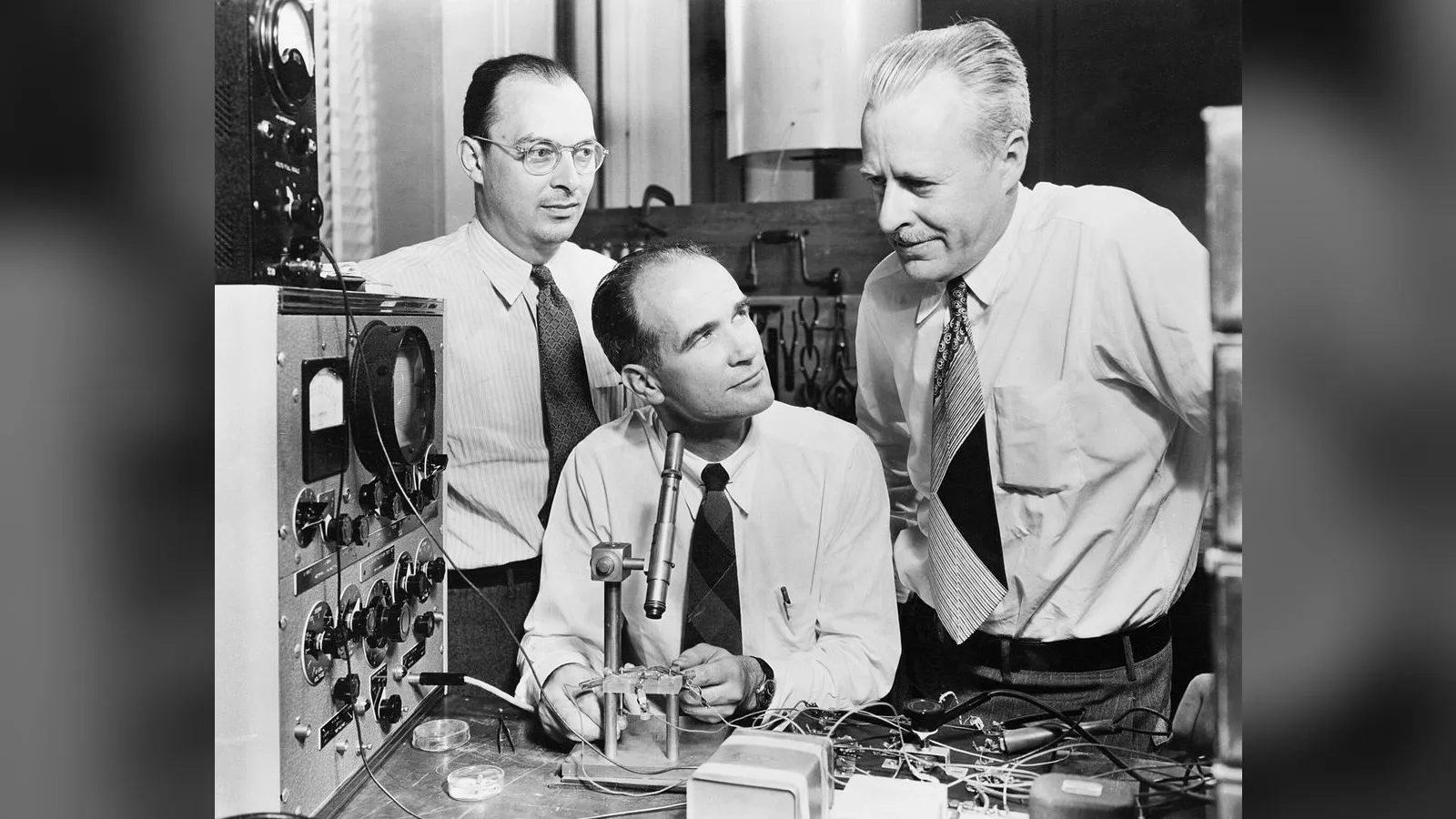

Walter Brattain (1902–1987)
Contents
TL;DR
- established Walter Brattain's documented Scottish ancestry is real but general: his father, Ross R. Brattain, is recorded as being of Scottish heritage, without a further documented trace to a specific clan, town, or ancestral seat — this article states this honestly at the level of specificity the record actually supports, rather than inventing a more detailed heritage story than the evidence allows.
- established Brattain was born in Amoy (now Xiamen), China, in 1902, to American missionary parents, and did not move to the United States until 1903, eventually settling on a cattle ranch near Tonasket, Washington, in 1911 — a specific, documented and unusual early biography this article states directly rather than presenting him as having had a conventional American upbringing from birth.
- established On 16 December 1947, Brattain devised the specific experimental breakthrough, using two gold leaf contacts on a sliver of germanium, that allowed him and physicist John Bardeen to demonstrate the first working point-contact transistor by 23 December 1947, after team leader William Shockley's own field-effect transistor design had failed to amplify signals as predicted — a specific, documented technical contribution this article names directly rather than crediting the transistor's invention to the Bell Labs team as an undifferentiated whole.
- disputed The credit for the transistor's invention became a genuine, documented source of conflict: William Shockley "believed and stated that he should have received all the credit for the invention," subsequently excluding both Bardeen and Brattain from developing the junction transistor, which he patented alone, a situation Bardeen described as "intolerable" and which contributed to his departure from Bell Labs in 1951 — this article states this real, documented interpersonal and professional conflict directly rather than presenting the three scientists' 1956 shared Nobel Prize as reflecting a harmonious collaboration throughout.
- established Brattain, Bardeen, and Shockley jointly received the 1956 Nobel Prize in Physics for their research on semiconductors and the discovery of the transistor effect, with Bardeen and Brattain specifically recognised for the point-contact transistor and Shockley for the junction transistor — a specific, documented division of the prize's basis this article names directly rather than treating the award as crediting all three equally for the same single invention.
Key Facts
- Born
- 10 February 1902, Amoy (Xiamen), China
- Died
- 13 October 1987, Seattle, Washington, USA
- Category
- Science, Technology & Invention
- Scottish ancestry
- Documented but general (father "of Scottish heritage")
- Key breakthrough
- First working point-contact transistor (23 December 1947)
- Co-inventors
- John Bardeen, William Shockley
- Key honour
- Nobel Prize in Physics, 1956 (shared)
Scottish Impact Index (SI Score)
- Global Influence
- 10/10
- Enduring Connection
- 4/10
- Material Contribution
- 10/10
- Scottish Diaspora Distinctiveness
- 6/10
- Diaspora Legacy
- 8/10
- Recognition
- 9/10
47/60
Ranked =36th of 45 in Diaspora
A Note on Claims and Evidence
Family background and ancestry, childhood in China and Washington state, education, the Bell Labs transistor breakthrough, the documented credit dispute among the three co-inventors, and the 1956 Nobel Prize are drawn from Wikipedia's published research record. This article states Brattain's Scottish ancestry at the level of specificity the documented record actually supports, a general statement of paternal heritage rather than a traceable ancestral-seat connection.
Timeline
Walter Houser Brattain is born in Amoy (now Xiamen), China, to American missionary parents, Ross R. Brattain, recorded as of Scottish heritage, and Ottilie Houser, whose own parents had immigrated from Stuttgart, Germany.
The Brattain family returns to the United States.
The family settles on a cattle ranch near Tonasket, Washington.
Brattain earns a BS in Physics and Mathematics from Whitman College, his parents' alma mater, as part of a celebrated cohort nicknamed "the four horsemen of physics."
Brattain completes a PhD at the University of Minnesota and joins Bell Telephone Laboratories, beginning decades of semiconductor research.
Bell Labs establishes a solid-state physics division led by William Shockley, which soon includes theorist John Bardeen, a close friend of Brattain's through his brother Robert.
After Shockley's field-effect transistor design fails to amplify signals as predicted, Brattain and Bardeen conduct experiments to understand the failure.
Brattain devises the specific breakthrough method using two gold leaf contacts on germanium.
Brattain and Bardeen demonstrate the first working point-contact transistor.
A genuine, documented conflict emerges: Shockley believes he should have received all credit for the invention and subsequently excludes Bardeen and Brattain from developing the junction transistor, which he patents alone; Bardeen, describing the situation as "intolerable," leaves Bell Labs for the University of Illinois in 1951.
Brattain, Bardeen, and Shockley jointly receive the Nobel Prize in Physics, with Bardeen and Brattain specifically recognised for the point-contact transistor and Shockley for the junction transistor.
Brattain returns to teach at Whitman College, eventually becoming an adjunct professor.
Brattain dies in Seattle from Alzheimer's disease, at age 85, and is buried in Pomeroy, Washington.
Details
An ancestry claim stated at its real, documented level of specificity
This article names Brattain's Scottish ancestry honestly rather than inflating it: his father, Ross R. Brattain, is documented as being of Scottish heritage, a real but general record, not a traceable connection to a specific clan, town, or ancestral seat. This article states this distinction because presenting a general heritage claim with invented specificity would misrepresent the real strength of the documented evidence.
An unusual early biography named rather than assumed conventional
This article states directly that Brattain was born in China to American missionary parents and did not arrive in the United States until age one, eventually settling on a Washington cattle ranch a decade later, rather than presenting him as having had a conventional American upbringing from birth. This article names this specific, documented early biography because it is the real, unusual circumstance of his childhood, not an assumed typical American origin story.
A specific technical contribution named within a team effort
This article names Brattain's individual contribution to the transistor's invention with real specificity rather than crediting the breakthrough to the Bell Labs team as an undifferentiated whole: the specific gold-leaf-contact experimental method he devised on 16 December 1947, leading to the first working point-contact transistor by 23 December. This article states this specific contribution because it clarifies the real, documented division of credit within a three-person collaboration, not a vague group achievement.
A genuine credit conflict presented without softening it
This article names the real, documented conflict over invention credit directly rather than presenting the three scientists' shared Nobel Prize as reflecting smooth collaboration throughout: Shockley's belief that he deserved sole credit, his exclusion of Bardeen and Brattain from the junction transistor's development and patent, and Bardeen's description of the resulting situation as "intolerable," which contributed to his departure from Bell Labs. This article states this conflict because presenting only the shared 1956 Nobel Prize without this context would misrepresent the genuinely difficult, documented working relationship behind one of the 20th century's most significant inventions.
A shared prize's real basis named with precision
This article names the specific division of credit behind the 1956 Nobel Prize rather than treating it as recognising all three scientists equally for the same single invention: Bardeen and Brattain were specifically recognised for the point-contact transistor, Shockley for the junction transistor. This article states this distinction because it reflects the real, documented basis of the shared award, not a generalised joint credit.
Did You Know?
- Walter Brattain was born in China to American missionary parents and didn't arrive in the United States until he was one year old.
- His father is documented as being of Scottish heritage, though the record doesn't trace to a specific clan or place.
- Brattain devised the specific experimental breakthrough behind the first working transistor on 16 December 1947, using two gold leaf contacts on germanium.
- The transistor's invention led to a real, documented conflict: team leader William Shockley believed he deserved all the credit and excluded his colleagues from developing the junction transistor.
- John Bardeen called the resulting situation "intolerable" and left Bell Labs for the University of Illinois in 1951.
- All three scientists still shared the 1956 Nobel Prize in Physics, but for two different transistor designs, not one shared invention.
- Brattain grew up partly on a Washington state cattle ranch before attending his parents' alma mater, Whitman College.
FAQ
1Was Walter Brattain's Scottish ancestry specific or general?
General — his father is documented as being of Scottish heritage, but the record doesn't trace to a specific clan or place.
2Where was Walter Brattain born?
In Amoy (now Xiamen), China, to American missionary parents, before the family returned to the US when he was about one year old.
3What exactly did Brattain contribute to the transistor's invention?
He devised the specific gold-leaf-contact experimental method on 16 December 1947 that led, with John Bardeen, to the first working point-contact transistor a week later.
4Did the three transistor inventors always work well together?
No — William Shockley believed he deserved sole credit and excluded Bardeen and Brattain from developing the junction transistor, a conflict Bardeen called "intolerable."
5Did all three scientists win the Nobel Prize for the same invention?
Not quite — Bardeen and Brattain were recognised specifically for the point-contact transistor, Shockley for the junction transistor, though all three shared the 1956 Physics prize.
6What did Walter Brattain do later in his career?
He taught at Harvard and then returned to his alma mater, Whitman College, eventually becoming an adjunct professor.
7When did Walter Brattain die?
13 October 1987, in Seattle, from Alzheimer's disease.
Sources and Further Reading
Caveats: Myths and Disputed Claims
- Clarification: This article does not present Walter Brattain's Scottish ancestry as tied to a specific clan or place; the documented record states only that his father was of Scottish heritage.
- disputed This article does not present the transistor's invention as a smoothly collaborative team achievement; the real, documented history includes a genuine credit conflict in which Shockley excluded his co-inventors from developing the junction transistor.
Card 005 · Diaspora