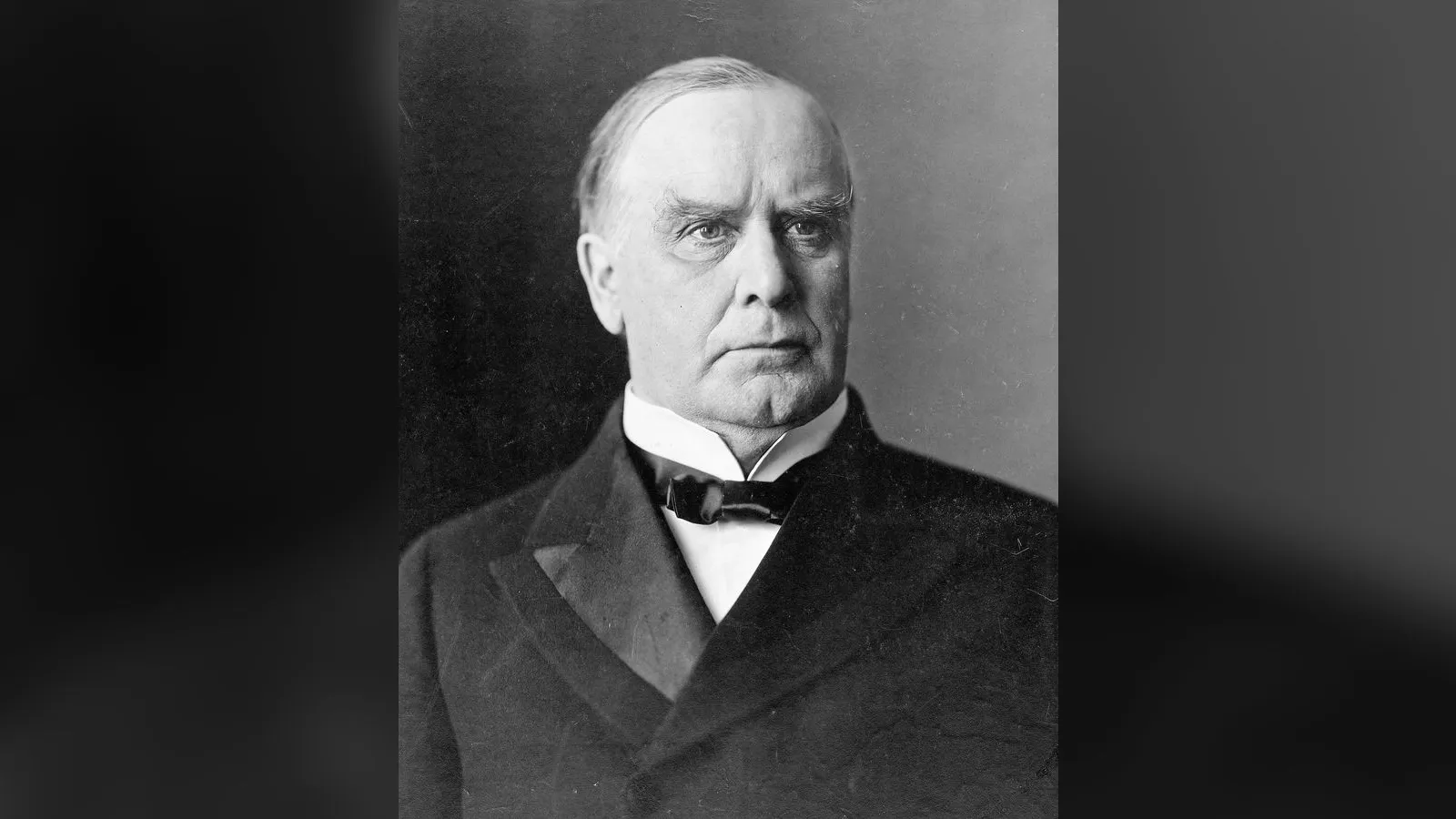

William McKinley (1843–1901)
Contents
TL;DR
- established William McKinley's Scots-Irish ancestry is documented with real specificity: his ancestor David McKinley originated in Dervock, County Antrim, in Ulster, a named town this article states directly rather than a vague claim of general Scottish heritage — his mother's side, by contrast, was of documented English descent.
- established McKinley enlisted as a private in the 23rd Ohio Infantry in 1861 at age eighteen and rose to brevet major by the war's end, participating in major Civil War engagements including Antietam, where he came under heavy fire delivering rations to frontline troops — this article names this specific, documented military record directly rather than treating McKinley's political career as his first public distinction.
- established As president, McKinley signed the Gold Standard Act of 1898 and championed protective tariffs, specific, documented economic policies this article states directly rather than a vague claim of "conservative economics."
- established McKinley led the United States through the 1898 Spanish-American War, resulting in the annexation of Hawaii, Puerto Rico, Guam, and the Philippines, a specific, documented expansion of American overseas territory this article names directly as a consequential and debated turn toward imperial expansion.
- established McKinley died on 14 September 1901 from gangrene following an assassination attempt by anarchist Leon Czolgosz eight days earlier, a specific, documented cause of death this article states directly.
Key Facts
- Born
- 29 January 1843, Niles, Ohio, USA
- Died
- 14 September 1901, Buffalo, New York, USA
- Category
- Statesmen, Politicians & Public Figures
- Scots-Irish ancestry
- Documented, specific — ancestor David McKinley from Dervock, County Antrim, Ulster
- Key achievement
- Gold Standard Act (1898); led US through Spanish-American War
- Presidency
- 25th US President (1897–1901)
- Death
- Assassinated by anarchist Leon Czolgosz, 1901
Scottish Impact Index (SI Score)
- Global Influence
- 9/10
- Enduring Connection
- 7/10
- Material Contribution
- 9/10
- Scottish Diaspora Distinctiveness
- 8/10
- Diaspora Legacy
- 9/10
- Recognition
- 9/10
51/60
Ranked =24th of 45 in Diaspora
A Note on Claims and Evidence
Family background and the specific, documented Scots-Irish ancestral connection to Dervock, County Antrim, are drawn from Wikipedia's published biographical record, which also notes McKinley's mother was of English descent. Civil War service, presidency and its specific economic and foreign policy achievements, and the 1901 assassination and death are drawn from Wikipedia's published research record.
Timeline
David McKinley, the family's documented ancestor, originates in Dervock, County Antrim, in Ulster, part of the Scots-Irish settlement tradition.
William McKinley Jr. is born in Niles, Ohio, to William McKinley Sr., an iron foundry operator, and Nancy Allison, of English descent.
McKinley enlists as a private in the 23rd Ohio Infantry at age eighteen, at the outbreak of the Civil War.
McKinley serves at the Battle of Antietam, coming under heavy fire while bringing rations to frontline troops.
McKinley is mustered out of the army with the rank of brevet major.
McKinley marries Ida Saxton; the couple's two daughters both die in infancy.
McKinley wins a realigning presidential election, establishing Republican political dominance that lasts through the Fourth Party System until 1932.
McKinley becomes the 25th President of the United States.
McKinley signs the Gold Standard Act; the United States wins the Spanish-American War under his leadership, leading to the annexation of Hawaii, Puerto Rico, Guam, and the Philippines.
McKinley promotes the "Open Door Policy" toward China.
McKinley wins re-election.
McKinley is shot by anarchist Leon Czolgosz in Buffalo, New York.
McKinley dies of gangrene from his wounds, eight days after the shooting.
Details
A specific, named ancestral town stated with real documentation
This article names William McKinley's Scots-Irish ancestry with precision rather than a vague general claim: the documented family ancestor, David McKinley, originated in Dervock, County Antrim, in Ulster. This article states this specific, named town directly because it represents a documented connection with real traceable detail, and also names his mother's separate English ancestry, rather than collapsing his full family background into a single simplified heritage claim.
A substantial military record named before McKinley's political fame
This article states McKinley's Civil War service directly, rather than presenting his political career as his first notable achievement: his enlistment as a private at eighteen, his rise to brevet major, and his documented service under fire at Antietam. This article names this because it represents the real, formative foundation of McKinley's later public life.
A consequential turn toward overseas expansion named directly
This article states the specific, documented scale of American territorial expansion under McKinley rather than a vague claim about the Spanish-American War's outcome: the annexation of Hawaii, Puerto Rico, Guam, and the Philippines. This article names this because it represents a real, consequential, and still-debated turning point in American foreign policy, not an incidental wartime footnote.
A documented assassination and its specific cause of death named directly
This article states the precise circumstances of McKinley's death rather than a vague reference to his assassination: he died from gangrene, a documented medical complication of his gunshot wounds, eight days after being shot by Leon Czolgosz. This article names this specific detail because it reflects the real documented record of his death.
Did You Know?
- William McKinley's documented Scots-Irish ancestor, David McKinley, came specifically from Dervock, County Antrim, in Ulster.
- McKinley's mother, by contrast, was of documented English descent, giving him a genuinely mixed family background.
- McKinley enlisted as a private in the Civil War at age eighteen and rose to brevet major, serving under fire at the Battle of Antietam.
- As president, McKinley signed the Gold Standard Act of 1898, formally establishing gold as the US monetary standard.
- Under McKinley's leadership, the US annexed Hawaii, Puerto Rico, Guam, and the Philippines following the Spanish-American War.
- McKinley's 1896 election victory realigned American politics, establishing Republican dominance for decades.
- McKinley died from gangrene, a complication of his gunshot wounds, eight days after being shot by an anarchist in 1901.
FAQ
1Was William McKinley actually of Scottish descent?
Yes, documented with real specificity — his Scots-Irish ancestor, David McKinley, came from Dervock, County Antrim, in Ulster; his mother was separately of English descent.
2Did William McKinley serve in the military before becoming president?
Yes — he enlisted as a private in the Civil War at age eighteen and rose to brevet major, serving under fire at Antietam.
3What is William McKinley best known for as president?
Signing the Gold Standard Act and leading the United States through the Spanish-American War, which resulted in major overseas territorial annexations.
4What territories did the US gain under McKinley?
Hawaii, Puerto Rico, Guam, and the Philippines, following the 1898 Spanish-American War.
5How did William McKinley die?
He died of gangrene on 14 September 1901, eight days after being shot by anarchist Leon Czolgosz in Buffalo, New York.
6Was McKinley's 1896 election significant?
Yes — it was a realigning election that established Republican political dominance lasting until 1932.
7When did William McKinley become president?
In 1897, serving until his assassination in 1901.
Sources and Further Reading
Primary/Institutional
Scholarly/Critical
- William McKinley, Biography, Significance, 25th President — American History Central
- The assassination of William McKinley — History Answers
General
Caveats: Myths and Disputed Claims
- Clarification: This article does not present William McKinley's ancestry as uniformly Scots-Irish; his documented family background is mixed, with his mother's side separately of English descent.
- Context note: This article names the Spanish-American War's territorial consequences (the annexation of Hawaii, Puerto Rico, Guam, and the Philippines) as a significant and debated turn toward American overseas expansion, rather than an incidental wartime detail.
Card 025 · Diaspora