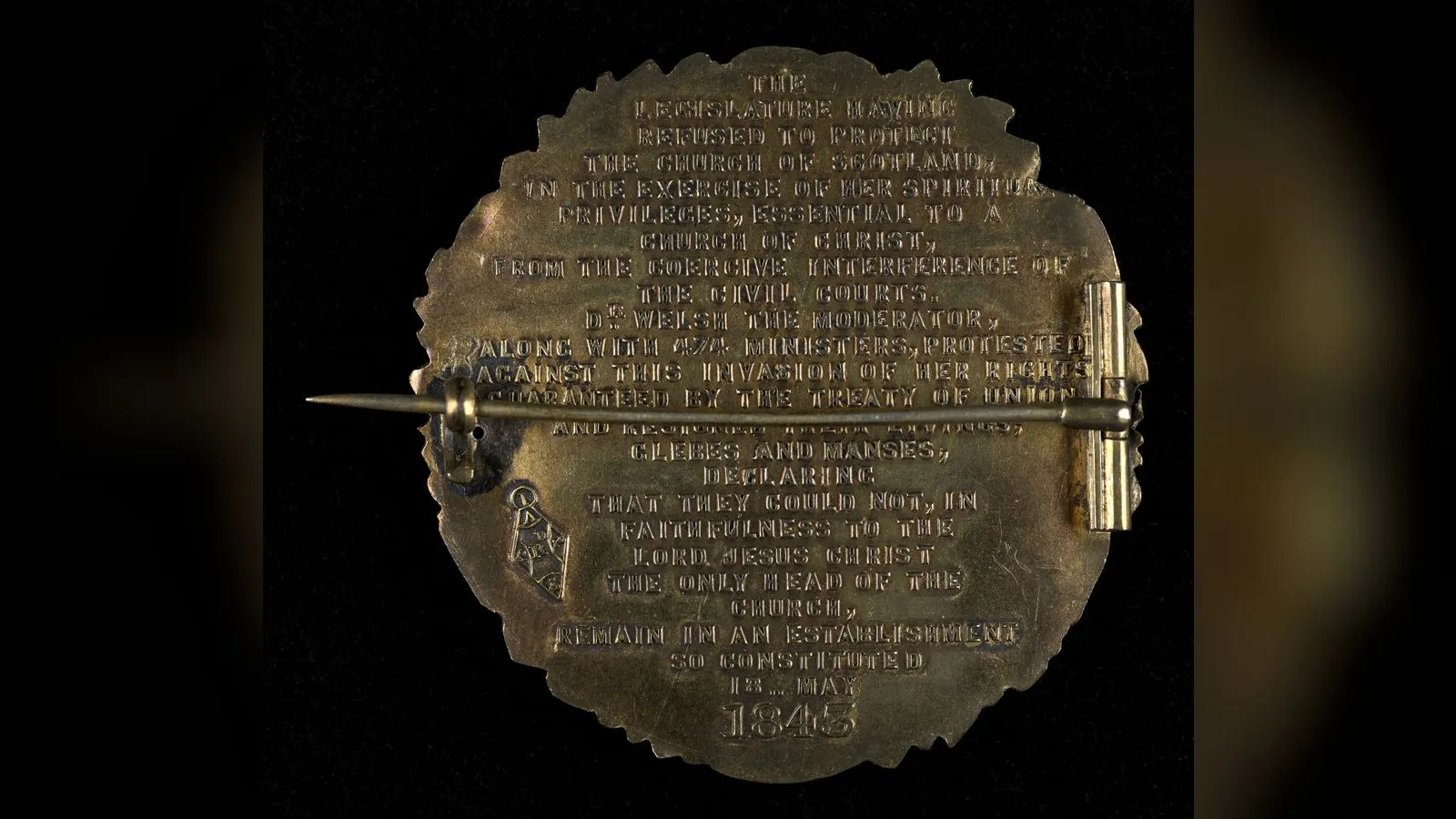

The Disruption of 1843
Contents
Legend/Myth Opener
The Disruption is sometimes flattened into a simple story of "the evangelicals versus the establishment," as if it were a sudden, single-issue walkout. In fact it was the culmination of a decade of escalating legal and constitutional conflict — the "Ten Years' Conflict" — over who ultimately controlled the Church of Scotland, and the walkout itself, while genuinely dramatic, was the carefully organised result of that long dispute rather than a spontaneous break.
TL;DR
- established On 18 May 1843, around a third of the Church of Scotland's ministers (roughly 450 of about 1,200–1,200+, with commonly cited figures around 470 ministers and some 450–470 ministers joined by a similar number of elders) formally withdrew from the General Assembly in Edinburgh to found the Free Church of Scotland, because the event is extensively documented in Church of Scotland and Free Church records, contemporary press accounts, and subsequent scholarship.
- established The immediate trigger was the "non-intrusion" principle — opposition to patrons (often local landowners) imposing ministers on congregations against their wishes — intensified by a sequence of Court of Session and House of Lords rulings (notably in the Auchterarder case) that denied the Church's General Assembly the power to override patronage through measures like the 1834 Veto Act, because these rulings and the Assembly's responses are recorded in contemporaneous legal and ecclesiastical documents.
- established This underlying dispute over patronage is covered in depth in the separate "Patronage Controversy" card in this series; this article focuses on the Disruption itself as a dramatic institutional and social event, because the two issues, while inseparable historically, are distinct enough in scope to warrant separate treatment without duplication.
- established The departing ministers and congregations undertook a remarkably fast and extensive church-building effort, erecting hundreds of new churches, manses, and schools within a few years largely through voluntary funding, because financial and building records of the new Free Church document this scale directly.
- traditional The Disruption is widely described by historians as one of the most significant single events in 19th-century Scottish religious and social history, a judgement broadly shared across scholarly accounts, though "most significant" inevitably involves comparative historical judgement rather than a single measurable fact.
Key Facts
- Category
- Detail
- Key Date(s)/Origin
- 18 May 1843, General Assembly, St Andrew's Church, Edinburgh, followed by relocation to Tanfield Hall, Canonmills; preceded by the "Ten Years' Conflict" (c.1833–1843)
- Key Figures/Bodies
- Dr Thomas Chalmers (leading figure, first Moderator of the Free Church); Dr David Welsh (outgoing Moderator of the Church of Scotland Assembly, who read the formal Protest and led the walkout); the Church of Scotland General Assembly; the Court of Session and House of Lords (via the Auchterarder case and related rulings)
- Key Source
- The Claim, Declaration and Protest of 1842–43; contemporary General Assembly records; Free Church of Scotland founding documents and early sustentation fund records
- Status Today
- The Free Church of Scotland founded in 1843 continued as a major denomination; most of it later united with other bodies (see the separate "Free Church of Scotland" card), while the Church of Scotland continued as the established church
- Scale
- Approximately 450–470 ministers (around a third of the total) and a comparable number of elders withdrew; roughly 470,000–500,000 adherents are commonly estimated to have joined the new Free Church in its early years
- Cross-reference
- See "Patronage Controversy" (root dispute) and "Free Church of Scotland" (the denomination's subsequent history) elsewhere in this series
A Note on Claims and Evidence
This article applies a three-tier framework. Documented claims — the date and location of the walkout, the identities of its principal leaders, the sequence of legal rulings that precipitated it, and the subsequent scale of church-building — rest on well-preserved contemporary records: General Assembly minutes, legal judgments, the Free Church's own founding and financial documents, and extensive contemporary press coverage, all later synthesised by professional historians. traditional claims include broad comparative or interpretive judgements — such as ranking the Disruption among the most significant events of the century — that are widely and consistently made by historians but involve comparative weighing rather than a single verifiable fact. This article identifies no significant legend/myth-tier claims specific to the Disruption event itself beyond the general popular tendency to oversimplify its causes (addressed in the Caveats section); readers interested in the deeper doctrinal and legal roots of the conflict should consult the separate "Patronage Controversy" card.
Timeline
Parliament abolishes lay patronage, giving the choice of minister to kirk sessions and heritors.
The British Parliament restores patronage, reopening a dispute that lasts until the Disruption.
Ebenezer and Ralph Erskine lead the first Secession from the Church of Scotland.
The Relief Church is formed.
Secession and Relief churches have over 300 congregations and perhaps 150,000 adherents, almost 10 per cent of Scots.
Thomas Chalmers's experiment in reviving the parish system in Glasgow.
The Church of Scotland General Assembly passes the Veto Act, allowing a majority of male heads of household in a congregation to reject a patron's nominated minister without stating a reason, asserting the "non-intrusion" principle against unwanted patronage appointments.
The Court of Session rules against the Church in the Auchterarder case, declaring the Veto Act had no legal standing and effectively asserting that the Church's own internal decisions could be overridden by civil courts on matters of ministerial appointment; this ruling is upheld on appeal to the House of Lords in 1839.
Further legal disputes (including the Strathbogie/Marnoch case and others) see civil courts repeatedly side against the Church's assertion of spiritual independence in appointment disputes, deepening what became known as the "Ten Years' Conflict."
The General Assembly adopts the Claim, Declaration and Protest, asserting the Church's spiritual independence from civil courts in matters of doctrine, discipline, and government, and appeals to Parliament for redress.
The UK Parliament declines to act on the Church's Claim of Right, removing the last realistic prospect of a parliamentary resolution and making a split within the Church increasingly likely.
At the opening of the General Assembly at St Andrew's Church, Edinburgh, outgoing Moderator Dr David Welsh reads a formal Protest and leads roughly 450–470 ministers and a similar number of elders out of the Assembly; the group proceeds to Tanfield Hall, Canonmills, to constitute the first General Assembly of the Free Church of Scotland, with Thomas Chalmers elected Moderator.
Thousands of ordinary congregants join the departing ministers in leaving the established Church; departing ministers forfeit their manses, stipends, and church buildings, creating urgent and immediate need for new premises.
A rapid, largely voluntarily funded building campaign erects several hundred new Free Church buildings, manses, and schools across Scotland within a few years, alongside the founding of New College, Edinburgh (opened November 1843) to train Free Church ministers, with Thomas Chalmers as its first Principal.
Most Secession and Relief churches unite as the United Presbyterian Church.
The religious census finds only about 32 per cent of churchgoers in the established Church.
Most of the Free Church unites with the United Presbyterian Church to form the United Free Church of Scotland, while a minority continues as the Free Church of Scotland (see the separate "Free Church of Scotland" card for this later history).
Details
Long Roots: Patronage and Secession, 1690–1830
The quarrel over patronage was more than a century old by 1843. As the historian Stewart J. Brown explains in the Oxford Handbook of Modern Scottish History (2012), Parliament abolished lay patronage in 1690 and gave the choice of minister to kirk sessions and heritors. In 1712, soon after the Union, the British Parliament restored it. Patrons tended to choose "moderate" ministers, and zealous Presbyterians saw these appointments as an attack on the Reformation. Inductions were sometimes blocked by angry crowds.
The result was a steady drain from the established Church. In 1733 Ebenezer and Ralph Erskine led a small group of ministers and congregations out to form the Associate Presbytery, or Secession Church. When the English evangelist George Whitefield visited in 1741, they told him to preach only to their own members, as "the Lord's people". The Seceders split in 1747 over oaths to the state, and both branches split again in the 1790s. A more inclusive Relief Church followed in 1761. By 1801 there were over 300 Secession and Relief congregations with perhaps 150,000 adherents, almost 10 per cent of the population. Brown cites Callum Brown's estimate that, with the evangelical revival, dissent grew between 1790 and 1830 to perhaps a third of Scots.
Chalmers and the Crisis of the Parish
Industrial growth added a second strain. By 1815 some urban parishes had 10,000 people or more, and the old parish system of church attendance, visiting, discipline, poor relief and schooling broke down. Thomas Chalmers tried to revive it in Glasgow between 1815 and 1823 using lay volunteers. After the Reform Act of 1832, middle-class dissenters campaigned to disestablish the Church of Scotland. Chalmers's response in 1834 combined the Veto Act with a national campaign to build new churches, and with new initiatives in education and overseas missions. Donations to the Church rose fourteenfold between 1834 and 1839, and for a few years the old ideal of the godly commonwealth seemed achievable in an industrial society. The court rulings from 1838 ended that hope.
The Ten Years' Conflict
The Disruption did not arise from a sudden disagreement but from roughly a decade of escalating constitutional conflict within the Church of Scotland over a question with deep historical roots: who should control the appointment of parish ministers, and more broadly, where the boundary lay between the Church's own spiritual authority and the authority of the civil state and its courts. The immediate flashpoint was patronage — the long-standing right of a landowner or other patron to nominate a parish's minister, a practice many evangelicals regarded as spiritually corrosive because it could install ministers with little regard for congregational wishes or spiritual fitness. In 1834 the Evangelical party, newly dominant in the General Assembly, passed the Veto Act, giving male heads of household in a congregation the power to reject an unwanted patron's nominee. The civil courts disagreed sharply with this assertion of ecclesiastical authority: in the Auchterarder case the Court of Session ruled the Veto Act had no legal force, a decision upheld by the House of Lords, and subsequent cases (notably involving the parish of Marnoch/Strathbogie) saw courts repeatedly side against the Church's claimed independence, in some instances effectively forcing presbyteries to induct ministers the Church's own General Assembly structures had tried to block. By 1842 the Assembly's Claim, Declaration and Protest asserted that the Church possessed an inherent spiritual independence in matters of doctrine, discipline, and government that civil courts had no right to override — a claim Parliament declined to endorse in January 1843, closing off the last plausible path to compromise. The full doctrinal and legal substance of this conflict is treated in depth in the separate "Patronage Controversy" card; this article focuses on how that decade of conflict produced the climactic event of May 1843.
The Walkout Itself
On the morning of 18 May 1843, the General Assembly convened as usual at St Andrew's Church on George Street, Edinburgh, with the Lord High Commissioner (the monarch's representative) and other dignitaries present in a setting of full ceremonial formality. Rather than proceed to ordinary Assembly business, the outgoing Moderator, Dr David Welsh, rose and read a lengthy, carefully prepared Protest, declaring that the civil courts' interference with the Church's spiritual independence made it impossible in conscience for the signatories to continue as part of the established Church, and that they therefore withdrew while still affirming the principle of an established national church (they did not initially leave as voluntarists opposed to establishment in principle, but as men forced out by what they saw as the state's violation of the Church's proper spiritual freedom). Welsh then led several hundred ministers and elders — commonly cited at roughly 450 to 470 ministers, joined by a similar number of elders — out of the church in a procession down the street to Tanfield Hall at Canonmills, a large hall taken for the occasion, where they immediately constituted themselves as the first General Assembly of the new Free Church of Scotland and elected Thomas Chalmers, the most prominent evangelical leader and a figure of substantial national reputation as a theologian, social reformer, and former Moderator, as the new church's first Moderator. Large and visibly emotional crowds reportedly lined the route, reflecting how closely the wider public had followed the preceding decade's legal and ecclesiastical disputes.
Immediate Consequences and the Building Effort
The practical consequences were severe and immediate: ministers who left forfeited their manses (official residences), stipends, and in almost all cases their existing church buildings, which remained the property of the established Church of Scotland. This created an urgent, nationwide practical problem — hundreds of congregations now without a building — which the new Free Church addressed through a genuinely remarkable voluntary fundraising and building campaign. Within a few years several hundred new churches, manses, and associated schools had been built across Scotland, funded very largely through voluntary congregational giving and a centrally coordinated "sustentation fund" (an innovation substantially associated with Chalmers' own thinking on church finance) designed to support ministers more evenly regardless of the wealth of their individual congregation. New College, Edinburgh, opened in November 1843 with Chalmers as its first Principal, to train ministers for the new denomination, admitting a substantial initial cohort of students. This combination — mass clerical departure, instant loss of physical infrastructure, and an extraordinarily rapid voluntary rebuilding — is what gives the Disruption its particular drama and why it is treated by historians as far more than a theological dispute among clergy: it was a genuine mass social and institutional event, engaging ordinary congregants, landowners, lawyers, and national politicians alike.
Who Went Out, and What They Built
Brown estimates that about a third of the ministers and perhaps half the lay members left in 1843. The Free Church was strongest in Lowland towns and cities, where, as Allan MacLaren has shown, a rising business middle class opposed to the old landed and merchant elite found in it an expression of a dynamic new Scotland. It was also strong in the Highlands, where membership was linked with Calvinism and with opposition to landlords. According to the historical geographer Charles Withers, in Gaelic in Scotland 1698–1981 (1984), 101 of the 201 Gaelic-speaking ministers then serving joined the Free Church, and in many Gaelic districts most of the people followed them. The Free Church long remained the main home of Gaelic worship: in Stornoway in 1877, 750 people attended its Gaelic services, against 44 at the Gaelic service of the established Church.
Within five years, entirely from private donations, the Free Church had built some 730 churches, 400 manses and 500 schools, and was building New College on the Mound. T. M. Devine has shown that during the potato famine of the later 1840s it gave more famine relief than any other denomination, and that its relief effort spared the western Highlands and Islands from mass deaths. Brown notes that historians have still not fully explained how it raised so much money in one of the century's worst economic downturns.
The established Church never recovered its national authority. The religious census of 1851 found that only about 32 per cent of churchgoers attended the Church of Scotland. The Poor Law Act of 1845 removed most of its role in poor relief, its control of education was weakened after 1843 and largely removed in 1872, and kirk session discipline faded as offenders simply left for another church. Yet Brown also notes a remarkable revival of the established Church from the 1850s. By 1901–10 over 45 per cent of Presbyterian marriages took place in it, and the campaign to disestablish it, revived by the Free and United Presbyterian Churches from the 1870s, failed.
Historical Significance
Historians of 19th-century Scotland consistently treat the Disruption as one of the defining events of the century's religious and social history, not only for its scale (a third of a national church's ministry departing in a single coordinated act) but for what it revealed and accelerated: a genuine popular commitment among many ordinary Scots to the principle of spiritual independence from state and landlord control, a demonstration of remarkable voluntary financial mobilisation outside state support, and a lasting reshaping of Scottish Presbyterianism into multiple competing (and later, in part, reuniting) denominations rather than a single established church commanding near-universal allegiance. The Church of Scotland itself, considerably weakened in numbers and influence by the departure, continued as the established church but never fully recovered its earlier position of unchallenged religious dominance in Scottish society. The subsequent history of the Free Church itself — its growth, its 1900 union with the United Presbyterian Church to form the United Free Church, and the smaller continuing Free Church that persists today — is addressed in the separate "Free Church of Scotland" card in this series.
A global schism: the Disruption abroad
The Disruption was argued out in Scotland but paid for partly from overseas. Graeme Morton notes that I. G. C. Hutchison identifies it, with the Highland land crisis of the 1880s, as one of only two Scottish issues important enough to receive extended discussion at Westminster in the nineteenth century, though Parliament's concern was more for its implications for the Church of England than for Presbyterian theology. John M. MacKenzie calls its impact throughout the empire extraordinary. In 1844 the Reverend Dr William Cunningham toured New York to raise funds for the new Free Church, a tour reported as far away as New Zealand. George Shepperson showed that donations of around £3,000 came from the slave-owning southern states of America, money whose acceptance became the subject of the "Send back the money" controversy in Scotland.
Did You Know?
-
Within five years of 1843 the Free Church had built about 730 churches, 400 manses and 500 schools from private donations alone.
-
When the first Seceders met the English evangelist George Whitefield in 1741, they told him to preach only to their own members.
-
The ministers who walked out on 18 May 1843 did not initially reject the principle of an established national church — many still believed in church establishment generally, but concluded the civil courts had so overridden the Church's spiritual independence that remaining within the existing establishment was untenable.
-
Thomas Chalmers, the new Free Church's first Moderator, was already a nationally prominent figure for his earlier work on urban poverty and parish-based social reform in Glasgow, well before the Disruption made him a household name.
-
Large crowds reportedly gathered to watch the procession of ministers from St Andrew's Church to Tanfield Hall, turning what was formally an ecclesiastical and legal event into a highly visible public spectacle.
-
The "sustentation fund," created to support Free Church ministers more evenly regardless of their congregation's individual wealth, was a genuine financial innovation that influenced later thinking about church funding well beyond Scotland.
-
New College, Edinburgh, founded within months of the Disruption specifically to train Free Church ministers, opened with a substantial initial student body, an extraordinary institutional achievement for a denomination only months old.
-
Ministers who left the established Church forfeited not just their salary but their home — the manse — meaning many faced genuine personal hardship and insecurity in the Disruption's immediate aftermath.
-
Hundreds of new church buildings were erected across Scotland within just a few years of 1843, funded almost entirely by voluntary giving rather than any state or institutional subsidy.
-
The underlying legal dispute that triggered the Disruption — over patronage and the Veto Act — is substantial and distinct enough to warrant its own dedicated treatment, covered separately in this series' "Patronage Controversy" card.
FAQ
1What exactly happened on 18 May 1843?
The outgoing Moderator of the Church of Scotland's General Assembly, Dr David Welsh, read a formal Protest and led roughly 450–470 ministers, along with a similar number of elders, out of the Assembly meeting in Edinburgh to found the new Free Church of Scotland.
2What caused the Disruption?
A decade-long dispute (the "Ten Years' Conflict") over whether civil courts or the Church's own General Assembly had final authority over ministerial appointments, particularly the right of patrons to impose ministers on congregations against their wishes — see the separate "Patronage Controversy" card for the full root dispute.
3Who led the walkout?
Dr David Welsh formally read the Protest and led the procession out; Dr Thomas Chalmers, already Scotland's most prominent evangelical churchman, was elected the new Free Church's first Moderator at Tanfield Hall immediately afterward.
4How many ministers actually left?
Commonly cited figures are around 450 to 470 ministers, roughly a third of the Church of Scotland's total ministry at the time, joined by a comparable number of elders.
5Did ordinary church members leave too, or just ministers?
Large numbers of ordinary congregants left with their ministers, with early Free Church adherence commonly estimated in the hundreds of thousands, making this a genuine mass social movement, not solely a clerical dispute.
6Did the departing ministers keep their churches and manses?
No — in almost all cases they forfeited their existing church buildings, manses, and stipends, since these belonged to the established Church of Scotland, creating an immediate, urgent need for new premises.
7How did the new Free Church manage to build so many churches so quickly?
Primarily through a large-scale voluntary fundraising effort, including a centrally coordinated "sustentation fund" that helped support ministers across richer and poorer congregations alike, allowing several hundred new churches, manses, and schools to be built within a few years.
8Is the Disruption the same event as the "Ten Years' Conflict"?
No — the Ten Years' Conflict refers to the preceding decade of legal and ecclesiastical dispute; the Disruption is the climactic walkout event itself in May 1843.
9What happened to the Free Church after 1843?
It grew rapidly in the following decades; most of it united with the United Presbyterian Church in 1900 to form the United Free Church of Scotland, while a smaller minority continued as the Free Church of Scotland — see the separate "Free Church of Scotland" card for this fuller later history.
10Was the Church of Scotland itself abolished or replaced?
No — the Church of Scotland continued as Scotland's established church after 1843, though significantly reduced in numbers and influence by the departure of roughly a third of its ministers and many congregants.
11Why do historians consider the Disruption so significant?
Because of its scale (a coordinated mass departure from a national established church), its demonstration of large-scale voluntary religious and financial mobilisation, and its lasting reshaping of Scottish Presbyterianism into multiple denominations.
12Does the split from 1843 still matter for Scottish churches today?
Yes, in part — the present-day Free Church of Scotland traces its institutional lineage directly to 1843, and the broader pattern of Presbyterian splits and reunions it set in motion continued to shape Scottish church history well into the 20th century (see the separate "Free Church of Scotland" card and this series' card on the 1929 reunion).
Sources and Further Reading
Primary/Institutional
- Church of Scotland — historical materials on the Disruption and the established church's perspective
- Free Church of Scotland — historical archive and transcripts relating to the 1843 Disruption and its early history
- National Records of Scotland — records relating to Church of Scotland and Free Church parish and legal history
Scholarly/Critical
- Graeme Morton, "Identity within the Union State, 1800–1900", in T. M. Devine and Jenny Wormald (eds), The Oxford Handbook of Modern Scottish History (Oxford University Press, 2012)
- Stewart J. Brown, "Religion and Society to c. 1900", in T. M. Devine and Jenny Wormald (eds), The Oxford Handbook of Modern Scottish History (Oxford University Press, 2012)
- Stewart J. Brown and Michael Fry (eds), Scotland in the Age of the Disruption (Edinburgh University Press, 1993)
- A. Allan MacLaren, Religion and Social Class: The Disruption Years in Aberdeen (Routledge & Kegan Paul, 1974)
- Charles W. J. Withers, Gaelic in Scotland 1698–1981: The Geographical History of a Language (John Donald, 1984; ebook Birlinn, 2021)
General
- Encyclopaedia Britannica — entry on the Disruption of 1843
- Disruption of 1843 — Wikipedia
- Scottish Religion in the Nineteenth Century — Wikipedia
- 1843 Disruption 2 — How the New Church Survived — Free Church of Scotland Legacy Archive
Caveats: Myths and Disputed Claims
- Do not describe the Disruption as a sudden or spontaneous event; it was the climax of roughly a decade of documented legal and ecclesiastical conflict (the Ten Years' Conflict), not an unplanned walkout.
- Do not state the departing ministers rejected the principle of church establishment itself; most, at the time, still supported the idea of a national established church and left specifically over the civil courts' perceived overreach into the Church's spiritual independence.
- Do not present exact numbers (ministers, elders, adherents) as precise beyond reasonable estimate; commonly cited figures (roughly 450–470 ministers) are widely used in scholarship but should be treated as well-supported approximations rather than an exact official headcount.
- Do not duplicate the full doctrinal/legal substance of the patronage dispute here; treat it as the established root cause and direct readers to the separate "Patronage Controversy" card for depth.
- Do not imply the Free Church founded in 1843 is identical to the present-day denomination using that name; the 1843 Free Church's subsequent history, including the 1900 union and the smaller continuing body, is covered in the separate "Free Church of Scotland" card.
Card 009 · Faith