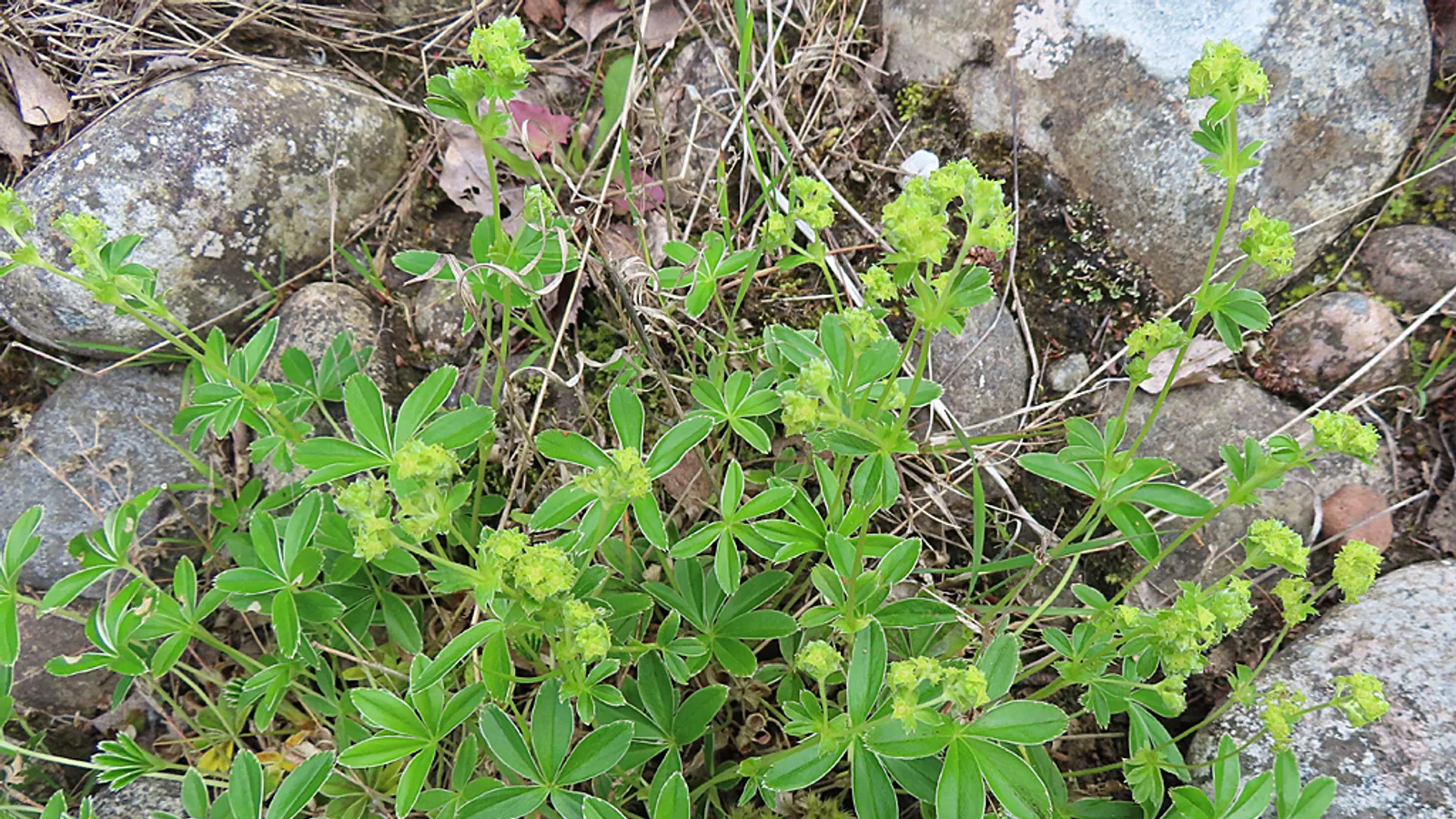

Alpine Lady's-mantle (Alchemilla alpina)
Contents
TL;DR
- established The genus name Alchemilla derives directly from the Arabic word for alchemy, reflecting a genuine medieval belief that the dewdrops collected in the plant's furrowed leaves and joined stipules held special, celestial properties, with alchemists incorporating this gathered water into potions and experimental work in pursuit of transformative substances — a specific, documented etymological and historical connection this article states directly rather than a vague claim that the plant has "mystical folklore."
- established Alpine lady's-mantle reproduces apomictically, meaning its seeds develop without being fertilised at all, a reproductive strategy that allows mutations to accumulate gradually across generations without the genetic reshuffling normal sexual reproduction would otherwise provide — a specific, documented biological mechanism this article names directly rather than a vague reference to the plant "self-seeding."
- established The plant's leaves are structurally distinctive: divided into around seven toothed, lance-shaped leaflets that are smooth on the upper surface but densely covered in silky hairs underneath, a structure this article names directly because it is the same physical feature responsible for both the plant's practical water-shedding ability and the alchemical dewdrop beliefs built around it.
- established Alpine lady's-mantle grows across a genuinely wide range of Scottish montane habitats, from moorland and alpine meadows to cliffs, stream banks, and areas covered by snow drifts through winter, reflecting real ecological flexibility within harsh upland conditions rather than dependence on one narrow habitat type — a specific, documented range this article states directly rather than a vague claim that the plant is "found in the mountains."
- established Alpine lady's-mantle's apomictic reproduction means that regional populations can accumulate distinct genetic differences over time purely through mutation, without needing cross-pollination to spread those changes. This is not unusual within the genus: most lady's-mantles reproduce the same way, which is why the common lady's-mantle is split into many near-identical microspecies.
Key Facts
- Scientific name
- Alchemilla alpina
- Category
- Flora
- Growth height
- 5–20cm
- Genus name origin
- Latin diminutive of alchimia (alchemy, from Arabic): "little alchemist"
- Reproduction
- Apomictic (seeds form without fertilisation)
- Flowering period
- June–September
- Flower structure
- Lime green; 4 sepals, no petals, 4 stamens, 1 carpel
- Key habitat range
- Moorland, alpine meadows, cliffs, stream banks, snow-bed ground
Scottish Impact Index (SI Score)
- Scottish Significance
- 7/10
- Ecological Persistence
- 7/10
- Ecological Importance
- 5/10
- Botanical Distinctiveness
- 8/10
- Conservation Significance
- 7/10
- Recognition
- 5/10
39/60
Ranked #45 of 45 in Flora
A Note on Claims and Evidence
Biology, leaf structure, apomictic reproduction, flowering, and habitat range details are drawn from the species' Wikipedia-summarised research record. The genus name's alchemical etymology and the specific medieval beliefs about dewdrops collected in the plant's leaves are drawn from published herbal-history sources citing Mrs. Grieve's historical herbal record.
Timeline
The genus Alchemilla acquires its name, derived from the Arabic word for alchemy, reflecting a genuine belief among medieval alchemists that the dewdrops collected in the plant's furrowed leaves and joined stipules held special, celestial properties; these gathered waters are incorporated into potions and experimental elixirs, with legendary claims attaching to the plant's use for purposes ranging from facial washing to transformative alchemical work.
Alpine lady's-mantle establishes itself as an arctic-montane perennial across northern Europe, the Alps, the Pyrenees, and southern Greenland, as well as across a wide range of Scottish montane habitats including moorland, alpine meadows, cliffs, stream banks, and snow-bed ground.
The plant flowers from June through September, producing lime-green flowers with four sepals, no petals, four stamens, and a single carpel, while reproducing apomictically, with seeds developing without fertilisation, a mechanism that allows gradual, cumulative genetic change to occur within populations without requiring cross-pollination.
Because apomictic reproduction bypasses normal sexual recombination, regional populations of alpine lady's-mantle can accumulate distinct genetic differences over time purely through mutation, a genuinely different evolutionary pathway from closely related, sexually reproducing plant species.
Alpine lady's-mantle remains a characteristic species of Scotland's montane flora, its distinctive silver-backed leaves and alchemical name-history persisting alongside its real, documented ecological flexibility across a range of harsh upland habitats.
Details
A name history traced to its real documented origin
This article names the genus Alchemilla's connection to alchemy with real specificity rather than a vague claim that the plant has "mystical folklore": the name derives directly from the Arabic word for alchemy, reflecting a genuine medieval belief that dewdrops collected in the plant's furrowed leaves and joined stipules held special, celestial properties, which alchemists incorporated into potions and experimental work. This article states this specific etymological and historical connection because it is a documented piece of naming history, not a loosely attached folk association.
A reproductive mechanism explained through its real biological process
This article names alpine lady's-mantle's reproduction precisely rather than a vague reference to the plant "self-seeding": it reproduces apomictically, meaning seeds develop without being fertilised at all, allowing mutations to accumulate gradually across generations without the genetic reshuffling that normal sexual reproduction would otherwise provide. This article states this mechanism directly because it represents a genuinely distinctive reproductive strategy with real evolutionary consequences, not an incidental detail of the plant's life cycle.
A leaf structure linking practical function and historical belief
This article names the specific structure of alpine lady's-mantle's leaves directly: divided into around seven toothed, lance-shaped leaflets, smooth above but densely covered in silky hairs underneath. This article states this structure because it is the same physical feature responsible both for the plant's practical ability to collect and shed water and for the alchemical dewdrop beliefs historically built around it, connecting the plant's biology directly to its documented cultural history rather than treating the two as unrelated facts.
A habitat range stated with its real documented breadth
This article names alpine lady's-mantle's Scottish habitat range with real specificity rather than a vague claim that the plant is "found in the mountains": it grows across moorland, alpine meadows, cliffs, stream banks, and areas covered by snow drifts through winter. This article states this range because it demonstrates genuine ecological flexibility within harsh upland conditions, not a narrow dependence on a single habitat type.
A genetic consequence of reproductive strategy, named directly
This article states plainly that alpine lady's-mantle's apomictic reproduction allows regional populations to accumulate distinct genetic differences over time purely through mutation, without needing cross-pollination to spread those changes, a genuinely different evolutionary pathway from sexually reproducing plants. This article names this consequence because treating all lady's-mantle populations as genetically uniform would misrepresent how apomictic reproduction actually shapes genetic variation within the species.
Correction. An earlier version of this article contrasted alpine lady's-mantle with a "fully sexually reproducing" wider genus. That is wrong. Apomixis is the rule among lady's-mantles, not the exception. Richard Mabey, in Flora Britannica (1996), describes the common lady's-mantle (Alchemilla vulgaris aggregate) as "a group of grassland species differing in only the smallest characteristics". Those many microspecies are the visible result of the same seed-without-sex reproduction described above.
Little alchemist, and Our Lady's Mantle
shared The name Alchemilla is usually explained as a Latin diminutive of alchimia, alchemy, a word that came into Latin from Arabic. Mabey renders it "little alchemist". So the Arabic connection is real but indirect, and the name itself was coined in Latin.
traditional Mabey gives the fullest account of why alchemists cared. Lady's-mantle leaves fold up overnight and catch the dew on their soft hairs. Plant dew was highly valued by early herbalists, and the alchemists wanted the purest dew for their attempts to turn base metals into gold. He writes that such a powerful and magical herb was "bound to be christianised", and some time in the late Middle Ages it was named Our Lady's Mantle, which became lady's-mantle. The scalloped leaves were likened to a cloak. Mabey's account is of the lowland lady's-mantles, but alpine lady's-mantle shares the name and the story.
traditional The same plants were prescribed as simples for wounds, infertility and impotence, Mabey records. These are traditional uses only, not medical advice, and they belong to the genus as a whole rather than to the alpine species in particular.
established Mabey notes that most native lady's-mantles do not occur at all in southern England. The group is a northern and upland one, and alpine lady's-mantle, abundant on Scottish hills, is the most mountainous of them.
Did You Know?
- The genus name Alchemilla comes directly from the Arabic word for alchemy, reflecting medieval beliefs about the plant's dewdrops.
- Alchemists historically believed dewdrops collected in the plant's leaves held special, celestial properties, and used them in potions and experimental elixirs.
- Alpine lady's-mantle reproduces without fertilisation at all, a process called apomixis.
- This reproductive strategy allows genetic mutations to accumulate gradually across generations without normal cross-pollination.
- Its leaves are smooth above but densely covered in silky hairs underneath — the same feature behind both its water-shedding ability and its alchemical reputation.
- The plant grows across a genuinely wide range of Scottish montane habitats, from moorland to cliffs to snow-bed ground.
- It flowers from June through September with small, petal-less lime-green flowers.
- Richard Mabey's Flora Britannica (1996) translates Alchemilla as "little alchemist".
- The English name comes from a late medieval christening of the plant as Our Lady's Mantle.
FAQ
1Why is the plant called "Alchemilla"?
The name comes from the Arabic word for alchemy, reflecting a medieval belief that dewdrops collected in its leaves held special, celestial properties used in alchemical potions.
2Does alpine lady's-mantle need pollination to produce seeds?
No — it reproduces apomictically, meaning its seeds develop without being fertilised at all.
3What does apomictic reproduction mean for the plant's genetics?
It allows mutations to accumulate gradually across generations without the genetic reshuffling normal sexual reproduction provides, letting regional populations diverge over time through mutation alone.
4Why are the plant's leaves hairy underneath?
This silky hair layer helps the plant shed water and is the same physical feature that gave rise to its historical dewdrop-collecting reputation.
5Where does alpine lady's-mantle grow in Scotland?
Across a wide range of montane habitats, including moorland, alpine meadows, cliffs, stream banks, and ground covered by winter snow drifts.
6When does it flower?
From June through September, with small, lime-green, petal-less flowers.
7Were the alchemical beliefs about this plant ever proven true?
No — they reflect genuine historical belief rather than demonstrated chemical or transformative properties; the dewdrops held no special alchemical power beyond their documented folkloric and herbal significance.
8Is apomixis unusual among lady's-mantles?
No. Most lady's-mantles set seed without fertilisation, which is why the common lady's-mantle is divided into many microspecies that differ, in Richard Mabey's words, in only the smallest characteristics.
9Where does the name "lady's-mantle" come from?
According to Richard Mabey's Flora Britannica (1996), the plant was christianised in the late Middle Ages as Our Lady's Mantle, the leaves being likened to a cloak.
10Was lady's-mantle used in medicine?
Traditionally, yes. Mabey records it was prescribed for wounds, infertility and impotence. These are historical uses, not advice.
Sources and Further Reading
Primary/Institutional
- Alchemilla alpina — Wikipedia
- British Wild Flower: Alchemilla alpina Alpine Lady's-mantle — UK Wildflowers
Scholarly/Critical
- Alpine Lady's Mantle — Royal Botanic Garden Edinburgh
- Richard Mabey, Flora Britannica (Sinclair-Stevenson, 1996).
- What Is In A Name: Lady's Mantle — Permies.com, citing Mrs. Grieve's "A Modern Herbal"
General
Caveats: Myths and Disputed Claims
- Clarification: This article does not present the historical alchemical beliefs about the plant's dewdrops as demonstrated fact; they are documented as genuine medieval belief and folk practice, not confirmed chemical or transformative properties.
- Note: This article does not treat all Alchemilla populations as genetically uniform; apomictic reproduction allows regional populations to diverge through accumulated mutation over time.
- Do not describe the wider Alchemilla genus as sexually reproducing; apomixis is widespread across it.
- Do not treat the traditional uses of lady's-mantle for wounds or fertility as medical advice.
Card 026 · Flora