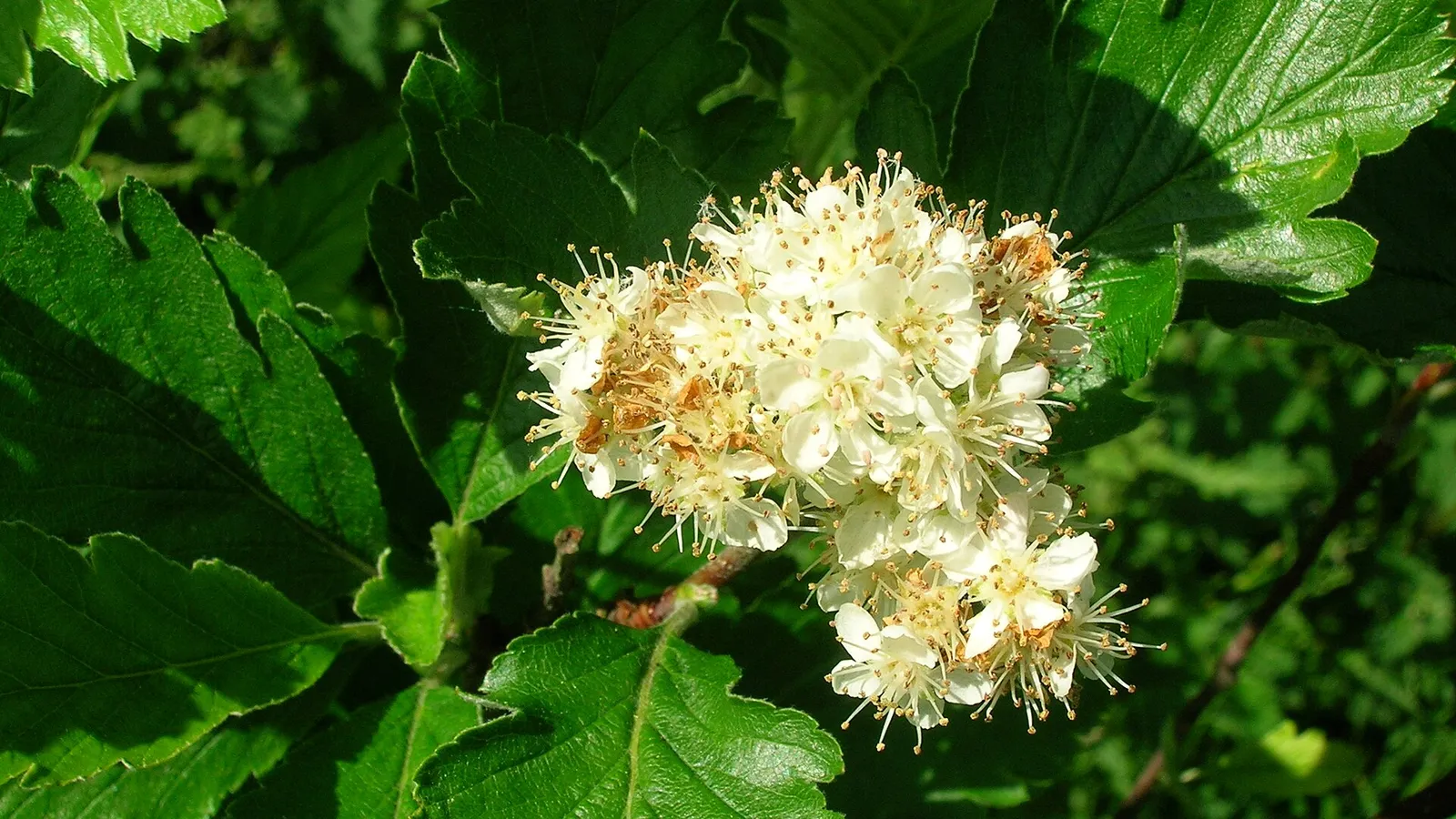

Arran Whitebeams (Sorbus arranensis / S. pseudofennica / S. pseudomeinichii)
Contents
TL;DR
- established Three distinct whitebeam species are found nowhere on Earth except the Isle of Arran, all originating through a documented chain of hybridisation between rowan and rock whitebeam — a specific, traceable evolutionary origin this article states directly rather than a vague claim of uniqueness.
- established The rarest of the three, the Catacol whitebeam (Sorbus pseudomeinichii), was collected in 1949 but misidentified, and was not formally recognised and described as its own species until 2006 — a specific, documented 57-year gap between collection and recognition this article states directly.
- established As of recent surveys, only a single individual Catacol whitebeam is known to survive in the wild, after a second nearby specimen disappeared, making it among the rarest trees on Earth by any reasonable measure — a specific, stark figure this article states plainly rather than a vague description of scarcity.
- established All three species reproduce through agamospermy, a form of asexual seed production in which offspring are genetic clones of the parent rather than the product of sexual recombination — a specific, documented reproductive mechanism this article names directly, because it means wild population recovery through natural reproduction alone is considered unlikely without active human intervention.
- established Historical sheep grazing reduced these species to steep slopes and inaccessible rocky crevices, the only places young trees could escape browsing — a specific, documented historical cause of their restricted modern range this article states directly, rather than treating their precarious cliff-ledge locations as simply their natural preferred habitat.
Key Facts
- Scientific names
- Sorbus arranensis, S. pseudofennica, S. pseudomeinichii
- Category
- Endemics
- Global range
- Isle of Arran only
- Core sites
- Glen Diomhan, Glen Catacol (SSSI)
- Mature trees recorded (1980)
- 283 (S. arranensis), 236 (S. pseudofennica)
- Known wild Catacol whitebeam (recent)
- 1 individual
- Reproduction
- Agamospermy (asexual seed production)
Scottish Impact Index (SI Score)
- Scottish Significance
- 10/10
- Ecological Persistence
- 6/10
- Ecological Importance
- 7/10
- Botanical Distinctiveness
- 10/10
- Conservation Significance
- 10/10
- Recognition
- 7/10
50/60
Ranked #18 of 45 in Flora
A Note on Claims and Evidence
Hybrid origin, taxonomic history, and 1980 population figures are drawn from published botanical sources, including Wikipedia's summarised research record. The Catacol whitebeam's 1949 misidentified collection, its 2006 formal description, its single-surviving-individual status, and Royal Botanic Garden Edinburgh's conservation and propagation efforts are drawn directly from the Royal Botanic Garden Edinburgh's own published account.
Timeline
A tetraploid rock whitebeam, itself derived from common whitebeam, interbreeds with rowan on Arran, giving rise to Sorbus arranensis; further hybridisation between S. arranensis and rowan subsequently produces S. pseudofennica.
Swedish botanist Johan Hedlund formally identifies two of the three Arran whitebeam species.
A specimen later recognised as a third, distinct species is collected but misidentified at the time.
Sheep grazing across Arran reduces whitebeam populations to steep slopes and rocky crevices, the only locations offering young trees protection from browsing.
A survey records 283 mature S. arranensis and 236 mature S. pseudofennica trees.
Richard Mabey's Flora Britannica names S. pseudofennica the "Arran service-tree", places it on the granite banks of Glen Catacol, and counts the Arran trees among 14 local British whitebeam endemics.
The 1949 specimen is formally described as a new species, the Catacol whitebeam (Sorbus pseudomeinichii), 57 years after its original, misidentified collection.
Two Catacol whitebeam specimens are known in the wild.
Only one of these specimens remains locatable, the second having disappeared.
The Royal Botanic Garden Edinburgh undertakes seed germination (with limited success), grafting onto rowan rootstock, and cultivation in botanic garden collections to secure the species' future outside its precarious wild location.
All three Arran whitebeam species remain confined entirely to the island, protected at key sites including the Glen Catacol SSSI, with the Catacol whitebeam surviving in the wild as a single known individual.
Details
An origin traced through a specific, documented hybrid chain
This article states the Arran whitebeams' evolutionary history with real specificity rather than a vague claim of uniqueness: a tetraploid rock whitebeam, itself derived from common whitebeam, interbred with rowan to produce Sorbus arranensis, which subsequently hybridised again with rowan to produce S. pseudofennica. This article names this chain directly because it represents a genuinely traceable, documented evolutionary pathway, not an unexplained botanical curiosity.
A species recognised only after decades of delay
This article states a specific, striking historical detail directly: the Catacol whitebeam was collected in 1949 but misidentified, and was not formally described as its own distinct species until 2006, 57 years later. This article names this gap because it illustrates how recently our scientific understanding of even this small island's unique flora has continued to develop, rather than treating all three species as having been equally well known from the start.
A rarity stated with its real, stark scale
This article presents the Catacol whitebeam's wild population with its actual documented figure: as few as a single known individual, following the disappearance of a second nearby specimen. This article states this number directly because it represents one of the starkest rarity figures of any tree species on Earth, a precision considerably more informative than a general description of scarcity.
A reproductive mechanism explaining the limits of natural recovery
This article names the mechanism behind these species' reproduction with real specificity: agamospermy, a form of asexual seed production in which offspring are genetic clones of the parent rather than products of sexual recombination. This article states this mechanism directly because it clarifies precisely why wild population recovery through natural means alone is considered unlikely — without active intervention such as cultivation and grafting, a single remaining wild individual has no means of producing genetically recombined offspring, let alone sufficient genetic diversity for long-term resilience.
A restricted range explained by its real historical cause
This article states plainly that these species' confinement to steep slopes and rocky crevices is not simply their natural habitat preference: historical sheep grazing across Arran eliminated young trees everywhere except inaccessible terrain where browsing animals could not reach them. This article names this cause directly because it clarifies that the species' precarious, cliff-bound modern distribution reflects a documented historical pressure, not an original ecological niche.
How Flora Britannica placed them in 1996
established One of Britain's "neighbourhood" trees. Richard Mabey, in Flora Britannica (1996), treats the Arran trees as part of a wider pattern. He calls the whitebeam family "remarkable for producing highly local endemic species", often confined to single rocky gorges, and notes that Stace's flora then listed 14 such Sorbus species across England, Scotland and Wales. The other 12 are scattered through the Avon Gorge, the Wye Valley, the Brecon limestone crags, north Devon and Lancashire. Arran is the only Scottish site on his list, which makes the island the northern outpost of a very British botanical oddity.
established The 1996 descriptions. Mabey gives S. pseudofennica the English name "Arran service-tree" and describes it as confined to steep granite banks in Glen Catacol. He describes S. arranensis as more widely distributed on steep stream-banks on the island. He adds that most of these local species were still "in need of local English names", which helps explain why the Arran trees have gone by several names since. His account predates the 2006 description of the Catacol whitebeam, so it covers only two Arran species.
established Names and fruit. Mabey notes that "whitebeam" means simply "white tree", from the felted white undersides of the leaves, and that the name came into use only in the eighteenth century. He also records that the fruits of these local species become edible once "bletted", softened by frost or keeping, as with the wild service-tree. That is a historical note on the genus, not a suggestion that anyone should pick fruit from trees this rare.
Did You Know?
- In 1996 Richard Mabey listed Arran as the only Scottish home of Britain's 14 "neighbourhood" whitebeam species, all of them confined to a few rocky sites.
- All three Arran whitebeam species are found nowhere on Earth except the Isle of Arran.
- They originated through a documented chain of hybridisation between rowan and rock whitebeam.
- The Catacol whitebeam was collected in 1949 but misidentified, and wasn't formally recognised as its own species until 2006.
- As few as a single wild individual Catacol whitebeam is known to survive, making it among the rarest trees on Earth.
- All three species reproduce asexually, meaning offspring are genetic clones of their parent trees.
- Historical sheep grazing confined these trees to steep slopes and rocky crevices, the only places young trees could escape browsing.
- The Royal Botanic Garden Edinburgh propagates the species through grafting and cultivation to secure their future.
FAQ
1How many Arran whitebeam species are there?
Three: Sorbus arranensis, S. pseudofennica, and the much rarer S. pseudomeinichii (Catacol whitebeam).
2Are they found anywhere else in the world?
No — all three are found nowhere on Earth except the Isle of Arran.
3How did they originate?
Through documented hybridisation: rock whitebeam crossed with rowan to produce S. arranensis, which crossed again with rowan to produce S. pseudofennica.
4How rare is the Catacol whitebeam?
Extremely — as few as a single wild individual is currently known, after a second specimen disappeared.
5Why was it only recognised as a species in 2006?
A specimen was collected in 1949 but misidentified; it wasn't formally described as its own distinct species until 2006.
6Can these trees reproduce normally?
No — they reproduce through agamospermy, asexual seed production that creates genetic clones rather than recombined offspring, limiting natural population recovery.
7Why do these trees grow on such precarious, steep terrain?
Historical sheep grazing eliminated young trees everywhere except inaccessible slopes and crevices where browsing animals couldn't reach them.
8What is being done to conserve them?
The Royal Botanic Garden Edinburgh propagates the species through seed germination, grafting onto rowan rootstock, and cultivation in botanic garden collections.
9Are there other trees like this elsewhere in Britain?
Yes. Richard Mabey's Flora Britannica (1996) counted 14 highly local whitebeam species in Britain, most on limestone gorges and crags in England and Wales. Arran was the only Scottish site on his list.
10What does "whitebeam" mean?
"White tree", from the white felt on the underside of the leaves. Mabey notes the name only came into use in the eighteenth century.
Sources and Further Reading
Primary/Institutional
- Arran's unique trees — Royal Botanic Garden Edinburgh
- Arran Whitebeam (Sorbus arranensis) — Woodland Trust
Scholarly/Critical
- Arran whitebeams — Wikipedia
- Hedlundia pseudomeinichii (Catacol whitebeam) — Wikipedia
- Richard Mabey, Flora Britannica (Sinclair-Stevenson, 1996).
General
Caveats: Myths and Disputed Claims
- Clarification: This article does not treat all three Arran whitebeam species as equally rare or equally long-recognised; the Catacol whitebeam's single-wild-individual status and its late 2006 formal description are specific to that species alone.
- Do not read the 1996 Flora Britannica account as a current census: it predates the recognition of the Catacol whitebeam in 2006 and names only two Arran species.
- Note: This article does not describe the trees' steep, cliff-bound locations as their original preferred habitat; this distribution is documented as a consequence of historical sheep grazing eliminating young trees elsewhere.
Card 003 · Flora