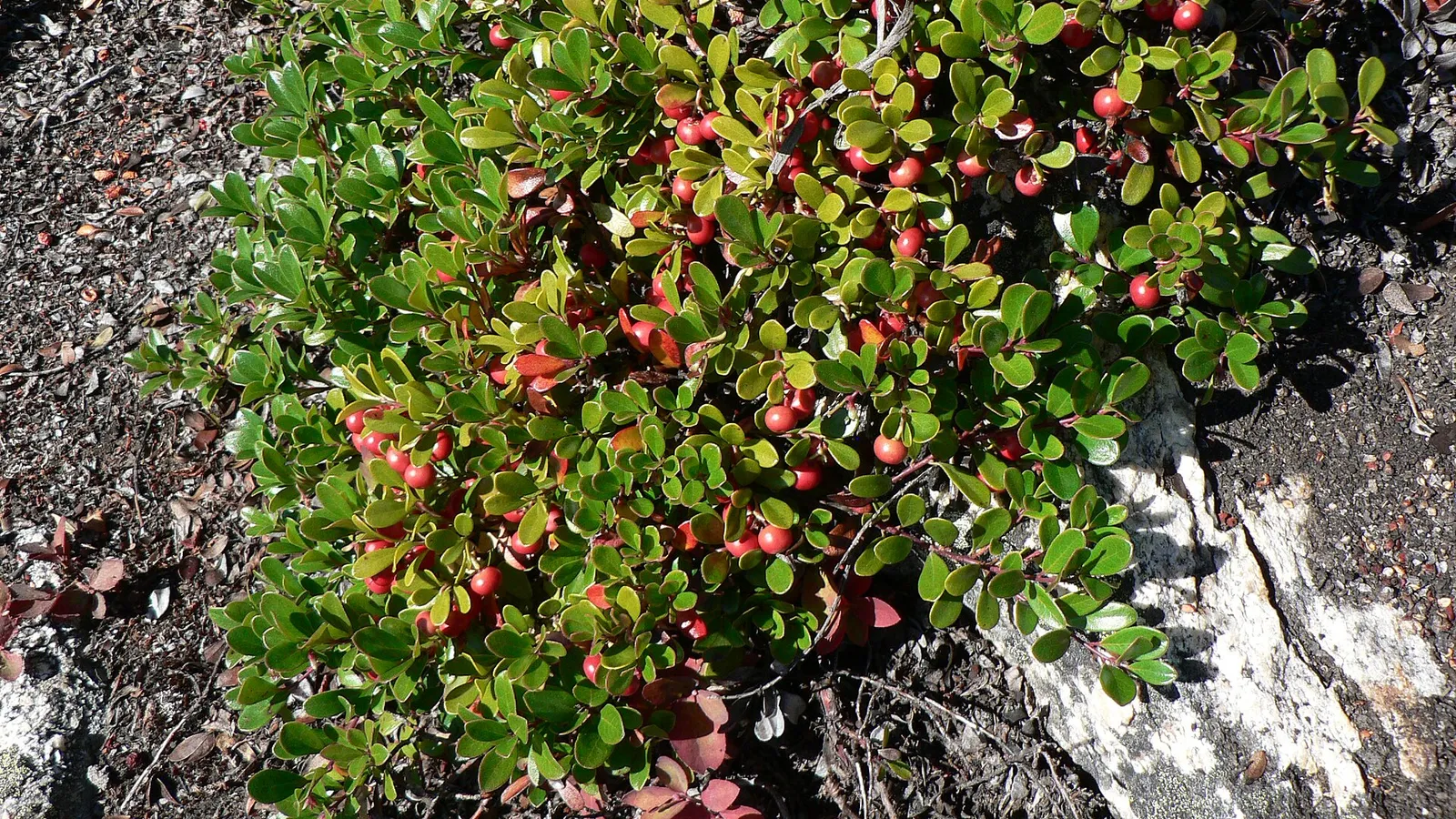

Bearberry (Arctostaphylos uva-ursi)
Contents
TL;DR
- established Bearberry leaves contain arbutin, a compound that can make up as much as 17% of the leaf's dry weight and is traditionally used as a urinary tract antiseptic and diuretic, but which metabolises in the body into hydroquinone, a compound with potential liver toxicity at high doses — this article states both the traditional use and its real documented safety caveat directly rather than presenting the plant's medicinal reputation without its genuine risk.
- established As of 2017, no high-quality clinical research evidence confirmed that bearberry-based urinary tract treatments are effective or safe, a specific, documented gap between traditional use and confirmed modern clinical evidence this article states directly rather than presenting bearberry's traditional medicinal reputation as clinically validated.
- established Bearberry is one of two recognised plant badges of Clan Ross, alongside juniper, a specific, documented Scottish clan symbol this article names directly rather than treating the plant's cultural significance as unattached to any particular clan.
- established Historically, dried bearberry leaves were mixed with tobacco, other herbs, or dogwood bark to create "kinnikinnick," a traditional smoking mixture used by Indigenous peoples of North America and early European settlers, a specific, documented practical use this article names directly rather than a vague reference to the plant's "traditional uses."
- established Bearberry is both fire-tolerant and seed-banking, meaning its seeds can persist dormant in the soil and the plant can recover after fire, while its deep root system makes it an effective natural groundcover for erosion control on exposed hillsides — a specific, documented ecological resilience mechanism this article states directly rather than a vague claim that the plant is simply "hardy."
Key Facts
- Scientific name
- Arctostaphylos uva-ursi
- Category
- Flora
- Growth height
- 5–30cm
- Flowering period
- May–June
- Key compound
- Arbutin (up to ~17% of leaf dry weight)
- Clan badge
- Clan Ross (alongside juniper)
- Traditional smoking use
- Key ingredient in kinnikinnick
- Clinical evidence status (2017)
- No high-quality evidence of efficacy/safety
A Note on Claims and Evidence
Biology, chemical composition, the arbutin/hydroquinone safety profile, the 2017 clinical evidence gap, kinnikinnick smoking-mixture history, dye use, and fire-tolerant/seed-banking ecology are drawn from Wikipedia's published research record. The Clan Ross plant badge association is drawn from Wikipedia's published record of Scottish clan plant badges.
Timeline
Bearberry establishes itself as a low-growing, evergreen, fire-tolerant shrub across subarctic and northern temperate regions, including Scotland, its deep root system stabilising exposed hillside soil and its seeds able to persist dormant in the soil to allow recovery after fire.
Indigenous peoples of North America and early European settlers develop "kinnikinnick," a smoking mixture made from dried bearberry leaves combined with tobacco, other herbs, or dogwood bark; separately, Indigenous traditional medicine uses bearberry leaf teas and extracts as urinary tract antiseptics, diuretics, and laxatives, while the plant's leaves are also used to produce yellow dye; in Scotland, bearberry becomes established as one of two recognised plant badges of Clan Ross, alongside juniper.
Clinical research review finds no high-quality evidence confirming that bearberry-based urinary tract treatments are effective or safe, establishing a documented gap between the plant's long traditional medicinal reputation and confirmed modern clinical evidence.
Bearberry remains present across Scotland's uplands and the wider circumboreal Northern Hemisphere, classified as Secure overall by NatureServe though rare or endangered in some regions, its documented traditional uses, real safety caveats, and Clan Ross symbolism all part of the current record, alongside its continued use as an ornamental groundcover.
Details
A traditional remedy named alongside its real, documented risk
This article names bearberry's traditional medicinal use directly rather than presenting its reputation without caveat: its leaves contain arbutin, making up as much as 17% of dry leaf weight, traditionally used as a urinary tract antiseptic and diuretic, but which metabolises in the body into hydroquinone, a compound with potential liver toxicity at high doses. This article states both halves of this picture because presenting the traditional use without its documented safety risk would misrepresent the plant's real pharmacological profile.
A gap between tradition and clinical evidence stated plainly
This article states directly that, as of 2017, no high-quality clinical research evidence confirmed bearberry-based urinary tract treatments as effective or safe, rather than presenting the plant's traditional medicinal reputation as clinically validated. This article names this specific evidence gap because it is the real, documented state of the clinical research record, not an assumption that long traditional use equates to confirmed modern efficacy.
A clan symbol named with its real specific attribution
This article states directly that bearberry is one of two recognised plant badges of Clan Ross, alongside juniper, rather than treating the plant's cultural significance as unattached to any particular clan. This article names this specific attribution because it is the real, documented clan association, not a general reference to Scottish plant symbolism.
A practical historical use named with its real specific practice
This article names bearberry's role in "kinnikinnick," the traditional smoking mixture made from dried bearberry leaves combined with tobacco, other herbs, or dogwood bark, directly rather than a vague reference to the plant's "traditional uses." This article states this specific practice because it represents a genuine, documented historical application distinct from the plant's medicinal and dye uses.
A resilience mechanism explained through its real ecological traits
This article names the specific traits behind bearberry's ecological resilience rather than a vague claim that the plant is simply "hardy": it is both fire-tolerant and seed-banking, meaning its seeds can persist dormant in the soil, while its deep root system makes it effective for erosion control on exposed hillsides. This article states these specific traits because they represent genuine, documented ecological mechanisms, not a general impression of toughness.
How a 1980s herbal saw it, and what has changed
established Richard Mabey's The Complete New Herbal (1988) gives a fuller chemistry for the leaves: arbutin at about 8 per cent, with methyl arbutin, flavonoids, allantoin, tannins, phenolic acids, a volatile oil and resin. It describes bearberry as a diuretic herb used in medieval medicine, and explains that arbutin is converted in the body to hydroquinone. The book warns that long-term use may be toxic, because hydroquinone is poisonous in large doses. It nonetheless calls normal use safe. That reassurance has not aged well. Later reviews found no high-quality evidence of either safety or effectiveness, and the herbal's own warning about hydroquinone is the stronger part of its account. The same herbal notes that heather contains arbutin too, which is why the two plants share a traditional reputation.
Names that dismiss it
established Richard Mabey, in Flora Britannica (1996), gives bearberry a single line: a locally common shrub of rocky moorland in northern Britain, whose shiny red berries are "sharp but edible". He adds that the black fruits of the rarer mountain bearberry, Arctostaphylos alpina, are edible too. He records no medicinal or other folk use in Britain.
established Peter Marren's appendix on Scottish plant names in the same book is more revealing. He had only known it called bearberry, but lists older names that may no longer be in use: dogberry, gnashacks and rapperdandie, and the Gaelic grainnseag. In his view "the names all imply uselessness". That suggests bearberry was not valued as a food plant in Scotland. The kinnikinnick smoking mixture described above is a North American tradition, and neither Mabey nor Marren records a Scottish folk use of the leaves.
Did You Know?
- Old Scots names for bearberry include gnashacks and rapperdandie, and its Gaelic name is grainnseag, according to Peter Marren's appendix in Flora Britannica (1996).
- Marren judged that all of bearberry's Scottish names "imply uselessness".
- Scotland also has the rarer mountain bearberry, Arctostaphylos alpina, which has black fruit.
- Heather, bearberry's moorland neighbour, also contains arbutin, which is why the two share a traditional herbal reputation.
- Bearberry leaves contain arbutin, traditionally used as a urinary tract antiseptic — but the compound breaks down in the body into a substance with potential liver toxicity at high doses.
- As of 2017, no high-quality clinical research confirmed that bearberry-based urinary treatments are actually effective or safe.
- Bearberry is one of two recognised plant badges of Clan Ross, alongside juniper.
- Dried bearberry leaves were historically mixed with tobacco or other herbs to make "kinnikinnick," a traditional smoking mixture.
- Indigenous peoples also used the plant's leaves to produce a yellow dye.
- Bearberry is both fire-tolerant and seed-banking, letting it recover after fire from seeds that persist dormant in the soil.
- Its deep root system makes it a genuinely effective natural groundcover for stabilising exposed hillside soil.
FAQ
1Is bearberry safe to use medicinally?
Not without real caution — its active compound, arbutin, breaks down into a substance with potential liver toxicity at high doses, and as of 2017 no high-quality clinical evidence confirmed its traditional urinary tract use as safe or effective.
2Which Scottish clan uses bearberry as a symbol?
Clan Ross, which recognises both bearberry and juniper as plant badges.
3What is kinnikinnick?
A traditional smoking mixture made from dried bearberry leaves combined with tobacco, other herbs, or dogwood bark.
4Was bearberry used for anything besides medicine and smoking?
Yes — its leaves were also used to produce a yellow dye.
5How does bearberry survive wildfire?
It's both fire-tolerant and seed-banking, meaning dormant seeds in the soil allow it to recover and regrow after fire.
6Does bearberry help prevent soil erosion?
Yes — its deep root system makes it an effective natural groundcover on exposed hillsides.
7Did older herbals consider bearberry safe?
Richard Mabey's The Complete New Herbal (1988) called normal use safe while warning that long-term use could be toxic. Later reviews found no high-quality evidence of safety or effectiveness, so the older reassurance should not be relied on. Nothing here is health advice.
8What are the Scots and Gaelic names for bearberry?
Peter Marren's appendix in Flora Britannica (1996) lists dogberry, gnashacks and rapperdandie, and the Gaelic grainnseag. He thought most may no longer be in everyday use.
9Can you eat bearberries?
Richard Mabey described the berries as sharp but edible. The Scottish names suggest they were not prized. This is not foraging advice.
10Is bearberry rare?
Overall it's classified as Secure by NatureServe, though it is rare or endangered in some specific regions.
Sources and Further Reading
Primary/Institutional
Scholarly/Critical
- Uva Ursi — PeaceHealth clinical monograph
- Spotlight on Bearberry (Arctostaphylos uva-ursi) — Botanic Biosciences
- Richard Mabey (ed.), The Complete New Herbal (Elm Tree Books, 1988).
Specialist
- Richard Mabey, Flora Britannica (Sinclair-Stevenson, 1996), including Peter Marren's appendix on Scottish vernacular plant names.
General
Caveats: Myths and Disputed Claims
- Clarification: This article does not present bearberry's traditional urinary tract remedy use as clinically confirmed; as of 2017, no high-quality clinical evidence supported its effectiveness or safety, and its active compound carries a documented liver-toxicity risk at high doses.
- Note: This article does not treat bearberry as symbolically tied to only one clan plant badge; Clan Ross recognises both bearberry and juniper.
- Do not rely on older herbals' assurances that normal medicinal use of bearberry is safe. The 1988 Complete New Herbal said so, but later reviews found no high-quality evidence of safety or effectiveness. This article is not health advice.
- Do not present kinnikinnick as a Scottish custom. It is a North American tradition, and the Scottish names for the plant suggest it was little used here.
Card 048 · Flora