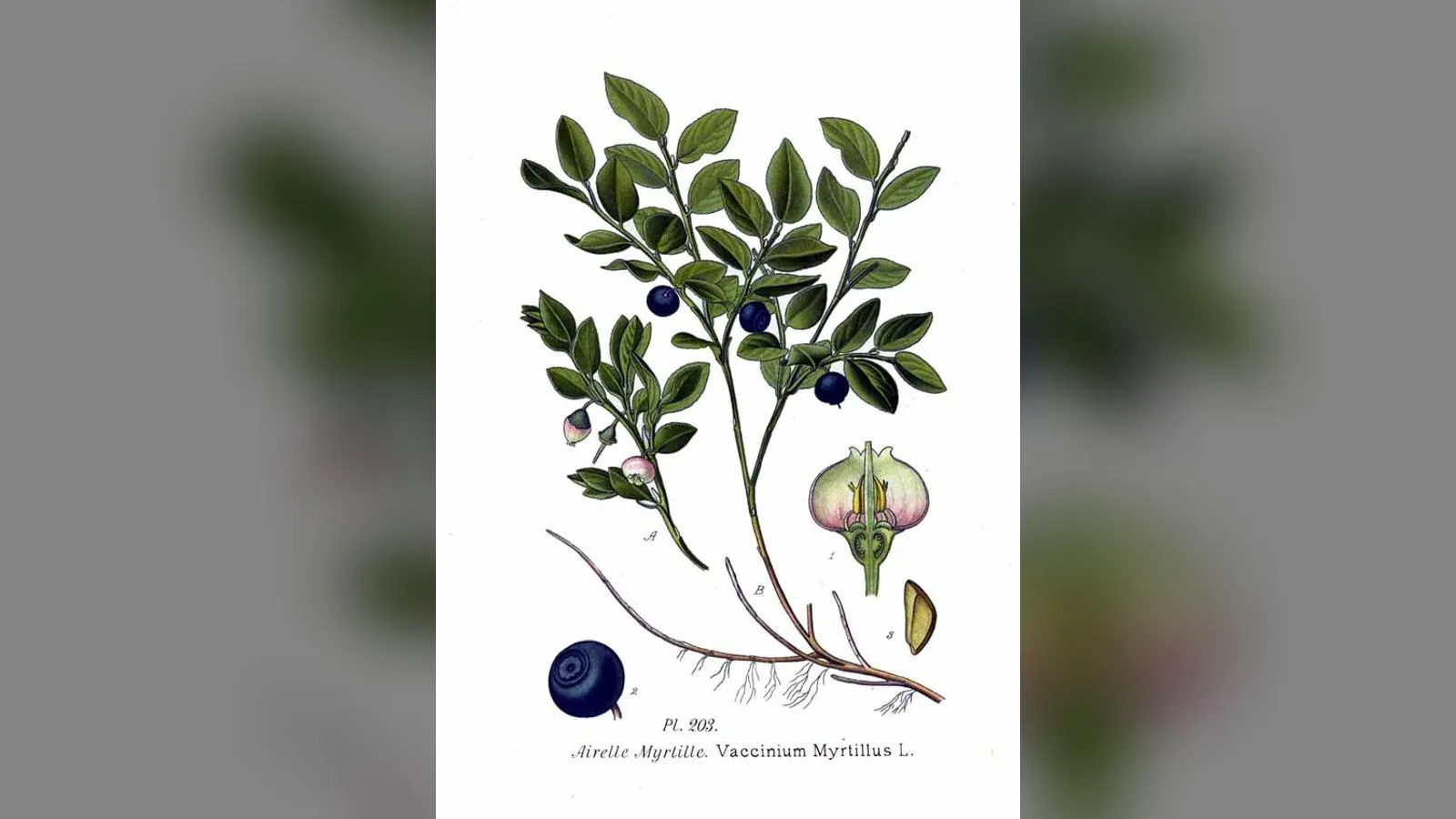

Blaeberry (Vaccinium myrtillus)
Contents
TL;DR
- established Blaeberry's role in traditional Scottish life extended well beyond food: its juice was used as a dye, producing blue with alum or copperas, dark brown with nut-galls, and purple-red or violet with other mordant combinations, making it one of the principal dyestuffs of Highland Gaelic tradition — a specific, documented range of dye colours this article states directly rather than a vague reference to "traditional uses."
- established Blaeberry is foundational to capercaillie survival in the Caledonian Forest: the birds depend on its stems and buds through winter, its foliage in spring and summer, and, critically, on the insects that feed on blaeberry plants as the near-essential food source for capercaillie chicks — a specific, documented, multi-stage ecological dependency this article names directly rather than a vague claim that capercaillie "eat berries."
- established Blaeberry also supports red grouse, ptarmigan, and black grouse through browsing, and provides berries eaten by pine martens and wood mice, making it a genuinely foundational food-web species across several of Scotland's most significant upland and woodland birds and mammals, not a resource used by any single species alone.
- established The plant reaches its greatest size specifically within birchwoods and pinewoods of Scotland's native forest, favouring shady conditions beneath the tree canopy on acid soils, and occurs across an elevation range from sea level up to 1,250 metres — a specific, documented habitat preference this article states directly rather than a vague description of "moorland and woodland."
- established Three centuries of combined forest loss and intensive sheep grazing have historically reduced blaeberry's flowering and fruiting capacity across much of Scotland, directly limiting the food resource available to the species that depend on it — a specific, documented historical cause this article states plainly, while noting that current Caledonian Forest regeneration efforts and renewed interest in wild food harvesting represent genuine, if partial, recent recovery momentum.
Key Facts
- Scientific name
- Vaccinium myrtillus
- Also known as
- Bilberry
- Category
- Pinewood
- Key dependent species
- Capercaillie, red grouse, ptarmigan, black grouse, pine marten, wood mouse
- Elevation range
- Sea level to 1,250m
- Preferred habitat
- Shaded woodland floor, acid soils; largest in birchwoods and pinewoods
- Historical uses
- Food, dye (blue, brown, purple-red, violet), traditional herbal remedy
- Primary historical pressure
- 300 years of forest loss and sheep grazing
Scottish Impact Index (SI Score)
- Scottish Significance
- 9/10
- Ecological Persistence
- 9/10
- Ecological Importance
- 8/10
- Botanical Distinctiveness
- 7/10
- Conservation Significance
- 7/10
- Recognition
- 8/10
48/60
Ranked =22nd of 45 in Flora
A Note on Claims and Evidence
Ecological dependency details, including the specific mechanism of capercaillie chick reliance on blaeberry-feeding insects, habitat range, and the historical decline cause, are drawn from Trees for Life's published assessment. Dye-use details, including the specific colours produced by different mordant combinations, are drawn directly from the published record of traditional Scottish Highland dyes.
Timeline
Blaeberry establishes itself as a foundational understorey species of Scotland's native birchwoods and pinewoods, supporting a wide range of dependent wildlife and providing food, dye, and traditional herbal remedies for Highland communities.
Blaeberry becomes one of the principal dyestuffs of Highland tradition, its juice processed with different mordants to produce blue, dark brown, purple-red, or violet dyes for textiles.
Sustained forest loss combined with intensive sheep grazing reduces blaeberry's flowering and fruiting capacity across much of Scotland, directly constraining the food resource available to capercaillie, grouse species, and other dependent wildlife.
Synthetic dyes largely supersede traditional plant dyes including blaeberry, reducing the practical use of the plant's historical dye-making role.
Caledonian Forest regeneration initiatives work to restore native pinewood and birchwood habitat, with blaeberry recognised as a key component of genuine forest recovery, alongside renewed public interest in wild food harvesting.
Blaeberry remains a foundational food-web species across Scotland's surviving native woodlands and moorlands, its health directly tied to the fortunes of capercaillie and other dependent species.
Details
A dye plant with its real, specific range of colours
This article names blaeberry's traditional use as a dye with real specificity rather than a vague reference to "traditional uses": its juice produced blue when processed with alum or copperas, dark brown with nut-galls, and purple-red or violet with other mordant combinations, making it one of the principal dyestuffs of Highland Gaelic tradition. This article states this specific range of colours because it reflects a genuine, documented, technically varied craft practice, not a single simple dye.
A capercaillie dependency explained through its real, multi-stage mechanism
This article names the plant's relationship with Scotland's capercaillie population with real mechanistic precision rather than a vague claim that the birds "eat berries": capercaillie depend on blaeberry stems and buds through winter, its foliage in spring and summer, and, critically, on the insects that feed on blaeberry plants as a near-essential food source for capercaillie chicks. This article states this multi-stage dependency directly because it clarifies that blaeberry's importance to capercaillie survival operates through several distinct pathways across the bird's life cycle, not a single straightforward food source.
A foundational role extending well beyond any single species
This article states plainly that blaeberry's ecological importance is not confined to capercaillie alone: red grouse, ptarmigan, and black grouse browse the plant directly, while pine martens and wood mice consume its berries. This article names these additional dependent species because it demonstrates blaeberry's genuine status as a foundational food-web component across several of Scotland's most significant upland and woodland species, not a resource associated with one headline bird alone.
A habitat preference stated with its real specificity
This article names blaeberry's preferred growing conditions precisely rather than a vague description of "moorland and woodland": shaded conditions beneath the tree canopy on acid soils, reaching its greatest size specifically within birchwoods and pinewoods of Scotland's native forest, and occurring across an elevation range from sea level to 1,250 metres. This article states these specific conditions because they clarify exactly where and why the plant thrives most, rather than treating its presence across varied upland habitats as uniform.
A historical decline cause named directly, with honest recent context
This article states plainly that blaeberry's reduced flowering and fruiting capacity across much of Scotland has a specific, documented historical cause: roughly three centuries of combined forest loss and intensive sheep grazing. This article names this cause directly because it clarifies that the plant's reduced abundance in many areas reflects sustained historical land-use pressure, not a natural baseline, while also noting that current forest regeneration efforts and renewed wild food interest represent genuine, though still partial, recent recovery momentum.
What Flora Britannica records
established Richard Mabey, in Flora Britannica (1996), places bilberry's favoured habitats on acid heaths and moors in the northern and western uplands, and as an understorey in Scottish pinewoods. That matches the habitat described above. He notes that the fruit is virtually unknown in cultivation, so almost every bilberry eaten in Britain has been picked wild, much of it on hands and knees because the berries hide under the leaves.
established The book's appendix on Scottish plant names, by the naturalist Peter Marren, says that in Scotland bilberry "is always blaeberry". It gives two Gaelic names, lus nan dearc and lus nan braoileag, and calls the plant "a dye plant as well as a feast". That supports the dye tradition described above. Blae is the Scots word for blue-black or livid blue, the colour of the ripe fruit.
shared Mabey's picking customs come almost entirely from England, Wales and the Isle of Man: "Whort Sunday" in Devon, family picking on the Welsh borders, and the Manx custom of gathering on the first Sunday in August. One Shropshire contributor told him that berries sold to dealers were sent away mainly for dye. The book records no comparable Scottish picking festival. That does not mean Scots did not gather blaeberries, only that his correspondents did not describe it.
Did You Know?
- In Gaelic, blaeberry is lus nan dearc or lus nan braoileag, according to Peter Marren's appendix in Flora Britannica (1996).
- Bilberries are almost never cultivated: the commercial blueberry is a larger American species.
- Blaeberry's juice was historically used as a dye, producing blue, dark brown, purple-red, or violet depending on the mordant used.
- Capercaillie depend on blaeberry in multiple ways across their life cycle: stems and buds in winter, foliage in spring and summer, and insects that feed on the plant as a near-essential food source for chicks.
- Red grouse, ptarmigan, and black grouse also browse blaeberry, while pine martens and wood mice eat its berries.
- The plant reaches its greatest size specifically within Scotland's native birchwoods and pinewoods.
- It grows across a huge elevation range, from sea level up to 1,250 metres.
- Roughly three centuries of forest loss and sheep grazing have historically reduced its flowering and fruiting capacity across much of Scotland.
- Blaeberry was also used traditionally as a herbal remedy for digestive problems and diabetes.
FAQ
1Is blaeberry the same as bilberry?
Yes — "blaeberry" is the Scots name for the same plant known as bilberry elsewhere in Britain.
2What was blaeberry used for historically?
Food, a traditional dye producing blue, brown, purple-red, or violet depending on processing, and herbal remedies for digestive problems and diabetes.
3Why is blaeberry important to capercaillie?
In several distinct ways across their life cycle — as winter food (stems and buds), spring and summer foliage, and as host plant for the insects capercaillie chicks depend on.
4Do other species depend on blaeberry too?
Yes — red grouse, ptarmigan, and black grouse browse it directly, while pine martens and wood mice eat its berries.
5Where does blaeberry grow best in Scotland?
In shaded conditions beneath the canopy in birchwoods and pinewoods on acid soils, reaching its greatest size there.
6What caused its historical decline in parts of Scotland?
Roughly three centuries of combined forest loss and intensive sheep grazing, which reduced its flowering and fruiting capacity.
7Is blaeberry recovering today?
Partially — Caledonian Forest regeneration initiatives and renewed interest in wild food harvesting offer genuine, if still partial, recovery momentum.
8What elevation range does it grow at?
From sea level up to 1,250 metres.
9What is blaeberry called in Gaelic?
Peter Marren's appendix in Flora Britannica (1996) gives lus nan dearc and lus nan braoileag.
10Is the blaeberry the same as the shop blueberry?
No. The commercial blueberry is a larger American species, Vaccinium corymbosum. Richard Mabey notes that the wild bilberry is virtually unknown in cultivation.
Sources and Further Reading
Primary/Institutional
Specialist
- Richard Mabey, Flora Britannica (Sinclair-Stevenson, 1996), including Peter Marren's appendix on Scottish vernacular plant names.
Scholarly/Critical
- Traditional dyes of the Scottish Highlands — Wikipedia
- PROJECT BLAEBERRY — Fiona Sinclair, Reforesting Scotland
General
Caveats: Myths and Disputed Claims
- Clarification: This article does not describe blaeberry's importance to capercaillie as a single simple food source; it operates through several distinct mechanisms across the bird's life cycle, including a critical insect-host role for chicks.
- Note: This article does not treat blaeberry's reduced abundance in many areas as a natural baseline; it is documented as the result of roughly three centuries of combined forest loss and sheep grazing pressure.
- Do not confuse the wild blaeberry with the cultivated blueberry, a separate American species.
Card 010 · Flora