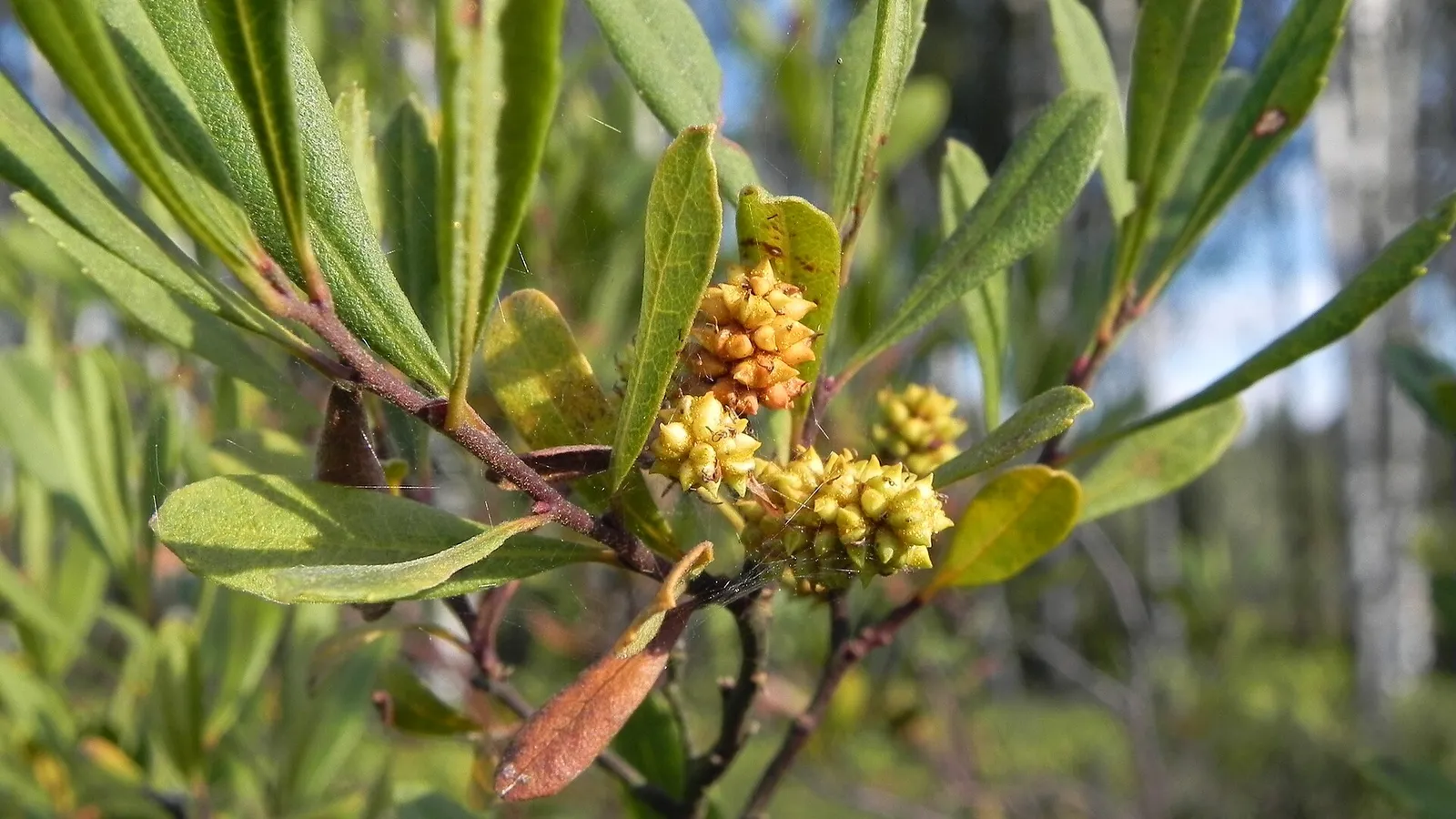

Bog Myrtle (Myrica gale)
Contents
TL;DR
- established Bog myrtle is an actinorhizal plant, meaning its roots form nitrogen-fixing nodules through symbiosis with Frankia bacteria, allowing it to enrich the nutrient-poor, waterlogged soils it grows in and enable ecological succession by making the ground suitable for more nutrient-demanding species afterward — a specific, documented ecological mechanism this article states directly rather than a vague claim that the plant "improves the soil."
- established Bog myrtle supports almost 70 species of leaf-eating insects, including a large number of moth caterpillars, a specific, documented scale of biodiversity support this article names directly rather than a vague claim that the plant "supports wildlife."
- established Traditional folklore held that bog myrtle repels biting insects, including the Highland midge, and this claim has recently been confirmed through scientific testing of oil extracted from the plant — a specific, documented case of folk knowledge being scientifically verified this article states directly rather than treating the repellent claim as either unproven tradition or settled modern science without acknowledging its folk origin.
- established Bog myrtle served as a key ingredient in gruit, the mix of herbs used to flavour and preserve beer across parts of northern Europe before the widespread adoption of hops, a specific, documented historical role in brewing this article names directly rather than a vague reference to the plant's "traditional uses."
- established Bog myrtle, or wild myrtle, is the traditional plant badge of Clan Campbell, reflecting the plant's abundance in Argyll, the clan's historical territory, despite the plant actually dropping its leaves each winter — a specific, documented detail about the badge's seasonal character this article states directly rather than presenting the plant badge as evergreen or year-round in appearance.
Key Facts
- Scientific name
- Myrica gale
- Also known as
- Sweet gale
- Category
- Flora
- Growth height
- 60–150cm
- Key ecological partner
- Frankia bacteria (nitrogen fixation)
- Insect species supported
- ~70
- Clan badge
- Clan Campbell
- Historical brewing use
- Key gruit ingredient (pre-hops northern Europe)
Scottish Impact Index (SI Score)
- Scottish Significance
- 9/10
- Ecological Persistence
- 8/10
- Ecological Importance
- 8/10
- Botanical Distinctiveness
- 9/10
- Conservation Significance
- 8/10
- Recognition
- 9/10
51/60
Ranked =9th of 45 in Flora
A Note on Claims and Evidence
Biology, nitrogen-fixing ecology, insect-support figures, and the scientific confirmation of midge-repellent properties are drawn from Trees for Life's published assessment. Gruit brewing history is drawn from published herbal brewing history sources. The Clan Campbell plant badge connection, including the detail about the plant's winter leaf drop, is drawn from the Wikipedia-summarised record of Scottish clan plant badges.
Timeline
Bog myrtle establishes itself across wet, acidic ground throughout Scotland, particularly in the west and Highlands, its root nodules forming a nitrogen-fixing symbiosis with Frankia bacteria that enriches nutrient-poor, waterlogged soils and enables ecological succession, supporting almost 70 species of leaf-eating insects including numerous moth caterpillars.
Bog myrtle becomes a key ingredient in gruit, the mix of herbs used to flavour and preserve beer across parts of northern Europe, before hops become the dominant brewing herb across the region.
Highland communities develop a folk belief that bog myrtle repels biting insects, including the midge, leading to its traditional use as an insect deterrent; separately, bog myrtle, or wild myrtle, becomes established as the traditional plant badge of Clan Campbell, reflecting the plant's abundance in the clan's historical territory of Argyll.
Scientific testing of oil extracted from bog myrtle confirms the plant's traditional insect-repellent reputation, verifying a specific folk claim rather than simply repeating it.
Bog myrtle remains a characteristic species of Scotland's wet Highland and western ground, its documented ecological, historical, and cultural significance spanning soil enrichment, insect biodiversity support, confirmed repellent properties, brewing history, and continued use as a clan symbol.
Details
A soil-enrichment mechanism explained through its real biological process
This article names the mechanism behind bog myrtle's role in soil fertility precisely rather than a vague claim that the plant "improves the soil": its roots form nitrogen-fixing nodules through symbiosis with Frankia bacteria, enriching nutrient-poor, waterlogged ground and enabling ecological succession by making the soil suitable for more nutrient-demanding species afterward. This article states this specific mechanism because it is the real, documented biological process behind the plant's wider ecological significance, not an assumed general benefit.
A biodiversity contribution stated with its real documented scale
This article names bog myrtle's support for insect life with real specificity rather than a vague claim that the plant "supports wildlife": almost 70 species of leaf-eating insects, including a large number of moth caterpillars. This article states this precise figure because it demonstrates a genuinely measured ecological significance, not a general impression of the plant's usefulness to insects.
A folk claim stated honestly as scientifically confirmed
This article names bog myrtle's midge-repellent reputation directly as traditional folklore that has since been scientifically confirmed through testing of oil extracted from the plant, rather than treating the claim as either unproven old wives' tale or settled science with no folk origin. This article states both halves of this history because the claim's real documented status, folklore now verified by research, is more precise than either extreme on its own.
A brewing history named with its real specific role
This article states bog myrtle's place in historical brewing directly rather than a vague reference to the plant's "traditional uses": it served as a key ingredient in gruit, the herb mixture used to flavour and preserve beer across parts of northern Europe before hops became the dominant brewing herb. This article names this specific historical role because it represents a genuine, documented place in European brewing history, not an incidental culinary curiosity.
A clan badge named with its real seasonal detail
This article names bog myrtle's status as the traditional plant badge of Clan Campbell directly, reflecting the plant's abundance in the clan's historical territory of Argyll, while also stating that the plant actually drops its leaves each winter. This article includes this seasonal detail because it clarifies that the badge plant is not evergreen, correcting an assumption a reader might otherwise make about a plant used as a year-round symbol.
Fleawood: an older household use
traditional Richard Mabey's The Complete New Herbal (1988) records that bog myrtle, or sweet gale, carried the old country name of fleawood. It was laid among linen to scent it and to drive out fleas. This fits the same aromatic oil that lies behind the plant's reputation against midges. The herbal calls bog myrtle a "rarer" plant and suggests commoner moth repellents such as wormwood instead. That view reflects a lowland English perspective. On the wet western and Highland ground of Scotland, bog myrtle is widespread and often abundant.
Bog myrtle in Flora Britannica
established Richard Mabey, in Flora Britannica (1996), describes bog myrtle as a shrub of wet, acid heath and moor found "chiefly in Scotland, North Wales and north-west England", with outlying colonies further south. That supports the caveat below about older herbals calling it rare. He notes that the scent of a large colony can carry hundreds of yards, and that the plant is rarely browsed.
established Peter Marren's appendix on Scottish plant names in the same book says that in Scotland bog myrtle is usually just "myrtle", and also gall, gale or Scotch gale. He gives the Gaelic roid as an ancient name still in use.
established Two Sutherland contributors gave Mabey Highland uses. Mary Beith of Melness, with Bridie Pursey of Elphin, reported that on Islay and Jura it was used as a garnish for food and stored with linen to drive away moths and scent the cloth. Kathleen MacLeod Rodger of Elphin told him that sachets of it among clothes and blankets smell "as delightful as that of lavender", that moths avoid it, and that some people, especially anglers, wear a sprig in a buttonhole against midges. Elsewhere in Britain, Mabey records its use to scent candles and to flavour home-made "gale beer", which is consistent with the gruit history above.
shared Mabey also records the first commercial midge repellent made from the plant. In 1995 a product called "Myrica" came on the market, made by steam-distilling wild bog myrtle gathered by crofters on Skye. In its first trial, eight volunteers had one arm treated with a gel of the oil and the other left bare. Over ten minutes the untreated arms received 155 bites and the treated arms 13. That was a small trial, but it is early evidence for the folk claim discussed above. More recent testing should be preferred where it exists.
Did You Know?
- In 1995 crofters on Skye supplied wild bog myrtle for the first commercial midge repellent made from the plant.
- In a small 1995 trial, arms treated with bog-myrtle oil received 13 midge bites in ten minutes; untreated arms received 155.
- Anglers in Sutherland wore a sprig of bog myrtle in a buttonhole against midges, a contributor told Richard Mabey.
- In Scotland the plant is often just called "myrtle"; its Gaelic name is roid.
- An old country name for bog myrtle is fleawood: it was laid among linen to scent it and keep fleas away.
- Bog myrtle's roots host nitrogen-fixing bacteria, letting it enrich poor, waterlogged soil and pave the way for other plants to follow.
- It supports almost 70 species of leaf-eating insects, including many moth caterpillars.
- Traditional folklore claimed bog myrtle repels biting insects like the midge — and recent scientific testing has confirmed this.
- The plant was a key ingredient in gruit, the herb mix used to flavour and preserve beer before hops became dominant in northern Europe.
- Bog myrtle, or wild myrtle, is the traditional plant badge of Clan Campbell, reflecting its abundance in Argyll.
- Despite its use as a clan symbol, bog myrtle actually drops its leaves every winter.
- The plant's leaves and fruit carry yellowish glands that secrete an aromatic oil, giving it a distinctive sweet smell.
FAQ
1Does bog myrtle really repel midges?
Yes — traditional folklore claimed this, and recent scientific testing of oil extracted from the plant has confirmed the repellent effect.
2How does bog myrtle improve the soil it grows in?
Through nitrogen-fixing nodules on its roots, formed in symbiosis with Frankia bacteria, which enrich nutrient-poor, waterlogged ground and allow other plants to establish afterward.
3How many insect species depend on bog myrtle?
Almost 70 species of leaf-eating insects, including many moth caterpillars.
4What was bog myrtle used for in brewing?
It was a key ingredient in gruit, the herb mixture used to flavour and preserve beer across parts of northern Europe before hops became dominant.
5Which Scottish clan uses bog myrtle as its plant badge?
Clan Campbell, reflecting the plant's abundance in the clan's historical territory of Argyll.
6Is bog myrtle evergreen, since it's used as a clan badge?
No — despite its symbolic use, the plant actually drops its leaves every winter.
7Why does bog myrtle smell distinctive?
Yellowish glands on its leaves and fruit secrete an aromatic oil, giving it a characteristic sweet smell.
8What is bog myrtle called in Scotland?
Usually just "myrtle", and also gall, gale or Scotch gale. The Gaelic name is roid, according to Peter Marren's appendix in Flora Britannica (1996).
9How was bog myrtle used in Highland homes?
Contributors from Sutherland told Richard Mabey it was stored with linen against moths, used as a garnish on Islay and Jura, and worn in a buttonhole against midges.
10When was the first bog-myrtle midge repellent sold?
In 1995, made from wild plants gathered by crofters on Skye.
11Why was bog myrtle called fleawood?
Richard Mabey's The Complete New Herbal (1988) records that it was used to scent linen and drive out fleas, which gave it that old country name.
Sources and Further Reading
Primary/Institutional
Scholarly/Critical
- Bog Myrtle: A rich history and growing body of research — Highland Soaps
- Myrica gale L., Bog-myrtle — BSBI species account
- Richard Mabey (ed.), The Complete New Herbal (Elm Tree Books, 1988).
Specialist
- Richard Mabey, Flora Britannica (Sinclair-Stevenson, 1996), including Peter Marren's appendix on Scottish vernacular plant names.
General
Caveats: Myths and Disputed Claims
- Clarification: This article does not treat bog myrtle's midge-repellent reputation as unverified folklore; recent scientific testing has specifically confirmed this traditional claim.
- Note: This article does not present the Clan Campbell plant badge as evergreen or symbolically year-round in appearance; bog myrtle actually drops its leaves every winter.
- Do not take general herbals' description of bog myrtle as a "rare" plant as true of Scotland. It is uncommon in much of lowland England but widespread on wet, acid ground in western and Highland Scotland.
- Do not treat the 1995 ten-minute trial of eight volunteers as proof on its own. It supports the folk claim but was small.
Card 036 · Flora