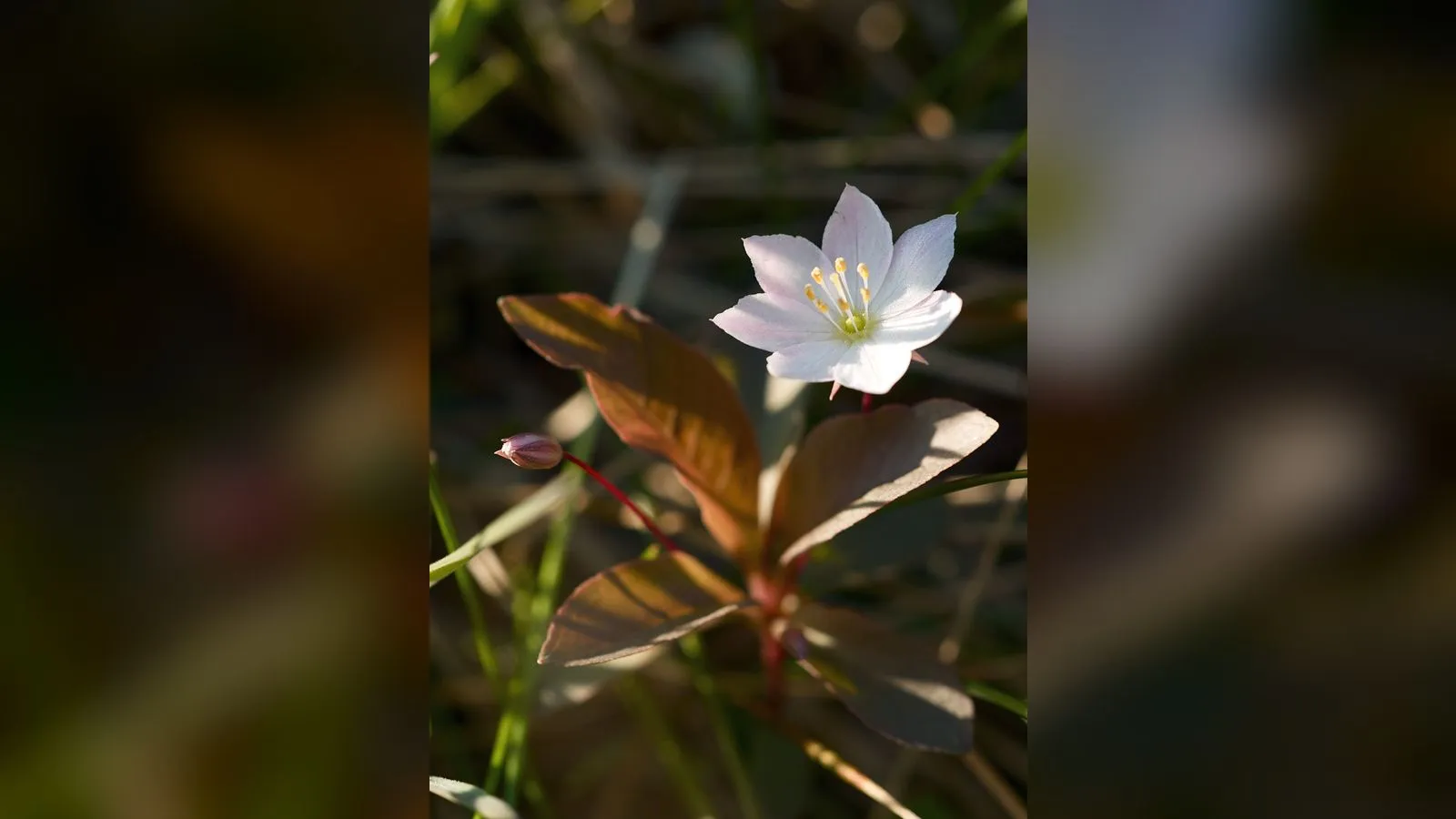

Chickweed Wintergreen (Lysimachia europaea, syn. Trientalis europaea)
Contents
TL;DR
- established Despite its common name, chickweed wintergreen is neither a true chickweed nor a true wintergreen: chickweeds belong to the pink family (Caryophyllaceae) and wintergreens to the heather family (Ericaceae), while this species belongs to the primrose family (Primulaceae) — a specific, documented taxonomic mismatch this article states directly rather than letting the folk name imply a botanical relationship that does not exist.
- established The species has recently been reclassified from its long-familiar genus Trientalis into Lysimachia, the loosestrife genus, reflecting updated genetic understanding of its true relationships within the primrose family — a specific, documented recent taxonomic shift this article names directly rather than treating the plant's scientific name as fixed and unchanging.
- established Where most flowering plants build their flowers from parts in multiples of five, chickweed wintergreen typically produces flowers with six to eight petals, an unusual departure from the standard floral plan that gives the plant its distinctive, star-like appearance — a specific, documented structural trait this article states directly rather than a vague description of "a pretty white flower."
- established The species spreads aggressively through underground rhizomes during the growing season, forming extensive clonal populations interconnected beneath the soil, and produces overwintering tubers that allow it to persist through the dormant season — a specific, documented growth mechanism this article names directly rather than a vague reference to the plant "spreading."
- established Within the UK, the species is notably absent from Ireland, Wales, and most of central and southern England, surviving in only scattered northern English populations, while in Scotland it remains a genuinely common plant of heather moorland and pine woods — a specific, documented uneven UK distribution this article states directly rather than treating the species as uniformly rare across Britain.
Key Facts
- Scientific name
- Lysimachia europaea (syn. Trientalis europaea)
- Category
- Pinewood
- Family
- Primulaceae (primrose family)
- Petal count
- Typically 6–8 (not the standard 5)
- UK status
- Common in Scotland; largely absent from Ireland, Wales, central/southern England
- Key habitat
- Heather moorland and pine woods
- Reproduction
- Clonal spread via rhizomes; overwintering tubers
- Typical height
- Up to ~20cm
Scottish Impact Index (SI Score)
- Scottish Significance
- 8/10
- Ecological Persistence
- 7/10
- Ecological Importance
- 6/10
- Botanical Distinctiveness
- 8/10
- Conservation Significance
- 8/10
- Recognition
- 5/10
42/60
Ranked =43rd of 45 in Flora
A Note on Claims and Evidence
Taxonomic classification, recent genus reclassification, petal count, and geographic range details are drawn from the species' Wikipedia-summarised research record. UK and Scottish distribution and habitat details are drawn from published UK wildflower reference sources.
Timeline
The species is long classified under the genus Trientalis, a name meaning "one-third of a foot," reflecting its small stature.
The plant establishes itself as a characteristic species of Scottish heather moorland and pine woodland, spreading clonally through underground rhizomes and persisting through winter via overwintering tubers, while remaining largely absent from Ireland, Wales, and most of central and southern England.
Updated molecular evidence leads to the species' reclassification from Trientalis into Lysimachia, the loosestrife genus, reflecting a revised understanding of its true relationships within the primrose family.
The species, now formally Lysimachia europaea though still widely known by its common names and former scientific name, remains a genuinely common plant across Scottish moorland and pinewood habitats, distinct in distribution from its scarcity across much of the rest of Britain.
Details
A name that misrepresents the plant's real taxonomic position
This article states directly that chickweed wintergreen's common name is genuinely misleading rather than letting it imply a botanical relationship that does not exist: true chickweeds belong to the pink family, Caryophyllaceae, and true wintergreens to the heather family, Ericaceae, while this species belongs to the primrose family, Primulaceae. This article names these three distinct plant families because the common name's dual misnomer is a specific, correctable point of confusion, not a minor technicality.
A taxonomic reclassification stated as a recent, real change
This article states plainly that the species' scientific name has recently changed, from the long-familiar Trientalis europaea to Lysimachia europaea, reflecting updated genetic evidence about its true relationships within the primrose family. This article names this shift directly because scientific names are not permanently fixed labels; they are revised as genetic and taxonomic understanding improves, and treating the older name as the only correct one would misrepresent current botanical classification.
A flower structure genuinely unusual among flowering plants
This article names the species' floral structure with real specificity: typically six to eight petals, a departure from the five-part floral plan followed by most flowering plants. This article states this precise range because it is the specific structural trait underlying the plant's distinctive, star-like flower, not an incidental detail of appearance.
A growth mechanism explained with real precision
This article names the species' reproductive and persistence strategy mechanistically rather than vaguely: aggressive clonal spread through underground rhizomes during the growing season, connecting multiple apparent "individual" plants beneath the soil as a single interconnected clone, combined with the production of overwintering tubers that allow the plant to persist through the dormant season. This article states this mechanism directly because it clarifies that a patch of chickweed wintergreen may represent far fewer genetically distinct individuals than its visible spread suggests.
A distribution stated honestly as uneven, not uniformly rare
This article presents the species' UK range with real geographic precision rather than a blanket claim of scarcity: notably absent from Ireland, Wales, and most of central and southern England, with only scattered populations in northern England, while remaining a genuinely common plant across Scottish heather moorland and pine woods. This article states this uneven pattern directly because the species' status differs sharply depending on which part of Britain is being discussed.
Did You Know?
- Chickweed wintergreen is neither a true chickweed nor a true wintergreen — it belongs to the primrose family instead.
- Its scientific name has recently changed from Trientalis europaea to Lysimachia europaea, reflecting updated genetic classification.
- Unlike most flowering plants, which build flowers in multiples of five, this species typically has six to eight petals.
- It spreads through underground rhizomes, meaning a visible patch of plants may actually be one interconnected clone.
- It produces overwintering tubers that allow it to survive the dormant season underground.
- The species is largely absent from Ireland, Wales, and most of central and southern England, but is genuinely common across Scottish moorland and pinewood.
- Its old genus name, Trientalis, means "one-third of a foot," a reference to its small stature.
FAQ
1Is chickweed wintergreen related to chickweed or wintergreen?
No — despite its name, it belongs to the primrose family, unrelated to true chickweeds (pink family) or true wintergreens (heather family).
2Why has its scientific name changed?
Updated genetic research reclassified it from Trientalis europaea into Lysimachia europaea, reflecting a revised understanding of its true family relationships.
3How many petals does its flower have?
Typically six to eight, unlike the five-part structure of most flowering plants.
4How does it spread?
Through underground rhizomes, forming interconnected clonal patches, with overwintering tubers allowing it to persist through winter.
5Is it common in Scotland?
Yes — it's a genuinely common plant of heather moorland and pine woods in Scotland, despite being largely absent from Ireland, Wales, and most of central and southern England.
6What habitat does it prefer?
Heather moorland and pine woodland, typically in Scotland and scattered parts of northern England.
7How tall does it grow?
Up to around 20cm — it's a small, easily overlooked plant.
8What does its old genus name mean?
Trientalis means "one-third of a foot," a reference to the plant's small stature.
Sources and Further Reading
Caveats: Myths and Disputed Claims
- Clarification: This article does not treat "chickweed wintergreen" as an accurate description of the plant's botanical relationships; it belongs to neither the chickweed family nor the wintergreen family.
- Note: This article does not treat the species' scientific name as permanently fixed; Lysimachia europaea reflects a recent reclassification from the long-familiar Trientalis europaea, and both names remain in current use.
Card 009 · Flora