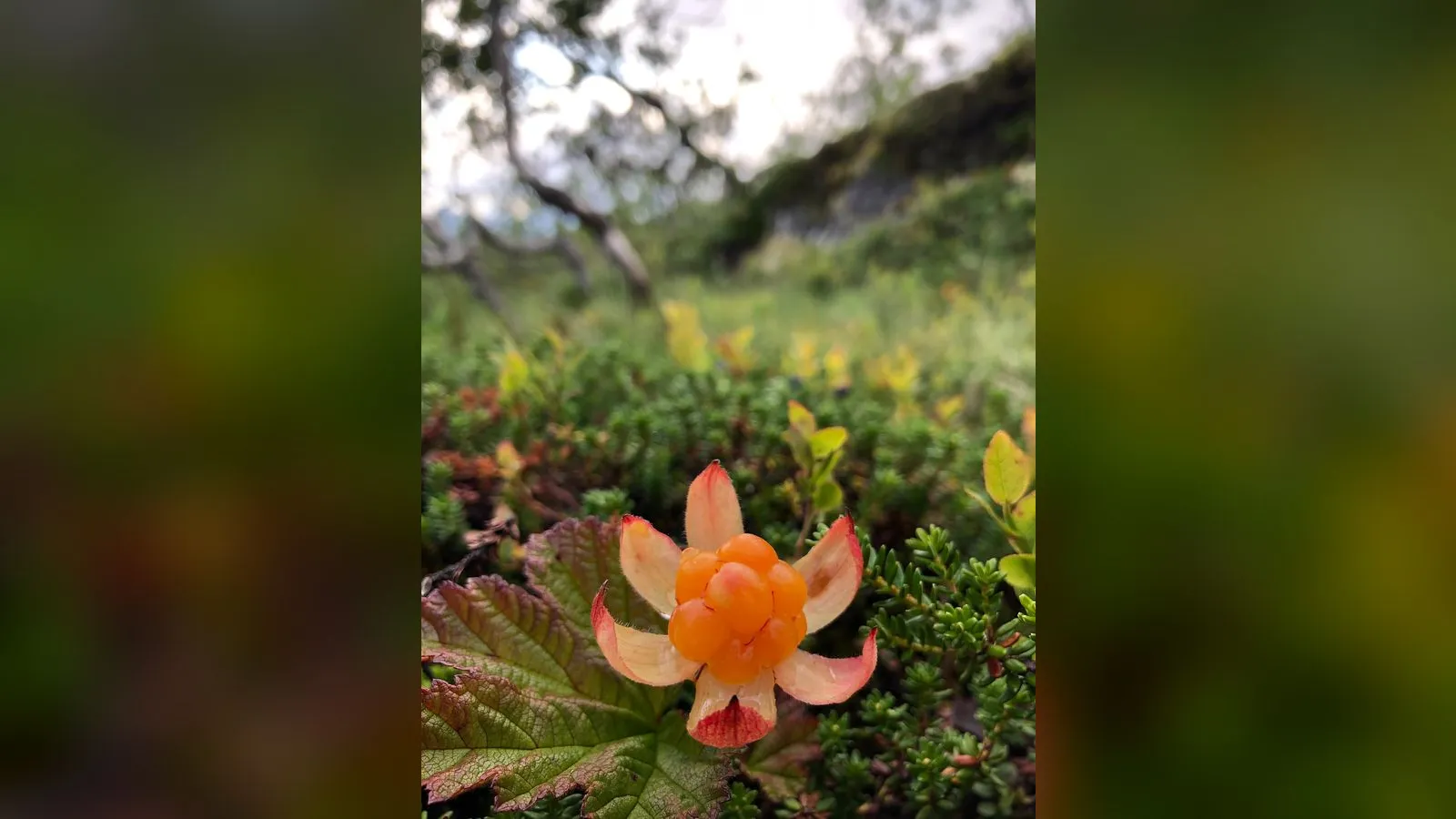

Cloudberry (Rubus chamaemorus)
Contents
TL;DR
- shared Cloudberry is genuinely restricted within the UK. It is a plant of mountain bogs and moors from Derbyshire and North Wales northwards, with its main British stronghold in the Scottish Highlands, and a single, fragile population survives in Northern Ireland's Sperrin Mountains. An earlier version of this article listed only the Pennines, the Highlands and Northern Ireland; Richard Mabey's Flora Britannica (1996) also places it in North Wales, and its Borders name, noop, shows it in the south of Scotland too.
- established A Scottish hill, Beinn nan Oighreag, takes its Gaelic name directly from the plant, translating as "Hill of the Cloudberries" — a specific, documented piece of linguistic and cultural evidence this article names directly because it demonstrates that cloudberry held genuine local significance precisely where it grows, not an incidental place-name curiosity.
- established Unlike most other Rubus species, cloudberry is dioecious, with separate male and female plants, meaning female plants require pollination from a nearby male plant to produce fruit, while the species also spreads vegetatively through rhizomes that can extend 10 metres or longer underground — a specific, documented reproductive mechanism this article states directly rather than a vague reference to the plant "spreading."
- established Cloudberries are rich in vitamin C, and Viking-era seafarers are documented to have preserved and carried the fruit on long voyages specifically to help prevent scurvy, a practical nutritional use that predates the berry's modern reputation as a luxury food — a specific, documented historical use this article names directly rather than treating cloudberry's cultural value as always having been purely prestige-driven.
- established Each cloudberry plant produces only a single fruit during a brief harvesting window in July, and the difficulty of collecting them across remote, often boggy Arctic terrain means frozen cloudberries can cost several hundred dollars for just a few pounds in weight, with one Nordic chef describing the fruit as "the gold of berries" — a specific, documented scale of modern scarcity and value this article states directly rather than a vague claim that cloudberries are "prized."
Key Facts
- Scientific name
- Rubus chamaemorus
- Category
- Flora
- Growth height
- 10–25cm
- Reproduction
- Dioecious (separate male/female plants); rhizomes to 10m+
- UK distribution
- Mountain bogs from Derbyshire and North Wales northwards, chiefly the Scottish Highlands; 1 site in Northern Ireland
- Scots and Gaelic names
- Aivrons, averin, noop (Borders), knoutberry; Gaelic lus nan eighreag
- Key habitat
- Acidic bogs, marshes, wet moorland, sphagnum-rich ground
- Historical use
- Vitamin C source, scurvy prevention (Viking era onward)
- Harvest window
- Brief, in July; one fruit per plant
Scottish Impact Index (SI Score)
- Scottish Significance
- 8/10
- Ecological Persistence
- 6/10
- Ecological Importance
- 6/10
- Botanical Distinctiveness
- 9/10
- Conservation Significance
- 8/10
- Recognition
- 7/10
44/60
Ranked =33rd of 45 in Flora
A Note on Claims and Evidence
Biology, reproduction, UK distribution, and habitat details are drawn from the species' Wikipedia-summarised research record. Viking-era scurvy-prevention history and modern Nordic scarcity and value details are drawn from published reporting on cloudberry's Scandinavian cultural and culinary significance.
Timeline
Cloudberry establishes itself across acidic bogs, marshes, wet meadows, and tundra in Britain's cooler, wetter uplands, becoming restricted to mountain bogs from Derbyshire and North Wales northwards, chiefly in the Scottish Highlands, with one fragile population in Northern Ireland's Sperrin Mountains; in Scotland, the plant's local significance is reflected directly in the Gaelic name of Beinn nan Oighreag, "Hill of the Cloudberries."
Norse seafarers preserve and carry cloudberries on long voyages specifically for their high vitamin C content, using the fruit as a practical defence against scurvy during extended expeditions, long before the berry acquires its modern reputation as a luxury food.
Cloudberry reproduces via separate male and female plants, with female plants requiring pollination from a nearby male to set fruit, while the species also spreads vegetatively through rhizomes extending 10 metres or more underground; each plant produces only a single fruit, harvested during a brief window in July.
Cloudberries remain a genuinely scarce, highly valued fruit across Scandinavia, where difficult harvesting conditions in remote, often boggy Arctic terrain keep supply limited and frozen cloudberries commanding several hundred dollars for just a few pounds, while in Scotland the species survives as a restricted, specialised component of Highland bog and moorland flora.
Details
A Scottish rarity stated with its real documented scale
This article names cloudberry's British distribution with real specificity rather than a vague claim that the plant is "uncommon": it occurs on mountain bogs and moors from Derbyshire and North Wales northwards, with its main British stronghold in the Scottish Highlands, and a single, fragile population surviving in Northern Ireland's Sperrin Mountains. This article states this precise, restricted distribution because it demonstrates a genuinely narrow range, not a general impression of upland rarity. Mabey's summary dates from 1996; current BSBI maps should be preferred for present detail.
A place-name connection naming the plant's real local significance
This article states directly that a Scottish hill, Beinn nan Oighreag, takes its Gaelic name from cloudberry, translating as "Hill of the Cloudberries." This article names this specific linguistic evidence because it demonstrates that the plant held genuine, documented local importance to the people who named the landscape around it, not an incidental or decorative place-name detail.
A reproductive mechanism explained through its real structure
This article names cloudberry's reproduction precisely rather than a vague reference to the plant "spreading": unlike most other Rubus species, it is dioecious, with separate male and female plants, meaning female plants require pollination from a nearby male to produce fruit, while the species also spreads vegetatively through rhizomes extending 10 metres or more underground. This article states this mechanism directly because it clarifies both why cloudberry stands apart biologically from its closest relatives and why isolated female plants may fail to fruit without a male plant nearby.
A practical historical use predating the berry's modern prestige
This article names cloudberry's Viking-era use directly rather than treating its cultural value as always having been purely prestige-driven: seafarers preserved and carried the vitamin C-rich fruit on long voyages specifically to help prevent scurvy. This article states this practical, documented historical use because it demonstrates that cloudberry's value began as a genuine nutritional necessity, not as a luxury food item from the outset.
A modern scarcity stated with its real economic scale
This article names the scale of cloudberry's current value with real specificity rather than a vague claim that the fruit is "prized": each plant yields only a single fruit during a brief July harvesting window, and the difficulty of collecting them across remote, often boggy Arctic terrain means frozen cloudberries can cost several hundred dollars for just a few pounds. This article states these specific figures and conditions because they demonstrate a genuinely severe, documented modern scarcity, not a general sense of the fruit being special.
Cloudberry in Flora Britannica
established Richard Mabey, in Flora Britannica (1996), describes cloudberry as a subalpine plant confined to mountain bogs and moors north from Derbyshire and North Wales. He records that the fruit, "like an orange dewberry", rarely forms in Britain, unlike in Scandinavia, because male plants heavily outnumber female ones. That fits the separate-sex biology described above and explains why walkers on Scottish hills see far more white flowers than amber berries. The book's photograph shows it in flower high in the Cairngorms.
established Peter Marren's appendix on Scottish vernacular plant names in the same book records cloudberry as aivrons or averin (with local variations), noop in the Borders, and knoutberry. Its Gaelic name is given as lus nan eighreag, the cloudberry word that also appears in Beinn nan Oighreag. Mabey lists noop and nowtberry as wider vernacular names.
shared A North Yorkshire contributor told Mabey that cloudberries are called nowtberries because they taste of nowt. Mabey prefers Geoffrey Grigson's more scholarly explanation: the northern "knout" or "nowt" prefix comes from Middle English knot, a hill, and "cloud" comes from Old English clud, also a hill, rather than from moorland mist. The popular joke and the etymology both circulate; the hill derivation has the better scholarly support.
traditional The only British custom Mabey records comes from Wales. In the parish of Llanrhaeadr, in the Berwyn Mountains, anyone who brought a quart of cloudberries to the parson on the morning of St Dogfan's Day was said to have their tithes remitted for the year, a measure of how scarce the fruit was. Mabey himself was unenthusiastic about eating it, calling the berries "indifferent eating" that make a thin marmalade.
Did You Know?
- A Scottish hill, Beinn nan Oighreag, takes its Gaelic name directly from cloudberry, meaning "Hill of the Cloudberries."
- Unlike most other Rubus species, cloudberry has separate male and female plants, and only female plants produce fruit, when pollinated.
- Cloudberry rhizomes can spread underground for 10 metres or more.
- Vikings preserved and carried cloudberries on long voyages specifically for their vitamin C content, to help prevent scurvy.
- In the UK, cloudberry grows on mountain bogs from Derbyshire and North Wales northwards, chiefly in the Scottish Highlands, with a single fragile site in Northern Ireland.
- Cloudberry rarely fruits in Britain because male plants heavily outnumber female ones, according to Richard Mabey's Flora Britannica (1996).
- In the Borders cloudberry was called noop; elsewhere in Scotland it was aivrons, averin or knoutberry.
- The "cloud" in cloudberry probably comes from an Old English word for a hill, not from mist.
- Each cloudberry plant produces only one fruit, harvested during a brief window in July.
- Frozen cloudberries can cost several hundred dollars for just a few pounds, reflecting their genuine modern scarcity in Scandinavia.
FAQ
1How rare is cloudberry in Britain?
Genuinely restricted. It grows on mountain bogs from Derbyshire and North Wales northwards, chiefly in the Scottish Highlands, with a single fragile site in Northern Ireland's Sperrin Mountains.
2Why does a Scottish hill share its name with this plant?
Beinn nan Oighreag translates from Gaelic as "Hill of the Cloudberries," reflecting the plant's real, documented local significance.
3Why doesn't every cloudberry plant produce fruit?
Because the species is dioecious, with separate male and female plants — only female plants produce fruit, and they need pollination from a nearby male plant.
4How did cloudberries help prevent scurvy?
They're rich in vitamin C, and Viking-era seafarers preserved and carried them on long voyages specifically to guard against the disease.
5Why are cloudberries so expensive today?
Each plant produces only one fruit, harvested in a brief July window, and collecting them across remote, often boggy Arctic terrain is genuinely difficult, keeping supply very limited.
6How does cloudberry spread?
Mainly through underground rhizomes, which can extend 10 metres or more, alongside sexual reproduction between separate male and female plants.
7What habitat does cloudberry need?
Acidic bogs, marshes, wet moorland, and sphagnum-rich ground, typically in cooler, wetter upland areas.
8Why do British cloudberries so rarely produce fruit?
Richard Mabey's Flora Britannica (1996) explains that male plants heavily outnumber female ones in Britain, so few flowers are pollinated and set fruit, unlike in Scandinavia.
9What is cloudberry called in Scots and Gaelic?
Peter Marren's appendix to Flora Britannica records aivrons, averin, knoutberry and, in the Borders, noop. The Gaelic is lus nan eighreag.
10Where does the name "cloudberry" come from?
Probably from Old English clud, a hill, rather than from clouds. A North Yorkshire joke derives "nowtberry" from the berries tasting of nowt, but the "knout" prefix more likely comes from Middle English knot, also a hill.
Sources and Further Reading
Primary/Institutional
Scholarly/Critical
- Rubus chamaemorus Cloudberry — Northern Ireland's Priority Species
- Wild Plant Foods of Britain: Cloudberry (Rubus chamaemorus) — Forager Plants
- Richard Mabey, Flora Britannica (Sinclair-Stevenson, 1996), including Peter Marren's appendix on Scottish vernacular plant names.
General
Caveats: Myths and Disputed Claims
- Clarification: This article does not present cloudberry's cultural value as having always been purely a luxury or prestige item; its documented Viking-era use was specifically practical, as a vitamin C source to prevent scurvy.
- Note: This article does not treat cloudberry's spread as uniform across all plants; because the species is dioecious, an isolated female plant without a nearby male will not produce fruit.
- Do not assume Scandinavian cloudberry harvests are possible in Scotland. British populations are dominated by male plants and rarely fruit, and the plant grows in fragile bog habitat.
- Do not derive "cloudberry" or "nowtberry" from mist or from tasting of nowt as settled fact; the scholarly derivation is from old words for a hill.
Card 023 · Flora