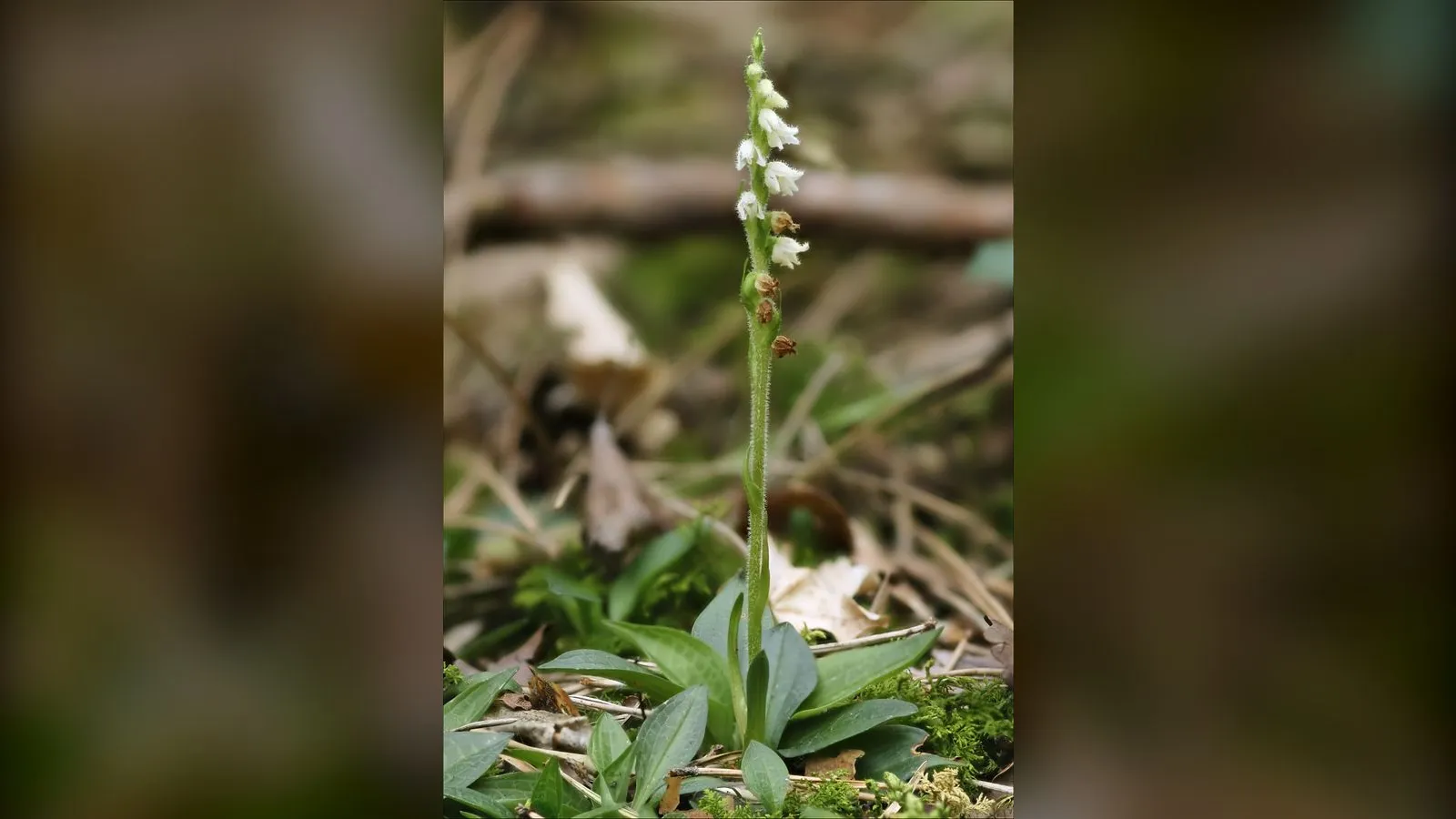

Creeping Lady's-tresses (Goodyera repens)
Contents
TL;DR
- established Within Britain, creeping lady's-tresses is almost exclusive to Scotland, concentrated in the surviving fragments of the Caledonian Forest, particularly Glen Affric, Strathspey, and the Cairngorms, with outlying English populations in Cumbria, Northumberland, County Durham, and a single outpost in Norfolk — a specific, documented distribution this article states directly rather than a vague claim of northern rarity.
- established The species cannot complete its own life cycle without a specific fungal partner, either Rhizoctonia goodyera-repentis or R. lanuginosa, since orchid seeds, which carry virtually no food reserves of their own, depend entirely on these fungi to germinate — a specific, documented biological dependency this article names directly rather than a vague reference to "soil conditions."
- established The orchid flowers unusually late in the season, from mid-July to late August, a timing that may be specifically coordinated with the flowering of bell heather to ensure sufficient pollinator activity is available when its own flowers open — a documented, if not fully certain, ecological coincidence this article states with its real basis.
- established Bumblebees, particularly Bombus lucorum, are identified as the species' primary pollinators, transferring pollen between the orchid's small, white, densely hairy flowers — a specific, named pollination relationship this article states directly rather than a vague reference to "insect pollination."
- established The species is formally classified Nationally Scarce and remains vulnerable to both overgrazing by deer and sheep and to certain forestry management practices, particularly thinning operations, though populations are documented to recover once grazing pressure is excluded — this article states both the vulnerability and the documented capacity for recovery directly, rather than presenting the species' status as either secure or irreversibly declining.
Key Facts
- Scientific name
- Goodyera repens
- Category
- Pinewood
- UK status
- Almost exclusive to Scotland; outlying English populations
- Key Scottish sites
- Glen Affric, Strathspey, Cairngorms
- Conservation status
- Nationally Scarce
- Flowering period
- Mid-July to late August
- Primary pollinator
- Bombus lucorum (bumblebee)
- Essential fungal partners
- Rhizoctonia goodyera-repentis, R. lanuginosa
Scottish Impact Index (SI Score)
- Scottish Significance
- 8/10
- Ecological Persistence
- 5/10
- Ecological Importance
- 6/10
- Botanical Distinctiveness
- 9/10
- Conservation Significance
- 10/10
- Recognition
- 5/10
43/60
Ranked =39th of 45 in Flora
A Note on Claims and Evidence
Distribution, fungal dependency, flowering timing, and pollinator details are drawn from Trees for Life's published assessment. Physical description and additional distribution and conservation detail are drawn from First Nature's published species account.
Timeline
Creeping lady's-tresses establishes itself as a characteristic species of Scotland's native pine forest floor, growing in needle litter among mosses and heather, almost entirely within what would become the UK's Caledonian Forest range.
The species is recorded more widely across its Scottish range, from Caithness through the Highlands to southeast Scotland and northern England.
Populations decline across parts of this range, with the species becoming extinct at many historical locations, particularly where forestry thinning operations or sustained overgrazing by deer and sheep have altered its specific habitat.
Surviving populations persist predominantly in Scots pine-dominated Caledonian Forest remnants, concentrated in Glen Affric, Strathspey, and the Cairngorms, with the species also found more occasionally alongside birch and in mature pine plantations.
The species flowers unusually late, from mid-July to late August, with bumblebees, particularly Bombus lucorum, carrying out pollination between its small, hairy white flowers.
The species remains formally classified Nationally Scarce, locally abundant in parts of northeastern Scotland but documented to decline under sustained grazing pressure and recover once herbivores are excluded.
Details
A Scottish concentration stated with its real geographic specificity
This article names creeping lady's-tresses' UK distribution directly rather than a vague claim of northern rarity: almost exclusive to Scotland, concentrated in Caledonian Forest remnants including Glen Affric, Strathspey, and the Cairngorms, with only outlying English populations in Cumbria, Northumberland, County Durham, and a single Norfolk outpost. This article states these specific locations because they convey the genuine, narrow extent of the species' British range.
A fungal dependency essential to the plant's survival
This article names the species' dependency on specific soil fungi directly rather than a vague reference to "particular soil conditions": it requires one of two named fungal partners, Rhizoctonia goodyera-repentis or R. lanuginosa, because orchid seeds carry virtually no food reserves of their own and cannot germinate without this fungal relationship. This article states this mechanism because it clarifies precisely why the species cannot simply be transplanted or introduced to apparently suitable habitat lacking the right fungal partner already present in the soil.
A flowering time possibly coordinated with another species
This article names the species' unusually late flowering period, mid-July to late August, directly, and states honestly that this timing may be specifically coordinated with bell heather's own flowering period to ensure sufficient pollinator activity is available. This article presents this as a documented, plausible ecological explanation rather than an established certainty, since the connection is one of timing coincidence rather than a definitively proven mechanism.
A specific, named pollination partnership
This article states the species' pollination relationship precisely rather than a vague reference to "insect pollination": bumblebees, particularly Bombus lucorum, are identified as the primary pollinators, transferring pollen between the orchid's small, densely hairy white flowers. This article names this specific relationship because it represents a documented, particular ecological partnership rather than an assumption that any passing insect will do.
A Norfolk outpost said to have come from Scotland
traditional Richard Mabey, in Flora Britannica (1996), describes creeping lady's-tresses as a native of pine and birch woods in northern England and Scotland. He notes an "odd outlying population" in the pine plantations of East Anglia. That colony, he records, was reputedly introduced in the roots of saplings brought from Scotland. The story fits the plant's needs. It lives in pine litter with its fungal partners, so a young pine lifted with its root ball could carry both the orchid and the fungi south. Mabey reports the story as reputed, not proven, and this article treats it the same way. It would explain why the single Norfolk site sits so far from every other British population.
established Mabey's mention of birch woods is a useful reminder that the orchid is not confined to Scots pine. That matches the modern accounts above, which record it more occasionally under birch and in mature pine plantations.
A vulnerability paired honestly with a documented capacity for recovery
This article states directly that the species remains vulnerable to both overgrazing by deer and sheep and to certain forestry management practices, particularly thinning, while also stating that populations are documented to recover once grazing pressure is specifically excluded. This article presents both findings because treating the species as simply declining would ignore the documented evidence of recovery under the right management, while treating it as secure would understate its genuine ongoing vulnerability.
Did You Know?
- Within Britain, creeping lady's-tresses is almost exclusively found in Scotland, concentrated in surviving Caledonian Forest remnants.
- The species cannot germinate without a specific fungal partner in the soil, since its seeds carry almost no food reserves of their own.
- It flowers unusually late, from mid-July to late August, possibly timed to coincide with bell heather flowering.
- Bumblebees, particularly Bombus lucorum, are its primary identified pollinators.
- The plant has become extinct at many historical sites, particularly where forestry thinning or sustained grazing has altered its habitat.
- Despite this, populations are documented to recover once deer and sheep grazing pressure is excluded.
- Its evergreen leaves show a distinctive fan-like veining pattern, unlike the parallel veining typical of most other orchids.
- The Norfolk colony was reputedly introduced in the roots of pine saplings brought from Scotland, according to Richard Mabey's Flora Britannica (1996).
FAQ
1Is creeping lady's-tresses found outside Scotland?
Only in small outlying populations — Cumbria, Northumberland, County Durham, and a single site in Norfolk; within Britain it's almost exclusively Scottish.
2Why can't this orchid simply be grown anywhere suitable-looking?
It depends entirely on a specific fungal partner in the soil to germinate, since its seeds have virtually no food reserves of their own.
3When does it flower?
Unusually late — mid-July to late August, possibly timed with bell heather's own flowering period.
4What pollinates it?
Bumblebees, particularly Bombus lucorum.
5Is the species declining?
It's classified Nationally Scarce and has become extinct at many historical sites, but documented evidence shows populations recover once grazing pressure is excluded.
6What threatens it?
Overgrazing by deer and sheep, and certain forestry management practices, particularly thinning operations.
7Where are its key Scottish strongholds?
Glen Affric, Strathspey, and the Cairngorms, within surviving Caledonian Forest remnants.
8How does it differ from other orchids in appearance?
Its evergreen leaves show fan-like veining, unlike the parallel veining typical of most other orchids.
9How did it reach Norfolk?
Richard Mabey's Flora Britannica (1996) records that the East Anglian colony was reputedly introduced in the roots of saplings brought from Scotland. It is a plausible story, not a proven one.
Sources and Further Reading
Primary/Institutional
- Creeping ladies tresses — Scotland's orchid — Trees for Life
- Goodyera repens — Creeping Lady's Tresses — First Nature
Scholarly/Critical
- Goodyera repens (L.) R.Br. — BSBI
- Deception above, deception below: linking pollination and mycorrhizal biology of orchids — Journal of Experimental Botany (Oxford Academic)
- Richard Mabey, Flora Britannica (Sinclair-Stevenson, 1996).
General
Caveats: Myths and Disputed Claims
- Clarification: This article does not state as certain that the species' late flowering is deliberately timed with bell heather; this is presented as a documented, plausible explanation rather than a proven mechanism.
- Note: This article does not treat the species' Nationally Scarce status as evidence of irreversible decline; documented recovery following grazing exclusion is stated directly alongside the species' genuine vulnerability.
- Do not treat the Scottish origin of the Norfolk colony as proven; Richard Mabey's Flora Britannica (1996) reports it only as reputed.
Card 007 · Flora