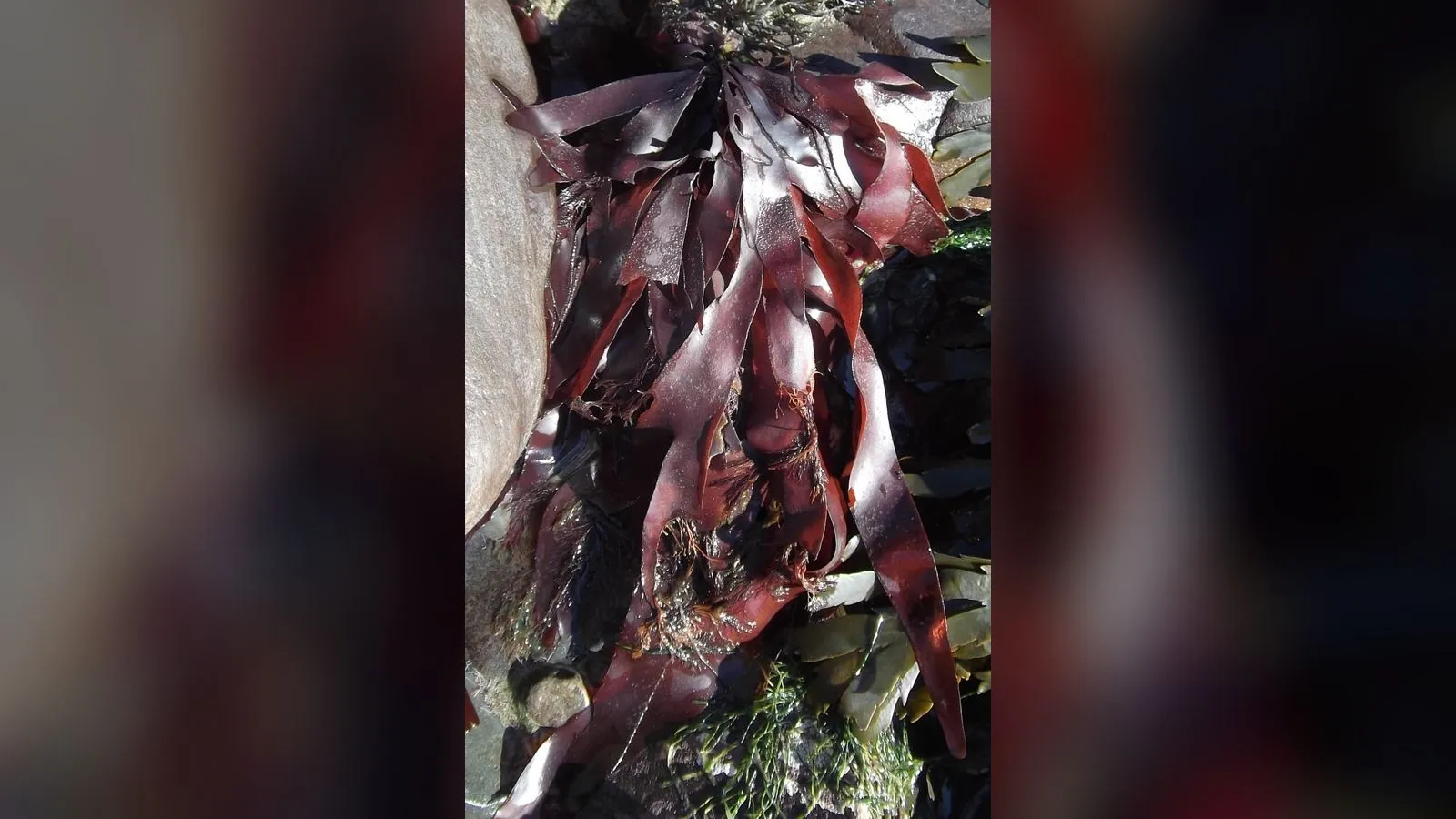

Dulse (Palmaria palmata)
Contents
TL;DR
- established Documented human consumption of dulse in European waters dates back to around 563 AD, when monks on Iona are recorded harvesting the seaweed, embedding the practice deep in early Celtic monastic life — a specific, documented historical starting point this article states directly rather than a vague claim that dulse has been eaten "since ancient times."
- established In 1858, Charles Dickens personally observed "dulse wives" selling the seaweed on the streets of Aberdeen, a specific, documented eyewitness record of dulse as everyday Scottish street food this article states directly rather than treating its food history as confined to monastic or rural tradition alone.
- established Dulse has a genuinely complex haplodiploid reproductive life cycle that was not fully understood by scientists until 1980, in which minute female plants become overgrown by the diploid plants that develop from them, while separate male plants take far longer, nine to twelve months, to reach sexual maturity — a specific, documented reproductive asymmetry this article names directly rather than a vague claim that dulse "reproduces like other seaweeds."
- established A five-gram serving of dulse provides approximately 19% of the recommended daily intake of iron, and the seaweed's protein content averages around 13% but can reach as high as 30% depending on harvest season and location, containing all essential amino acids — a specific, documented nutritional profile this article states directly rather than a vague claim that dulse is "nutritious."
- established Dulse was historically used by sailors as a chewing-tobacco substitute, and Celtic warriors are recorded consuming dried dulse during marches for sustained stamina, specific, documented practical uses this article names directly rather than treating dulse's traditional role as limited to a food eaten at the table.
Key Facts
- Scientific name
- Palmaria palmata
- Category
- Flora (seaweed)
- Also known as
- Dillisk, dilsk, duileasc
- Frond length
- Up to ~50cm
- Earliest documented harvest
- ~563 AD (Iona monks)
- Iron content (5g serving)
- ~19% RDI
- Protein content
- ~13% average, up to ~30% seasonal/location-dependent
- Key historical fair
- Ould Lammas Fair, Ballycastle (since 1606)
Scottish Impact Index (SI Score)
- Scottish Significance
- 7/10
- Ecological Persistence
- 8/10
- Ecological Importance
- 8/10
- Botanical Distinctiveness
- 8/10
- Conservation Significance
- 7/10
- Recognition
- 7/10
45/60
Ranked =29th of 45 in Flora
A Note on Claims and Evidence
Biology, reproductive life cycle, taxonomy, and general habitat and distribution details are drawn from Wikipedia's published research record. Historical food use, the Iona monastic record, the 1858 Dickens observation in Aberdeen, chewing-tobacco and warrior-stamina uses, the Ould Lammas Fair, and nutritional figures are drawn from SeaVeg's published ecological and human-history assessment of dulse.
Timeline
Monks on Iona are documented harvesting dulse, among the earliest recorded instances of European dulse consumption, embedding the practice in early Celtic monastic life.
Dulse collection becomes recognised in law across the Celtic and Norse world; by the 1100s, Iceland's legal codes explicitly permit travellers to collect and eat another person's dulse, while 5th-century Irish laws already address the eating of duileasc.
Dulse becomes embedded in everyday coastal life: Celtic warriors consume dried dulse during marches for sustained stamina, sailors use it as a chewing-tobacco substitute, and the Ould Lammas Fair in Ballycastle, continuously operating since 1606, becomes the longest-running dulse-trading tradition in the region.
Charles Dickens personally observes "dulse wives" selling the seaweed on the streets of Aberdeen, a documented eyewitness record of dulse as everyday Scottish urban food, not merely a rural or monastic practice.
Scientists fully characterise dulse's complex haplodiploid reproductive life cycle for the first time, resolving a reproductive asymmetry in which female plants mature within days while separate male plants take nine to twelve months to reach sexual maturity.
Dulse remains harvested and eaten across Scotland, Ireland, and the wider North Atlantic, valued for a nutritional profile including high iron and protein content, its documented history spanning early monastic harvest, medieval legal recognition, practical wartime and seafaring use, and continuous market trading into the modern day.
Details
A documented history traced to its real earliest record
This article names dulse's earliest documented European consumption with real specificity rather than a vague claim that it has been eaten "since ancient times": monks on Iona are recorded harvesting the seaweed around 563 AD. This article states this specific date and location because it represents the real, documented starting point of dulse's recorded food history, not an assumed timeless practice.
A specific eyewitness record naming dulse as everyday Scottish food
This article names Charles Dickens's 1858 observation of "dulse wives" selling the seaweed on the streets of Aberdeen directly, rather than treating dulse's food history as confined to monastic or rural tradition alone. This article states this specific eyewitness record because it documents dulse as genuine, everyday urban Scottish commerce at a particular, verifiable moment, not merely an assumed ancient or folk practice.
A reproductive cycle explained through its real, recently resolved complexity
This article names dulse's reproductive biology with real specificity rather than a vague claim that it "reproduces like other seaweeds": it has a complex haplodiploid life cycle, not fully understood by scientists until 1980, in which minute female plants become overgrown by the diploid plants that develop from them, while separate male plants take nine to twelve months to reach sexual maturity. This article states this specific asymmetry because it is a genuine, documented biological complexity, not a generic description of seaweed reproduction.
A nutritional profile stated with its real documented figures
This article names dulse's nutritional content with real specificity rather than a vague claim that it is "nutritious": a five-gram serving provides approximately 19% of the recommended daily intake of iron, and its protein content averages around 13% but can reach as high as 30% depending on harvest season and location, containing all essential amino acids. This article states these specific figures because they represent genuinely measured nutritional data, not a general impression of seaweed's health value.
Practical uses named beyond the dinner table
This article names dulse's historical use as a chewing-tobacco substitute for sailors and as a stamina food for marching Celtic warriors directly, rather than treating its traditional role as limited to a food eaten at the table. This article states these specific practical uses because they represent genuine, documented historical applications distinct from ordinary dietary consumption.
Did You Know?
- Monks on Iona are documented harvesting dulse as far back as around 563 AD.
- In 1858, Charles Dickens personally observed "dulse wives" selling the seaweed on the streets of Aberdeen.
- By the 1100s, Icelandic law explicitly permitted travellers to collect and eat another person's dulse.
- Sailors historically used dulse as a chewing-tobacco substitute, and Celtic warriors ate dried dulse during marches for stamina.
- Dulse's reproductive biology wasn't fully understood by scientists until 1980 — females mature within days, while separate male plants take nine to twelve months.
- A five-gram serving of dulse provides around 19% of the recommended daily intake of iron.
- Dulse's protein content can reach up to 30% depending on when and where it's harvested.
- The Ould Lammas Fair in Ballycastle has traded dulse continuously since 1606.
FAQ
1How long have people been eating dulse?
Documented European consumption dates back to around 563 AD, when monks on Iona are recorded harvesting it.
2Was dulse ever sold as everyday street food in Scotland?
Yes — Charles Dickens personally observed "dulse wives" selling it on the streets of Aberdeen in 1858.
3Was dulse used for anything besides eating?
Yes — sailors used it as a chewing-tobacco substitute, and Celtic warriors ate dried dulse during marches for stamina.
4Is dulse nutritious?
Yes, with real documented figures: a five-gram serving provides around 19% of the recommended daily iron intake, and its protein content can reach up to 30% depending on harvest conditions.
5Is dulse's reproduction unusual?
Yes — it has a complex life cycle not fully understood until 1980, where female plants mature within days but males take nine to twelve months.
6Where does dulse grow?
On rocky coasts from the intertidal zone to significant depths, found from Portugal and the Baltic to Iceland, Scotland, Ireland, Canada, and beyond.
7Is there a traditional dulse market still running today?
Yes — the Ould Lammas Fair in Ballycastle, Northern Ireland, has continuously traded dulse since 1606.
Sources and Further Reading
Caveats: Myths and Disputed Claims
- Clarification: This article does not treat dulse's food history as vaguely "ancient"; its earliest documented European consumption is specifically dated to around 563 AD, among monks on Iona.
- Note: This article does not present dulse's traditional use as limited to rural or monastic diets; it is separately documented as ordinary urban street food, observed firsthand by Charles Dickens in 1858 Aberdeen.
Card 044 · Flora