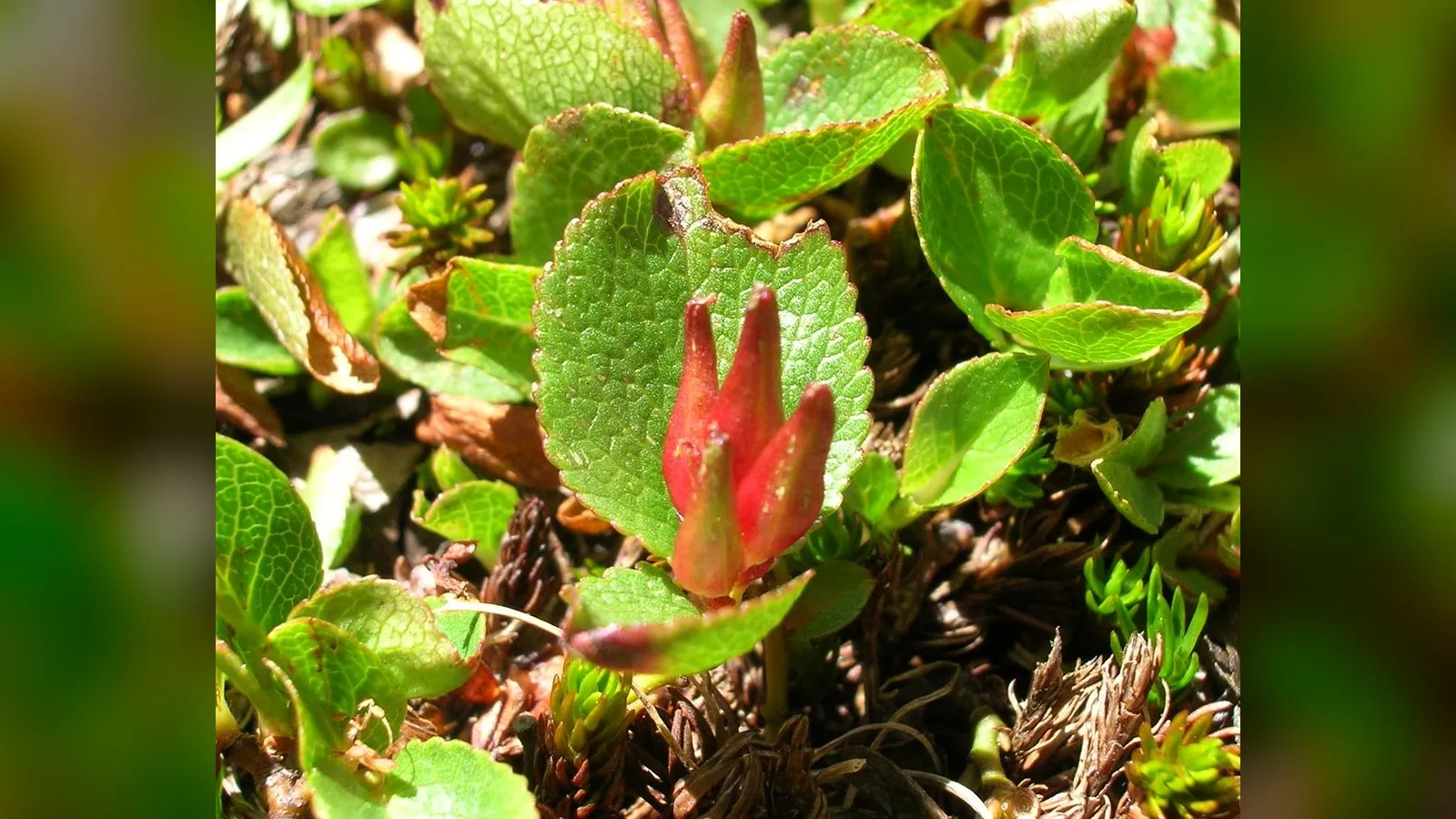

Dwarf Willow (Salix herbacea)
Contents
TL;DR
- established Dwarf willow is one of the smallest woody plants in the world, typically growing just 1–6cm tall with prostrate, spreading branches that run just beneath the surface of the ground, forming open mats rather than anything resembling a conventional tree or shrub — a specific, documented scale this article states directly rather than a vague claim that the species is "tiny."
- established Despite its minute size, dwarf willow is a genuine clonal organism, with individual plants, or ramets, sharing resources within a larger integrated genetic system; in Italy's Northern Apennines, some of these clonal individuals have been documented as at least 2,000 years old, showing that the species' extreme smallness is entirely unrelated to short lifespan — a specific, documented longevity record this article names directly rather than assuming a tiny plant must also be short-lived.
- established Dwarf willow grows on Scottish mountain plateaus at elevations the species elsewhere in its range typically only reaches above 1,500m, an elevation requirement that varies across its distribution and is notably lower at higher latitudes, reaching down to sea level in the high Arctic — a specific, documented elevation pattern this article states directly rather than treating the species' altitude requirement as fixed everywhere it grows.
- established Scotland's mountain willows, including dwarf willow, have historically been protected from spring grazing by persistent snow cover, but as snow cover reduces, populations are increasingly restricted to inaccessible ledges that have escaped grazing and to higher altitudes still — a specific, documented mechanism by which climate change removes a protective buffer rather than simply warming the habitat directly, this article states this chain of cause and effect precisely rather than a vague claim that "climate change threatens mountain plants."
- established Like several other Scottish montane willow species, including woolly willow and downy willow, dwarf willow and its neighbours rely on structural adaptations, from dense protective hair coverage that retains heat on cold, wet, windy days to a prostrate growth habit that prevents the plant from being torn up and blown away, to survive on exposed mountain plateaus — a specific, documented set of shared adaptations this article names directly rather than treating dwarf willow's survival strategy as unique to itself alone.
Key Facts
- Scientific name
- Salix herbacea
- Category
- Flora
- Growth height
- 1–6cm
- Reproduction
- Dioecious; also spreads clonally
- Oldest documented clonal individual
- 2,000+ years (Northern Apennines, Italy)
- Typical elevation (southern range)
- Usually above 1,500m
- Key current threat
- Reduced snow cover removing historical grazing protection
- Leaf size
- 0.3–2cm
Scottish Impact Index (SI Score)
- Scottish Significance
- 8/10
- Ecological Persistence
- 6/10
- Ecological Importance
- 7/10
- Botanical Distinctiveness
- 9/10
- Conservation Significance
- 9/10
- Recognition
- 5/10
44/60
Ranked =33rd of 45 in Flora
A Note on Claims and Evidence
Biology, clonal growth, longevity record, and elevation-range details are drawn from the species' Wikipedia-summarised research record. Scottish habitat, grazing-protection mechanism, and the current climate-driven threat to mountain willow populations are drawn from published Cairngorms-based alpine botany field reporting.
Timeline
Dwarf willow establishes itself across arctic and alpine regions from Greenland and Canada to Northern Europe, including Scotland's mountain plateaus, forming open, prostrate mats as one of the smallest woody plants in the world, typically requiring elevations above 1,500m in the southern parts of its range but surviving down to sea level in the high Arctic.
The species demonstrates genuine clonal longevity; in Italy's Northern Apennines, individual clonal genets are documented as at least 2,000 years old, sharing resources across an integrated system of ramets despite the plant's minute individual size.
Persistent snow cover on Scottish mountain plateaus protects dwarf willow and related montane willow species from spring grazing pressure, allowing populations to persist in locations that would otherwise be heavily browsed.
As snow cover reduces, this historical protection weakens, and dwarf willow and related species become increasingly restricted to inaccessible ledges that have escaped grazing and to higher altitudes still, a documented shift in population distribution driven by changing snow dynamics rather than warming alone.
Dwarf willow remains, where recorded, more locally abundant on Scottish mountain plateaus than sometimes assumed, surviving through a shared set of structural adaptations with other Scottish montane willows, even as the specific mechanism protecting it from grazing continues to erode.
Details
A scale of smallness stated with its real documented figures
This article names dwarf willow's size with real precision rather than a vague claim that the plant is "tiny": typically 1–6cm tall, with prostrate, spreading branches running just beneath the ground surface, forming open mats rather than anything resembling a conventional tree or shrub. This article states this specific scale because it represents one of the most extreme examples of woody-plant miniaturisation documented anywhere, not a loose comparison to other small plants.
A longevity record that corrects an intuitive assumption
This article states directly that dwarf willow's extreme smallness has nothing to do with a short lifespan: individual clonal genets in Italy's Northern Apennines are documented as at least 2,000 years old, sharing resources across an integrated system of ramets. This article names this specific longevity record because it corrects the intuitive but incorrect assumption that a minuscule plant must also be short-lived, demonstrating instead a genuinely ancient clonal organism.
An elevation requirement stated honestly as variable, not fixed
This article names dwarf willow's elevation range with real geographic nuance rather than treating it as a single fixed figure: typically above 1,500m in the southern parts of its range, but reaching down to sea level in the high Arctic. This article states this variation directly because it clarifies that the species' altitude requirement shifts with latitude, reflecting underlying climate rather than an intrinsic preference for height itself.
A protective mechanism named precisely, not assumed
This article states the real mechanism by which reduced snow cover threatens Scottish mountain willows rather than a vague claim that "climate change threatens mountain plants": persistent snow has historically protected dwarf willow and related species from spring grazing, and as that snow cover reduces, populations become increasingly restricted to inaccessible ledges and higher altitudes. This article names this specific chain of cause and effect because it clarifies that the threat operates by removing a protective buffer against grazing, not simply by direct warming of the habitat.
A survival strategy shared across related montane species
This article names dwarf willow's structural adaptations alongside those of its neighbouring montane willow species, including woolly willow and downy willow, rather than treating its survival strategy as unique to itself alone: dense protective hair coverage retains heat on cold, wet, windy days in some related species, while a prostrate growth habit across these species prevents plants from being torn up and blown away. This article states this shared pattern because it demonstrates a genuine, convergent survival strategy across Scotland's exposed montane willow community, not an isolated adaptation.
Did You Know?
- Dwarf willow is one of the smallest woody plants in the world, typically only 1–6cm tall.
- Despite its tiny size, it can be genuinely ancient — clonal individuals in Italy's Northern Apennines are documented as at least 2,000 years old.
- Its elevation requirement varies by latitude: usually above 1,500m in the south of its range, but down to sea level in the high Arctic.
- Persistent snow cover has historically protected dwarf willow from spring grazing on Scottish mountains.
- As snow cover reduces, populations are increasingly restricted to inaccessible ledges and higher ground.
- Dwarf willow's branches grow just beneath the surface of the ground, forming open mats rather than an upright plant.
- Related Scottish montane willows, including woolly and downy willow, share a similarly low, hair-covered growth form to survive exposed mountain conditions.
FAQ
1How small is dwarf willow, really?
Typically just 1–6cm tall, with branches running just beneath the ground surface — one of the smallest woody plants in the world.
2Is dwarf willow short-lived because it's so small?
No — clonal individuals in Italy's Northern Apennines are documented as at least 2,000 years old, showing its tiny size has nothing to do with lifespan.
3How high up does dwarf willow grow?
It varies by latitude — typically above 1,500m in the southern parts of its range, but down to sea level in the high Arctic.
4Why is climate change a threat to dwarf willow specifically?
Because reduced snow cover removes a historical protection from spring grazing, pushing populations onto increasingly inaccessible ledges and higher ground rather than warming the habitat directly.
5How does dwarf willow survive extreme mountain conditions?
Through a low, prostrate growth form shared with related montane willows, which prevents the plant from being torn up and blown away.
6Is dwarf willow a tree or a shrub?
Neither in the conventional sense — it forms open, prostrate mats just above (and partly beneath) the ground surface.
7Where does dwarf willow grow in Scotland?
On exposed mountain plateaus, where it can be more locally abundant than often assumed.
Sources and Further Reading
Primary/Institutional
Scholarly/Critical
- Salix herbacea L. (Dwarf Willow) — BSBI
- Ecology of Alpine Snowbeds and the Impact of Global Change — Arctic, Antarctic, and Alpine Research (Taylor & Francis)
General
Caveats: Myths and Disputed Claims
- Clarification: This article does not assume dwarf willow's extreme smallness implies a short lifespan; documented clonal individuals have been dated to at least 2,000 years old.
- Note: This article does not describe climate change's threat to dwarf willow as simple direct warming; the documented mechanism is the loss of a protective snow-cover buffer against spring grazing.
Card 025 · Flora