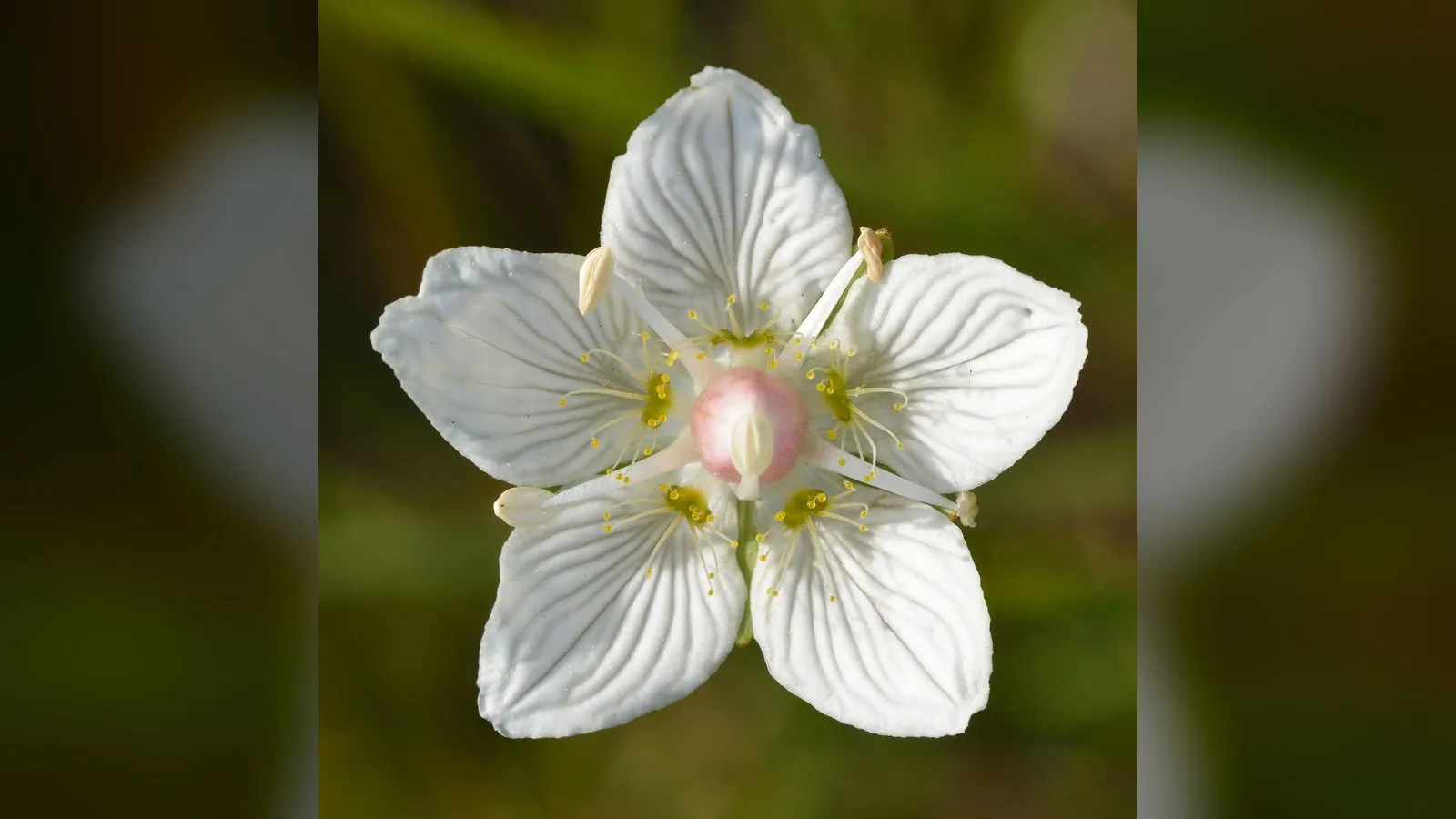

Grass of Parnassus (Parnassia palustris)
Contents
TL;DR
- established Despite its common name, grass of Parnassus is not a grass at all, but a flowering plant whose cupped white petals, marked with translucent green veins, surround gold reproductive structures — a specific, documented misnomer this article states directly rather than leaving the plant's common name to imply a botanical relationship that does not exist.
- established The flower operates a genuinely sophisticated pollination mechanism: rather than releasing pollen from all five stamens at once, each anther matures and moves into position over the pistil one at a time, probably one per day, before withdrawing to let the next stamen take its turn — a specific, documented sequential timing strategy this article names directly rather than a vague reference to the plant being "insect-pollinated."
- established The flower also produces modified, sterile stamens called staminodes, marked with green-striped nectar guides that direct visiting insects toward genuine nectar rewards without themselves producing pollen, functioning as a structural signpost for pollinators rather than a source of reproductive material — a specific, documented floral deception mechanism this article states directly rather than a vague claim that the flower "attracts insects."
- established The plant's own stigma, the pollen-receiving structure, does not develop until all five stamens have completed their sequential cycle, a specific, documented timing mechanism that prevents the flower from self-pollinating with its own pollen before cross-pollination from a visiting insect becomes possible — this article states this mechanism directly because it is the precise structural reason the plant favours genetic diversity over self-fertilisation.
- disputed The Parnassus name is older than Linnaeus: the Flemish botanist Matthias de l'Obel called the plant Gramen Parnasi in 1576, and Henry Lyte's English "Grass of Parnassus" followed in 1578. Linnaeus's later genus name Parnassia is generally understood as a reference to Mount Parnassus, possibly linking the flower's beauty to the home of Apollo, yet the plant is in fact rare in the south of Europe where that mountain lies, a genuine tension this article states directly rather than resolving it into a simple, uncomplicated naming story.
Key Facts
- Scientific name
- Parnassia palustris
- Category
- Flora
- Growth height
- Up to ~25cm
- Plant type
- Flowering herb (not a grass, despite the name)
- Key Scottish sites
- Sutherland, Argyll, the Hebrides (including machair)
- Flowering period
- July–August
- Key habitat requirement
- Permanently damp, alkaline-leaning, open, non-wooded ground
- Pollination mechanism
- Sequential stamen movement; staminode nectar guides
Scottish Impact Index (SI Score)
- Scottish Significance
- 8/10
- Ecological Persistence
- 8/10
- Ecological Importance
- 7/10
- Botanical Distinctiveness
- 8/10
- Conservation Significance
- 7/10
- Recognition
- 7/10
45/60
Ranked =29th of 45 in Flora
A Note on Claims and Evidence
The misleading common name, its Linnaean naming history, Swedish folk name, Scottish distribution, and habitat requirement details are drawn from the Scottish Wildlife Trust's published assessment. The detailed sequential-stamen and staminode pollination mechanism is drawn from published field-naturalist research reporting on the species' reproductive biology.
Timeline
Grass of Parnassus establishes itself across damp pastures, moorlands, grasslands, roadsides, and Hebridean machair, requiring permanently damp, alkaline-leaning, open, non-wooded ground, with Scottish populations recorded in Sutherland, Argyll, and the Hebrides.
The Flemish botanist Matthias de l'Obel calls the species Gramen Parnasi, "grass of Parnassus".
The English translation, Grass of Parnassus, is attributed to Henry Lyte.
Linnaeus adopts the older name for the plant's scientific genus, Parnassia, generally understood as a reference to Mount Parnassus, possibly linking the flower's beauty to the home of Apollo, even though the plant itself is in fact rare in the south of Europe where that mountain lies.
In Sweden, the plant acquires the folk name slåtterblomma, meaning "hay-making flower," reflecting its practical traditional use as a seasonal signal marking the start of the hay harvest.
The plant flowers in July and August, its five stamens maturing and moving into position over the pistil one at a time, probably one per day, while separate staminodes display green-striped nectar guides that direct visiting insects toward genuine nectar rewards; the stigma itself does not develop until all five stamens have completed this sequential cycle, preventing self-pollination.
Grass of Parnassus remains a genuinely enigmatic and widely misnamed species within Scotland's damp grassland and machair habitats, with the specific reasons for its patchy absence from parts of northern Scotland still not clearly understood.
Details
A common name stated as a documented misnomer
This article names grass of Parnassus's misleading common name directly rather than letting it imply a botanical relationship that does not exist: despite the name, it is not a grass at all, but a flowering plant with cupped white petals marked by translucent green veins surrounding gold reproductive structures. This article states this correction because treating the plant as grass-like would misrepresent its real botanical identity.
A pollination mechanism explained through its real sequential structure
This article names grass of Parnassus's pollination strategy with real precision rather than a vague reference to the plant being "insect-pollinated": each of its five stamens matures and moves into position over the pistil one at a time, probably one per day, before withdrawing to let the next stamen take its turn. This article states this sequential structure directly because it represents a genuinely sophisticated, documented timing mechanism, not a simple, one-off release of pollen.
A floral deception named with its real function
This article states the function of grass of Parnassus's staminodes precisely rather than a vague claim that the flower "attracts insects": these modified, sterile stamens carry green-striped nectar guides that direct visiting insects toward genuine nectar rewards, without themselves producing pollen. This article names this mechanism directly because it demonstrates a genuine structural signalling strategy distinct from the flower's actual reproductive stamens.
A self-pollination barrier stated through its real timing mechanism
This article names the precise mechanism preventing grass of Parnassus from self-pollinating rather than assuming this happens automatically: the plant's stigma does not develop until all five stamens have completed their sequential cycle, meaning the flower's own pollen has already been dispersed, or has had the opportunity to be, before the stigma becomes receptive. This article states this mechanism because it is the specific structural reason the plant favours cross-pollination and genetic diversity over simple self-fertilisation.
A naming origin stated honestly, with its real internal tension
This article presents the Linnaean naming of Parnassia directly rather than resolving it into a simple, uncomplicated story: generally understood as a reference to Mount Parnassus, possibly linking the flower's beauty to the home of Apollo, even though the plant is in fact rare in the south of Europe where that mountain lies. This article states this tension because the naming connection and the plant's real distribution genuinely sit in some tension with each other, and smoothing over that mismatch would overstate how settled the naming explanation actually is.
Correction. An earlier version of this article implied that the Parnassus name began with Linnaeus. Richard Mabey's Flora Britannica (1996) dates it to de l'Obel's Gramen Parnasi of 1576, with Lyte's English form in 1578. Linnaeus inherited the name rather than inventing it, so any explanation of the Apollo link belongs to the sixteenth century.
Grass of Parnassus in Flora Britannica
established Richard Mabey, in Flora Britannica (1996), describes grass of Parnassus as a handsome plant with heart-shaped leaves and ivory-white, chalice-shaped flowers, by then more or less confined to damp pastures, moors and marshes in northern Britain. He records that it once grew more widely and still survived in the Norfolk Broads and fens. That is a 1996 picture of a characteristically northern plant; current BSBI maps should be used for present detail.
shared Mabey thought the classical name seemed "rather extravagant" until the flower is examined closely. The petals are not pure white but veined with translucent green stripes, cupped around glistening yellow stamens. His description matches the veined petals and staminodes discussed above. The book's caption calls it a beautiful relative of the saxifrages, the family in which older Floras placed it.
Did You Know?
- Despite its name, grass of Parnassus is not a grass — it's a flowering herb.
- Its five stamens mature and move into pollinating position one at a time, probably one per day, rather than all at once.
- Modified, sterile stamens called staminodes have green-striped "nectar guides" that direct insects to real nectar, without producing any pollen themselves.
- The flower's own stigma doesn't develop until all five stamens have finished their sequential cycle, helping prevent self-pollination.
- In Sweden, the plant's folk name translates as "hay-making flower," since its bloom traditionally signalled the start of the hay harvest.
- The genus name references Mount Parnassus, possibly linking the flower to Apollo — even though the plant is actually rare in southern Europe, where that mountain is located.
- In Scotland, it grows in Sutherland, Argyll, and the Hebrides, including machair grassland.
- The name "Grass of Parnassus" dates from 1576, nearly two centuries before Linnaeus.
- Richard Mabey's Flora Britannica (1996) records that it once grew more widely in southern Britain and still survived in the Norfolk Broads.
FAQ
1Is grass of Parnassus actually a type of grass?
No — despite the name, it's a flowering herb, unrelated botanically to true grasses.
2How does its unusual pollination mechanism work?
Its five stamens mature and move into position over the pistil one at a time, probably one per day, while separate staminodes display nectar guides that direct insects toward real nectar rewards without producing pollen themselves.
3How does the flower avoid pollinating itself?
Its stigma doesn't develop until all five stamens have completed their sequential cycle, which helps prevent the flower's own pollen from fertilising itself.
4Why is it called "grass of Parnassus"?
The name goes back to the Flemish botanist de l'Obel, who called it Gramen Parnasi in 1576; Henry Lyte gave the English form in 1578, and Linnaeus later made it the genus Parnassia. It is generally read as a reference to Mount Parnassus, possibly linking the flower's beauty to the home of Apollo, though the plant is actually rare in southern Europe, where that mountain is located.
5What does the Swedish folk name mean?
Slåtterblomma, or "hay-making flower," reflecting its traditional use as a seasonal signal marking the start of the hay harvest.
6Where does grass of Parnassus grow in Scotland?
In Sutherland, Argyll, and the Hebrides, including machair grassland, favouring permanently damp, alkaline-leaning, open ground.
7When does it flower?
In July and August.
8Was grass of Parnassus once more widespread in Britain?
Yes. Richard Mabey's Flora Britannica (1996) records that it once occurred more widely and by then was more or less confined to northern Britain, with outposts in the Norfolk Broads and fens.
Sources and Further Reading
Primary/Institutional
- Grass of Parnassus - enigmatic and misnamed? — Scottish Wildlife Trust
- Parnassia palustris, Grass of Parnassus: identification, distribution, habitat — First Nature
Scholarly/Critical
- A Flower's Reproductive Antics — Bryan Pfeiffer, field naturalist research reporting
- Quantitative importance of staminodes for female reproductive success in Parnassia palustris under contrasting environmental conditions — Canadian Journal of Botany
- Richard Mabey, Flora Britannica (Sinclair-Stevenson, 1996).
General
Caveats: Myths and Disputed Claims
- Clarification: This article does not treat "grass of Parnassus" as a botanically accurate name; the plant is not a grass, and its common name is a documented misnomer.
- Do not credit Linnaeus with coining the Parnassus name; it goes back to de l'Obel in 1576.
- disputed This article does not present the Mount Parnassus naming connection as a fully settled explanation; the plant's genuine rarity in southern Europe, where that mountain lies, sits in real tension with the naming story.
Card 031 · Flora