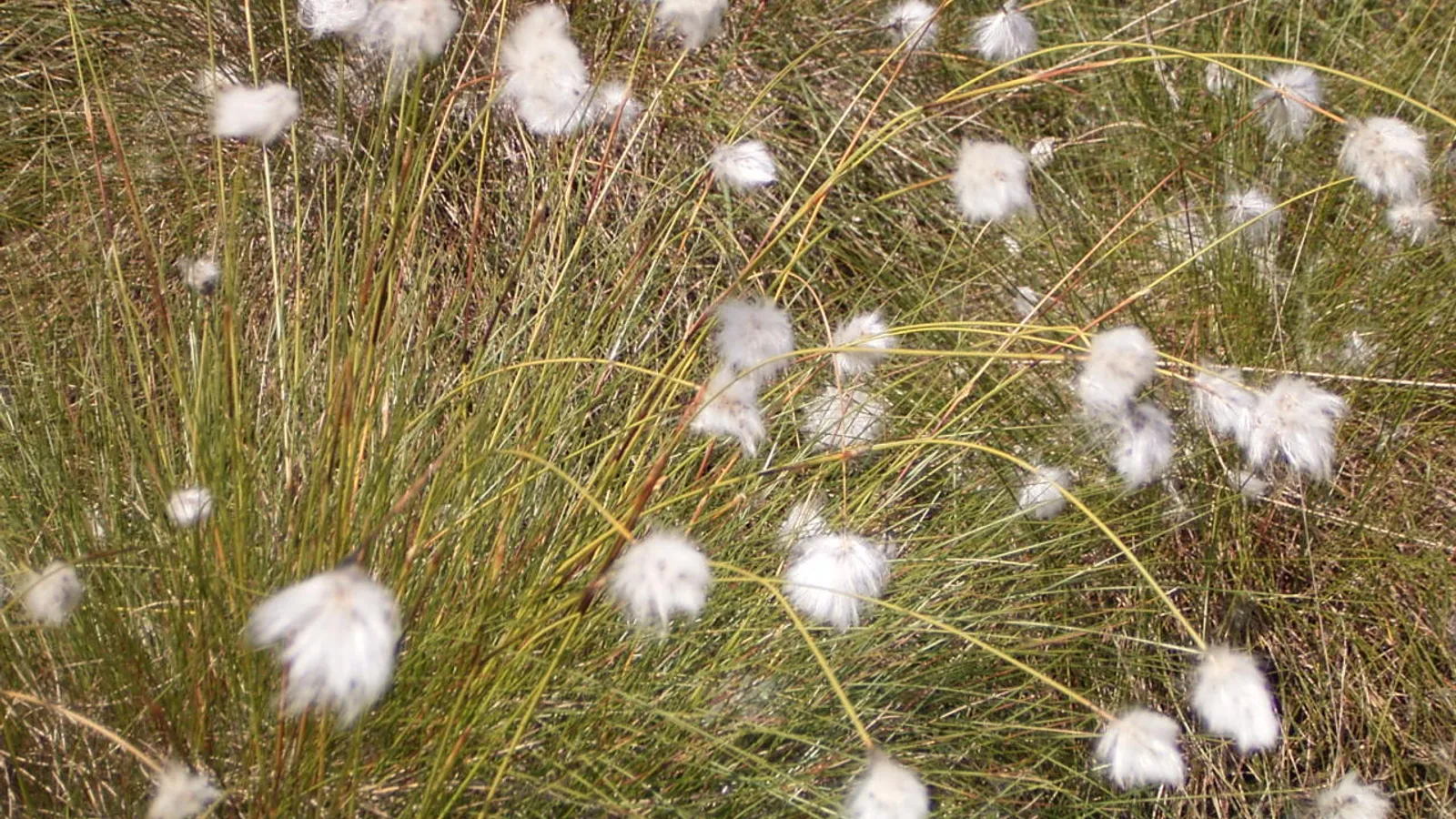

Hare's-tail Cottongrass (Eriophorum vaginatum)
Contents
TL;DR
- established Hare's-tail cottongrass is a key peat-forming species, and ecologists use its abundance as a direct health indicator for blanket bog: on a healthy bog, the species should not exceed 75% of vegetation cover, with higher dominance signalling degraded, disturbed conditions — a specific, documented ecological threshold this article states directly rather than a vague claim that the plant is simply "good for peatlands."
- established The dense, tussock-forming growth habit that gives hare's-tail cottongrass its name becomes especially pronounced in drier, degraded peatland conditions, and these tussocks confer genuine fire resistance, meaning that management burning on a 10-to-15-year interval tends to favour this species over others in the same habitat — a specific, documented ecological consequence of land management this article names directly rather than treating fire resilience and burning regimes as unrelated facts.
- established Hare's-tail cottongrass is the primary larval food plant of the large heath butterfly, a species in genuine decline across England and Wales, making this one grass species directly responsible for sustaining a threatened butterfly population — a specific, documented dependency this article states directly rather than a vague claim that the plant "supports wildlife."
- established Historically, the soft white seed-head fibres of cottongrass were put to real practical use in Scotland, serving as candle wicks and as stuffing for pillows, a specific, documented traditional use this article names directly rather than treating the plant's cotton-like appearance as purely ornamental.
- established Hare's-tail cottongrass is the only cottongrass species that develops a single, upright seed head per stem, a specific, documented identifying feature distinguishing it from other cottongrass species that produce multiple drooping heads, this article names directly rather than treating all cottongrasses as visually identical.
Key Facts
- Scientific name
- Eriophorum vaginatum
- Category
- Flora
- Also known as
- Draw-ling, drawmoss
- Family
- Cyperaceae (sedge family)
- Height
- 15–75cm
- Key habitat
- Acidic peat bogs, blanket bog, poor fens
- Healthy-bog threshold
- Should not exceed 75% of vegetation cover
- Key wildlife dependency
- Large heath butterfly larval food plant
Scottish Impact Index (SI Score)
- Scottish Significance
- 9/10
- Ecological Persistence
- 9/10
- Ecological Importance
- 9/10
- Botanical Distinctiveness
- 8/10
- Conservation Significance
- 8/10
- Recognition
- 9/10
52/60
Ranked #8 of 45 in Flora
A Note on Claims and Evidence
Biology, taxonomy, and general distribution details are drawn from Wikipedia's published research record. The peat-forming role, bog-health indicator threshold, fire-resilience and management-burning relationship, and large heath butterfly dependency are drawn from the IUCN UK Peatland Programme's published species showcase. Traditional candle-wick and pillow-stuffing uses are drawn from published Scottish hillwalking and natural-history sources.
Timeline
Hare's-tail cottongrass establishes itself across acidic peat bogs, blanket bog, and poor fens throughout Scotland and the wider subarctic and temperate Northern Hemisphere, its dense tussock growth and single, upright seed head distinguishing it from other cottongrass species, contributing to peat formation and carbon accumulation over time.
Scottish communities put the plant's soft white seed-head fibres to practical use, employing them as candle wicks and as stuffing for pillows, while the species becomes known locally by alternate names including draw-ling and drawmoss.
Hare's-tail cottongrass's tussock growth form, especially pronounced in drier, degraded peatland conditions, confers real fire resistance, with management burning on a 10-to-15-year interval tending to favour this species over others in the same habitat; separately, the species becomes recognised as the primary larval food plant of the large heath butterfly, a species in genuine decline across England and Wales.
Ecologists establish the species' abundance as a direct indicator of blanket bog health, with cover exceeding 75% of vegetation signalling degraded, disturbed conditions rather than a thriving bog, informing peatland restoration and monitoring work across Scotland.
Hare's-tail cottongrass remains a defining species of Scotland's peat bogs and blanket bog, its ecological role as peat-former, fire-resilient management-responsive species, bog-health indicator, and butterfly food plant all part of the current, documented record.
Details
A peat-forming role explained through its real documented threshold
This article names hare's-tail cottongrass's significance to peatland health with real specificity rather than a vague claim that the plant is "good for peatlands": ecologists use its abundance as a direct health indicator for blanket bog, with cover exceeding 75% of vegetation signalling degraded, disturbed conditions. This article states this specific threshold because it represents a genuine, documented ecological benchmark used in real conservation and restoration monitoring, not a general impression of the plant's environmental value.
A fire-resilience trait connected directly to its management consequence
This article names the link between hare's-tail cottongrass's tussock growth and land management directly rather than treating fire resilience and burning regimes as unrelated facts: its dense tussocks, especially pronounced in drier, degraded peatland conditions, confer genuine fire resistance, meaning management burning on a 10-to-15-year interval tends to favour this species over others in the same habitat. This article states this consequence because it is a real, documented outcome of deliberate land management practice, not an incidental trait of the plant alone.
A single-species butterfly dependency named with its real stakes
This article names hare's-tail cottongrass's ecological significance to the large heath butterfly directly rather than a vague claim that the plant "supports wildlife": it is the species' primary larval food plant, and the butterfly itself is in genuine decline across England and Wales. This article states this specific dependency because it demonstrates a real, documented case where one grass species' presence directly sustains a threatened insect population, not a general or interchangeable ecological relationship.
A traditional use named with its real practical application
This article names hare's-tail cottongrass's historical use in Scotland directly rather than treating its cotton-like seed heads as purely ornamental: the soft white fibres were used as candle wicks and as stuffing for pillows. This article states these specific uses because they represent genuine, documented practical applications of the plant's physical properties, not an assumed or invented folk use.
An identifying feature named to distinguish it from related species
This article states directly that hare's-tail cottongrass is the only cottongrass species that develops a single, upright seed head per stem, rather than treating all cottongrasses as visually identical. This article names this specific feature because it is the real, documented characteristic distinguishing this species from other cottongrasses, which produce multiple drooping seed heads.
Cottongrass in Flora Britannica
Richard Mabey's Flora Britannica (1996) has no separate entry for hare's-tail cottongrass. Its account is of common cottongrass, Eriophorum angustifolium, and the names it records are for cottongrass in general. What follows applies to the cottongrasses as a group unless stated otherwise.
shared Mabey records that people have tried to spin a usable thread from the silky seed-plumes, but the fibres are too short. The plumes were used for stuffing pillows in Sussex, which supports the pillow use described above, and during the First World War Scottish children gathered them for wound dressings. He does not mention candle wicks, so that use rests on the other sources cited.
established Peter Marren's appendix on Scottish vernacular plant names in the same book records cottongrass as draw-moss in the north-east, matching the drawmoss above, and Lukki's oo in Shetland, "oo" being the Scots word for wool. He adds that the Gaelic name cannach was still in use in Glasgow a century before he wrote, that is, in the late nineteenth century.
Did You Know?
- Hare's-tail cottongrass is a key peat-forming species, and ecologists use its abundance as a direct indicator of blanket bog health — if it covers more than 75% of the vegetation, the bog is likely degraded.
- Its dense tussocks are genuinely fire-resistant, and periodic management burning tends to favour this species over others in the same habitat.
- It's the primary food plant for large heath butterfly caterpillars, a species in genuine decline across England and Wales.
- The soft white seed heads were traditionally used in Scotland as candle wicks and pillow stuffing.
- Hare's-tail cottongrass is the only cottongrass species with a single, upright seed head — other cottongrasses produce multiple drooping heads.
- It's also known locally as draw-ling or drawmoss.
- Despite the name "cottongrass," it's actually a sedge, not a true grass.
- In the First World War, Scottish children gathered cottongrass plumes for wound dressings.
- In Shetland cottongrass has been called Lukki's oo; "oo" is the Scots word for wool.
- Cottongrass fibres are too short to spin into usable thread, though people have tried.
FAQ
1Why is hare's-tail cottongrass important for peatlands?
It's a key peat-forming species, and ecologists use its cover as a direct indicator of blanket bog health — healthy bogs should have less than 75% cottongrass cover.
2Does burning moorland affect cottongrass?
Yes — its tussocks are genuinely fire-resistant, so periodic management burning tends to favour this species over others in the same peatland habitat.
3What wildlife depends on hare's-tail cottongrass?
It's the primary larval food plant for the large heath butterfly, a species currently in decline across England and Wales.
4Was cottongrass ever put to practical use?
Yes — its soft white seed-head fibres were traditionally used in Scotland as candle wicks and pillow stuffing.
5How do you tell hare's-tail cottongrass apart from other cottongrasses?
It's the only one with a single, upright seed head per stem; other cottongrass species produce multiple drooping heads.
6Is cottongrass actually a grass?
No — despite the name, it's a sedge, in the family Cyperaceae.
7Where does hare's-tail cottongrass grow in Scotland?
It's common throughout Scotland in acidic peat bogs, blanket bog, and poor fens.
8Was cottongrass used in wartime?
Yes. Richard Mabey's Flora Britannica (1996) records that Scottish children gathered cottongrass plumes for wound dressings during the First World War. His account is of common cottongrass, so it may not refer to hare's-tail cottongrass specifically.
9What are the Scots and Gaelic names for cottongrass?
Peter Marren's appendix to Flora Britannica gives draw-moss in the north-east, Lukki's oo in Shetland, and the Gaelic cannach, still heard in Glasgow in the late nineteenth century.
10Can cottongrass be spun like cotton?
Not usefully. Mabey notes that experiments to make thread from the seed-plumes failed because the fibres are too short.
Sources and Further Reading
Primary/Institutional
Scholarly/Critical
- The effects of Eriophorum vaginatum on N2O fluxes at a restored, extracted peatland — ScienceDirect
- Hare's Tail, Cotton-grass — Royal Forestry Society species guide
- Richard Mabey, Flora Britannica (Sinclair-Stevenson, 1996), including Peter Marren's appendix on Scottish vernacular plant names.
General
Caveats: Myths and Disputed Claims
- Clarification: This article does not describe hare's-tail cottongrass as simply beneficial to peatlands in all circumstances; its dominance above a 75% cover threshold is specifically used by ecologists as a sign of bog degradation, not health.
- Note: This article does not describe cottongrass as a true grass; despite its common name, it belongs to the sedge family, Cyperaceae.
- Do not attribute every cottongrass use or name to hare's-tail cottongrass specifically. Flora Britannica's wartime and pillow records concern common cottongrass, and the Scots names cover cottongrasses in general.
Card 040 · Flora