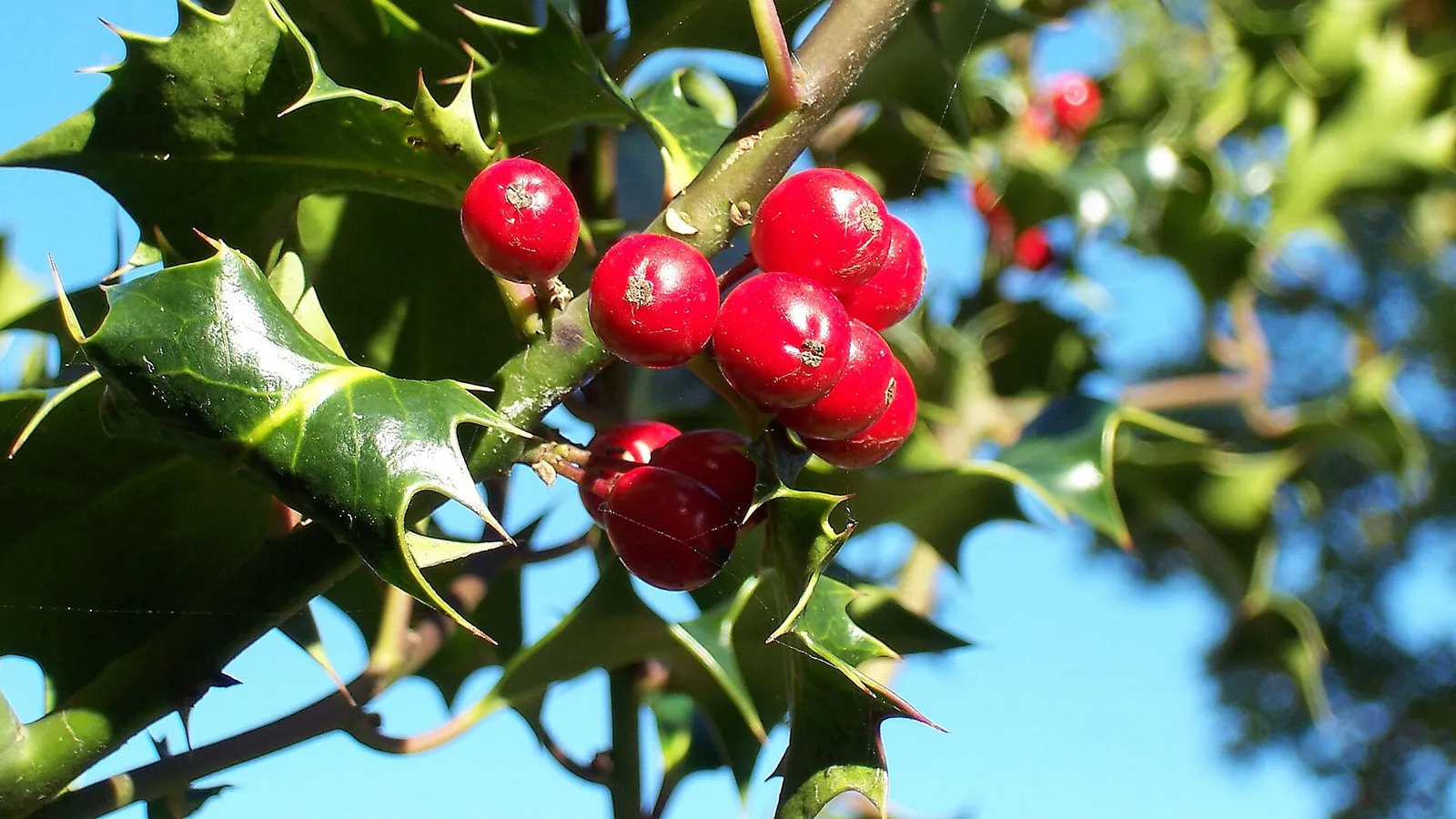

Holly (Ilex aquifolium)
Contents
TL;DR
- established Holly produces spiny leaves near the ground and smoother, less-spined leaves higher up the same tree, and researchers have identified the mechanism behind this as DNA methylation, an epigenetic process that switches spine production on or off in response to recent animal browsing, without any change to the tree's underlying genetic code — a specific, documented, genuinely remarkable biological mechanism this article states directly rather than a vague claim that "holly leaves get spikier lower down."
- established A Spanish research team examined 40 European holly trees and found that 39 displayed this height-dependent leaf variation, with directly measured lower DNA methylation in spiny leaves compared with smooth ones, establishing a real link between recent browsing pressure and the epigenetic production of defensive spines — a specific, documented study this article names directly rather than treating the spine-height pattern as folk observation.
- established As one of the only evergreen broadleaved trees native to the UK, holly serves as a critical winter food source: its berries sustain thrushes, including redwings and fieldfares, through the coldest months, while the leaves themselves are browsed by red deer and sheep despite their spines — a specific, documented dual role this article states directly rather than a vague reference to holly "providing food."
- established Ancient cultures linked holly to thunder deities including Thor and Taranis, and believed its spines acted as a form of lightning protection when branches were brought indoors during the darkest days of winter — a belief this article names as having "a kernel of scientific basis," since spiny, pointed structures can in fact act as electrical conductors, while being clear that the ancient protective belief itself was not grounded in an understanding of that mechanism.
- established In Celtic tradition, the Holly King was said to rule from midsummer to midwinter before yielding to the Oak King, and rural British communities referred to holly trees simply as "Christmas trees" long before the Victorian era popularised the indoor conifer tradition familiar today — a specific, documented continuity between pre-Christian and Christmas-season symbolism this article states directly rather than treating holly's festive association as a purely Christian invention.
Key Facts
- Scientific name
- Ilex aquifolium
- Category
- Trees
- Typical lifespan
- 250–300 years (UK specimens to ~400)
- Maximum height (Scotland)
- Up to 10m typically, to 25m possible
- Key mechanism
- Height-dependent leaf spininess via DNA methylation
- Research scale
- 39 of 40 trees studied showed this leaf variation
- Key dependent species
- Thrushes (redwing, fieldfare), red deer, sheep
- Scottish distribution
- Throughout mainland Scotland except Caithness; Orkney, Lewis, Harris, Skye
Scottish Impact Index (SI Score)
- Scottish Significance
- 7/10
- Ecological Persistence
- 9/10
- Ecological Importance
- 7/10
- Botanical Distinctiveness
- 7/10
- Conservation Significance
- 6/10
- Recognition
- 8/10
44/60
Ranked =33rd of 45 in Flora
A Note on Claims and Evidence
Biology, reproduction, winter wildlife use, and Scottish distribution details are drawn from Trees for Life's published assessment. The leaf-spininess DNA methylation mechanism and research findings are drawn directly from published coverage of the Spanish National Research Council study led by Carlos Herrera. Folklore and pre-Christian symbolism details, including the Holly King and lightning-protection belief, are drawn from published Celtic and Roman tree-folklore sources.
Timeline
Holly establishes itself throughout mainland Scotland except Caithness, and on Orkney, Lewis, Harris, and Skye, becoming a prominent understorey species in western oakwoods and native pinewoods of the Caledonian Forest, valued as one of the UK's only native evergreen broadleaved trees.
Ancient cultures link holly to thunder deities including Thor and Taranis, bringing branches indoors during winter's darkest days to ward off evil spirits, believing the leaf spines offered protection against lightning strikes; in Celtic tradition, the Holly King is said to rule from midsummer to midwinter before yielding to the Oak King.
Holly is incorporated into Saturnalia, the Roman midwinter festival, viewed as a symbol of immortality and exchanged as a gift believed to bring good fortune.
Rural British communities refer to holly trees simply as "Christmas trees," a usage that predates the Victorian popularisation of the indoor conifer tradition now associated with that name.
At Inveraray, the Duke of Argyll has a public road diverted around an ancient holly rather than fell it.
Holly is the favoured wood for driving-whip stocks, with some 210,000 made a year at the peak of the horse-drawn era.
Richard Mabey's Flora Britannica records holly still cut as winter fodder for sheep in Dumfriesshire, and a persistent taboo against felling holly trees.
Holly flowers from May to June, pollinated primarily by bees, with berries ripening to bright red by midwinter; their initial bitterness softens after frost, and they persist on the tree for months as a critical late-winter food source for thrushes including redwings and fieldfares.
A Spanish National Research Council study examines 40 European holly trees and finds that 39 display height-dependent leaf-spine variation, establishing through DNA methylation analysis that recent browsing pressure directly triggers epigenetic spine production in reachable lower leaves.
Holly remains a significant understorey species across Scottish woodland, valued both for its genuine ecological role as a winter food source and shelter plant, and for its documented capacity to respond rapidly to browsing pressure through epigenetic rather than purely genetic adaptation.
Details
A leaf-spine mechanism explained through real, named research
This article names the mechanism behind holly's height-dependent leaf spininess with real scientific precision rather than a vague claim that "leaves get spikier lower down": researchers identified DNA methylation, an epigenetic process, as the trigger, switching spine production on in reachable lower leaves in direct response to recent animal browsing, without any change to the tree's underlying genetic code. This article states this mechanism because it is a genuinely remarkable, well-documented biological finding, not a simple matter of leaves naturally varying by height.
A specific study cited rather than a general scientific impression
This article names the actual research behind the leaf-spine finding directly: a Spanish National Research Council team examined 40 European holly trees, found that 39 displayed this height-dependent variation, and measured significantly lower DNA methylation in spiny leaves compared with smooth ones. This article states this specific study scale and result because it grounds a genuinely striking biological claim in documented, quantified research rather than folk observation.
A winter food role named with its real dual mechanism
This article states holly's winter ecological importance with real specificity rather than a vague reference to holly "providing food": as one of the UK's only native evergreen broadleaved trees, its berries sustain thrushes including redwings and fieldfares through the coldest months, while its spiny leaves are nonetheless browsed directly by red deer and sheep. This article names both food pathways because they demonstrate holly's genuine, dual significance to Scotland's winter wildlife, not a single incidental use.
A folklore belief named honestly, with its real partial scientific basis
This article states the ancient belief that holly's spines protected against lightning directly, and names this belief as having "a kernel of scientific basis," since spiny, pointed structures can in fact act as electrical conductors. This article is careful to state that the ancient belief itself was not grounded in an understanding of that underlying physical mechanism, because crediting ancient observers with modern scientific reasoning would misrepresent how the belief actually originated.
A festive symbolism traced to its real pre-Christian roots
This article names holly's connection to midwinter celebration with real historical specificity rather than treating it as a purely Christian invention: ancient cultures linked the plant to thunder deities, Celtic tradition held that the Holly King ruled from midsummer to midwinter, Romans incorporated holly into Saturnalia as a symbol of immortality, and rural British communities referred to holly trees simply as "Christmas trees" before the Victorian era popularised the now-familiar indoor conifer tradition. This article states this lineage because it demonstrates a genuine continuity of midwinter symbolism predating Christmas itself, not a decorative custom invented alongside the holiday.
Holly in Flora Britannica (1996)
established Spiny below, smooth above. Richard Mabey, in Flora Britannica (1996), describes the same pattern the recent research explains: spineless leaves are "normally confined to the top, unbrowsed reaches of the tree". He adds that occasional trees carry nothing but spineless leaves. Christmas dealers in Shropshire called this "free" or "slike" holly and paid more for it.
established A Stirlingshire whip tradition. A contributor from Stirlingshire told Flora Britannica that in the days of plough horses, holly was planted in deep burnsides and coppiced to produce long straight stems for ploughmen's whip handles, and believed this was a local Stirlingshire practice. The same contributor noted that roe deer crop holly's lower leaves with a neat cut, while red deer chew the branches above in a ragged way. Nationally, Mabey cites an estimate that some 210,000 holly whips a year were made at the peak of the horse-drawn era, because the wood is white and pliable.
established A holly that bent a road. At Inveraray, Mabey records, a particularly venerable holly was saved in 1861 when the Duke of Argyll insisted that an awkward bend be put in a public road rather than cut the tree down. He gives it as an example of holly's long-standing protection as a boundary and landmark tree.
established Winter fodder. Mabey describes the old practice of lopping holly for sheep and cattle in winter, recorded in "hollin" place-names across northern England, and notes that in the 1990s holly boughs were still cut for stock in Dumfriesshire, Derbyshire and Cumbria. This matches the browsing by sheep and deer described above.
shared Cullen and the Gaelic for holly. Mabey suggests that the name of Cullen in Banffshire probably derives from the Gaelic word for holly, cuileann (he spells it "cuillioon"). He offers it only as probable, so it is best read as a suggestion rather than a settled etymology.
traditional Bad luck and lightning. Mabey found a belief, still widespread in the 1990s, that felling a whole holly tree brings bad luck, even among forestry workers and trained ecologists, though cutting boughs for Christmas was accepted. He also records holly planted on either side of a building on the Isle of Wight "as a form of lightning conductor", and points out the irony that holly is extremely inflammable. The modern lightning theory above should be read alongside that.
shared "Christmas tree" as a holly name. Mabey records "Christmas tree" as an early local name for holly in the Chilterns, where Christmas Common may be named after it. That supports the claim that holly was called a Christmas tree before the Victorian conifer, but the evidence he gives is local and English rather than a general rural usage across Britain.
Did You Know?
- In 1861 the Duke of Argyll had a public road at Inveraray bent around an ancient holly rather than fell it.
- Stirlingshire ploughmen's whip handles were cut from holly coppiced along burnsides, according to a contributor to Flora Britannica.
- At the height of the horse-drawn era some 210,000 holly whips a year were made in Britain.
- Holly with no spines at all was called "slike" holly in Shropshire and fetched a better price at Christmas.
- Holly leaves are spinier near the ground and smoother higher up the same tree — and researchers found this is controlled by an epigenetic process called DNA methylation, triggered by recent animal browsing.
- A study of 40 European holly trees found that 39 showed this height-dependent leaf variation.
- Holly is one of the UK's only native evergreen broadleaved trees, making its berries a critical winter food source for thrushes.
- Despite their spines, holly leaves are browsed directly by red deer and sheep.
- Ancient cultures believed holly's spines protected against lightning strikes — a belief with "a kernel of scientific basis," since spiny structures can act as electrical conductors.
- In Celtic tradition, the Holly King was said to rule from midsummer to midwinter, before yielding to the Oak King.
- Rural British communities called holly trees "Christmas trees" long before the Victorian indoor conifer tradition began.
- Holly can live 250–300 years, with some UK specimens reaching around 400.
FAQ
1Why are holly leaves spikier near the bottom of the tree than near the top?
Because of an epigenetic mechanism, DNA methylation, which switches spine production on in reachable lower leaves in response to recent browsing by animals, without changing the tree's underlying genetic code.
2Is this leaf-spine variation common in holly trees?
Yes — a study of 40 European holly trees found that 39 displayed this height-dependent pattern.
3Why is holly so important to wildlife in winter?
It's one of the UK's only native evergreen broadleaved trees, so its persistent red berries become a critical winter food source for thrushes including redwings and fieldfares, while deer and sheep browse the leaves directly.
4Did ancient people really believe holly protected against lightning?
Yes — branches were brought indoors during winter believing the spines offered protection, a belief that has a kernel of scientific basis since spiny structures can act as electrical conductors, though the ancient belief wasn't based on that understanding.
5What was the Holly King?
A Celtic mythological figure said to rule from midsummer to midwinter, before yielding power to the Oak King.
6Is holly's connection to Christmas a Victorian invention?
No — rural British communities called holly trees "Christmas trees" before the Victorian era popularised the indoor conifer tradition, and the plant's midwinter symbolism traces back through Roman Saturnalia to earlier pre-Christian beliefs.
7Where does holly grow in Scotland?
Throughout mainland Scotland except Caithness, plus Orkney, Lewis, Harris, and Skye, most commonly as understorey in western oakwoods and native pinewoods.
8How long can holly trees live?
Typically 250–300 years, with some UK specimens reaching around 400 years old.
9Is it unlucky to cut down a holly?
Many people have believed so. Richard Mabey's Flora Britannica (1996) found the taboo against felling whole holly trees still widespread, even though cutting branches for Christmas was accepted.
10What was holly wood used for?
Its white, pliable wood was the favourite for whip handles; a Stirlingshire contributor described holly coppiced along burnsides for ploughmen's whips. It was also fed to sheep and cattle in winter.
11Is Cullen named after holly?
Possibly. Mabey suggests Cullen in Banffshire probably comes from the Gaelic for holly, cuileann, but the derivation is not certain.
Sources and Further Reading
Primary/Institutional
Scholarly/Critical
- Hollies Get Prickly for a Reason — National Geographic
- Ilex aquifolium — Wikipedia
- Richard Mabey, Flora Britannica (Sinclair-Stevenson, 1996).
General
Caveats: Myths and Disputed Claims
- Clarification: This article does not credit ancient observers with scientific knowledge of electrical conduction; their lightning-protection belief had a kernel of real scientific basis without being grounded in an understanding of that mechanism.
- Do not present "Christmas tree" as a general rural British name for holly; the documented examples are local, chiefly from the Chilterns.
- Do not state as certain that Cullen in Banffshire is named after holly; it is a probable but unproven derivation.
- Note: This article does not treat holly's leaf-spine variation as a simple matter of leaves naturally differing by height; it is a documented epigenetic response to recent browsing pressure, controlled by DNA methylation.
Card 016 · Flora