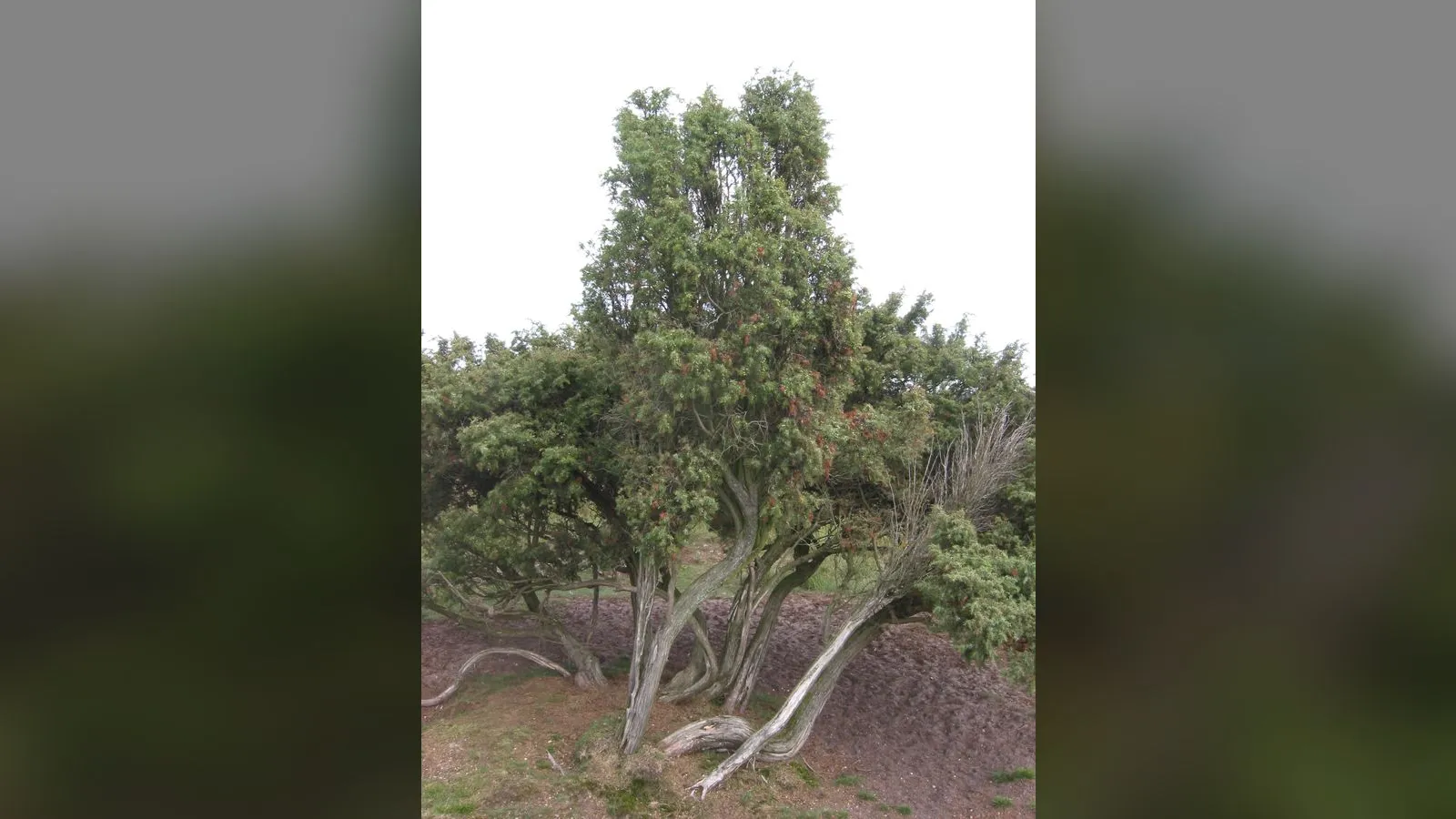

Juniper (Juniperus communis)
Contents
TL;DR
- established Juniper is one of only three conifer species native to Britain, alongside Scots pine and yew, and Scotland now holds roughly 80% of the UK's remaining juniper population — a specific, documented share of national responsibility this article states directly rather than a vague claim that juniper is "a Scottish plant."
- established Because juniper is dioecious, with separate male and female plants, isolated bushes cannot produce viable seed on their own; a genuinely self-sustaining population needs more than 50 plants scattered within 500m of each other, yet many surviving Scottish stands now number fewer than 10 — a specific, documented structural reproduction problem this article names directly rather than a vague reference to "declining numbers."
- established A soil-borne pathogen, Phytophthora austrocedrae, is actively spreading through Scottish juniper populations via infected soil and water, killing large numbers of plants especially on wet ground, and poses a direct threat to an industry: Scotland produces roughly 70% of UK gin, a spirit whose name and flavour both derive from juniper berries — a specific, documented, ongoing disease threat this article states plainly rather than treating juniper's conservation story as historical.
- established During the era of illicit Highland whisky distilling, juniper wood was deliberately chosen as fuel because it burns with minimal smoke, helping hidden stills evade detection by excise officers — a specific, documented practical reason for the wood's historical use this article names directly rather than a vague reference to "traditional fuel."
- established Juniper's conservation threats run in both directions at once: too much grazing by red deer and rabbits causes bushes to decline, while too little grazing lets faster-growing vegetation shade juniper out, meaning successful management is a genuine balancing act rather than simply "protecting the plant from browsing animals" — this article states this dual pressure directly rather than resolving it into a single simple threat.
Key Facts
- Scientific name
- Juniperus communis
- Category
- Trees
- UK native conifer status
- One of only 3 native British conifers (with Scots pine and yew)
- Scotland's share of UK population
- ~80%
- Typical lifespan
- 100–120 years (oldest UK specimen: 255 years)
- Viable population size
- 50+ plants within 500m
- Key current threat
- Phytophthora austrocedrae (soil-borne pathogen)
- Economic link
- Scotland produces ~70% of UK gin, a juniper-flavoured spirit (most gin berries are imported)
Scottish Impact Index (SI Score)
- Scottish Significance
- 8/10
- Ecological Persistence
- 7/10
- Ecological Importance
- 9/10
- Botanical Distinctiveness
- 8/10
- Conservation Significance
- 9/10
- Recognition
- 8/10
49/60
Ranked =19th of 45 in Flora
A Note on Claims and Evidence
Biology, reproduction, Scottish distribution, and grazing-balance details are drawn from Trees for Life's and Scotland's Farm Advisory Service's published assessments. Phytophthora austrocedrae disease details and the gin-industry threat are drawn from University of Exeter research reporting. Traditional whisky-fuel and gin-origin details are drawn from Trees for Life's published folklore and history record.
Timeline
Juniper establishes itself as one of only three native British conifers, occurring throughout most of Scotland, from the Borders to Orkney and the Hebrides, though common only in the Highlands, growing as an understorey shrub in open birch and pine woodland as well as on moorland and montane ground up to 1,000m.
Juniper berries flavour Highland whisky, likely serving both as flavouring and medicinal aid, while juniper wood becomes a favoured fuel for illicit hillside stills specifically because its low smoke output helps distillers avoid detection by excise officers.
Highland gatherers collect juniper berries by the bagful for export via Inverness and Aberdeen to Dutch gin distillers, cementing the plant's long-standing link to gin production, a spirit whose very name shares a common linguistic root with "juniper."
In Lothian, giving birth "under the savin tree" is used as a euphemism for a miscarriage or juniper-induced abortion, as recorded by Richard Mabey.
UK juniper populations, particularly in England, undergo substantial decline in both distribution and colony size, driven by excessive deer and rabbit grazing, moorland burning that limits regeneration, and insect seed predation, with juniper berry mites found affecting up to 82% of berries in some areas; the species becomes a UK Biodiversity Action Plan priority species and a key target under the Scottish Forestry Strategy 2006.
Richard Mabey's Flora Britannica notes that gin berries are mostly imported from eastern Europe, and that the Taynish juniper in Argyll has almost no young bushes.
Phytophthora austrocedrae, a soil-borne pathogen spreading through soil and water, is identified as an active, worsening threat to Scottish juniper, killing significant numbers of plants especially on wet sites, and is recognised as a direct risk to an industry: Scotland's gin sector, which relies on juniper berries and produces around 70% of UK gin.
Conservation efforts focus on protecting less disease-vulnerable sites, researching resistant juniper varieties, managing grazing pressure to strike a careful balance, and encouraging public biosecurity measures such as cleaning boots and equipment before and after visiting juniper habitat to limit the pathogen's spread.
Details
A native conifer status stated with its real national significance
This article names juniper's conservation status with real specificity rather than a vague claim that it is "a Scottish plant": it is one of only three conifer species native to Britain, alongside Scots pine and yew, and Scotland now holds roughly 80% of the UK's remaining juniper population. This article states this proportion directly because it clarifies that Scotland carries the overwhelming majority of national responsibility for the species' survival, not an incidental share.
A reproduction problem explained through its real structural mechanism
This article names the specific biological reason many Scottish juniper populations struggle to reproduce, rather than a vague reference to "declining numbers": because juniper is dioecious, with separate male and female plants, an isolated bush cannot produce viable seed alone, and a genuinely self-sustaining population requires more than 50 plants scattered within 500m of one another. This article states that many surviving Scottish stands now number fewer than 10 plants because it clarifies that fragmentation itself, not merely plant loss, is actively undermining the species' ability to regenerate.
A disease threat named as current, not historical
This article states directly that Phytophthora austrocedrae, a soil-borne pathogen spreading through infected soil and water, is an active, ongoing threat to Scottish juniper, killing significant numbers of plants especially on wet ground. This article names the disease's direct link to Scotland's gin industry, which produces roughly 70% of UK gin from juniper berries, because it demonstrates that juniper's conservation story is not a settled historical decline but a live, economically consequential problem.
A practical, specific reason behind a traditional use
This article names the precise reason juniper wood was chosen as fuel for illicit Highland whisky stills, rather than a vague reference to "traditional fuel": its low smoke output helped distillers avoid detection by excise officers. This article states this specific practical motivation directly because it reflects a genuine historical logic, not simply an available local wood being used by default.
A management challenge stated honestly as a balance, not a single threat
This article presents juniper's conservation management as a genuine two-sided balancing act rather than a single simple threat to guard against: too much grazing by red deer and rabbits causes bushes to decline, while too little grazing allows faster-growing vegetation to shade juniper out. This article states both pressures directly because effective conservation requires calibrating grazing levels carefully, not simply excluding herbivores from juniper sites.
The chemistry behind the gin
established Richard Mabey's The Complete New Herbal (1988) explains what gives juniper its flavour. The berries, which are botanically female cones, carry a volatile oil whose main components are pinene, myrcene and sabinene, with limonene, terpinene, camphene and thujone, alongside resin, sugars, vitamin C and tannins. This oil is why the berries are used to flavour gin and liqueurs, and why the plant's survival matters to Scotland's distillers.
traditional The same herbal records juniper as a traditional diuretic and digestive herb, and notes that chewing the berries was used to sweeten the breath. It also sets out clear cautions: juniper should not be used in pregnancy or where there is kidney disease, and the essential oil is for professional use only. These are herbal traditions rather than proven treatments.
What Flora Britannica added in 1996
established Where gin's berries actually come from. Richard Mabey, in Flora Britannica (1996), notes that native juniper had probably not been used by British distillers since the nineteenth century, and that gin berries were by then mostly imported from eastern Europe. The link between Scotland's gin industry and Scotland's wild juniper is therefore one of shared name and flavour, not of supply. The position may have shifted since 1996, but the "~70%" figure above measures gin production, not a Scottish berry harvest. Mabey does record home-grown berries being used again as a flavouring, especially with game; one contributor from Arnside in Lancashire cooked them whole with venison.
established Two very different homes. Mabey stresses that juniper is "eccentrically local". In the north it prefers cold, rainy sites on acid soils, growing with heather and bilberry on moorland and as an understorey in Highland birch and pine woods. In the south it is a plant of hot, dry chalk downland. Bushes can be prostrate or tall and conical, up to about 17 feet, and older ones tend to die out from the centre and collapse.
established An ageing Argyll population. Mabey singles out the Taynish peninsula in Argyll as one of the longest-standing juniper populations in Britain, and observes that there were almost no young bushes there. He links juniper's survival in many places to cycles of land use: grazing that opens bare ground for seedlings, followed by a pause in grazing that lets them grow. This matches the grazing balance described above, seen from the historical side.
traditional A dark Lothian euphemism. Juniper oil has an ancient reputation as an abortifacient, and Mabey records that in medieval Lothian giving birth "under the savin tree" was a euphemism for a miscarriage or a juniper-induced abortion. Savin is a related European juniper, J. sabina, whose oil is more potent and more toxic. He adds that juniper pills were still advertised as "The Lady's Friend" in the 1980s. This is social history, and it is the reason modern herbals warn against juniper in pregnancy.
established Other old uses. In Upper Teesdale juniper boughs were cut for firewood, which burns with a cedar-like scent, and for the bases of haystacks. Prickly branches were laid on top of stone walls as a substitute for barbed wire. These records are English, but they match the Highland use of juniper as a clean-burning fuel.
Did You Know?
- Richard Mabey reported in 1996 that British distillers had probably not used native juniper since the nineteenth century; most gin berries were imported.
- In medieval Lothian, "under the savin tree" was a euphemism for a miscarriage or abortion, a grim echo of juniper oil's old reputation.
- The Taynish peninsula in Argyll holds one of Britain's longest-standing juniper populations, but Mabey found almost no young bushes there.
- Juniper berries are not true berries but female cones, and their flavour comes mainly from pinene, myrcene and sabinene in the volatile oil.
- Juniper is one of only three conifer species native to Britain, alongside Scots pine and yew.
- Scotland holds roughly 80% of the UK's remaining juniper population.
- Juniper plants are either male or female, and isolated bushes cannot produce viable seed without a nearby partner of the opposite sex.
- The words "gin" and "juniper" share a common linguistic root.
- Juniper wood was a favoured fuel for illicit Highland whisky stills because it produces very little smoke, helping distillers avoid detection.
- A soil-borne disease, Phytophthora austrocedrae, is actively spreading through Scottish juniper and threatens the gin industry, which relies on juniper berries.
- The UK's oldest recorded juniper specimen lived to 255 years old.
- Insect seed predation by juniper berry mites can affect up to 82% of berries at some sites.
FAQ
1Is juniper native to Scotland?
Yes — it's one of only three conifer species native to Britain, alongside Scots pine and yew, and Scotland now holds around 80% of the UK's remaining population.
2Why do some juniper populations fail to reproduce even though they still have plants?
Because juniper has separate male and female plants, and many surviving stands are too small or isolated to include both sexes within a self-sustaining distance — a genuinely viable population needs 50+ plants within 500m.
3What is the biggest current threat to Scottish juniper?
Phytophthora austrocedrae, a soil-borne pathogen that spreads through soil and water and kills plants, especially on wet sites — it's an active, ongoing threat, not a historical one.
4Does this disease threaten the gin industry?
Scotland produces around 70% of UK gin, which relies on juniper berries for its characteristic flavour, so researchers see juniper disease as a risk to the sector. Most gin berries, however, are imported rather than picked from Scottish hillsides; Richard Mabey noted in 1996 that native juniper had probably not been used by British distillers since the nineteenth century.
5Where does juniper grow in Britain?
In two very different habitats: cold, wet, acid moorland and Highland birch and pine woods in the north, and hot, dry chalk downland in the south, according to Flora Britannica.
6Why was juniper wood used for illicit whisky stills?
Because it burns with very little smoke, helping distillers hide their stills from excise officers.
7Is grazing good or bad for juniper?
Both, depending on the amount — too much grazing damages bushes directly, while too little lets other vegetation overshadow them; the right balance is light, managed grazing.
8How long do juniper plants live?
Typically 100–120 years, though the UK's oldest recorded specimen reached 255 years.
9What gives juniper berries their flavour?
A volatile oil dominated by pinene, myrcene and sabinene, according to Richard Mabey's The Complete New Herbal (1988). It is the reason the berries flavour gin.
10What can the public do to help protect juniper?
Clean soil from boots and equipment before and after visiting juniper habitat, to help limit the spread of Phytophthora austrocedrae.
Sources and Further Reading
Primary/Institutional
- Juniper facts and information — Trees for Life
- Juniper — Scotland's National Priority Species, Farm Advisory Service
Scholarly/Critical
- Biological Flora of the British Isles: Juniperus communis L. — Journal of Ecology (Wiley)
- Phytophthora austrocedrae emerges as a serious threat to juniper (Juniperus communis) in Britain — Plant Pathology (Wiley)
- Plant diseases threaten UK whisky and gin — University of Exeter
- Richard Mabey (ed.), The Complete New Herbal (Elm Tree Books, 1988).
- Richard Mabey, Flora Britannica (Sinclair-Stevenson, 1996).
General
Caveats: Myths and Disputed Claims
- Clarification: This article does not treat juniper's conservation threats as a single simple problem; grazing pressure must be carefully balanced in both directions, and disease, fragmentation, and seed predation operate as separate, compounding pressures.
- Note: This article does not describe the Phytophthora austrocedrae threat as a past or resolved issue; current research describes it as an active, spreading pathogen with direct economic consequences for Scotland's gin industry.
- Do not assume Scottish gin is made from Scottish wild juniper; most gin berries have long been imported, and the "~70%" figure refers to Scotland's share of UK gin production, not to berries.
- Do not treat juniper's herbal uses as proven or safe for everyone. Herbals advise against it in pregnancy and kidney disease, and its essential oil is not for home internal use. This article is not health advice.
Card 011 · Flora