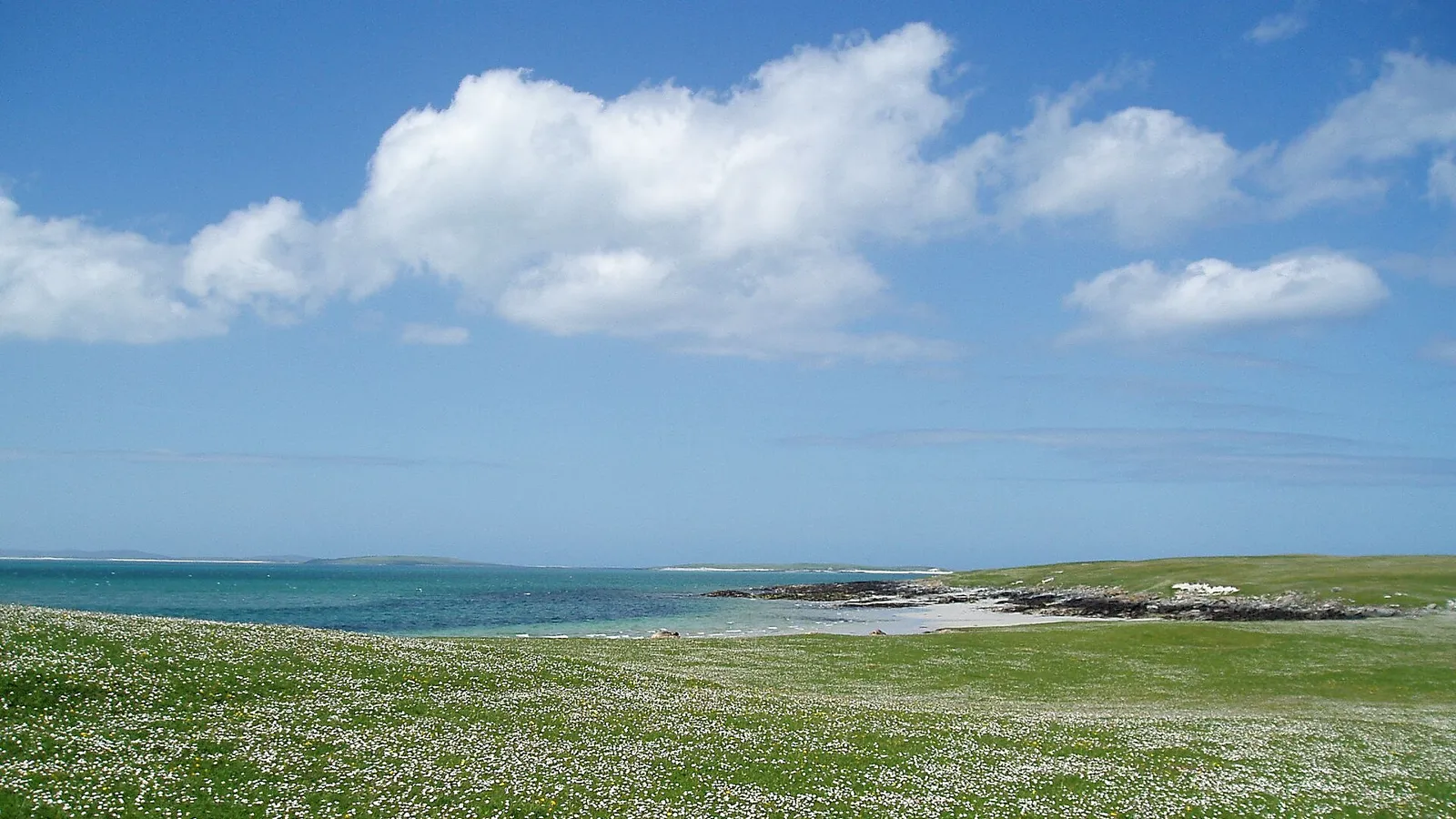

Machair
Contents
TL;DR
- established Machair is a globally rare habitat, a fertile, low-lying, calcium-rich grassland formed from windblown shell sand, found almost nowhere else on Earth outside the northwestern coastlines of Scotland and Ireland, with Scotland's best examples concentrated on North and South Uist, Harris, and Lewis in the Outer Hebrides — a specific, documented geographic rarity this article states directly rather than a vague claim that machair is simply "a type of grassland."
- established Machair's exceptional biodiversity is not an accident of untouched wilderness but a direct, documented consequence of centuries of traditional low-intensity human farming: light cattle grazing, hay cutting, and rotational cropping without artificial fertilisers or pesticides have actively shaped and sustained the habitat's ecological balance, meaning machair is fundamentally a co-created, human-managed landscape rather than an untouched natural one — this article states this directly rather than presenting machair's biodiversity as existing independently of the farming communities who built it.
- established The single greatest current threat to machair is not direct environmental destruction but the economic decline of the very crofting system that created it: as Common Agricultural Policy-era subsidy changes made traditional rotational farming less economically viable, undergrazing and land abandonment have followed, in some cases requiring increased fertiliser and herbicide use to compensate, while traditional machair cultivation now "only really occurs on the Uists" — a specific, documented socioeconomic threat this article names directly rather than attributing machair's vulnerability only to climate or coastal erosion.
- established Machair's formation depends on genuinely high calcium carbonate concentrations, ranging from 20% to 80% on the beaches themselves and decreasing further inland, derived from wind-blown fragments of crushed shell rather than ordinary silica sand, making the habitat alkaline and distinct even from the dune systems found on Scotland's own east coast — a specific, documented geological mechanism this article names directly rather than a vague claim that machair is "sandy ground."
- established Machair supports a genuinely dense concentration of nationally and internationally significant species, including the corncrake, a bird in serious decline across most of Britain, alongside twite, dunlin, redshank, ringed plover, the rare great yellow bumblebee and northern colletes bee, and orchids including Irish lady's-tresses and the Hebridean spotted orchid — a specific, documented list of dependent species this article names directly rather than a vague claim that machair "supports wildlife."
Key Facts
- Category
- Ecosystem/habitat
- Gaelic meaning
- "Fertile, low-lying plain"
- Global distribution
- NW Scotland and NW Ireland only
- Best Scottish examples
- North/South Uist, Harris, Lewis
- Formation
- Windblown, crushed-shell sand (calcium carbonate 20–80%)
- Key sustaining practice
- Traditional rotational crofting agriculture
- Primary current threat
- Decline of economically viable crofting
- Key indicator species
- Corncrake
A Note on Claims and Evidence
Formation geology, global rarity and distribution, traditional agricultural connection, dependent species, and current threats are drawn from Wikipedia's published research record on machair. The habitat's traditional low-intensity farming character, its current biodiversity significance, and the specific modern pressures facing crofting-dependent machair management are drawn from the Wildlife Trusts' published habitat assessment.
Timeline
Wave action rolls and crushes shell fragments on Scotland's and Ireland's northwestern coasts, with wind then blowing the resulting calcium-rich sand inland to form machair's characteristic low, fertile plains, highly calcareous and alkaline, distinct from Scotland's east-coast dune systems.
Early farming communities begin clearing trees and settling machair coastlines, applying seaweed as a protective, nutrient-adding soil cover and grazing cattle and sheep, whose grazing keeps grass short while creating the tussock structure that benefits ground-nesting birds; limited traditional crops, including oats, rye, and bere barley, become established in rotational cultivation.
Centuries of light cattle grazing, hay cutting, and low-intensity rotational crop farming, carried out without artificial fertilisers or pesticides, actively shape and sustain machair's exceptional plant and bird diversity, supporting species including the corncrake, twite, dunlin, redshank, ringed plover, rare bees including the great yellow bumblebee and northern colletes bee, and orchids including Irish lady's-tresses and the Hebridean spotted orchid.
Changes in Common Agricultural Policy-era subsidy structures make traditional rotational crofting less economically viable, leading to undergrazing and land abandonment in many areas, in some cases requiring increased fertiliser and herbicide use to compensate; traditional machair cultivation now survives in its fullest form mainly on the Uists.
Machair remains a globally rare, documented habitat found almost nowhere outside northwestern Scotland and Ireland, its future genuinely dependent on continued agri-environment funding support for the crofting communities whose traditional farming methods created and continue to sustain its ecological character, even as rising sea levels, coastal erosion, and storm damage add further documented pressure.
Details
A rarity stated with its real, narrow global distribution
This article names machair's global rarity with real specificity rather than a vague claim that it is "a type of grassland": it is found almost nowhere else on Earth outside the northwestern coastlines of Scotland and Ireland, with Scotland's best examples concentrated on North and South Uist, Harris, and Lewis. This article states this specific distribution because it clarifies that machair represents a genuinely globally rare habitat type, not merely a locally distinctive one.
A landscape explained honestly as human-made, not untouched wilderness
This article states directly that machair's exceptional biodiversity results from centuries of traditional low-intensity human farming, light cattle grazing, hay cutting, and rotational cropping without artificial fertilisers or pesticides, rather than presenting the habitat's richness as existing independently of the farming communities who shaped it. This article names this human dimension because it is the real, documented ecological history of the habitat: machair is fundamentally co-created, not an untouched natural landscape that happens to host farmers.
A threat named through its real, uncomfortable economic cause
This article names the primary documented threat to machair directly rather than attributing its vulnerability only to climate change or coastal erosion: the economic decline of the crofting system itself, driven by Common Agricultural Policy-era subsidy changes that made traditional rotational farming less viable, leading to undergrazing, land abandonment, and in some cases increased fertiliser and herbicide use to compensate. This article states this uncomfortable economic cause because presenting only environmental threats would omit the real, documented socioeconomic pressure currently facing machair's survival.
A formation mechanism explained through its real geological process
This article names the specific process behind machair's formation rather than a vague claim that it is "sandy ground": wind-blown fragments of crushed shell, with calcium carbonate concentrations ranging from 20% to 80% on the beaches and decreasing inland, create an alkaline, highly calcareous plain distinct even from Scotland's own east-coast dune systems. This article states this specific mechanism because it is the real, documented geological process that distinguishes machair from ordinary coastal dune or grassland habitat.
A dependent species list named with real specificity
This article names machair's dependent species directly rather than a vague claim that it "supports wildlife": the corncrake, a bird in serious decline across most of Britain, alongside twite, dunlin, redshank, ringed plover, the rare great yellow bumblebee and northern colletes bee, and orchids including Irish lady's-tresses and the Hebridean spotted orchid. This article states this specific list because it represents a genuinely documented concentration of nationally and internationally significant species, not a general impression of habitat richness.
Machair birds: corncrake, dunlin and ringed plover
established Mark Cocker and Richard Mabey, in Birds Britannica (2005), show why machair and its crofts matter so much to birds. The corncrake bred across almost all of Britain until mechanical mowers spread north and west from the mid-nineteenth century. Machines cut from the field edge inwards and trapped birds in the last stand of grass. The authors argue it is no coincidence that the bird's last refuge was the extreme north-west, "where agricultural mechanisation was slowest to arrive" and crops are cut latest in the season. The late-cut hay and cover of crofted machair are exactly what that refuge consists of.
established Machair is also a stronghold for breeding waders. The book records that the main British breeding concentrations of ringed plover are on the open sandy machair of North and South Uist. Dunlin, scattered thinly across most of their upland range, become semi-colonial on the coastal machair of the two Uists, with nests sometimes just a few feet apart.
established Hebridean crofters have lived closely with these birds. Birds Britannica tells of a corncrake on Tiree that walked into a woman's house five summers running to feed on kitchen scraps, and of one that wintered on Barra in 1999 and took its turn at the hens' feed. Northern island speech reflects the ringed plover's love of sand: in Orkney and Shetland it was the "sand lo" or "sandy lo", from the Norse word for plover.
Did You Know?
- Machair is found almost nowhere else on Earth outside the northwestern coastlines of Scotland and Ireland.
- It's formed from windblown shell sand, with calcium carbonate concentrations reaching up to 80% on the beaches themselves.
- Machair's rich biodiversity isn't accidental wilderness — it's the direct result of centuries of traditional low-intensity crofting farming.
- The habitat's single biggest current threat is the economic decline of crofting itself, not direct environmental destruction.
- Traditional machair cultivation in its fullest form now survives mainly on the Uists.
- Machair supports the corncrake, a bird in serious decline across most of Britain, alongside rare bees and orchids found almost nowhere else.
- Farmers have been shaping machair since the Neolithic, using seaweed to protect and fertilise the soil.
- On the machair of the Uists, dunlin can nest just a few feet apart, unlike their scattered pairs on mainland moors.
- The main British breeding concentrations of ringed plover are on the machair of North and South Uist.
FAQ
1What exactly is machair?
A globally rare, fertile, low-lying grassland formed from windblown, calcium-rich shell sand, found almost nowhere outside northwestern Scotland and Ireland.
2Is machair a natural, untouched habitat?
No — its exceptional biodiversity is the direct, documented result of centuries of traditional low-intensity farming: cattle grazing, hay cutting, and rotational cropping without artificial fertilisers or pesticides.
3What's the biggest threat to machair today?
The economic decline of the crofting system that created and sustains it, as subsidy changes have made traditional farming less viable, leading to undergrazing and abandonment in many areas.
4Where is machair best preserved in Scotland?
North and South Uist, Harris, and Lewis in the Outer Hebrides, with traditional cultivation in its fullest form mainly surviving on the Uists.
5What makes machair's sand different from ordinary beach sand?
It's formed from crushed shell fragments, giving it very high calcium carbonate content, up to 80% on the beaches, making it alkaline rather than silica-based.
6What wildlife depends on machair?
Species including the corncrake, twite, dunlin, redshank, rare bees like the great yellow bumblebee, and orchids including Irish lady's-tresses.
7Why is the corncrake so closely tied to machair?
Mechanised mowing wiped the corncrake out across most of Britain. The crofted machair of the north-west, where machines came last and hay is cut late, became its final refuge.
8Which waders breed on machair?
Ringed plover, dunlin, redshank and others. Birds Britannica (2005) records the Uist machair as the main British breeding concentration of ringed plover, with dunlin nesting there at unusually high densities.
9How long have people been farming machair?
Farming on the machair goes back to the Neolithic, which began in Scotland around 4000 BC.
Sources and Further Reading
Primary/Institutional
Scholarly/Critical
- Mark Cocker and Richard Mabey, Birds Britannica (Chatto & Windus, 2005)
- The conservation of Scottish Machair: a new approach — Glasgow Natural History Society
- UK BAP Habitats: Machair — JNCC
General
Caveats: Myths and Disputed Claims
- Clarification: This article does not present machair as untouched natural wilderness; its biodiversity is the direct, documented result of centuries of traditional human farming practice.
- Note: This article does not attribute machair's vulnerability only to climate change or coastal erosion; the primary documented threat is the economic decline of the crofting system itself.
Card 049 · Flora