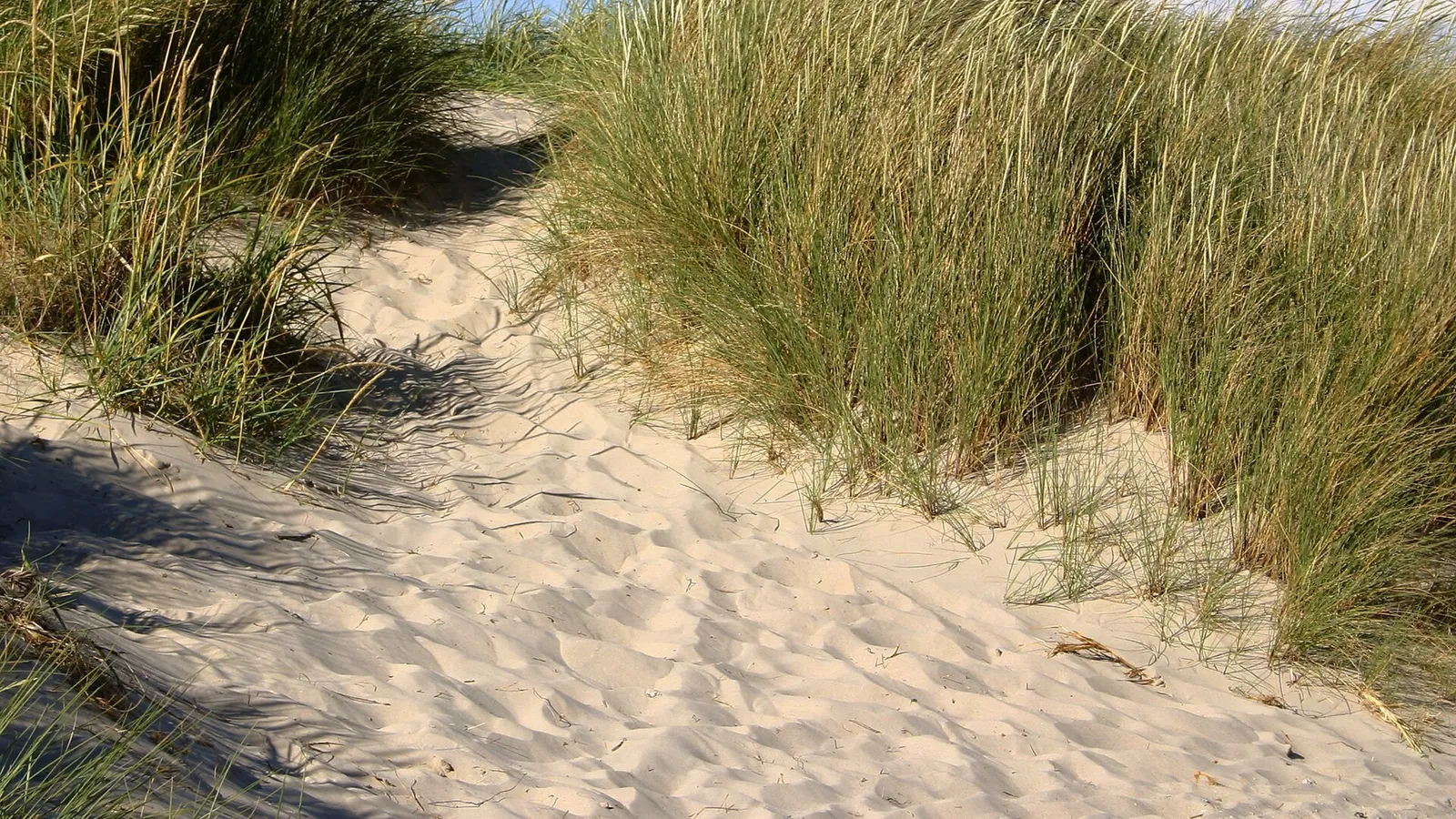

Marram Grass (Ammophila arenaria)
Contents
TL;DR
- established Marram grass actively builds sand dunes rather than merely tolerating them: when wind deposits sand onto the plant, it grows up through the new deposit, with its extensive root and rhizome system helping to stabilise the accumulating sand into embryo and semi-fixed dune habitats — a specific, documented mechanism this article states directly rather than a vague claim that the grass "holds dunes together."
- established Marram grass survives genuinely extreme conditions: at Braunton Burrows in Devon, the species thrives even where the water table lies 26 metres below ground, alongside tolerance of salty conditions and wide daily temperature fluctuations — a specific, documented physiological tolerance this article names directly rather than a vague claim that the plant is "hardy."
- established In the Highlands and Islands, marram grass, known in Gaelic as mura, was traditionally used for roof thatching, held down not by fixing it directly to the roof but by a system of netting and stone weights, a specific technique developed because the material's lower durability in Scotland's wet climate required a different approach from English thatching methods — a specific, documented regional building technique this article states directly rather than a vague reference to the plant's "traditional uses."
- established Historic overharvesting of marram grass for thatching and rope-making directly caused sand dune erosion in parts of Scotland, a documented environmental consequence that has led to cutting now being permitted only in some areas under tightly controlled conditions — this article states this cause-and-effect relationship directly rather than treating marram harvesting as a traditional practice without environmental cost.
- established The traditional craft of hand-twisting marram grass into rope used for securing thatch has been effectively lost in Scotland: coir rope replaced it in the late 19th century, and the specific grade of marram grass once used for rope-making is no longer available, making a full return to hand rope-making economically impractical today — a specific, documented loss of traditional craft knowledge and material this article names directly rather than presenting the thatching tradition as fully intact.
Key Facts
- Scientific name
- Ammophila arenaria
- Category
- Flora
- Gaelic name
- Mura
- Growth height
- Up to ~1m
- Flowering period
- July–August (seeds dispersed August–September)
- Key tolerance
- Water table as deep as 26m below ground (Braunton Burrows, Devon)
- Traditional use
- Roof thatching, rope, baskets, paper
- Current harvesting status
- Tightly controlled, permitted only in some areas
Scottish Impact Index (SI Score)
- Scottish Significance
- 9/10
- Ecological Persistence
- 9/10
- Ecological Importance
- 10/10
- Botanical Distinctiveness
- 7/10
- Conservation Significance
- 8/10
- Recognition
- 8/10
51/60
Ranked =9th of 45 in Flora
A Note on Claims and Evidence
Biology, the sand-stabilisation mechanism, physiological tolerance, and general traditional uses are drawn from Dynamic Dunescapes' published species assessment. Highlands and Islands thatching technique, the Gaelic name, overharvesting-driven dune erosion, and the loss of traditional rope-making craft are drawn from Heritage Crafts' published assessment of the Highlands and Islands thatching tradition.
Timeline
Marram grass establishes itself across Scotland's sandy coastlines, actively building embryo and semi-fixed dune habitats through its distinctive growth response to sand burial, tolerating salty conditions, wide daily temperature fluctuations, and genuinely extreme water scarcity.
In the Highlands and Islands, marram grass, known in Gaelic as mura, becomes a locally available thatching material, applied not by fixing it directly to the roof but through a system of netting and stone weights, with rope hand-twisted from the grass used to secure the thatch; new layers are installed over existing thatch, settling and compressing naturally over several years before requiring renewal.
Overharvesting of marram grass for thatching and rope-making causes documented sand dune erosion in parts of Scotland, establishing a direct environmental cost to traditional harvesting practices.
Coir rope replaces hand-twisted marram grass rope in thatching practice, and the specific grade of marram grass once used for rope-making becomes unavailable, effectively ending that strand of the traditional craft; cotton nets later replace handmade netting as well.
In response to the documented erosion risk, cutting of marram grass is now permitted only in some areas under tightly controlled conditions, while Historic Environment Scotland provides targeted grants to support the revival of marram grass thatching skills.
Marram grass remains foundational to Scotland's dune ecosystems, actively stabilising sand into habitat supporting numerous insect and plant species, even as the traditional craft knowledge and specific plant material once used for hand-twisted thatching rope has been substantially lost.
Details
A dune-building mechanism explained through its real process
This article names marram grass's relationship with sand dunes precisely rather than a vague claim that the grass "holds dunes together": when wind deposits sand onto the plant, it grows up through the new deposit, its extensive root and rhizome system stabilising the accumulating sand into embryo and semi-fixed dune habitats. This article states this active growth-and-burial mechanism directly because it clarifies that marram grass does not merely survive dune conditions but is the active agent constructing the dune habitat itself.
A physiological tolerance stated with its real documented extreme
This article names marram grass's drought tolerance with real specificity rather than a vague claim that the plant is "hardy": at Braunton Burrows in Devon, the species thrives even where the water table lies 26 metres below ground. This article states this specific figure because it represents a genuinely extreme, documented physiological tolerance, not a general impression of coastal plant resilience.
A regional thatching technique named with its real specific method
This article states the Highlands and Islands thatching technique with real specificity rather than a vague reference to the plant's "traditional uses": marram grass, known in Gaelic as mura, was held down not by fixing it directly to the roof but by a system of netting and stone weights, a technique developed because the material's lower durability in Scotland's wet climate required a different approach from English thatching methods. This article names this specific technique because it represents a genuine, documented regional building adaptation, not a generic description of thatched roofing.
An environmental cost named directly, not smoothed over
This article states plainly that historic overharvesting of marram grass for thatching and rope-making caused documented sand dune erosion in parts of Scotland, leading to today's tightly controlled harvesting restrictions. This article names this cause-and-effect relationship directly because treating marram harvesting as a traditional practice without environmental cost would misrepresent its real historical impact on the dune systems the grass itself helps build.
A lost craft skill acknowledged rather than assumed intact
This article names the specific loss of marram grass rope-making directly rather than presenting the thatching tradition as fully intact: coir rope replaced hand-twisted marram rope in the late 19th century, and the specific grade of marram grass once used for rope-making is no longer available, making a full return to hand rope-making economically impractical today. This article states this specific material and skill loss because it clarifies that reviving marram thatching today operates within real, documented constraints, not as a simple continuation of an unbroken tradition.
Marram in Flora Britannica
shared Richard Mabey, in Flora Britannica (1996), gives the adaptations behind the dune-building described above. Marram's leaves have glossy cuticles against blasting sand and roll into tubes in drying winds to cut water loss, while its matted roots bind the sand. He notes that the mobile dunes it stabilises can advance as much as 30 feet a year. His account has no Scottish material, but it shows that the Highland and Island crafts belonged to a wider British tradition.
established The fullest testimony Mabey gathered comes from Wales. A contributor described a marram-weaving industry along the south-west coast of Anglesey, making mats for haystacks, barn roofs and cucumber frames, nets and cordage for fishermen, and even shoes. The grass was cut in late summer and dried in the dune-slacks, each family harvesting its own dune by tradition. In Lancashire, where marram was called starr-grass, a contributor said it was still made into brushes. Peter Marren's appendix on Scottish names in the same book records the similar name star-reed in Scotland, but for common reed, not marram.
shared Mabey quotes the food and crafts writer Dorothy Hartley, who found a woven marram hassock, perhaps a century old, in the crypt of a ruined Irish church. She judged it as springy as growing grass: "the marram grass endured" where straw, reed or rush would have perished. That supports the durability that made marram worth using for Scottish thatch and rope. Hartley's further idea that woven marram inspired the curves of Celtic design is her own speculation and has no firm evidence behind it.
shared Mabey confirms that marram harvesting had been made illegal in some western coastal areas to protect dunes, in line with the controls described above. He thought that something of an overreaction, because marram is a pioneer that needs open sand and tends to die back once a dune is fully covered. That was a 1996 opinion. Current dune management advice should be followed, and any cutting needs the landowner's and the conservation agencies' consent.
Did You Know?
- Marram grass actively builds sand dunes: when wind buries it in sand, it simply grows up through the new deposit, stabilising it as it goes.
- At Braunton Burrows in Devon, marram grass thrives even where the water table is 26 metres below ground.
- In Gaelic, marram grass is called mura, and it was traditionally used for roof thatching in the Highlands and Islands.
- Highland and Island thatch was held down by netting and stone weights rather than fixed directly to the roof, a technique suited to Scotland's wet climate.
- Historic overharvesting of marram grass for thatching and rope caused documented sand dune erosion in parts of Scotland.
- The specific grade of marram grass once used for hand-twisted thatching rope is no longer available — coir rope replaced it in the late 19th century.
- Marram grass cutting today is permitted only in some areas under tightly controlled conditions, to protect dune systems.
- Marram leaves roll into tubes in drying winds, cutting their exposed surface and saving water.
- On Anglesey, marram was once woven into mats, fishing nets, cordage and even shoes.
- Dorothy Hartley found a woven marram stool, perhaps a century old, that was still springy.
FAQ
1How does marram grass actually build sand dunes?
When wind deposits sand onto the plant, it grows up through the new deposit, and its extensive root system stabilises the accumulating sand into embryo and semi-fixed dune habitats.
2How drought-tolerant is marram grass?
Extremely — at Braunton Burrows in Devon, it thrives even where the water table lies 26 metres below ground.
3What was marram grass traditionally used for in Scotland?
Roof thatching in the Highlands and Islands, where it was known as mura and held down with netting and stone weights rather than fixed directly to the roof.
4Did harvesting marram grass cause any environmental problems?
Yes — historic overharvesting for thatching and rope-making caused documented sand dune erosion in parts of Scotland, which is why cutting is now tightly controlled.
5Can marram grass still be hand-twisted into rope for thatching today?
Not easily — coir rope replaced it in the late 19th century, and the specific grade of marram grass once used for rope-making is no longer available.
6Is marram grass harvesting still allowed?
Only in some areas, under tightly controlled conditions, to protect dune systems from erosion.
7Why is marram grass ecologically important beyond dune-building?
The sandy habitats it creates and stabilises are vitally important for many insect and plant species that specifically need sandy soils.
8How does marram survive blowing sand and salt wind?
Richard Mabey's Flora Britannica (1996) describes glossy leaf cuticles that resist abrasion and leaves that roll into tubes to save water in drying winds, while its matted roots bind the sand.
9Was marram used outside Scotland?
Yes. Mabey records a large marram-weaving industry on Anglesey in the nineteenth century and brush-making in Lancashire, where it was called starr-grass.
Sources and Further Reading
Primary/Institutional
Scholarly/Critical
- Ammophila arenaria — an overview — ScienceDirect Topics
- Fact File: Marram grass (Ammophila arenaria) — Natural Resources Wales
- Richard Mabey, Flora Britannica (Sinclair-Stevenson, 1996), including Peter Marren's appendix on Scottish vernacular plant names.
General
Caveats: Myths and Disputed Claims
- Clarification: This article does not treat marram grass harvesting as a traditional practice without environmental cost; historic overharvesting directly caused documented sand dune erosion in parts of Scotland.
- Note: This article does not present Highlands and Islands marram thatching as a fully intact, unbroken tradition; the specific craft of hand-twisting marram rope has been effectively lost since the late 19th century.
- Do not present Dorothy Hartley's idea that woven marram shaped Celtic scroll-work as established; it is her speculation.
- Do not confuse the Lancashire name starr-grass (marram) with the Scots star-reed, which Peter Marren records for common reed.
Card 033 · Flora