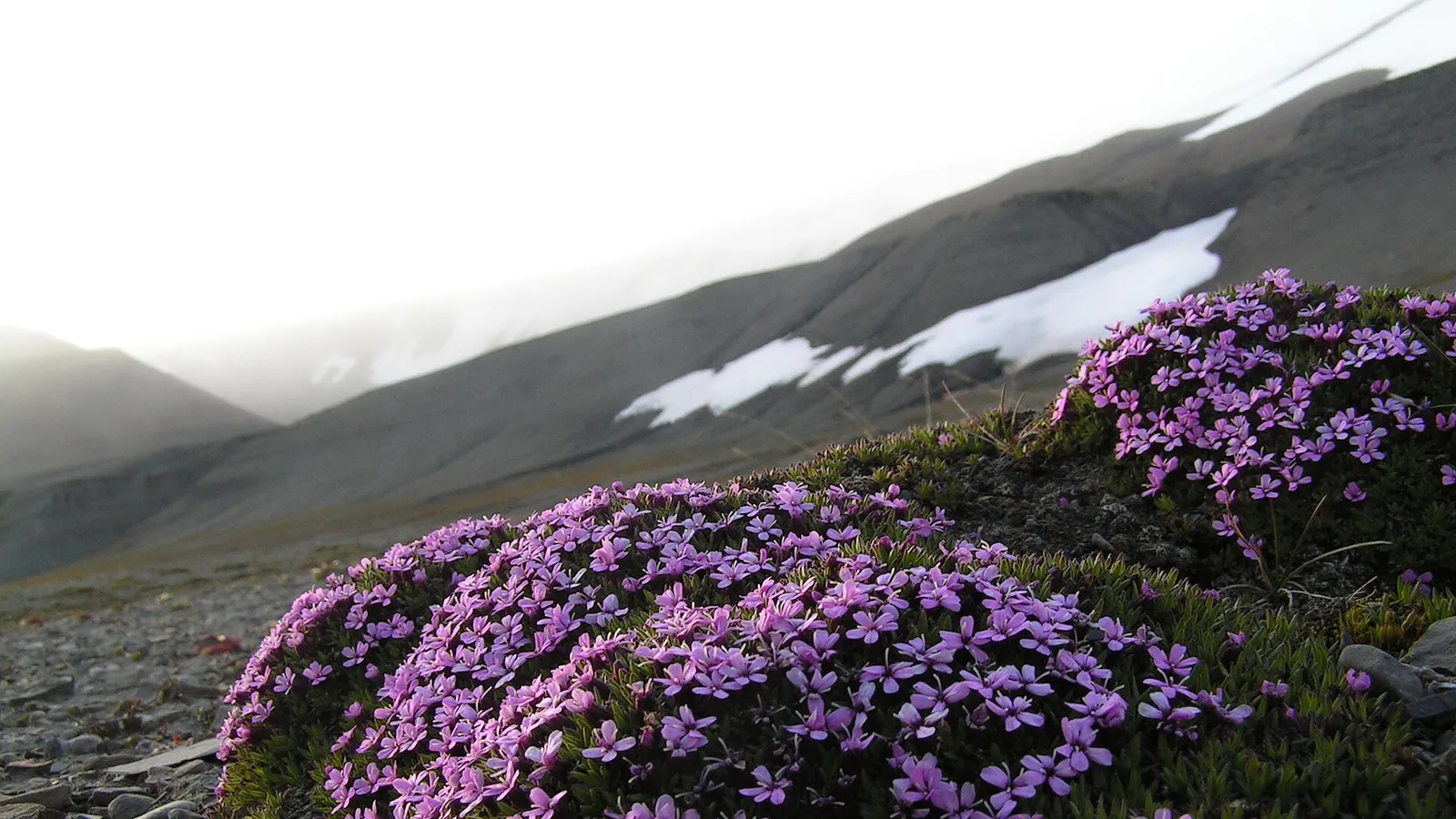

Moss Campion (Silene acaulis)
Contents
TL;DR
- established Moss campion grows as a dense, ground-hugging cushion that builds its own warmer microclimate, with measurably higher temperatures inside the cushion than the surrounding air when the sun shines — a specific, documented thermal adaptation this article states directly rather than a vague claim that the plant "copes with cold."
- established Individual moss campion cushions are genuinely long-lived: specimens in Colorado reach 75–100 years, Alaskan plants can reach around 300 years, and the oldest documented moss campion on record is 350 years old with a diameter of two feet — a specific, documented longevity record this article states directly rather than a vague claim that the plant is "slow-growing."
- established Moss campion cushions produce female, male, or hermaphrodite flowers, and a single cushion can change the sex of its flowers from one year to the next, with female flowers becoming more frequent at higher elevations — a specific, documented reproductive flexibility this article names directly rather than treating the plant's sex expression as fixed.
- disputed Scotland's arctic-alpine plant community faces a well-documented "elevator to extinction" threat, in which species retreating upslope to escape rising temperatures eventually run out of mountain left to climb; related Scottish arctic-alpine species have already shown severe, specifically quantified declines — snow pearlwort down 66% since the mid-1990s and now found only metres from a summit, drooping saxifrage and mountain sandwort both down over 50% — but this article does not attribute these specific figures to moss campion itself, since the cited research names those three species specifically and does not report equivalent figures for moss campion.
- established Research into moss campion's own response to warming finds a genuinely two-stage pattern: initial warming has been shown to benefit flowering and seed production, but longer-term projections point toward climate-driven fast decline across both North America and the British Isles — this article states both halves of this finding directly rather than only the short-term benefit or only the longer-term risk.
Key Facts
- Scientific name
- Silene acaulis
- Category
- Flora
- Growth form
- Dense, ground-hugging cushion
- Flower width
- 6–12mm, typically pink
- Oldest documented specimen
- 350 years old, two feet in diameter
- Sex expression
- Female, male, or hermaphrodite; can change year to year
- Key habitat
- Scottish mountain summits and arctic-alpine ground; also down to near sea level on exposed coasts in the far north and the Northern Isles
- Wider threat context
- "Elevator to extinction" facing Scotland's arctic-alpine flora
Scottish Impact Index (SI Score)
- Scottish Significance
- 8/10
- Ecological Persistence
- 8/10
- Ecological Importance
- 6/10
- Botanical Distinctiveness
- 9/10
- Conservation Significance
- 8/10
- Recognition
- 7/10
46/60
Ranked =27th of 45 in Flora
A Note on Claims and Evidence
Biology, cushion microclimate mechanism, longevity records, flower-sex flexibility, and climate-response research are drawn from the species' Wikipedia-summarised research record. The "elevator to extinction" threat mechanism and the specific decline figures for snow pearlwort, drooping saxifrage, and mountain sandwort are drawn from the Botanical Society of Britain and Ireland's published coverage of University of Stirling research; these figures are reported for those named species specifically, not for moss campion.
Timeline
Moss campion establishes itself across arctic-alpine ground in the Scottish Highlands and the wider Northern Hemisphere, forming dense cushions that persist for decades to centuries, with dead foliage retained within the cushion for years as part of its structure.
Individual plants grow extremely slowly but persist for a genuinely long time, with recorded lifespans reaching 75–100 years in Colorado, around 300 years in Alaska, and up to 350 years in the oldest documented specimen, which had grown to two feet in diameter.
Cushions produce solitary, star-shaped pink flowers that may be female, male, or hermaphrodite, with a cushion capable of changing which sex its flowers express from one year to the next, and female flowers becoming more frequent at higher elevations.
Climate studies find that initial warming benefits moss campion's flowering and seed production, while longer-term projections point toward climate-driven fast decline across North America and the British Isles; separately, University of Stirling research documents severe recent declines in related Scottish arctic-alpine species, including snow pearlwort (down 66% since the mid-1990s, now classified endangered), drooping saxifrage, and mountain sandwort (both down over 50%), attributing the pattern to an "elevator to extinction" mechanism as species run out of higher ground to retreat to.
Moss campion remains a long-lived, resilient-seeming presence on Scotland's mountain summits, while belonging to an arctic-alpine plant community now recognised as facing a genuine, documented climate-driven extinction risk, even where the specific decline figures measured for other named species have not been separately reported for moss campion itself.
Details
A thermal adaptation explained through its real mechanism
This article names the mechanism behind moss campion's cold tolerance directly rather than a vague claim that it "copes with cold": its dense cushion form generates its own warmer microclimate, with measurably higher internal temperatures than the surrounding air when the sun shines. This article states this specific mechanism because it is the real structural basis for the plant's survival in exposed, high-altitude conditions, not an incidental feature of its growth form.
A longevity record stated with its real documented figures
This article names moss campion's lifespan with real specificity rather than a vague claim that it is "slow-growing": Colorado specimens reach 75–100 years, Alaskan plants can reach around 300 years, and the oldest documented individual on record is 350 years old with a two-foot diameter. This article states these specific figures because they represent a genuinely remarkable, measured longevity for such a small-looking plant, not an assumed trait of alpine cushion species generally.
A reproductive flexibility named rather than assumed fixed
This article states moss campion's sex expression precisely rather than treating it as fixed: cushions can be female, male, or hermaphrodite, and an individual cushion can change which sex its flowers express from one year to the next, with female flowers becoming more frequent at higher elevations. This article names this flexibility directly because it is a genuinely documented biological trait, not a simplification of the plant's reproductive biology.
A shared climate threat, stated without over-attributing specific figures
This article names the "elevator to extinction" mechanism facing Scotland's arctic-alpine plant community directly, including the severe, specifically measured declines recorded in snow pearlwort, drooping saxifrage, and mountain sandwort, because moss campion belongs to the same threatened habitat and faces the same underlying mechanism: upslope retreat from warming temperatures running out of mountain to climb. This article is careful not to attribute these specific percentage declines to moss campion itself, since the cited research reports them for those three named species rather than for moss campion, and conflating them would overstate what is directly documented for this particular plant.
A two-stage climate finding, stated in full rather than selectively
This article presents moss campion's own documented response to warming with both of its genuinely contrasting findings rather than only one: initial warming has been shown to benefit the plant's flowering and seed production, while longer-term projections separately point toward climate-driven fast decline across North America and the British Isles. This article states both halves because reporting only the short-term benefit, or only the longer-term risk, would each misrepresent the fuller, more complicated picture researchers have actually found.
Where the name "campion" comes from
shared Richard Mabey, in Flora Britannica (1996), does not give moss campion an entry of its own, but he explains the family name. "Campion" is a fourteenth-century word, a doublet of "champion". It may be that these flowers were seen as champion's flowers, fit for a garland. But the word was not attached to plants in English until the sixteenth century, so Mabey also offers a second explanation: a later sense of "champion" or "champaign", meaning level, open country. Neither is proven. "Moss" needs no explaining; the tight green cushion looks like moss until it flowers.
Did You Know?
- Moss campion cushions generate their own warmer microclimate, with measurably higher internal temperatures than the surrounding air in sunlight.
- The oldest documented moss campion plant is 350 years old and two feet in diameter.
- A single cushion can produce female, male, or hermaphrodite flowers, and can change which sex it expresses from year to year.
- Female flowers become more common at higher elevations.
- Related Scottish arctic-alpine plants face a documented "elevator to extinction" threat, running out of cooler ground to retreat to as temperatures rise — snow pearlwort has declined 66% since the mid-1990s.
- Research on moss campion itself finds a mixed climate picture: initial warming can boost its flowering, but longer-term projections point to fast decline.
- Dead foliage persists within moss campion cushions for years, forming part of the plant's physical structure.
FAQ
1How does moss campion survive such exposed, cold conditions?
Its dense cushion form creates its own warmer microclimate, with measurably higher internal temperatures than the surrounding air when the sun shines.
2How long can moss campion plants live?
Individual cushions can live for centuries — the oldest documented specimen is 350 years old, with Alaskan plants recorded reaching around 300 years.
3Does moss campion have male and female plants?
Not fixed ones — individual cushions can produce female, male, or hermaphrodite flowers, and can even change which sex they express from year to year.
4Is moss campion itself declining due to climate change?
Research shows a mixed picture: initial warming has been shown to benefit its flowering and seed production, but longer-term projections point to climate-driven fast decline across North America and the British Isles.
5What is the "elevator to extinction" facing Scotland's mountain plants?
As temperatures rise, arctic-alpine species retreat upslope to stay cool, but mountains have a finite height — species like snow pearlwort, drooping saxifrage, and mountain sandwort have already declined severely as a result.
6Has moss campion declined by the same amount as those other species?
That's not established by the available research — the severe decline figures reported (such as snow pearlwort's 66% drop) are specific to those named species, not separately measured for moss campion.
7Where does moss campion grow in Scotland?
On exposed mountain summits and other arctic-alpine ground across the Highlands, and, in the far north of Scotland and the Northern Isles, on exposed cliff-tops and coastal heath close to sea level.
8Why is it called a campion?
The word is a doublet of "champion". Richard Mabey's Flora Britannica (1996) suggests either champion's flowers fit for a garland, or a later sense meaning open country; the origin is not settled.
Sources and Further Reading
Primary/Institutional
- Silene acaulis — Wikipedia
- Arctic-alpine plants: on the 'elevator to extinction'? — Botanical Society of Britain & Ireland
Scholarly/Critical
- Tiny but tenacious: arctic-alpine plants are engineers and warning bells — The Conversation
- Scottish botanist raises extinction alarm on arctic-alpine plants — Botanical Society of Britain & Ireland
- Richard Mabey, Flora Britannica (Sinclair-Stevenson, 1996).
General
Caveats: Myths and Disputed Claims
- Clarification: This article does not attribute the specific decline percentages measured for snow pearlwort, drooping saxifrage, or mountain sandwort to moss campion itself; those figures are reported for those named species in the cited research, not separately for moss campion.
- Note: This article does not present moss campion's response to warming as simply positive or simply negative; documented research shows an initial benefit to flowering alongside a separately projected longer-term decline.
Card 021 · Flora