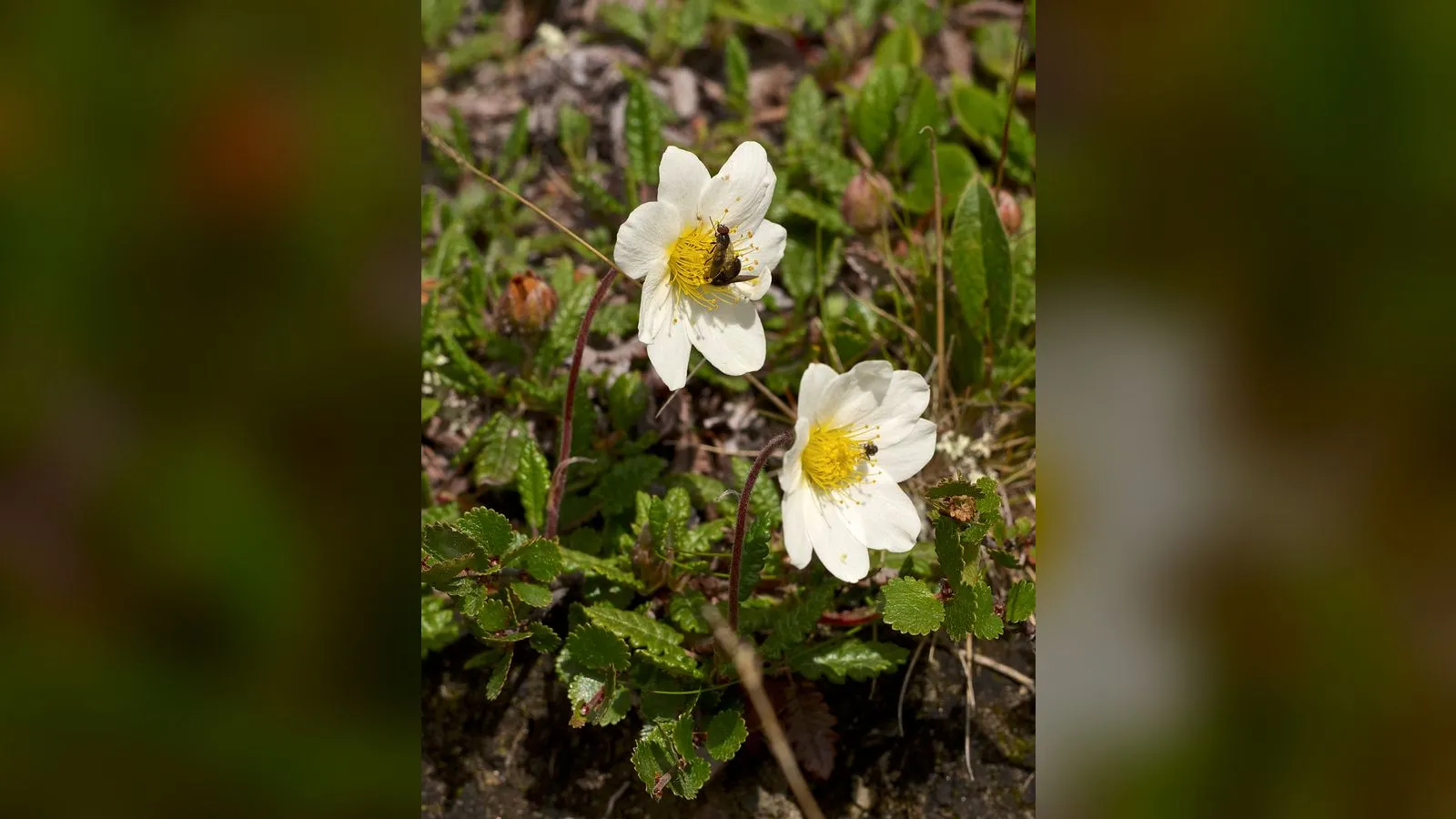

Mountain Avens (Dryas octopetala)
Contents
TL;DR
- established An entire named period of Earth's climate history, the Younger Dryas — the sharp, roughly 1,200-year return to near-glacial cold that interrupted warming at the end of the last ice age around 12,900 years ago — is named directly after this plant, because vast quantities of its distinctive pollen were found in sediment cores dating from that period, when the species was far more widespread across the Northern Hemisphere than it is today — a specific, documented scientific naming this article states directly rather than a vague claim that mountain avens is "an ice age plant."
- established Mountain avens survives today in Scotland as a genuine ice age relict, now confined largely to the Highlands within Britain, where it persists in fast-draining, calcium-rich soils among limestone outcrops — conditions that mimic, in miniature, the open, mineral-rich ground the species once dominated across much of a colder Northern Hemisphere — a specific, documented ecological continuity this article names directly rather than treating the plant's current rarity as disconnected from its ice age history.
- established The species disperses its seeds through a genuinely elegant mechanism: each seed carries a persistent, feathery white style that starts twisted tightly against its neighbours before spreading into an expanded, glossy ball that the wind then carries apart — a specific, documented physical process this article states directly rather than a vague reference to the plant's seeds "blowing in the wind."
- established Mountain avens forms ground-hugging mats rarely more than 10cm tall, an evergreen subshrub whose leaves are smooth and dark green above but covered in fine white hairs beneath, an adaptation that, alongside its prostrate growth form, allows it to survive the extreme cold, wind exposure, and short growing seasons of Scotland's high mountain ledges — a specific, documented physical adaptation this article names directly rather than a vague claim that the plant is simply "hardy."
- established Mountain avens is the national flower of Iceland, a status that reflects the species' continued ecological prominence across the wider Arctic and subarctic Northern Hemisphere even as it has retreated, within Britain, to a small number of surviving mountain refuges — a specific, documented point of contrast this article states directly rather than presenting the species as uniformly rare across its entire global range.
Key Facts
- Scientific name
- Dryas octopetala
- Category
- Flora
- Growth form
- Prostrate evergreen subshrub, mats rarely over 10cm tall
- UK distribution
- Sparse in Pennines/Snowdonia; more plentiful in Scottish Highlands
- Key habitat
- Shallow, calcareous (limestone) soils, fast-draining
- Named climate period
- The Younger (and Older/Oldest) Dryas stadial
- National status elsewhere
- National flower of Iceland
- Seed dispersal
- Wind, via feathery persistent styles
Scottish Impact Index (SI Score)
- Scottish Significance
- 9/10
- Ecological Persistence
- 8/10
- Ecological Importance
- 7/10
- Botanical Distinctiveness
- 10/10
- Conservation Significance
- 9/10
- Recognition
- 8/10
51/60
Ranked =9th of 45 in Flora
A Note on Claims and Evidence
Biology, UK and Scottish distribution, and habitat requirement details are drawn from First Nature's published species account. The Younger Dryas naming, pollen-record significance, and seed-dispersal mechanism are drawn from the species' Wikipedia-summarised research record.
Timeline
Mountain avens becomes so abundant across much of the Northern Hemisphere during these cold climatic phases that its pollen dominates sediment cores from the period, leading geologists to name the periods themselves — the Oldest Dryas, Older Dryas, and Younger Dryas — directly after the plant.
Mountain avens retreats from much of its former widespread range as warmer, more vegetated conditions replace the open, mineral-rich ground it depends on, surviving in Britain primarily as scattered populations on mountains and limestone outcrops offering similar conditions in miniature.
Within Britain, the species persists sparsely in the Pennines and parts of Snowdonia, while remaining more plentiful in the Highlands of Scotland, growing in fast-draining, calcium-rich soils among limestone outcrops; in southwest Ireland's Burren region, it survives at sea level, a notably lower elevation than its mainland British populations.
Mountain avens remains both a genuine ice age relict within Scotland's mountain flora and the national flower of Iceland, reflecting its continued ecological prominence across the wider Arctic and subarctic Northern Hemisphere even as its British range has contracted to a small number of surviving refuges.
Details
A climate period named directly after this plant
This article states one of mountain avens' most striking scientific distinctions directly rather than a vague claim that it is "an ice age plant": the Younger Dryas, alongside the Older and Oldest Dryas stadials, are climate periods named after the species itself, because vast quantities of its distinctive pollen were found in sediment cores dating from those cold intervals, when the plant was far more widespread across the Northern Hemisphere than it is today. This article names this naming convention directly because it reflects a genuine, documented paleoclimatological significance, not a loose poetic association between the plant and cold weather.
A present-day ecological continuity with its ice age past
This article names the specific conditions mountain avens now depends on in Scotland directly rather than treating its current rarity as disconnected from its ice age history: fast-draining, calcium-rich soils among limestone outcrops, conditions that mimic, in miniature, the open, mineral-rich ground the species once dominated across a colder Northern Hemisphere. This article states this continuity because it clarifies that the plant's current Highland strongholds are not an arbitrary modern distribution, but a direct echo of the habitat type that once supported it at a continental scale.
A seed-dispersal mechanism named with its real physical detail
This article states mountain avens' dispersal strategy precisely rather than a vague reference to seeds "blowing in the wind": each seed carries a persistent, feathery white style that begins twisted tightly against its neighbours before spreading into an expanded, glossy ball that the wind then carries apart. This article names this specific physical process because it is a genuinely distinctive mechanism, not an incidental detail of the plant's reproduction.
A physical adaptation explained through its real structural logic
This article names mountain avens' prostrate, mat-forming growth form and its leaf structure, smooth and dark green above but covered in fine white hairs beneath, directly rather than a vague claim that the plant is "hardy." This article states these specific features because they represent documented structural adaptations enabling survival in extreme cold, wind exposure, and short growing seasons, not a generalised toughness.
What Flora Britannica added
established Richard Mabey, in Flora Britannica (1996), calls mountain avens "an exquisite mat-forming arctic-alpine". He suggests it has probably been present in Britain continuously since before the last Ice Age, and must have been widespread just after the glaciers retreated. That fits the pollen record behind the Dryas climate periods described above. By the mid-1990s he placed it on calcium-rich rock ledges and crevices in the mountains of the north and west, especially Snowdonia, the Lake District and the western Highlands. His wording, calcium-rich rock rather than limestone alone, is the safer one for Scotland, where many sites are on lime-rich schist and other base-rich rocks. His range is dated context; later atlases should be used for current status.
established Mabey gives a close description of the flower and fruit. The white petals seem to have a sheen, reflected from the dense cluster of golden stamens at the centre. The feathery seed head that follows is twisted at the top, "as if it were a sweet-wrapper", a homely match for the dispersal mechanism described above.
established The scientific name octopetala means eight petals, and most flowers have eight. Mabey notes that double flowers are quite frequent. In the Burren in western Ireland, where sheets of mountain avens cover the limestone pavements in May, the botanist Mary-Angela Keane recorded a single flower with 17 petals.
A global status that complicates a simple rarity narrative
This article names mountain avens' status as the national flower of Iceland directly, alongside its contracted British range, because treating the species as uniformly rare across its entire global range would misrepresent its real ecological standing: it remains ecologically prominent across much of the wider Arctic and subarctic Northern Hemisphere, even as it survives in Britain only in a small number of mountain and limestone refuges.
Did You Know?
- The Younger Dryas, a sharp return to near-glacial cold at the end of the last ice age, is named directly after mountain avens, because its pollen dominates sediment cores from that period.
- Mountain avens is a genuine ice age relict, now surviving mainly in Scotland's Highlands within Britain.
- Its seeds disperse via a feathery, persistent style that spreads into a glossy ball before the wind carries it apart.
- The plant forms ground-hugging mats rarely more than 10cm tall, with leaves covered in fine white hairs underneath to cope with extreme exposure.
- In the Burren in western Ireland mountain avens grows down to sea level, and in the far north of Scotland, on limestone and shell sand near Durness and Bettyhill in Sutherland, it also grows close to the sea.
- Mountain avens is the national flower of Iceland.
- The name octopetala means eight petals, but double flowers are quite frequent; one Burren plant was recorded with 17 petals, according to Richard Mabey's Flora Britannica (1996).
- Mabey likened the twisted top of the feathery seed head to a sweet-wrapper.
- Despite its rarity in Britain, the species remains widespread and ecologically prominent across much of the Arctic and subarctic Northern Hemisphere.
FAQ
1Why is a geological time period named after this plant?
Because the Younger Dryas (and the earlier Older and Oldest Dryas) cold periods are named after mountain avens, whose pollen was found in huge quantities in sediment cores from those times, when the plant was far more widespread than it is today.
2Where does mountain avens grow in Scotland?
Mainly in the Highlands, in fast-draining, calcium-rich soils among limestone outcrops — conditions echoing the open, mineral-rich ground it once dominated more widely.
3How does mountain avens disperse its seeds?
Through a feathery, persistent style attached to each seed, which starts twisted against its neighbours before spreading into a glossy ball that the wind carries apart.
4Is mountain avens rare everywhere, or just in Britain?
Just in Britain, largely — it remains ecologically prominent and widespread across much of the Arctic and subarctic Northern Hemisphere, and is in fact Iceland's national flower.
5How tall does mountain avens grow?
It forms ground-hugging mats rarely more than 10cm tall.
6Why does it grow at sea level in Ireland and the far north of Scotland but only on mountains elsewhere?
The Burren region of southwest Ireland offers the same fast-draining, calcareous conditions the species needs, but at a much lower elevation than typical in mainland Britain. In Sutherland, too, it reaches close to sea level on the Durness limestone and the shell-sand dunes at Invernaver near Bettyhill, where the northern climate does the work that altitude does further south.
7What does "ice age relict" mean for this species?
It means the plant was far more widespread during colder past climates and now survives only in isolated pockets offering similar harsh, open, mineral-rich conditions.
8Does every flower have eight petals?
Most do, as the name octopetala suggests. Richard Mabey's Flora Britannica (1996) notes that double flowers are quite frequent, and records one Burren flower with 17 petals.
9Has it been in Britain since before the Ice Age?
Probably. Richard Mabey's Flora Britannica (1996) suggests it has been present continuously since before the last glaciation, surviving the cold and spreading widely once the ice retreated.
Sources and Further Reading
Primary/Institutional
- Dryas octopetala, Mountain Avens: identification, distribution, habitat — First Nature
- Dryas octopetala — Wikipedia
Scholarly/Critical
- Dryas octopetala L., Mountain Avens — BSBI species account
- Refugia, differentiation and postglacial migration in arctic-alpine Eurasia, exemplified by the mountain avens (Dryas octopetala L.) — ResearchGate
- Richard Mabey, Flora Britannica (Sinclair-Stevenson, 1996).
General
Caveats: Myths and Disputed Claims
- Clarification: This article does not present mountain avens as globally rare; while contracted to a small number of refuges in Britain, it remains ecologically prominent across much of the Arctic and subarctic Northern Hemisphere.
- Note: This article does not treat the Younger Dryas naming as a loose poetic association; it reflects a genuine, documented paleoclimatological link between the plant's historical pollen abundance and the identification of the period itself.
- Do not assume every Scottish site is on limestone; Richard Mabey's Flora Britannica (1996) describes its habitat as calcium-rich rock ledges and crevices, which in Scotland include lime-rich schists as well as limestone.
Card 020 · Flora