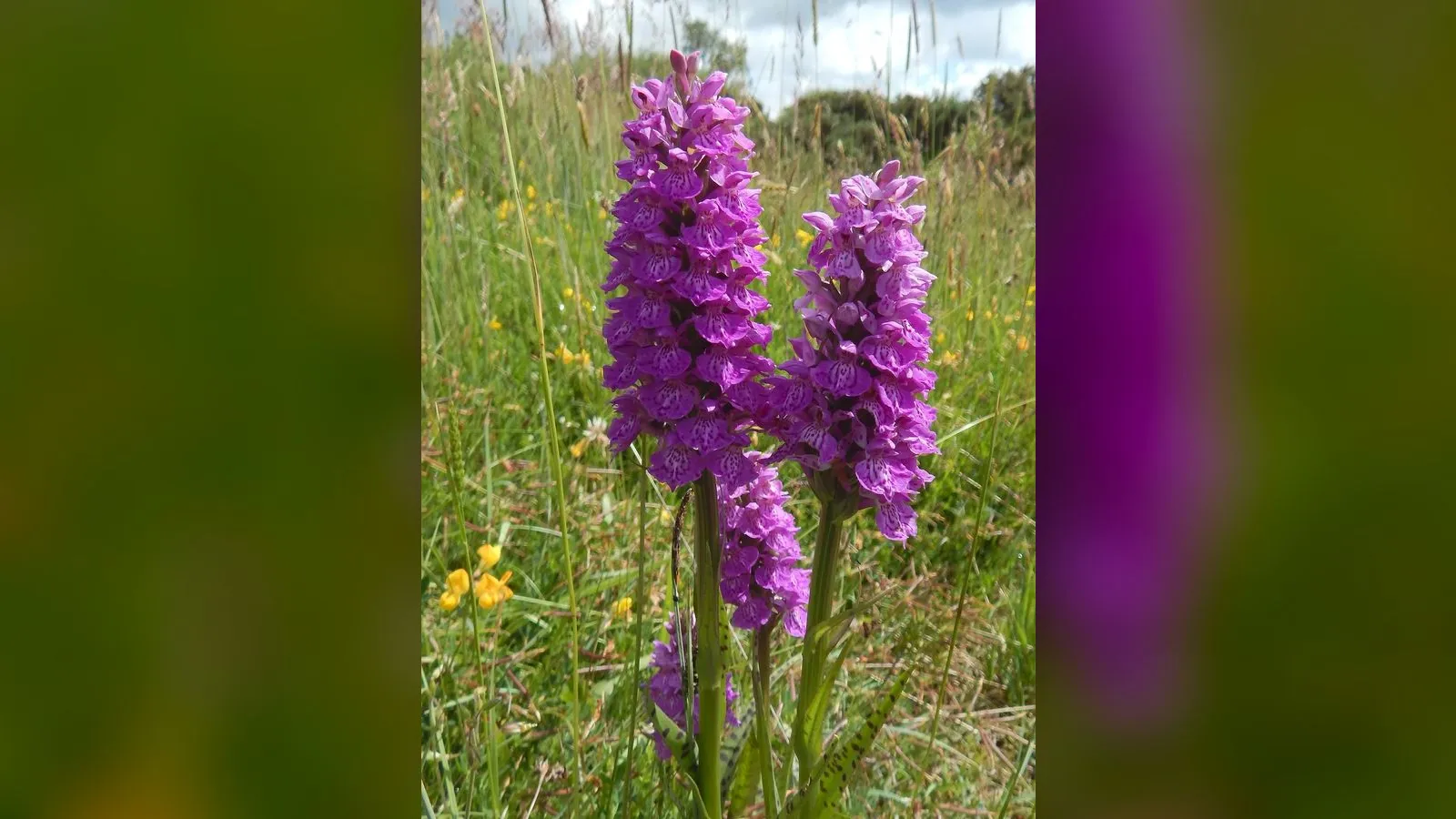

Northern Marsh-orchid (Dactylorhiza purpurella)
Contents
TL;DR
- established Northern marsh-orchid is an allotetraploid species, meaning it originated through hybridisation between two diploid orchid species, Dactylorhiza fuchsii and Dactylorhiza incarnata, and carries a doubled chromosome count of 80 as a direct genetic consequence of that ancestry — a specific, documented genetic origin this article states directly rather than a vague claim that the species is simply "related to" other marsh-orchids.
- disputed The taxonomic status of northern marsh-orchid remains genuinely contested among botanists: some authorities treat it as a fully distinct species, while others classify it as a subspecies or variety of the related Dactylorhiza majalis, with contemporary taxonomists such as Brandrud and colleagues (2020) arguing for species status based on distinctive morphology and ecological preference — this article presents this disagreement directly rather than treating the species' classification as settled.
- established Northern marsh-orchid hybridises readily with at least five other related species, including Dactylorhiza fuchsii, Dactylorhiza incarnata, Dactylorhiza maculata, Dactylorhiza praetermissa, and the frog orchid (Dactylorhiza viridis), as well as forming at least one documented intergeneric hybrid with Gymnadenia (fragrant orchids) — a specific, documented scale of hybridisation this article states directly rather than a vague claim that the species "sometimes crosses with others."
- established Like all orchids, northern marsh-orchid produces dust-like seeds that lack the nutrient reserves most flowering plants pack into their seeds, meaning germination depends on the seed forming a partnership with a specific mycorrhizal fungus in the soil that supplies it with nutrients until the seedling can photosynthesise for itself — a specific, documented reproductive dependency this article names directly rather than treating orchid seeds as self-sufficient like ordinary wildflower seeds.
- established In the Outer Hebrides, northern marsh-orchid forms extensive colonies specifically within machair grassland, the rare, low-lying, shell-sand coastal habitat largely confined to Scotland's west coast and islands, a specific, documented habitat association this article states directly rather than treating the species as a generalist found equally across all damp ground.
Key Facts
- Scientific name
- Dactylorhiza purpurella
- Category
- Flora
- Height
- 15–30cm (occasionally up to 40cm)
- Flowering period
- Late May–July
- Chromosome count
- 2n = 4x = 80 (allotetraploid)
- Parent species
- D. fuchsii × D. incarnata
- Key Scottish habitat
- Machair, damp coastal dune slacks
- Taxonomic status
- Disputed (species vs. subspecies of D. majalis)
A Note on Claims and Evidence
Biology, identification, genetic origin, hybridisation record, and the ongoing taxonomic dispute are drawn from Wikipedia's published research record. Habitat, machair association, flowering period, and Scottish and wider UK distribution are drawn from First Nature's published species account. The general dependency of orchid seed germination on mycorrhizal fungal partnership is drawn from the published general orchid-mycorrhiza research record.
Timeline
Northern marsh-orchid originates through hybridisation between two diploid orchid species, Dactylorhiza fuchsii and Dactylorhiza incarnata, resulting in an allotetraploid species carrying a doubled chromosome count of 80.
Northern marsh-orchid establishes itself across damp coastal dune slacks and machair grassland in Wales and Scotland, forming extensive colonies in the Outer Hebrides' machair habitat, its dust-like seeds dependent on partnership with specific mycorrhizal fungi in the soil to germinate, since the seeds lack the nutrient reserves most flowering plants carry.
The species is first formally described as Orchis purpurella by T. Stephenson and T.A. Stephenson, based on specimens from a hay meadow near Aberystwyth, Wales.
The species is transferred to the genus Dactylorhiza by Rezső Soó, establishing its current scientific name.
Botanists continue to disagree over the species' taxonomic status, with some treating it as fully distinct and others classifying it as a subspecies or variety of the related Dactylorhiza majalis; the species is also documented hybridising readily with at least five related species, including the frog orchid, and with the unrelated genus Gymnadenia.
Northern marsh-orchid remains a characteristic species of Scotland's machair and coastal dune slack habitats, particularly in the Western Isles, its genetic origin, extensive hybridisation record, and ongoing taxonomic dispute all part of the current, documented botanical record.
Details
A genetic origin explained through its real hybrid ancestry
This article names the specific origin of northern marsh-orchid rather than a vague claim that the species is simply "related to" other marsh-orchids: it is allotetraploid, having originated through hybridisation between two diploid species, Dactylorhiza fuchsii and Dactylorhiza incarnata, and carries a doubled chromosome count of 80 as a direct genetic consequence. This article states this specific origin because it is the real, documented genetic history behind the species, not an assumed general resemblance to its relatives.
A genuine taxonomic dispute presented without resolving it
This article presents northern marsh-orchid's taxonomic status as a real, ongoing disagreement among botanists rather than a settled classification: some authorities treat it as a fully distinct species, while others classify it as a subspecies or variety of Dactylorhiza majalis. This article states both positions because current botanical literature genuinely holds this disagreement, and presenting only one side would misrepresent an active taxonomic debate.
A hybridisation record stated with its real documented scale
This article names northern marsh-orchid's hybridisation record with real specificity rather than a vague claim that it "sometimes crosses with others": it hybridises readily with at least five related species, including the frog orchid, and forms at least one documented intergeneric hybrid with Gymnadenia. This article states this specific scale because it represents a genuinely documented pattern of hybridisation, not a general impression of orchid promiscuity.
A reproductive dependency named rather than assumed self-sufficient
This article states directly that, like all orchids, northern marsh-orchid produces dust-like seeds lacking the nutrient reserves most flowering plants carry, meaning germination depends on partnership with a specific mycorrhizal fungus in the soil. This article names this dependency because it is a real, documented reproductive constraint shared across the orchid family, not an assumption that orchid seeds behave like ordinary wildflower seeds.
A habitat association named with its real geographic specificity
This article names northern marsh-orchid's association with machair grassland in the Outer Hebrides directly rather than treating the species as a generalist found equally across all damp ground: machair is itself a rare, low-lying, shell-sand coastal habitat largely confined to Scotland's west coast and islands. This article states this specific association because it reflects a genuine, documented habitat relationship, not a general preference for any wet ground.
Orchids in Flora Britannica
Richard Mabey's Flora Britannica (1996) has no separate entry for northern marsh-orchid. What it offers is context for the genus and the Scots names for orchids in general.
shared Mabey describes the marsh- and spotted-orchids (Dactylorhiza) as the most widespread British orchids and the least fussy about habitat, and as "extremely variable", with many subspecies, hybrids and colour forms. That supports the hybridisation record and the taxonomic uncertainty described above.
established Peter Marren's appendix on Scottish vernacular plant names in the same book records that in Shetland orchids are still called curly doddies, possibly from the twisted "stems" (really ovaries) of the flowers. The name is also used for devil's-bit scabious and other round-headed flowers, from a fancied likeness to a child's curly head. Elsewhere in Scotland orchids were called beldairy or puldary, and buldeeri in the northern isles. These are names for orchids in general, but the northern marsh-orchid is one of the commonest orchids in the far north, so it may well be among the plants meant.
traditional Marren notes that the Scottish National Dictionary also lists gentle Janet, hen's kames, deid man's thoombs and dog's dubbles for orchids, the last three referring to the paired root-tubers. He had never heard any of them in use, so they should be treated as historical records rather than living names.
Did You Know?
- Northern marsh-orchid originated through hybridisation between two other orchid species, and carries a doubled chromosome count as a direct result.
- Botanists still genuinely disagree over whether it's a distinct species or a variety of a related orchid, Dactylorhiza majalis.
- It hybridises readily with at least five related species, including the frog orchid, plus at least one cross with an unrelated genus, Gymnadenia.
- Like all orchids, its seeds are dust-like and can't germinate without partnering with a specific fungus in the soil.
- In the Outer Hebrides, it forms extensive colonies specifically in machair, Scotland's rare shell-sand coastal grassland.
- It was first formally described in 1920, from specimens found in a Welsh hay meadow.
- The flower's intense dark purple colour is notoriously difficult to photograph accurately.
- In Shetland, orchids are still called curly doddies.
- Older Scots names for orchids include beldairy, puldary and, in the northern isles, buldeeri.
FAQ
1How did northern marsh-orchid originate?
Through hybridisation between two diploid orchid species, Dactylorhiza fuchsii and Dactylorhiza incarnata, giving it a doubled chromosome count.
2Is northern marsh-orchid a fully distinct species?
It's genuinely disputed — some botanists treat it as distinct, others classify it as a subspecies or variety of Dactylorhiza majalis.
3Does it hybridise with other orchids?
Yes, readily — with at least five related species, including the frog orchid, plus at least one documented cross with the unrelated genus Gymnadenia.
4Why can't orchid seeds just germinate on their own?
Orchid seeds are dust-like and lack the nutrient reserves most flowering plant seeds have, so they depend on a partnership with a specific soil fungus to germinate.
5Where does northern marsh-orchid grow in Scotland?
Particularly in machair grassland and damp coastal dune slacks in the Western Isles.
6When does it flower?
Late May into July.
7When was it first scientifically described?
In 1920, based on specimens from a hay meadow near Aberystwyth, Wales.
8Does it have a Scots name?
Not one of its own. Peter Marren's appendix to Richard Mabey's Flora Britannica (1996) records that orchids in general are curly doddies in Shetland, and beldairy, puldary or buldeeri elsewhere in Scotland and the northern isles.
Sources and Further Reading
Primary/Institutional
Scholarly/Critical
- Systematic reappraisal of marsh-orchids native to Scotland — Kew Bulletin (Springer)
- Orchid mycorrhizas — David Moore's World of Fungi
- Richard Mabey, Flora Britannica (Sinclair-Stevenson, 1996), including Peter Marren's appendix on Scottish vernacular plant names.
General
Caveats: Myths and Disputed Claims
- disputed This article does not present northern marsh-orchid's species status as settled; botanical authorities genuinely disagree over whether it is a distinct species or a subspecies/variety of Dactylorhiza majalis.
- Clarification: This article does not treat orchid seeds as capable of ordinary independent germination; like all orchids, this species depends on a specific soil fungus partnership to germinate at all.
- Do not present curly doddies, beldairy or the dictionary names as names for northern marsh-orchid alone; they apply to orchids generally, and several of the dictionary names may no longer be in use.
Card 047 · Flora