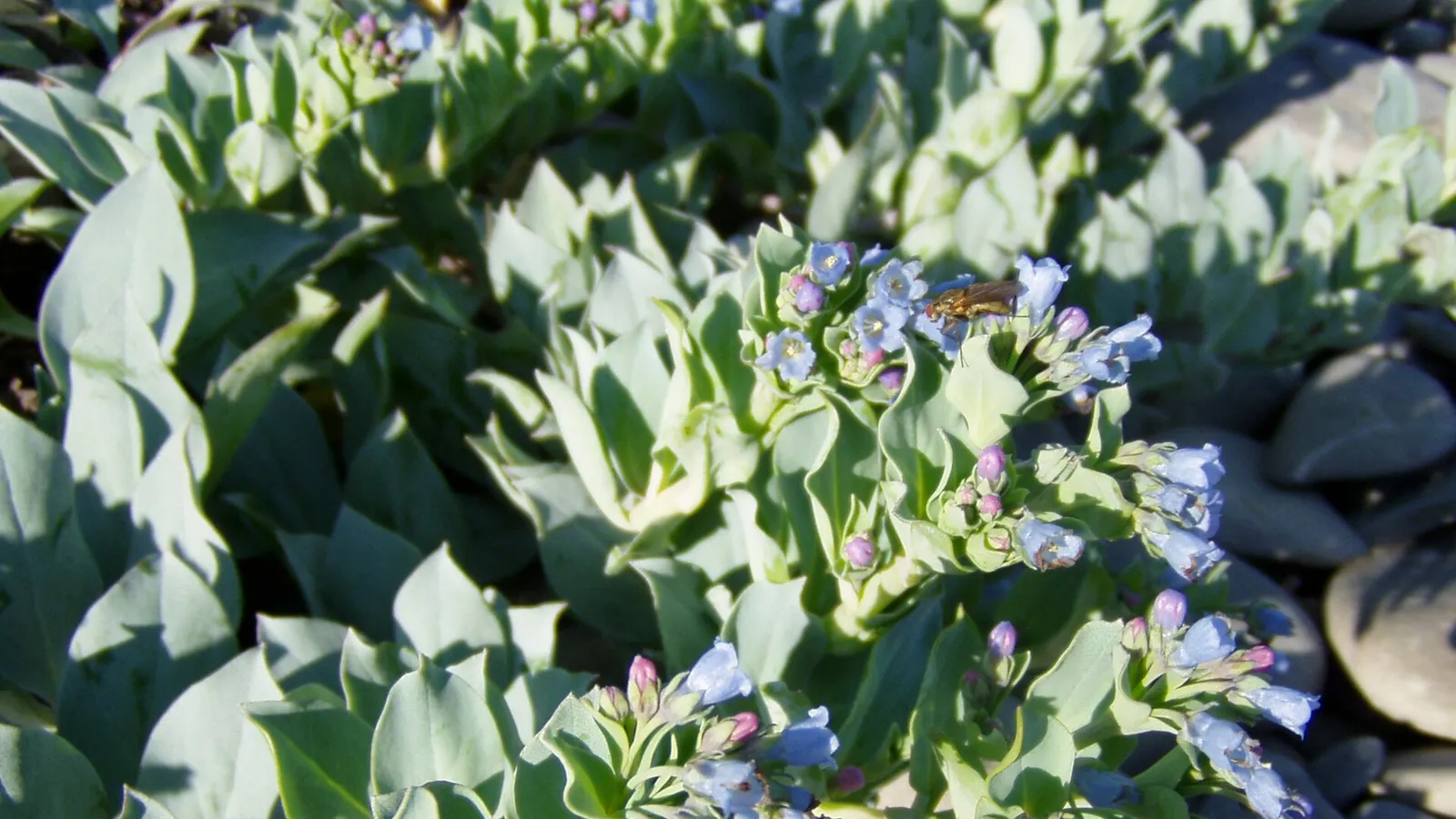

Oysterplant (Mertensia maritima)
Contents
TL;DR
- established Oysterplant's name reflects a real chemical fact rather than a loose comparison: when its leaves are crushed, they release dimethyl sulphide, the same compound that forms a major part of the odour and flavour profile of raw oysters, giving the plant a genuinely oyster-like taste — a specific, documented chemical explanation this article states directly rather than a vague claim that the plant "tastes like seafood."
- established On Fair Isle, a single colony of just two oysterplant plants recorded in 1992 grew, following the installation of protective fencing, to 2,360 plants twenty years later — a specific, documented conservation success this article states directly rather than a vague claim that "protection helped the species recover."
- established Oysterplant faces a genuine, documented range shift: the species is contracting in the south of its British range while expanding further north, with current strongholds concentrated in Scotland, especially Orkney and Shetland, alongside Northern Ireland, even as historical populations in northern England, North Wales, and the Isle of Man have been lost — this article states this contraction-and-expansion pattern together rather than presenting the species as simply declining everywhere.
- established Research suggests oysterplant seeds require a prolonged period in cold seawater below 5°C to germinate successfully, meaning that warming sea temperatures pose a specific, documented threat to the plant's reproduction, separate from and in addition to direct physical habitat damage — a specific, documented climate mechanism this article names directly rather than a vague reference to "climate change affecting coastal plants."
- established Oysterplant faces several separate, documented physical threats to its shingle-beach habitat, including shingle removal, which severely damaged a Northern Ireland population, uncontrolled dogs and storm damage that eliminated a North Wales population, and sheep grazing that restricts the species' distribution across much of Orkney and Shetland — this article names each distinct threat directly rather than collapsing them into a single vague cause of decline.
Key Facts
- Scientific name
- Mertensia maritima
- Category
- Flora
- Plant family
- Boraginaceae (borage family)
- Growth form
- Perennial, up to ~50cm, trailing on shingle
- Flavour compound
- Dimethyl sulphide (same as raw oysters)
- Key Scottish strongholds
- Orkney, Shetland
- Fair Isle recovery
- 2 plants (1992) → 2,360 plants (20 years later)
- Germination requirement
- Cold seawater below 5°C
Scottish Impact Index (SI Score)
- Scottish Significance
- 8/10
- Ecological Persistence
- 4/10
- Ecological Importance
- 6/10
- Botanical Distinctiveness
- 10/10
- Conservation Significance
- 10/10
- Recognition
- 6/10
44/60
Ranked =33rd of 45 in Flora
A Note on Claims and Evidence
Biology, flavour-chemistry, geographic distribution, and decline details are drawn from the species' Wikipedia-summarised research record. Specific decline causes, the Fair Isle fencing recovery figures, the cold-seawater germination requirement, and range-shift detail are drawn from published UK coastal botany field reporting.
Timeline
Oysterplant establishes itself on gravelly and sandy shingle shores across sub-Arctic and northern temperate coastlines of the Northern Hemisphere, including Britain, Canada, Greenland, Spitzbergen, Alaska, and Northeastern Asia, with historical British populations recorded in northern England, North Wales, and the Isle of Man, alongside its current Scottish and Northern Irish strongholds.
Populations in the south of Britain's range are lost or severely damaged through a combination of specific, documented pressures: uncontrolled dogs and storm damage eliminate the Abergele, North Wales population, and shingle removal severely damages a Northern Ireland population at Glassdrumman Port, County Down.
Sheep grazing restricts the species' distribution across much of these core strongholds, limiting where oysterplant can establish even within otherwise suitable coastal habitat.
A single colony of just two oysterplant plants is recorded on Fair Isle.
Over the subsequent twenty years, the Fair Isle population grows from two plants to 2,360, a documented conservation success directly attributable to physical protection of the site.
Studies identify that oysterplant seeds require a prolonged period in cold seawater below 5°C to germinate successfully, establishing warming sea temperatures as a specific, additional threat to the species' reproduction, separate from direct physical habitat damage; separately, the species' overall range is documented as contracting in the south while expanding further north.
Oysterplant remains a Priority Species in Northern Ireland and a species of real conservation concern across its British range, with Orkney and Shetland continuing as its key Scottish strongholds, even as the Fair Isle recovery demonstrates that targeted physical protection can produce genuinely dramatic population gains.
Details
A flavour name grounded in real chemistry
This article names the chemical basis of oysterplant's distinctive taste directly rather than a vague claim that the plant "tastes like seafood": crushing its leaves releases dimethyl sulphide, the same compound that forms a major part of the odour and flavour profile of raw oysters. This article states this specific chemical explanation because it is a genuine, documented mechanism behind the plant's name, not a loose sensory comparison.
A conservation recovery stated with its real documented figures
This article names the Fair Isle recovery with real specificity rather than a vague claim that "protection helped the species recover": a single colony of two plants recorded in 1992 grew, following the installation of protective fencing, to 2,360 plants twenty years later. This article states these precise figures because they represent a genuinely dramatic, measured conservation success directly attributable to physical site protection, not a general improvement in the species' fortunes.
A range shift presented as contraction and expansion together
This article states oysterplant's British distribution pattern honestly, as both contraction and expansion occurring simultaneously, rather than presenting the species as simply declining everywhere: historical southern populations in northern England, North Wales, and the Isle of Man have been lost, even as the species' range expands further north, with Orkney and Shetland remaining key strongholds. This article presents both directions of this pattern together because reporting only the southern losses, or only the northern persistence, would each misrepresent the fuller, more complicated geographic picture.
A climate threat named through its real reproductive mechanism
This article states the specific mechanism by which warming seas threaten oysterplant rather than a vague reference to "climate change affecting coastal plants": research suggests the species' seeds require a prolonged period in cold seawater below 5°C to germinate successfully, meaning warming sea temperatures pose a documented, distinct threat to reproduction, separate from direct physical habitat damage. This article names this mechanism because it clarifies a specific causal pathway rather than treating climate change as a single undifferentiated pressure.
Separate physical threats, named individually rather than merged
This article names oysterplant's documented physical threats individually rather than collapsing them into a single vague cause of decline: shingle removal severely damaged a Northern Ireland population, uncontrolled dogs and storm damage eliminated a North Wales population, and sheep grazing restricts the species' distribution across much of Orkney and Shetland. This article states each threat separately because they represent genuinely distinct pressures operating in different locations and through different mechanisms, not a single generic "habitat loss."
Oysterplant in Flora Britannica
established Richard Mabey, in Flora Britannica (1996), describes oysterplant as "a rather scarce native" of shingle and sand-banks in Scotland and north-west England, with smooth, grey, fleshy leaves that have been eaten. His mention of north-west England is a 1996 picture; the losses in the south of the range described above mean present-day maps should be preferred.
shared Mabey's best evidence for the name is a Scottish contributor's testimony. The only local patch they knew grew on a shingle beach near Sunnyside. Having once been poisoned by an oyster, they found that tasting the leaf made them retch, "so true is it to its name". That supports the oyster-like flavour explained above by dimethyl sulphide, from the point of view of someone who could not abide oysters.
established Peter Marren's appendix on Scottish vernacular plant names in the same book notes that oysterplant is called sea gromwell in Mary McCallum Webster's Flora of Moray, Nairn and East Inverness (1978). Marren adds that the name has "a bookish ring", so it should not be presented as a living folk name.
Did You Know?
- Oysterplant's leaves genuinely taste of oysters, caused by dimethyl sulphide, the same chemical compound found in raw oysters' flavour profile.
- A Fair Isle colony of just two plants in 1992 grew to 2,360 plants twenty years later after protective fencing was installed.
- The species' British range shows a genuine contraction in the south alongside expansion further north.
- Oysterplant seeds are thought to require a prolonged spell in cold seawater below 5°C to germinate — meaning warming seas pose a direct reproductive threat.
- Sheep grazing restricts where oysterplant can grow across much of Orkney and Shetland, its core Scottish strongholds.
- Shingle removal severely damaged one Northern Ireland population, while storm damage and uncontrolled dogs eliminated a North Wales population.
- The species holds Priority Species conservation status in Northern Ireland.
- A Scottish contributor to Flora Britannica who could not stand oysters found the leaf so oyster-like that it made them retch.
- In one north-east Scottish Flora, oysterplant is called sea gromwell, though that looks like a book name rather than a folk one.
FAQ
1Why is it called "oysterplant"?
Because crushing its leaves releases dimethyl sulphide, the same chemical compound that gives raw oysters their characteristic flavour and smell.
2Where is oysterplant found in Scotland?
Its key strongholds are Orkney and Shetland, where it grows on gravelly and sandy shingle shores.
3What caused the dramatic recovery on Fair Isle?
Protective fencing around a colony of just two plants in 1992 allowed it to grow to 2,360 plants over the following twenty years.
4Is oysterplant declining or expanding in Britain?
Both, in different places — it's contracting in the south of its range, where several historical populations have been lost, while expanding further north.
5How does climate change specifically threaten oysterplant?
Its seeds are thought to require a prolonged period in cold seawater below 5°C to germinate, so warming seas could directly prevent successful reproduction.
6What other threats does oysterplant face?
Shingle removal, storm damage, uncontrolled dogs, and sheep grazing have each caused documented damage to specific populations.
7Can you eat oysterplant?
Yes — its leaves are edible and have a genuine oyster-like flavour, which is why it's also known as oyster leaf. Wild plants are scarce and vulnerable, so any tasting should come from garden-grown plants, not from wild shingle colonies.
8Does oysterplant really taste of oysters?
People who have tried it think so. A Scottish contributor told Richard Mabey's Flora Britannica (1996) that the leaf was so true to its name that it made them retch, because they could not abide oysters.
9Does oysterplant have a Scots name?
Not a well-attested one. Mary McCallum Webster's Moray Flora calls it sea gromwell, but Peter Marren, writing in Flora Britannica, thought the name sounded bookish.
Sources and Further Reading
Primary/Institutional
Scholarly/Critical
- Mertensia maritima Oyster Plant — Northern Ireland's Priority Species
- British Wild Plant: Mertensia maritima Oyster Plant — UK Wildflowers
- Richard Mabey, Flora Britannica (Sinclair-Stevenson, 1996), including Peter Marren's appendix on Scottish vernacular plant names.
General
Caveats: Myths and Disputed Claims
- Clarification: This article does not describe oysterplant as simply declining; its British range shows genuine contraction in the south alongside documented expansion further north.
- Note: This article does not treat oysterplant's threats as a single undifferentiated problem; shingle removal, storm/dog damage, sheep grazing, and warming-sea germination failure are each named as separate, documented pressures.
- Do not present "sea gromwell" as a living Scots folk name; it comes from a twentieth-century Flora and Marren doubted its currency.
- Do not encourage picking wild oysterplant to taste; colonies are small and easily damaged.
Card 029 · Flora