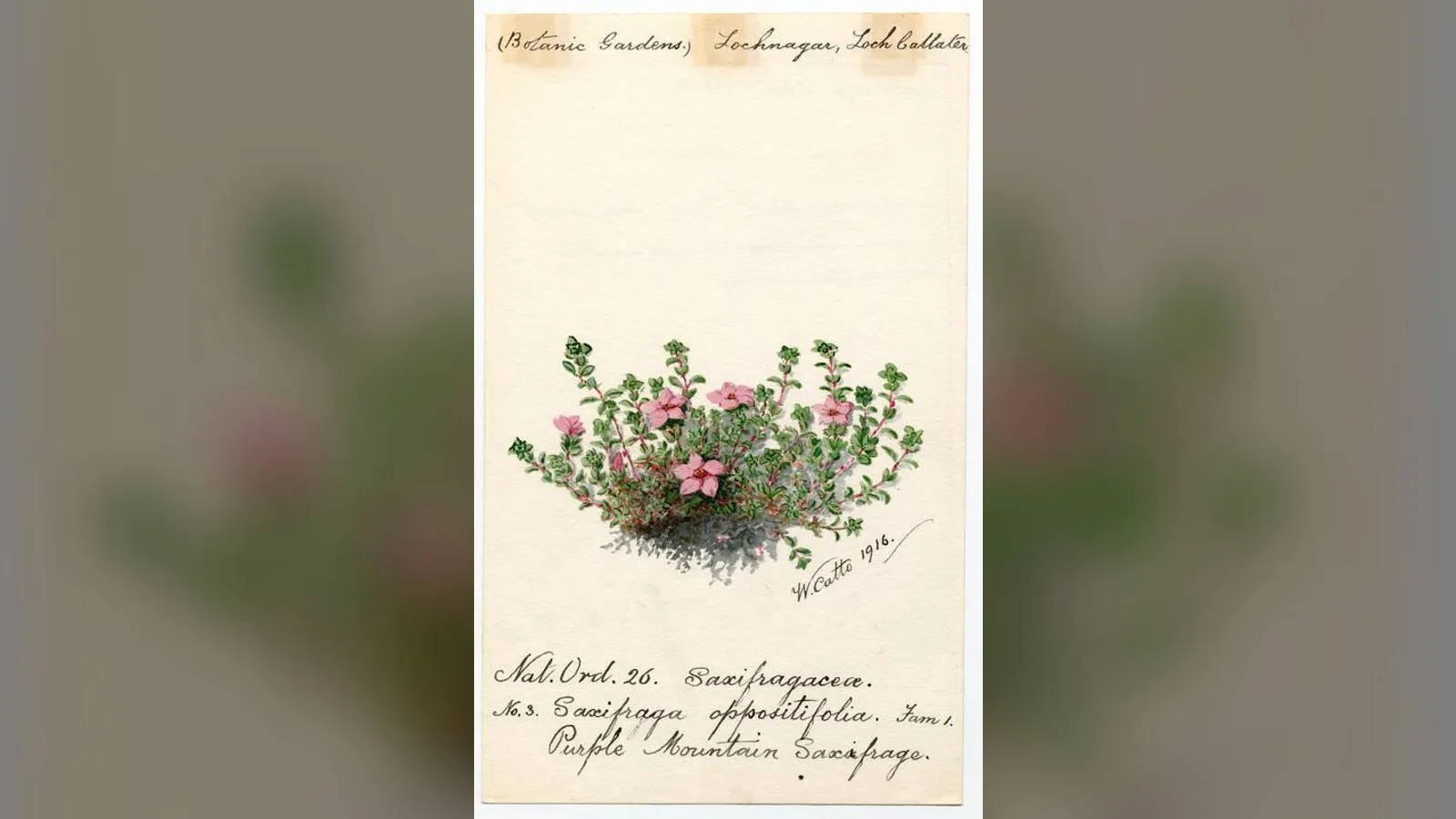

Purple Saxifrage (Saxifraga oppositifolia)
Contents
TL;DR
- established Purple saxifrage holds the record for the northernmost-growing plant on Earth, documented at 83°40'N on Kaffeklubben Island, a spit of land north of Greenland that contains the northernmost undisputed point of land on the planet — a specific, documented world record this article states directly rather than a vague claim that the species is "extremely hardy."
- established Swiss botanist Christian Körner documented purple saxifrage growing at 4,505m in the Swiss Alps, making it the highest-elevation flowering plant recorded anywhere in Europe — a specific, documented altitude record this article names directly alongside the species' northernmost-plant record, because the two together demonstrate a genuinely exceptional tolerance for extreme cold across both latitude and elevation.
- established Purple saxifrage is typically one of the very first plants to flower each spring across Arctic and alpine habitats, frequently emerging and blooming while snow is still on the ground, a timing that provides a critically early nectar source for insects and bees at the start of the Arctic growing season — a specific, documented ecological role this article states directly rather than a vague claim that the plant "flowers early."
- established The species survives these extreme conditions through specific structural adaptations: it grows as a low, dense, carpet-like mound rarely more than 5cm high, which conserves heat close to the ground, while its small, scale-like, leathery leaves reduce water loss in environments where liquid water is often scarce despite abundant surrounding ice and snow — a specific, documented set of mechanisms this article names directly rather than a vague claim that the plant is simply "adapted to the cold."
- established Within the British Isles, purple saxifrage survives as part of the arctic-alpine flora of Scotland's high mountain ground, alongside outlying populations in northern England, Wales and Northern Ireland, where it is the official county flower of County Londonderry — a specific, documented point of distribution this article states directly rather than treating the species as found only in the high Arctic.
Key Facts
- Scientific name
- Saxifraga oppositifolia
- Category
- Flora
- Growth form
- Low, dense mat, up to 5cm high
- Flower size
- ~1cm diameter, purple/lilac
- Northernmost plant record
- 83°40'N, Kaffeklubben Island (north of Greenland)
- Highest-elevation flowering plant in Europe
- 4,505m, Swiss Alps
- UK distribution
- Chiefly the Scottish Highlands, south to Yorkshire, Snowdonia and the Brecon Beacons; county flower, Co. Londonderry
- Key ecological role
- Among the first spring nectar sources in Arctic/alpine habitats
Scottish Impact Index (SI Score)
- Scottish Significance
- 9/10
- Ecological Persistence
- 8/10
- Ecological Importance
- 6/10
- Botanical Distinctiveness
- 10/10
- Conservation Significance
- 9/10
- Recognition
- 9/10
51/60
Ranked =9th of 45 in Flora
A Note on Claims and Evidence
Biology, flowering pattern, structural adaptations, and UK distribution details are drawn from the species' Wikipedia-summarised research record and published Arctic ecology reporting. The northernmost-plant record (Kaffeklubben Island) and highest-elevation European flowering-plant record (Christian Körner's documentation) are drawn directly from these same sources and are presented as established, named records.
Timeline
Purple saxifrage establishes itself across the full breadth of cold temperate to Arctic habitats in the Northern Hemisphere, from tundra and arctic coastal bluffs to alpine scree and rock crevices, becoming one of the most widely distributed plants capable of surviving at the absolute edges of where flowering plants can grow.
The species is recorded growing at 83°40'N on Kaffeklubben Island, north of Greenland, the northernmost undisputed point of land on Earth, establishing it as one of the northernmost-growing plants in the world; separately, Swiss botanist Christian Körner documents the species at 4,505m in the Swiss Alps, the highest elevation recorded for any flowering plant in Europe.
Purple saxifrage emerges and flowers while snow is often still on the ground, ranking among the very first spring flowers in these habitats, providing a critical early nectar source for insects and bees at the start of the growing season, and continuing to flower through summer in locations where snow melts later.
Within the British Isles, purple saxifrage persists as part of Scotland's arctic-alpine mountain flora, with outlying populations in northern England, Wales and Northern Ireland, where it holds the distinction of being the official county flower of County Londonderry.
Purple saxifrage remains a defining species of Scotland's high mountain ground and the wider Arctic and alpine world, its structural adaptations and extreme-record distribution continuing to make it one of the clearest examples of a flowering plant surviving at the genuine limits of where plant life is possible.
Details
A world record stated with its real documented precision
This article names purple saxifrage's status as the northernmost-growing plant on Earth with real specificity rather than a vague claim that the species is "extremely hardy": it has been documented at 83°40'N on Kaffeklubben Island, a spit of land north of Greenland containing the northernmost undisputed point of land on the planet. This article states this precise location and coordinate because it represents a genuine, documented world record, not a general impression of the plant's cold tolerance.
A second extreme record named alongside the first
This article names purple saxifrage's elevation record directly: Swiss botanist Christian Körner documented the species growing at 4,505m in the Swiss Alps, the highest elevation recorded for any flowering plant in Europe. This article states both the northernmost and the highest-elevation records together because they jointly demonstrate the species' genuinely exceptional tolerance for extreme cold across two entirely different kinds of harsh environment, not a single isolated extreme.
An early-flowering role explained through its real ecological function
This article states purple saxifrage's early flowering with real specificity rather than a vague claim that the plant "flowers early": it is typically one of the very first plants to bloom each spring in Arctic and alpine habitats, frequently emerging while snow is still on the ground, and this timing provides a critically early nectar source for insects and bees at the start of the growing season. This article names this function directly because it clarifies the plant's real ecological importance to the wider food web at a moment when few other nectar sources exist.
Survival mechanisms named with their real structural logic
This article states the specific adaptations behind purple saxifrage's cold tolerance rather than a vague claim that it is "adapted to the cold": its low, dense, carpet-like mound form, rarely more than 5cm high, conserves heat close to the ground, while its small, scale-like, leathery leaves reduce water loss in environments where liquid water is often scarce despite surrounding ice and snow. This article names these specific structural mechanisms because they represent the real, documented basis for the species' extreme-environment survival, not an assumed general toughness.
A British distribution stated honestly, beyond the high Arctic alone
This article names purple saxifrage's presence within the British Isles directly rather than treating the species as confined to the high Arctic: it survives as part of Scotland's arctic-alpine mountain flora, with outlying populations in northern England, Wales and Northern Ireland, where it serves as the official county flower of County Londonderry. This article states this distribution because it clarifies that the species' extreme-latitude and extreme-altitude records coexist with a genuine, if more modest, British Isles presence.
established The range outside Scotland is wider than "northern Britain" suggests. Richard Mabey, in Flora Britannica (1996), places the species chiefly in Scotland but reaching as far south as the limestone uplands of Yorkshire and South Wales, and it also grows in Snowdonia. Scotland holds the great majority of the British plants, but the range runs the length of upland Britain.
Snow purple, and a plant once sold in London
established Mabey describes purple saxifrage as a plant of damp mountain ledges and scree, tufted, with quite large flowers from pale pink to purple, "often blooming against the snow". The book captions it with the name "snow purple", which fits that habit. He quotes the fellwalker Alfred Wainwright, who wrote that April visitors would remember Pen-y-ghent in Yorkshire as the mountain of the purple saxifrage, draped over its limestone cliffs like aubretia on a garden wall.
established Mabey also records that the species was much gathered from the wild for sale in Covent Garden. Its early colour made it an obvious target for collectors and traders. That trade belongs to the past. Purple saxifrage, like other arctic-alpines on Ben Lawers and elsewhere, should not be dug or picked, and many of its Scottish sites now lie within protected areas.
established The book records no Gaelic or Scots name for it, and no Highland custom. As with several of Scotland's arctic-alpines, its story is mainly botanical.
Did You Know?
- Purple saxifrage holds the record for the northernmost-growing plant on Earth, found at 83°40'N on Kaffeklubben Island, north of Greenland.
- It's also been recorded at 4,505m in the Swiss Alps — the highest elevation of any flowering plant in Europe.
- It's often one of the very first plants to flower each spring, sometimes blooming while snow is still on the ground.
- Its early flowers provide a critical early nectar source for insects and bees at the start of the Arctic growing season.
- The plant grows as a dense, carpet-like mound rarely more than 5cm high, which helps conserve heat close to the ground.
- Its leathery leaves help reduce water loss in an environment where liquid water is often scarce despite abundant ice and snow.
- Purple saxifrage is the official county flower of County Londonderry in Northern Ireland.
- It has been called "snow purple" for its habit of flowering against the snow, as recorded in Richard Mabey's Flora Britannica (1996).
- Wild plants were once much gathered for sale in Covent Garden market in London.
FAQ
1Is purple saxifrage really the northernmost plant in the world?
It's documented at 83°40'N on Kaffeklubben Island, north of Greenland, at the northernmost undisputed point of land on Earth, making it one of the northernmost-growing plants known.
2What's special about where it grows in the Alps?
It's been recorded at 4,505m in the Swiss Alps, the highest elevation documented for any flowering plant in Europe.
3Why does it matter that purple saxifrage flowers so early?
Its blooms, often appearing while snow is still on the ground, provide a critical early nectar source for insects and bees at a time when few other flowers are available.
4How does such a small plant survive such extreme cold?
Through specific structural adaptations — a dense, low, carpet-like growth form that conserves heat, and leathery, scale-like leaves that reduce water loss.
5Does purple saxifrage grow in Scotland?
Yes — it's part of the arctic-alpine flora found on Scotland's high mountain ground, with further populations in northern England, Wales and Northern Ireland.
6Why is it the county flower of County Londonderry?
It was selected to represent the county as part of a broader tradition of county flowers across the British Isles, reflecting its presence in Northern Ireland's flora.
7How tall does purple saxifrage grow?
Rarely more than around 5cm high, growing as a dense, low mat.
8Does it grow outside Scotland in Britain?
Yes. Richard Mabey's Flora Britannica (1996) places it chiefly in Scotland but as far south as the limestone uplands of Yorkshire and South Wales; it also grows in Snowdonia.
9Was it ever collected from the wild?
Yes. Mabey records that it was much gathered from the wild for sale in Covent Garden. It should be left where it grows.
Sources and Further Reading
Primary/Institutional
Scholarly/Critical
- Saxifraga oppositifolia L. (Purple Saxifrage) — BSBI
- Arctic-alpine plants of Ben Lawers — National Trust for Scotland
- Richard Mabey, Flora Britannica (Sinclair-Stevenson, 1996).
General
Caveats: Myths and Disputed Claims
- Clarification: This article does not present purple saxifrage as found only in the high Arctic; it also survives as part of Scotland's arctic-alpine mountain flora and in outlying populations across northern England, Wales and Northern Ireland.
- Note: This article names the species' northernmost-plant and highest-elevation records as specific, documented findings tied to named locations and researchers, not general claims of the species being "the hardiest plant in the world."
- Do not describe its British range outside Scotland as northern only; it reaches Yorkshire, Snowdonia and South Wales.
Card 022 · Flora